Reverse Engineering Patch Tuesday
John McIntosh (Security Researcher · C Labs)
44CON 2024 · Day 1 · Main
Overview
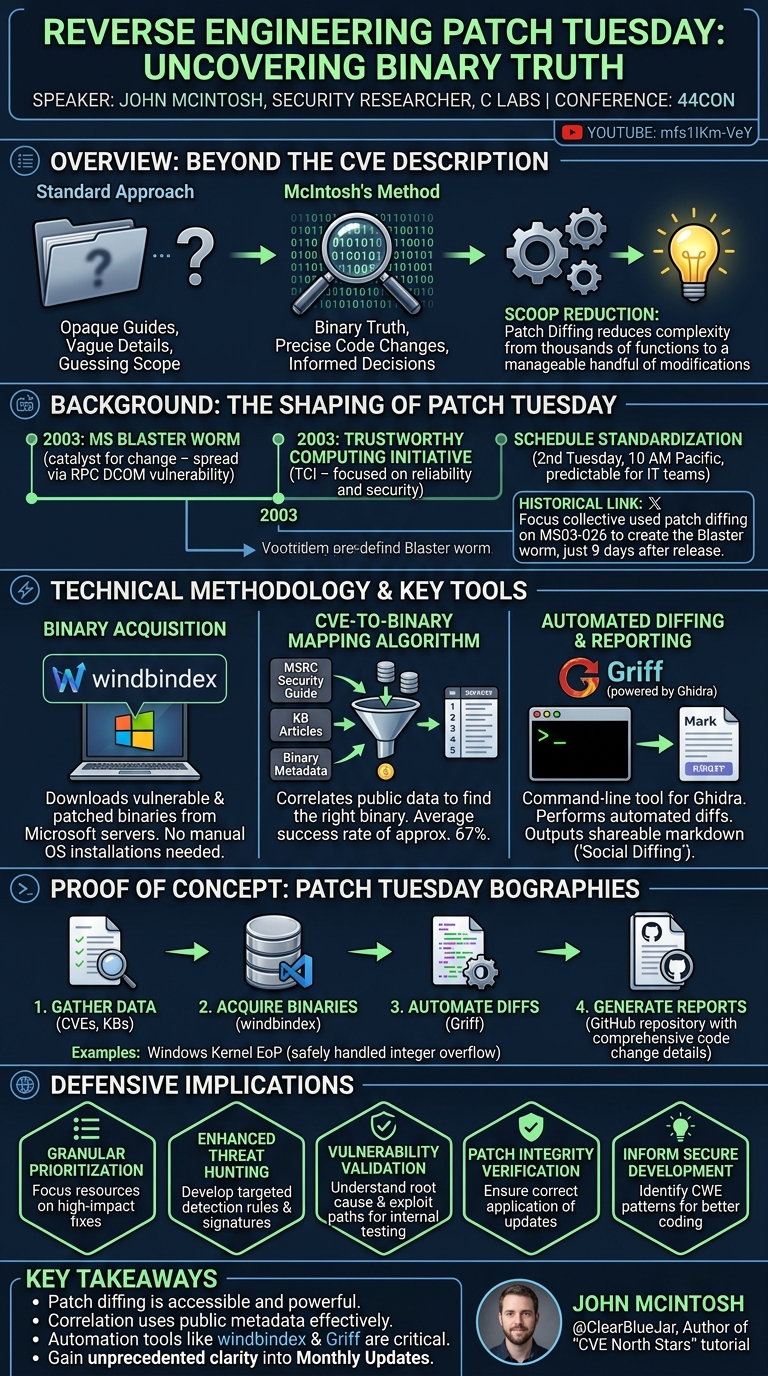
In his 44CON talk, John McIntosh, a Security Researcher at C Labs, delved into the intricacies of "Reverse Engineering Patch Tuesday," offering a method to gain "binary truth" from Microsoft's monthly security updates. Building on his prior work with tools like Griff and the "CVE North Stars" tutorial, McIntosh demonstrated how security researchers and defenders can move beyond high-level vulnerability descriptions to understand the precise code changes implemented in patches. This talk is a call to action for deeper, self-reliant analysis, providing the techniques and tools necessary to dissect Microsoft’s security fixes.
Key moments
- 0:00 Introduction to Reverse Engineering Patch Tuesday
- 0:30 CVE North Stars and motivation for patch diffing
- 2:30 The core problem: identifying specific updated binaries
- 4:00 From blurry picture to binary truth: talk's goal
- 5:00 Talk overview: patch diffing, reverse engineering, bogra
- 5:45 Understanding Patch Tuesday and its scheduling rationale
Reverse Engineering Patch Tuesday
Speakers: John McIntosh, Security Researcher, C Labs
Conference: 44CON
YouTube: https://www.youtube.com/watch?v=mfs1IKm-VeY
Overview
In his 44CON talk, John McIntosh, a Security Researcher at C Labs, delved into the intricacies of "Reverse Engineering Patch Tuesday," offering a method to gain "binary truth" from Microsoft's monthly security updates. Building on his prior work with tools like Griff and the "CVE North Stars" tutorial, McIntosh demonstrated how security researchers and defenders can move beyond high-level vulnerability descriptions to understand the precise code changes implemented in patches. This talk is a call to action for deeper, self-reliant analysis, providing the techniques and tools necessary to dissect Microsoft’s security fixes.
The core problem addressed is the sheer volume and often opaque nature of Microsoft's Patch Tuesday releases. Each month, Microsoft publishes a Security Update Guide listing dozens, sometimes over a hundred, CVEs. While these guides offer crucial details like severity, attack vector, and impact, they rarely specify the exact binaries or functions modified. This ambiguity leaves security professionals guessing about the true scope and nature of a fix. McIntosh’s methodology aims to cut through this noise, enabling a clear, granular understanding of what was actually patched, which is invaluable for vulnerability research, exploit development, and robust defensive strategies.
McIntosh articulates that by leveraging patch diffing—the process of comparing vulnerable and patched versions of a binary—researchers can drastically reduce the scope of their analysis, transforming a complex problem of thousands of functions into a manageable handful. This direct observation of code changes empowers defenders to make informed decisions, prioritize effectively, and develop targeted protections based on concrete evidence rather than generalized threat intelligence. The talk not only demystifies the process but also highlights the historical significance of patch diffing, revealing its surprising role in the very genesis of Patch Tuesday itself.
Background
▶ Watch: Introduction to Reverse Engineering Patch Tuesday (0:00)
Patch Tuesday is a deeply ingrained fixture in the cybersecurity calendar, occurring on the second Tuesday of every month at 10 AM Pacific. This standardized release schedule, adopted by Microsoft and several other major vendors, delivers security updates for a vast array of products, including Windows OS, Office applications, and Visual Studio. Its purpose is to provide IT professionals with a predictable window to plan, deploy, and manage critical security patches, mitigating the chaos of ad-hoc releases. The timing, specifically Tuesday, is strategic, allowing IT teams Monday to finalize previous week's tasks and then several days post-release for deployment before the weekend.
The origins of Patch Tuesday trace back to 2003, a period marked by significant upheaval in the software security landscape. Prior to standardization, Microsoft would release patches as soon as they were available, leading to an unpredictable and challenging environment for IT administrators. A major catalyst for change was the MS Blaster worm of 2003. This worm exploited an RPC DCOM vulnerability, spreading rapidly across networks due to the prevalence of publicly addressable machines. The widespread impact underscored the urgent need for a more structured approach to vulnerability management. This era also saw the launch of Bill Gates' Trustworthy Computing Initiative (TCI), a directive emphasizing that computing systems must be as reliable and trustworthy as essential utilities like electricity and water. TCI solidified Microsoft's commitment to security, paving the way for the formalized Patch Tuesday.
Over the years, the distribution of updates has evolved significantly. Initially, users had to manually download patches, often from security bulletins that offered "suggestions" for updates. This progressed to Service Packs and cumulative updates, bundling multiple fixes for easier deployment. The introduction of the Windows Update Agent in Vista began to automate the process, culminating in Windows 10 and 11 where updates are largely mandatory, reflecting the critical importance of keeping systems current. While Microsoft's MSRC Security Guide provides extensive CVE details, including severity, attack vector, and recently, Common Weakness Enumeration (CWE) (backdated to 2023), identifying the exact binaries and code changes remains a persistent challenge for researchers. Though Microsoft offers early access to vulnerability information for members of its Active Protection Program, McIntosh’s talk presents a methodology for non-members to achieve similar insights through independent reverse engineering.
Intriguingly, the very concept of Patch Tuesday has a historical link to patch diffing. The MS Blaster worm, a primary driver for the standardization of updates, was itself born from a patch diff. A Chinese hacking collective, X Focus, reverse-engineered Microsoft's MS03-026 patch for an RPC DCOM vulnerability just nine days after its release. This "uncoordinated vulnerability disclosure," as McIntosh terms it, led directly to the creation and widespread dissemination of the Blaster worm, demonstrating the profound impact that reverse-engineering patches can have—both for good and ill—and cementing its place in the history of vulnerability research.
Key Findings
▶ Watch: The core problem: identifying specific updated binaries (2:30)
The central finding of John McIntosh's talk is the demonstrable power and accessibility of patch diffing to achieve "binary truth" regarding Microsoft's monthly security updates. This technique allows security professionals to move beyond high-level descriptions and directly observe the precise code changes implemented in patched binaries.
Key findings and contributions include:
- Scope Reduction: Patch diffing dramatically reduces the complexity of vulnerability analysis. Instead of sifting through tens of thousands of functions in a large binary like the Windows kernel, diffing narrows the focus to only the handful of functions that have been added, deleted, or modified between versions. This transformation makes complex reverse engineering tasks feasible for individual researchers.
- Automated Binary Acquisition: The talk highlights the critical role of tools like
windbindexin solving the perennial problem of acquiring both vulnerable and patched versions of Windows binaries.windbindexprovides metadata and direct download links from Microsoft servers, eliminating the need for manual OS installations or precarious searches for old files. - Command-Line Diffing: McIntosh's custom tool,
Griff, built on Ghidra, is a significant enabler for automation. By providing a command-line interface for binary diffing and outputting results in markdown,Grifffacilitates integration into automated workflows and easy sharing ("social diffing"). - CVE-to-Binary Mapping Algorithm: McIntosh presented a novel, albeit non-AI/ML, algorithm that correlates publicly available Microsoft data (MSRC Security Guide, KB articles, binary metadata) to map CVEs to their corresponding updated binaries. This algorithm, developed through a series of "small experiments" with web scraping and Jupyter notebooks, achieves an average success rate of approximately 67% for Windows OS files since 2016, providing a solid starting point for targeted diffing.
- "Patch Tuesday Bographies" (Bographies): The culmination of this research is the concept and implementation of "Patch Tuesday Bographies." This automated system takes a given Patch Tuesday, identifies all relevant CVEs and their likely associated binaries, downloads the necessary versions, performs diffs using
Griff, and generates comprehensive markdown reports detailing the precise code changes. This offers a clear, actionable overview of monthly updates. - Historical Validation: McIntosh demonstrated that patch diffing is not a new technique but has a rich history, playing a pivotal role in the MS Blaster worm incident in 2003. By successfully replicating the original patch diff, he confirmed that the fundamental principles remain powerful and relevant today.
These findings collectively provide a robust framework for independently verifying and deeply understanding the technical specifics of Microsoft's security patches, empowering the security community with unprecedented clarity into the "binary truth."
Technical Deep Dive
▶ Watch: From blurry picture to binary truth: talk's goal (4:00)
The technical core of John McIntosh's talk revolves around the methodology of patch diffing and its automation to reverse engineer Microsoft’s Patch Tuesday. This process transforms the daunting task of understanding monthly security updates into a targeted, manageable analysis.
The fundamental principle of patch diffing involves comparing a vulnerable version of a binary with its patched counterpart. The goal is to identify only the code segments that have changed, thereby pinpointing the exact location and nature of the security fix. This approach drastically reduces the analytical surface area. For instance, McIntosh illustrated that a Windows kernel vulnerability, which could involve analyzing an 11 MB binary with approximately 30,000 functions, could be narrowed down to examining as few as 50 functions, or even just one or two critical modifications, through effective diffing.
Several key tools and techniques underpin this methodology:
- Ghidra: This open-source Software Reverse Engineering (SRE) framework is central to the process. It provides powerful decompilation capabilities, allowing researchers to view assembly code as more readable C-like pseudo-code. Ghidra's version tracking features are particularly useful for highlighting differences between binary versions.
- Griff: Developed by McIntosh,
Griffis a command-line diffing tool built on top of Ghidra. Its primary advantage is automation; it takes two binaries as input and outputs a diff report in markdown format. This "social diffing" capability makesGriffideal for scripting and sharing findings. - Windbindex: Acquiring the correct vulnerable and patched binaries is often the first hurdle.
Windbindexaddresses this by providing metadata and direct download links for a vast repository of Windows binaries from Microsoft's servers. This eliminates the need for maintaining multiple OS installations or manually searching for specific file versions, a problem McIntosh faced when replicating the 2003 Blaster worm patch diff. - Data Correlation and Web Scraping (CVE Matching Algorithm): To automate the mapping of CVEs to specific binaries, McIntosh developed a correlation algorithm. This is not machine learning or AI, but rather a structured approach using:
- Data Sources: MSRC Security Update Guide (CVE descriptions, tags, titles, FAQs), Windows binary names/descriptions, and KB articles.
- Initial Filtering: KB articles often list updated binaries for a given patch. This provides the first crucial filter, reducing the potential pool from around 16,000 Windows binaries to perhaps 100-200 relevant to a specific Patch Tuesday.
- Fuzzy Matching: The algorithm performs string comparisons and fuzzy matching between CVE metadata (titles, tags, descriptions) and binary names or their internal descriptions. McIntosh experimented with correlation thresholds (e.g., 75% match) in Jupyter notebooks to optimize the accuracy of binary identification.
- Noise Reduction: Certain CVE tags, like "Visual Studio," are too broad to map to a single binary. The algorithm learns to de-prioritize or handle such "noisy" tags, focusing on more descriptive ones like "Microsoft Edge" or specific component names.
- Output: The result is a curated list for each CVE, identifying a few likely updated and relevant binaries. McIntosh reported an average 67% success rate in mapping CVEs to binaries for Windows OS files since 2016.
McIntosh illustrated the power of this approach with several examples:
- Windows Kernel Elevation of Privilege CVE (January): A kernel vulnerability typically involves the
ntoskrnl.exebinary. Diffing the patched version against the previous one revealed that instead of complex, potentially unsafe integer multiplications and additions within an allocation function, the new version utilized "safe" functions likeRtlULongAddandRtlULongMultiply. This precise change pointed directly to an integer overflow or similar numerical vulnerability. A call graph could then be used to trace how an attacker might reach this modified function, determining if it's a local or remote attack vector. - Windows TCP/IP RCE: A highly publicized "wormable" Remote Code Execution (RCE) vulnerability in the TCP/IP stack. Patch diffing quickly identified changes related to IPv6 handling, specifically modifications around the
IPSendErrorfunction. This provided an immediate starting point for dynamic analysis, allowing researchers to craft specific IPv6 packets (e.g., using Scapy and Python) to interact with the vulnerable code path. - Re-enacting the MS Blaster Patch Diff (2003): To demonstrate the historical relevance, McIntosh recreated the patch diff that led to the Blaster worm. He obtained a vulnerable Windows XP binary and the
MS03-026patch. By observing thependingfilerenameoperationsregistry key after applying the patch, he identified the updated binaries:ole32.dll,rpcrt4.dll, andrpcss.exe. Diffing therpcss.exebinary revealed the buffer overflow in theGetMachineNamefunction. The vulnerability stemmed from storing a long UNC path (e.g.,\\SERVER\C$) into a fixed-size 32-byte buffer. The patch fixed this by significantly increasing the buffer size, a simple yet critical change that modern SRE tools like Ghidra make trivial to identify through decompilation, something likely much harder for the X Focus group in 2003.
This technical deep dive underscores that by combining robust SRE tools, automated binary acquisition, and intelligent data correlation, the seemingly insurmountable task of understanding Patch Tuesday can be systematically broken down and analyzed, providing invaluable low-level security intelligence.
Demo / Proof of Concept
▶ Watch: Talk overview: patch diffing, reverse engineering, bogra (5:00)
John McIntosh's talk culminated in a compelling demonstration of his automated system, aptly named "Patch Tuesday Bographies" (or simply "bographies"). This system exemplifies the practical application of his patch diffing methodology, providing a clear, actionable overview of monthly security updates.
The demonstration showcased the end-to-end workflow of the Patch Tuesday Bographies tool:
- Data Gathering: The tool first collects all relevant CVE data from McIntosh's aggregated data sources, which are derived from Microsoft's public security guides and KB articles.
- Binary Acquisition: Leveraging the
windbindexservice, the system then systematically downloads the necessary binaries. For each potential CVE match, it retrieves both the vulnerable (pre-patch) and patched versions of the identified files. The system intelligently verifies that the downloaded binaries correspond to the correct update versions. - Automated Diffing: Once the binaries are acquired,
Griff(powered by Ghidra) is invoked to perform the binary diffing. The demonstration highlightedGriff's ability to run analyses concurrently, processing approximately 8 binaries at a time, significantly speeding up the overall process. - Report Generation: After the diffing is complete, the system generates comprehensive markdown reports for each Patch Tuesday. These reports are designed to be easily readable and shareable.
McIntosh provided a live look at a GitHub repository (github.com/ClearBlueJar/PatchTuesdayBographies) containing the generated reports for recent Patch Tuesdays (July, August, and September). Navigating through these reports, he illustrated how researchers can quickly identify specific CVEs and their associated updated binaries. For each binary, the report clearly lists the number of functions added, deleted, and modified.
For example, in the September report, McIntosh pointed to a "Windows Remote Access Connection Manager" out-of-bounds read vulnerability. The report identified a specific file, likely starting with reses, as being related to this CVE. By drilling down, a researcher could then see the exact functions that were modified, providing immediate insight into the nature of the fix. While the on-screen display in the conference hall had some CSS limitations, the utility of the structured markdown output for in-depth analysis was evident.
The Patch Tuesday Bographies project serves as a concrete proof of concept, demonstrating that automated, granular reverse engineering of security patches is not only feasible but also highly practical. It provides security professionals with a direct, "binary truth" perspective, enabling them to bypass generalized summaries and immediately focus on the precise code changes relevant to a given vulnerability.
Defensive Implications
▶ Watch: Understanding Patch Tuesday and its scheduling rationale (5:45)
The ability to reverse engineer Patch Tuesday updates and uncover "binary truth" offers profound implications for defenders, moving them from reactive patching to proactive, informed security strategies.
- Granular Prioritization of Patching: Instead of relying solely on high-level CVSS scores or vendor severity ratings, defenders can use patch diffing to understand the exact root cause and impact of a vulnerability. Knowing precisely which functions were modified and why (e.g., an integer overflow fix, a bounds check addition) allows organizations to prioritize patching efforts more effectively, focusing critical resources on vulnerabilities that pose the most immediate and severe threat to their specific environment.
- Enhanced Threat Hunting and Detection: With knowledge of the specific code changes, defenders can develop highly targeted threat hunting queries and detection rules. If a patch modifies a particular function in a critical binary, security teams can create YARA rules, EDR signatures, or behavioral analytics to detect attempts to exploit the old, vulnerable code path or to monitor for suspicious activity related to the newly patched functionality. This precision greatly improves the signal-to-noise ratio in security alerts.
- Vulnerability Validation and Exploit Understanding: For internal red teams or vulnerability management teams, understanding the patch provides an invaluable shortcut to validate the existence of a vulnerability and to understand how an exploit might work. By examining the fix, they can often infer the original vulnerability, aiding in internal testing or the reproduction of reported issues.
- Patch Verification and Integrity: Organizations can use these reverse engineering techniques to verify that patches have been correctly applied across their infrastructure. By comparing the installed binaries against the known patched versions, they can ensure integrity and compliance, especially in highly regulated environments.
- Informing Secure Development Practices: The identification of common weakness enumerations (CWEs) and their corresponding code fixes can provide valuable feedback to internal development teams. Understanding how specific vulnerabilities are patched can inform secure coding guidelines, training, and architectural reviews, fostering a more proactive approach to security by addressing root causes in future development cycles.
- Supply Chain Security and Third-Party Risk: For critical software components or third-party libraries, the ability to analyze patches independently provides an additional layer of assurance. Organizations can assess the quality of fixes and understand the true impact of updates from their vendors.
- Beyond Microsoft: The methodology presented is extensible. While the talk focused on Microsoft, the core techniques of binary acquisition, diffing, and data correlation can be applied to other software vendors and proprietary applications, provided similar update mechanisms or data sources are available, thereby broadening its defensive utility across a diverse technology stack.
In essence, reverse engineering Patch Tuesday transforms a reactive, often overwhelming, monthly event into an opportunity for deep intelligence gathering, enabling defenders to build stronger, more resilient security postures.
Key Takeaways
- Patch diffing is a highly effective and accessible reverse engineering technique for uncovering the "binary truth" behind security updates, allowing direct observation of code changes rather than relying solely on high-level descriptions.
- Microsoft provides sufficient publicly available metadata (MSRC Security Guides, KB articles, binary descriptions) to enable automated correlation and mapping of CVEs to specific updated binaries, making this granular analysis feasible.
- Specialized tools like
windbindexandGriffare critical enablers for automating the process of acquiring correct binary versions and performing efficient, command-line diffs, significantly reducing manual effort. - The "Patch Tuesday Bographies" project offers a practical, automated solution to generate comprehensive reports of code changes for all relevant CVEs in a given month, providing unprecedented clarity into the technical specifics of security patches.
- Understanding the precise root cause and code-level fixes of vulnerabilities empowers defenders to prioritize patching, develop highly targeted threat hunting signatures, and inform more secure development practices.
- The historical impact of patch diffing is significant, as demonstrated by its role in the MS Blaster worm incident in 2003, which itself was a major catalyst for the standardization of Patch Tuesday.
About the Speaker(s)
John McIntosh is a dedicated Security Researcher at C Labs, deeply immersed in the world of reverse engineering and vulnerability research. He is known in the community by his social media handle, @ClearBlueJar. McIntosh has a history of sharing his expertise, including a previous talk at 44CON on his patch diffing tool, Griff. He is the author of the "CVE North Stars" tutorial, a resource designed to guide individuals in learning and improving their patch diffing skills by using CVEs as starting points for analysis. His work spans writing, speaking, and extensive hands-on reverse engineering, often spending his days "head down into Ghidra." McIntosh's contributions include the Griff command-line diffing tool, the Winbind project for creating binary biographies, and the "Patch Tuesday Bographies" system, which was the focus of this talk.
Reviews
Dr. Zero (Offensive Security Researcher) — STRONG ACCEPT
McIntosh delivers a technically grounded, tool-backed methodology for automating patch diffing at scale against Patch Tuesday releases — real work, real tooling, real results. The 67% CVE-to-binary mapping rate is an honest, quantified claim, which immediately separates this from the usual hand-wavy research theater. Not a world-shaker, but exactly the kind of practitioner-grade engineering talk that makes a conference worth attending.
Heather Calloway (CISO) — WEAK
Technically competent and genuinely useful for researchers who do this kind of work, but the talk never crosses the bridge to organizational defense. The defensive implications exist — they're just asserted, not demonstrated, and nothing here changes how a security program operates at the institutional level.