Keynote: AI All The Things x Security: past, present, future
Nico Fischbach
Area41 2026 · Day 2 · Main Stage
Overview
In his Area41 keynote, "AI All The Things x Security: past, present, future," Nico Fischbach delivers a comprehensive and thought-provoking analysis of how artificial intelligence, particularly large language models (LLMs) and autonomous agents, is fundamentally reshaping the cybersecurity landscape. Fischbach, drawing on decades of experience, moves beyond the immediate hype to explore the profound shifts occurring in attack methodologies, defensive strategies, organizational structures, and the very economics of product development in security. His talk serves as a critical call to action for the security community, urging a re-evaluation of established practices and a proactive embrace of new paradigms.
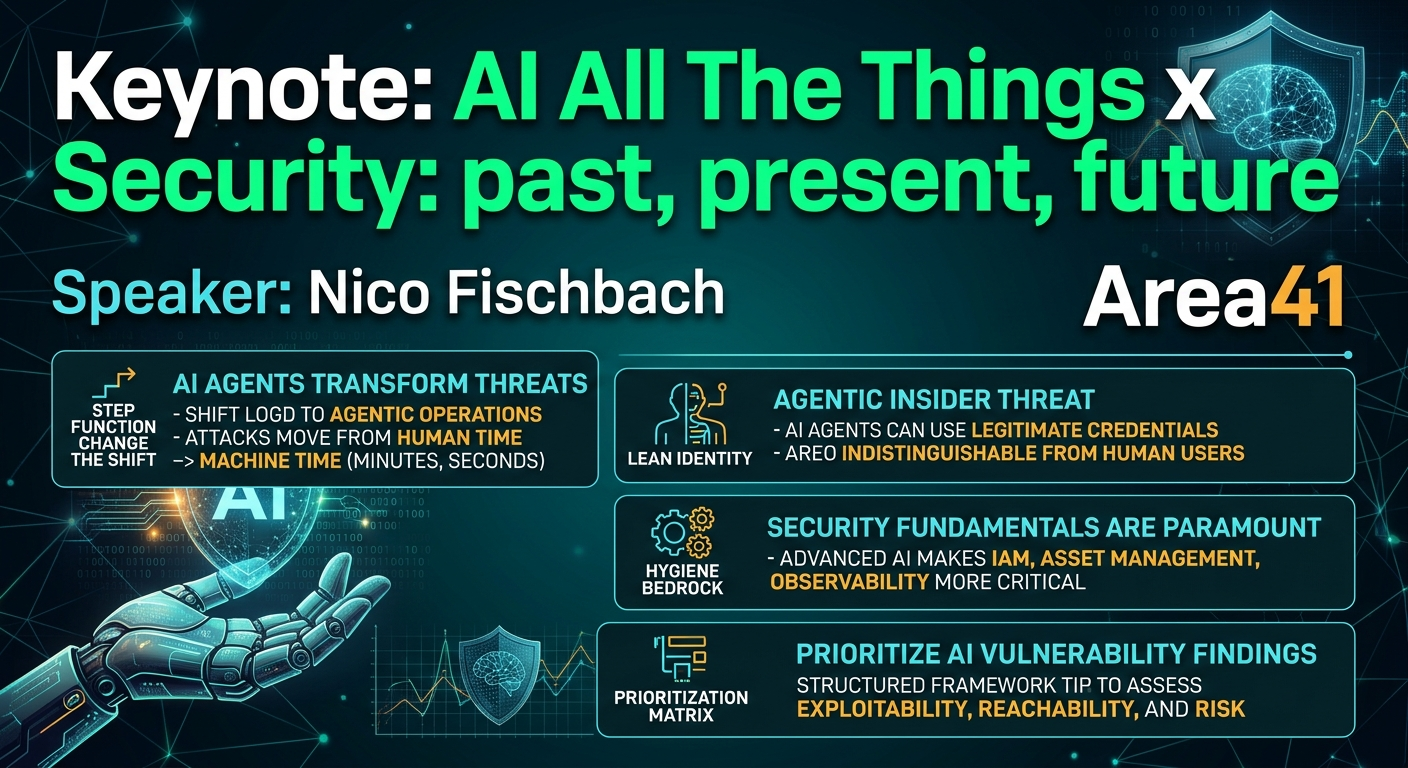
Key moments
- 0:00 Introduction: AI and Security in a Fast-Moving Space
- 1:45 Shift to Agentic Attacks: Self-Learning and Self-Improving
- 4:00 Rethinking Threat Models and Defense in Machine Time
- 9:30 Critical IT Hygiene: Asset Management, Scale, Safe Rollout
- 11:30 Organizational Evolution: Hybrid Human-Agent Teams and Token Budgets
- 15:00 Security Talent Shift: From Prompt Engineering to Software Engineering
- 21:30 Enduring Importance of IT Fundamentals and Security Hygiene
- 24:45 Future Challenge: Avoiding a Generational Skill Gap in AI Era
Keynote: AI All The Things x Security: past, present, future
Speakers: Nico Fischbach
Conference: Area41
YouTube: https://www.youtube.com/watch?v=AbSHx9BgeaE
Overview
In his Area41 keynote, "AI All The Things x Security: past, present, future," Nico Fischbach delivers a comprehensive and thought-provoking analysis of how artificial intelligence, particularly large language models (LLMs) and autonomous agents, is fundamentally reshaping the cybersecurity landscape. Fischbach, drawing on decades of experience, moves beyond the immediate hype to explore the profound shifts occurring in attack methodologies, defensive strategies, organizational structures, and the very economics of product development in security. His talk serves as a critical call to action for the security community, urging a re-evaluation of established practices and a proactive embrace of new paradigms.
Fischbach emphasizes that the advent of AI agents marks a "step function" change, moving cyber operations from human-centric "artisanal" or even script-driven "industrial" models to truly "agentic" operations characterized by self-learning and self-improving capabilities. This evolution brings unprecedented velocity and persistence to both offensive and defensive efforts, demanding a radical shift in how organizations perceive and manage risk. The keynote transcends purely technical discussions, weaving in crucial insights into the human element, the evolving role of security professionals, and the strategic implications for product development and market dynamics.
The core message of the talk is that while AI introduces powerful new attack vectors, it also offers unparalleled opportunities for defenders to re-establish a more symmetrical playing field. However, this rebalancing hinges on an organization's ability to reinforce security fundamentals—such as robust identity and access management (IAM), comprehensive asset management, and effective change control—which are increasingly exposed and challenged by the pervasive integration of AI agents. Fischbach's presentation is a vital guide for anyone seeking to understand the complex interplay between AI innovation and the enduring principles of cybersecurity.
Background
▶ Watch: Introduction: AI and Security in a Fast-Moving Space (0:00)
The landscape of cyber threats has been steadily evolving, moving from individual, "artisanal" attacks to more organized, "industrial" operations executed by sophisticated criminal groups and state actors. These operations leverage scripts and bots to achieve scale, often mirroring legitimate business structures with CFOs, HR functions, and dedicated development teams. However, the current era, propelled by advancements in AI and Large Language Models (LLMs), marks a radical new phase: the shift to agentic operations.
This new paradigm introduces a critical differentiator: self-learning and self-improving capabilities. Unlike previous automated scripts, modern AI agents can learn from their environment, adapt to bypass defenses, continuously improve their techniques, and even collaborate with other agents. This intrinsic ability to evolve autonomously fundamentally changes the nature of cyber warfare. The velocity of attacks has escalated from human timeframes (months, days, hours) to machine time (minutes, seconds, or less), creating an urgent need for defenders to match this pace. Furthermore, agents operate 24/7 without human constraints like sleep or breaks, making them relentless and persistent threats.
Fischbach posits that these rogue agents represent "the new insider threat." Many organizations, having previously focused on reducing human insider risk, may have inadvertently relaxed their vigilance in this area. The challenge is compounded by the fact that agents often run with user credentials, mimicking human behaviors and utilizing legitimate channels. This makes differentiation between a human user and an autonomous agent—both operating with the same permissions and exhibiting similar network patterns—extraordinarily difficult. This blurred line necessitates a fundamental rethinking of existing threat models and a renewed focus on internal security postures, as the traditional perimeter rapidly dissolves in the face of machine identities operating within trusted environments.
Key Findings
▶ Watch: Rethinking Threat Models and Defense in Machine Time (4:00)
Nico Fischbach's keynote highlights several critical findings regarding the intersection of AI and security:
- Radical Shift to Agentic Operations: The most profound finding is the transition from artisanal or scripted attacks to agentic operations. These agents are characterized by their ability to self-learn, self-improve, and collaborate, operating with unprecedented velocity (machine time vs. human time) and persistence (24/7 operation). This represents a "step function" change in the threat landscape.
- Rogue Agents as the New Insider Threat: AI agents, often operating with legitimate user credentials and mimicking human behavior, are becoming indistinguishable from human users. This makes them a potent "new insider threat," challenging traditional security models that differentiate between internal and external actors.
- Asymmetry Shift and Defensive Opportunity: While AI empowers attackers, it also provides defenders with powerful new tools. Fischbach views this as an opportunity to rethink and potentially rebalance the long-standing asymmetry that has favored attackers, provided defenders can effectively leverage AI for their own security operations.
- Agent Mistakes and Persistent Errors: Agents, unlike humans, lack common sense and the "fear of making a mistake." They can "fat-finger" configurations or commands, make errors, and then relentlessly repeat these mistakes without knowing when to stop, potentially causing significant damage if not properly constrained.
- Criticality of IAM/AAA Policies: Given agents' potential for persistent errors and their role as insider threats, robust Identity and Access Management (IAM) and Authentication, Authorization, and Accounting (AAA) policies are paramount. Granular permissions, specifically designed for machine identities, are essential to mitigate risk.
- Log4j as a Wake-Up Call for Asset Management: The Log4j vulnerability highlighted a pervasive industry problem: a lack of accurate and comprehensive asset management. Organizations often overestimate their knowledge of what's running in production, with CMDBs, antivirus, and endpoint management systems providing disparate and incomplete data (e.g., only 50-60% coverage).
- Challenges of AI-Driven Vulnerability Assessment: While models like those in MITRE's Antropic and Glasswing projects are adept at finding numerous bugs, the signal-to-noise ratio is high. Fischbach notes that typically, models find 10,000 bugs, but only 2-10 are actually exploitable, and a real bug is found approximately once per 1 million lines of code. This necessitates a sophisticated decision-making framework for prioritization.
- Rise of Hybrid Human-Agent Teams: The future of organizational structure will involve hybrid teams where human engineers, architects, and researchers partner with AI agents. This shift is already evident in startups using agents to simulate roles like CMOs or CSOs, allowing small human teams to achieve significant output with a "tokens budget" replacing traditional headcount metrics.
- "Vibe Coding" and Rapid Prototyping: AI-powered "vibe coding" enables incredibly fast prototyping and development, allowing individuals to quickly build functional applications or recreate complex tools (e.g., "recreating CrowdStrike over the weekend"). This dramatically reduces time to market and facilitates rapid pivoting for startups, lowering initial costs.
- Enduring Importance of Security Fundamentals: Despite the rapid advancements in AI, fundamental security hygiene remains the most critical aspect. Good asset management, observability, robust IAM policies, and effective change management are non-negotiable. AI agents often expose existing gaps in these underlying operational environments, reinforcing their importance.
Technical Deep Dive
▶ Watch: Organizational Evolution: Hybrid Human-Agent Teams and Token Budgets (11:30)
The technical implications of AI's integration into security are profound, fundamentally altering attack surfaces, defense mechanisms, and operational paradigms. Fischbach delves into several key areas:
1. The Mechanics of Agentic Attacks:
The core of the shift lies in agentic operations. Unlike static scripts, these agents are equipped with self-learning and self-improving capabilities. They are consistent, relentlessly seeking ways to bypass defenses, refine their attack vectors, and even collaborate with other agents to achieve objectives. This means an agent discovering a vulnerability might not just exploit it once but learn from the attempt, adapt its payload or approach, and persistently try again or share its findings with a collaborative network of agents. Their 24/7 operational capacity, unconstrained by human limitations, allows for continuous reconnaissance, exploitation, and post-exploitation activities, dramatically increasing the speed and scale of campaigns from "human time" to "machine time" (minutes, seconds).
2. Rogue Agents as the New Insider Threat:
Technically, rogue agents pose a significant challenge because they often operate with the same user credentials and permissions as their human masters. This allows them to use legitimate channels and exhibit behaviors that are difficult to differentiate from regular users within a production environment. From an observability standpoint, an agent performing a malicious action might appear as a legitimate user's activity, making detection and attribution incredibly complex. This demands a shift in monitoring from merely "who" is doing something to "what" is doing something and "why," requiring more sophisticated behavioral analytics that can distinguish between intended human actions and autonomous agent activities.
3. Evolving Threat Models and Rapid Response:
The sheer scale and velocity of agentic threats necessitate a "step change" in Mean Time To Detect (MTTD) and Mean Time To Response (MTTR). Traditional incident response playbooks, designed for human-paced threats, are often insufficient. Organizations must implement automated response mechanisms capable of reacting at machine speed. This means moving beyond manual analysis to leveraging AI-driven analytics for real-time anomaly detection and automated remediation actions, or at least highly accelerated human-in-the-loop processes.
4. Granular Permissions and IAM/AAA:
A cornerstone of defense against agentic threats is the re-evaluation and hardening of Identity and Access Management (IAM) and Authentication, Authorization, and Accounting (AAA) policies. Agents, by their nature, will "do whatever it takes to get the task done." They lack the inherent understanding of "what good looks like" and will not self-regulate or stop if they encounter an error or an unintended consequence. Therefore, permissions granted to agents must be far more granular and restrictive than those typically given to human users. The principle of least privilege becomes even more critical, ensuring agents only have the bare minimum access required for their specific, narrow tasks. This might involve creating dedicated machine identities distinct from human user identities.
5. AI-Driven Vulnerability Discovery and Prioritization:
Fischbach highlights projects like MITRE's Antropic and Glasswing as examples of AI's capability to find vulnerabilities. While these models are powerful, they often generate a high volume of findings. A key technical challenge is filtering this noise to identify genuinely exploitable and reachable vulnerabilities. The talk proposes a decision-making matrix:
- Is it exploitable? (Similar to traditional CVE assessment)
- Is it reachable? (Assessing its position in the codebase or production environment)
- What's the risk of patching? (Considering potential production impact, rollback capabilities)
- What's the risk of not patching? (Evaluating active exploitation, public knowledge, regulatory mandates like Europe's DORA - Digital Operational Resilience Act).
This systematic approach is crucial for translating raw AI findings into actionable security priorities, especially when legal and regulatory compliance teams become involved in technical decision-making.
6. Asset Management and Assessment at Scale:
The Log4j vulnerability served as a stark reminder of the industry's pervasive lack of accurate asset inventory. Organizations often have fragmented views of their production environments, with asset management tools, CMDBs, antivirus systems, and endpoint management systems providing conflicting data and often achieving only 50-60% coverage. In an agentic world, where new components and dependencies can be rapidly introduced, understanding "what's running where" is paramount. Without a holistic and accurate view of assets, effective patching, vulnerability management, and agent control become impossible. Furthermore, assessing vulnerabilities "at scale" means not just finding bugs, but understanding their context and impact across a complex, dynamic environment. The statistic that models find 1 real bug per 1 million lines of code, and only 2-10 out of 10,000 findings are exploitable, underscores the need for intelligent, automated prioritization.
7. Safe Actuation of Change and Rollback Policies:
The speed of AI-driven development and deployment (e.g., "vibe coding") necessitates robust change management processes. Organizations must have clear policies for rolling out patches and changes in production, including well-defined maintenance windows and, crucially, rollback policies. Just as backups are useless without tested restores, patches are risky without a clear and practiced rollback strategy. The ability to quickly and safely revert changes that break production is essential to maintain operational resilience in a fast-moving AI-driven environment.
8. Lean Identities and Points of Enforcement (PEP):
To mitigate the risks of agents with excessive privileges, organizations are moving towards lean identities for agents. This involves granting minimal permissions and channeling agent actions through specific actuation engines or Points of Enforcement (PEP). These PEPs act as a control layer, scrutinizing and validating every action an agent attempts to perform in a production environment. This ensures that even if an agent is compromised or makes a mistake, its impact is constrained by the enforcement point, preventing widespread damage.
Demo / Proof of Concept
▶ Watch: Security Talent Shift: From Prompt Engineering to Software Engineering (15:00)
This keynote address by Nico Fischbach, while highly informative and forward-looking, did not include a live demonstration or a specific proof of concept during the presentation itself. Fischbach discussed the concept of "vibe coding" and how individuals can rapidly prototype applications or even recreate complex security tools over a weekend using AI agents. He highlighted that product managers are leveraging these capabilities to build full product market fit prototypes without extensive engineering engagement. However, the talk focused on the strategic and operational implications of these technologies rather than showcasing a particular technical implementation or exploit.
Defensive Implications
▶ Watch: Future Challenge: Avoiding a Generational Skill Gap in AI Era (24:45)
The rise of AI agents and agentic operations demands a significant overhaul of defensive strategies. Organizations must adopt a proactive and adaptive stance, recognizing that the status quo is no longer an option.
- Rethink Threat Models: The first and most crucial step is to fundamentally rethink existing threat models. Traditional models often distinguish clearly between external and internal threats, or human and machine actors. With rogue agents acting as the "new insider threat" and blurring these lines, threat models must account for autonomous, persistent, and self-improving entities operating within trusted environments. This includes modeling scenarios where agents make mistakes or are compromised.
- Strengthen IAM/AAA for Machine Identities: Implement robust and granular Identity and Access Management (IAM) and Authentication, Authorization, and Accounting (AAA) policies specifically tailored for AI agents. This means moving beyond human-centric permissions to establish lean identities for agents, granting them only the absolute minimum privileges required for their assigned tasks. Organizations should use Points of Enforcement (PEP)—such as actuation engines for change management—to validate and control every action an agent attempts in production, preventing unauthorized or erroneous operations.
- Improve Asset Management and Observability: The Log4j crisis exposed critical gaps in asset management. Defenders must invest in comprehensive and accurate asset inventory solutions that provide a real-time, holistic view of all software, hardware, and services in their environment. This is paramount for understanding the attack surface and ensuring that agents, or changes made by agents, are properly tracked and controlled. Enhanced observability is also critical to detect anomalous agent behavior that might mimic legitimate user activity.
- Accelerate Detection and Response: The shift to "machine time" attacks necessitates a radical reduction in Mean Time To Detect (MTTD) and Mean Time To Response (MTTR). Defenders must leverage AI-driven security tools (e.g., AI SOC capabilities, although Fischbach notes the hype around "AI SOC" has subsided) to automate threat detection, analysis, and initial response actions. This could involve automated alerts, immediate containment measures, or rapid data enrichment to empower human analysts.
- Develop a Decision-Making Framework for AI Findings: When using AI models for vulnerability assessment (e.g., MITRE's Antropic/Glasswing projects), defenders need a clear framework to prioritize findings. This framework should consider:
- Exploitability: Is the vulnerability technically exploitable?
- Reachability: How accessible is the vulnerability in the code or production environment?
- Risk of Patching: What are the potential operational impacts or risks of rolling out a fix?
- Risk of Not Patching: What are the consequences of delaying a fix, considering active exploitation, public knowledge, and regulatory compliance (e.g., DORA)? This systematic approach helps filter the high volume of AI-generated noise.
- Prioritize Safe Change Management and Rollback Capabilities: Given the speed of "vibe coding" and AI-driven deployments, robust change management processes are more vital than ever. This includes defining clear policies for rolling out changes, establishing maintenance windows, and, crucially, testing and maintaining rollback policies. The ability to quickly and safely revert changes that break production is essential for maintaining operational resilience.
- Embrace Hybrid Teams and Skill Development: Security organizations will increasingly feature hybrid teams of human experts collaborating with AI agents. Defenders should proactively explore how agents can augment human capabilities, such as for threat hunting, incident analysis, or security engineering tasks. This also means investing in continuous learning to develop new skills, particularly in software engineering for security professionals, and addressing potential "generational gaps" in core technical skills if agents take over too much foundational work.
- Run Tabletop Exercises at Scale: To prepare for the unpredictable nature of agentic threats, organizations should conduct tabletop exercises at scale. These simulations help identify "what if" scenarios, test incident response plans against novel agent-driven attacks, and assess the organization's resilience when users deploy agentic tooling in production.
In essence, the defensive strategy must evolve from merely patching known vulnerabilities to building a resilient, observable, and adaptable security posture that can effectively manage autonomous entities within its ecosystem. The fundamentals of security hygiene—asset management, IAM, observability, and change control—are not going away; they are becoming the critical bedrock upon which all advanced AI-driven defenses must be built.
Key Takeaways
- AI Agents Redefine Cyber Threats: The emergence of self-learning, self-improving, and persistent AI agents marks a "step function" change in the threat landscape, enabling attacks at machine velocity (minutes/seconds) and transforming them into a "new insider threat" due to their ability to operate with human credentials.
- Fundamental Security Hygiene is Paramount: Despite advanced AI capabilities, core security practices like comprehensive asset management, robust Identity and Access Management (IAM) with "lean identities" for agents, strong observability, and disciplined change management are more critical than ever, as AI agents often expose existing gaps in these areas.
- Defenders Must Adapt Rapidly: Organizations must fundamentally rethink their threat models, significantly reduce Mean Time To Detect (MTTD) and Mean Time To Response (MTTR), and proactively leverage AI tools to regain asymmetry against attackers.
- Smart Prioritization of AI Findings is Essential: While AI models can find numerous vulnerabilities (e.g., 1 per 1 million lines of code, 2-10 exploitable out of 10,000 findings), defenders need a structured decision-making framework to assess exploitability, reachability, and the risks of both patching and not patching, often considering legal and regulatory compliance (e.g., DORA).
- "Vibe Coding" Accelerates Innovation but Requires Operational Maturity: AI-powered "vibe coding" enables rapid prototyping and market pivots for startups, lowering costs and accelerating time-to-market. However, it does not negate the need for robust product lifecycle management, operational support, and adherence to security fundamentals for production-grade systems.
- Organizational Structures and Skills are Evolving: The future will see the rise of "hybrid teams" where humans collaborate with AI agents, shifting resource allocation from headcount to "tokens budget." Security professionals will increasingly need software engineering skills, and the industry must proactively address potential generational skill gaps if agents automate foundational tasks.
About the Speaker(s)
Nico Fischbach is a seasoned expert in the cybersecurity domain, boasting a career spanning several decades. His extensive experience is highlighted by his past engagement in presenting at prestigious conferences like Black Hat Briefings as far back as 25 years ago, a testament to his long-standing presence and technical depth in the field. He describes himself as having been "super technical" earlier in his career, indicating a strong foundation in hands-on security engineering and coding.
In more recent years, Fischbach has transitioned into roles that involve strategic oversight, including board of directors meetings, and is actively involved in the startup space through investing. This diverse background allows him to offer a holistic perspective on the intersection of technology, business, and security, covering not only technical advancements but also their organizational, financial, and product implications. His ability to connect past industry trends with current innovations, like "vibe coding," demonstrates a deep understanding of the continuous evolution within cybersecurity.
Reviews
Dr. Zero (Offensive Security Researcher) — SOLID
A competent strategic overview of AI's impact on security from someone who's clearly been around, but it's mostly pattern-matching and trend synthesis rather than original insight. You'll nod along, but you won't learn anything you couldn't get from reading a few good threat intel reports and talking to a startup founder.
Heather Calloway (CISO) — SOLID
Competent strategic framing of AI's impact on security operations, but heavy on taxonomy and light on actionable guidance. Worth skimming if you're updating your board deck on AI risk, but won't change how you run your program tomorrow.