Digital First Responders: Fixing Patient Safety Gaps with Smart Tech & AI
Jennifer Schieferle Uhlenbrock
Biohacking Village @ DEF CON 33 · Day 1 · Biohacking Village
Overview
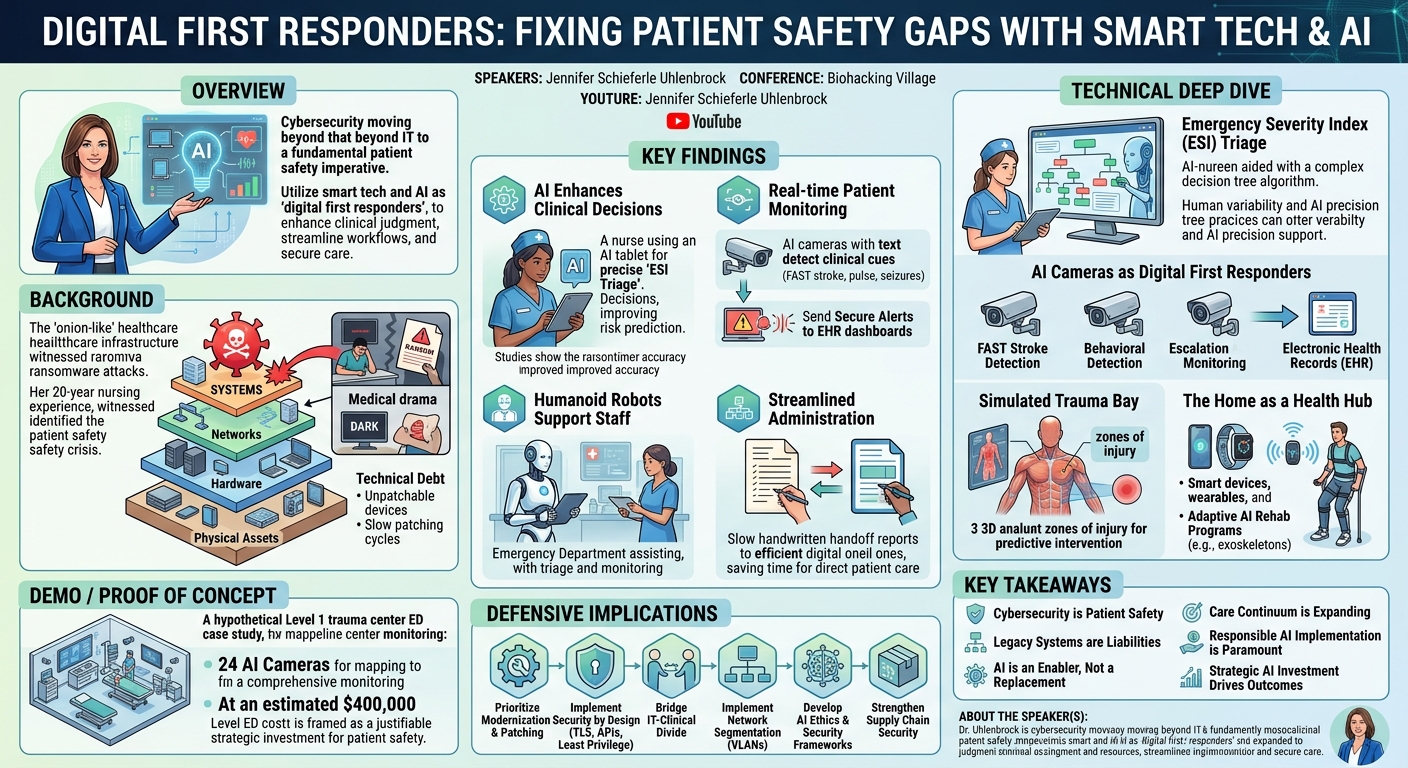
In an era where healthcare systems are increasingly digitized, Dr. Jennifer Schieferle Uhlenbrock's talk, "Digital First Responders: Fixing Patient Safety Gaps with Smart Tech & AI," delivers a critical message: cybersecurity is no longer merely an IT concern but a fundamental patient safety imperative. Drawing from two decades of experience as an expert nurse and her subsequent deep dive into cybersecurity, Dr. Uhlenbrock highlights the alarming vulnerabilities within healthcare infrastructure that are being exploited by ransomware and other cyber threats. This presentation serves as a clarion call to action, urging the healthcare industry to move beyond complacency and proactively integrate smart technology and artificial intelligence to fortify patient care against digital threats and systemic inefficiencies.
Key moments
- 0:00 Healthcare veteran's journey to cyber advocacy
- 0:50 Ransomware: Not just IT, but a patient safety crisis
- 1:40 Chilling reality: Hacked medical devices at Defcon
- 3:30 Unpacking healthcare's complex, fragile digital infrastructure
- 6:20 When cyber attacks become life-threatening medical emergencies
- 8:05 Modernizing healthcare with purpose to prevent emergencies
- 8:50 AI's role in critical emergency department triage
- 10:00 Surprising variability in critical nurse triage adherence
Digital First Responders: Fixing Patient Safety Gaps with Smart Tech & AI
Speakers: Jennifer Schieferle Uhlenbrock
Conference: Biohacking Village
YouTube: https://www.youtube.com/watch?v=ItjAPsvrBj8
Overview
In an era where healthcare systems are increasingly digitized, Dr. Jennifer Schieferle Uhlenbrock's talk, "Digital First Responders: Fixing Patient Safety Gaps with Smart Tech & AI," delivers a critical message: cybersecurity is no longer merely an IT concern but a fundamental patient safety imperative. Drawing from two decades of experience as an expert nurse and her subsequent deep dive into cybersecurity, Dr. Uhlenbrock highlights the alarming vulnerabilities within healthcare infrastructure that are being exploited by ransomware and other cyber threats. This presentation serves as a clarion call to action, urging the healthcare industry to move beyond complacency and proactively integrate smart technology and artificial intelligence to fortify patient care against digital threats and systemic inefficiencies.
Dr. Uhlenbrock, now a healthcare cybersecurity consultant, articulates a compelling vision for a future where AI and advanced technology act as "digital first responders," enhancing clinical judgment, streamlining workflows, and extending the reach of care. The talk meticulously unpacks the current fragility of healthcare's digital landscape, rife with legacy systems and technical debt, before pivoting to demonstrate how judicious application of AI can revolutionize everything from emergency department triage and surgical simulations to patient education, rehabilitation, and even in-home care. It's a comprehensive exploration of how bridging the divide between healthcare and cybersecurity, with AI as a central tool, can not only prevent catastrophic patient outcomes but also drive significant improvements in operational efficiency and quality metrics.
The core premise is that the normalization of fragile healthcare systems, where cyber incidents can escalate into medical emergencies, is unacceptable. Dr. Uhlenbrock passionately argues that by modernizing with purpose, breaking down organizational silos, and embracing AI responsibly, healthcare can transform its inherent vulnerabilities into opportunities for unprecedented safety and efficacy. This article will delve into the critical background, key findings, technical implementations, and defensive strategies presented, offering a detailed blueprint for how healthcare can leverage smart tech and AI to protect patients and optimize care delivery.
Background
▶ Watch: Healthcare veteran's journey to cyber advocacy (0:00)
Dr. Jennifer Schieferle Uhlenbrock's journey from a seasoned nurse with 20 years of experience to a cybersecurity advocate underscores the urgent need for this talk. For two decades, her world was defined by hospitals, patients, research, and medical devices, with an unquestioning trust in the underlying systems. This perspective dramatically shifted with the surge of ransomware attacks targeting hospitals and healthcare systems, leading to billions in losses, compromised patient care, and leaked private health records through triple extortion. This was her "aha!" moment: it wasn't just an IT or cyber problem; it was a profound patient safety crisis. This realization propelled her into the cybersecurity domain, where she earned certifications like Security+ and CC, and engaged with communities like ISSA and Women in Cyber Security. Her experience at Defcon's Biohacking Village, witnessing medical devices being hacked in real-time, further solidified her commitment to bridging healthcare and cyber to keep patients safe.
The current state of healthcare infrastructure, as described by Dr. Uhlenbrock, is akin to an "onion" – complicated, layered, and often tear-inducing. Hospitals are presented as "digital cities" built upon a fragile, multi-layered foundation. At the base are physical assets like power and buildings, overlaid with hardware that includes aging servers and unpatchable devices. Above this, networks are frequently characterized by flat architectures, spotty Wi-Fi, and open remote access. The topmost layer consists of critical systems such as Electronic Health Records (EHRs), PACS, and billing systems, all interconnected but inherently fragile. Into this complex and often outdated environment, AI is now being introduced.
Dr. Uhlenbrock categorizes healthcare systems into three groups: leaders who have modernized core systems and stable networks; those amid transformation, making smart upgrades despite budget constraints; and a significant number deeply reliant on legacy systems, unsupported software, flat networks, and a proliferation of unpatched devices. This technical debt is not merely an inconvenience; it's a systemic risk. Devices designed primarily for function, not security, contribute to slow patching cycles and widespread unsupported systems. The speaker humorously, yet pointedly, "roasts" healthcare's cybersecurity posture: "Patch Tuesday is celebrated annually," "Half the biomedical devices run unsupported Windows and the other half run Vibes," "The most effective DLP strategy is system crashes," and "The only zero trust in the building is between IT and clinical staff." These jokes, she emphasizes, highlight risks that can no longer be laughed off, as the fragility has become normalized.
The talk then vividly illustrates the grim reality of a cyber attack escalating into a medical emergency. Imagine a scenario from a medical drama where, mid-surgery or during childbirth, all monitors go black, a ransomware note appears, and patient care grinds to a halt. Patients are diverted, staff revert to manual mode, and lives are directly endangered. This isn't fiction; it's the stark reality of ransomware in healthcare, where "when hospital systems crash, lives do too." The underlying message is clear: cyber incidents do not have to be medical emergencies. The solution lies in "modernizing with purpose," which entails a comprehensive audit of existing assets, breaking down organizational silos, investing in scalable infrastructure, and strategically piloting AI in mature, ready environments, with the emergency department identified as a prime candidate for immediate impact.
Key Findings
▶ Watch: Chilling reality: Hacked medical devices at Defcon (1:40)
Dr. Uhlenbrock’s presentation reveals several pivotal findings regarding the integration of smart tech and AI in healthcare, particularly concerning patient safety and operational efficiency:
- AI Significantly Enhances Clinical Decision-Making and Triage Accuracy: Traditional emergency department (ED) triage, a critical decision point, suffers from human variability, with nurse adherence to the ESI algorithm as low as 60% in some studies. AI-powered systems can outperform traditional models, improving risk prediction, hospital admission forecasting, and length of stay accuracy. This isn't about replacing clinicians but providing "precision support" to enhance decision-making in specific contexts, as evidenced by internal studies showing AI diagnosing patients four times more accurately than human doctors in narrow use cases.
- Real-time Patient Monitoring and Situational Awareness are Revolutionized by AI Cameras: AI-powered cameras, beyond traditional security, can detect clinical cues (e.g., pulse, breathing, signs of escalation, stroke symptoms via FAST algorithms) in real-time. These "digital first responders" can push secure alerts to EHRs and clinical dashboards, integrating with workflows to notify appropriate teams for immediate intervention in critical situations like seizures, altercations, or patient elopement.
- Immersive AI Simulations Transform Healthcare Education and Training: Moving beyond traditional mannequins, AI-driven simulation labs offer digital twins and personalized feedback. Students can replay disease progression, test interventions, and observe the impact of their decisions, fostering deeper clinical growth and understanding of patient outcomes.
- Humanoid Robots Offer Critical Support in High-Acuity Settings: In fast-paced environments like the ED, humanoid robots can provide invaluable assistance in roles such as triage support, behavioral de-escalation, non-invasive patient monitoring, and even family presence. These robots, undergoing FDA classification similar to other medical devices, are already moving from lab demos to real-world deployments in countries like China (GR1) and the USA (Digit), signaling a paradigm shift in clinical staffing and workflow.
- AI Streamlines Administrative and Communication Bottlenecks: Manual processes, such as handwritten nurse handoff reports, consume significant clinical time. Digital handoff reports, potentially AI-assisted, can save substantial time (e.g., 15 minutes per nurse handoff, translating to 10 hours of direct patient care per shift on a single unit), freeing nurses for direct patient engagement. Similarly, personalized patient-facing screens, enabled by AI, can deliver approved updates like lab results and vitals, improving communication and patient satisfaction.
- The Care Continuum Extends Beyond Hospital Walls with AI and Telemedicine: Telemedicine, augmented by AI, is expanding from post-discharge follow-ups to in-hospital specialist consults and hyper-personalized virtual visits for chronic conditions. This, coupled with smart home technologies that monitor vitals and alert care teams, and AI-powered rehabilitation programs (including wearables and exoskeletons like the ExR), redefines recovery, promotes health equity, and transforms homes into continuous care hubs.
- Responsible AI Implementation Drives Tangible Business and Quality Metrics: Beyond innovation, AI directly impacts critical healthcare metrics. It can improve ED throughput, shorten average length of stay, boost operating room (OR) efficiency, decrease readmission rates, improve clean claims, and help achieve accreditation targets. By aligning AI initiatives with these outcomes, healthcare leadership can justify strategic investments that benefit all departments and improve reimbursement.
Technical Deep Dive
▶ Watch: When cyber attacks become life-threatening medical emergencies (6:20)
The technical heart of Dr. Uhlenbrock's presentation lies in the practical application of AI and smart technologies across the entire patient care continuum, from initial emergency response to post-discharge recovery.
One of the most immediate and impactful applications of AI discussed is in Emergency Severity Index (ESI) triage. ESI triage is a five-level algorithm used by approximately 94% of U.S. hospitals to determine medical urgency within five minutes. However, nurse adherence to this critical algorithm can be as low as 60%, leading to significant variability in patient flow and outcomes. AI systems are presented as a solution to this variability, leveraging advanced algorithms to improve risk prediction, hospital admission forecasting, and length of stay accuracy. While not replacing human judgment, AI provides "precision support," enhancing the nurse's ability to make rapid, accurate decisions based on a broader dataset and more consistent application of protocols. The speaker references internal studies by Microsoft, where their AI system diagnosed patients four times more accurately than human doctors in narrow, specific use cases, underscoring AI's potential for diagnostic assistance in defined contexts.
Moving from static data analysis to real-time visual monitoring, AI-powered cameras are envisioned as ubiquitous "digital first responders." These cameras transcend traditional security functions by being trained to detect subtle clinical cues. For instance, in mental health settings, they can monitor video feeds for changes in pulse, breathing, or signs of behavioral escalation. In emergency scenarios, they can be programmed to screen for stroke symptoms using the FAST acronym (Face droop, Arm weakness, Speech difficulty, Time). The deployment architecture for these cameras typically involves running on cloud platforms like Azure, pushing alerts through secure APIs into Electronic Health Records (EHRs) or dedicated clinical dashboards. This integration allows for immediate notification to specific clinical teams (e.g., code teams) if a seizure is detected in room three, a fight in room eight, or a patient elopes from room ten. This system represents a significant step towards clinical automation in critical environments like the ED, operating room (OR), and intensive care units (ICUs).
The concept of extending AI's visual capabilities into the human body is explored through the "trauma bay of the future." Here, AI will overlay a real-time 3D model of the human body based on aggregated data from vitals, medical history, PACS imaging, and the EHR. This sophisticated model will be capable of simulating injuries from various mechanisms (e.g., falls, motor vehicle collisions, crush injuries, penetrating trauma) and predicting the cascading effects throughout the body. It will highlight specific zones of injury, model potential damage to organs and tissues, and simulate injury pathways, providing clinicians with an unprecedented predictive tool for emergency intervention and surgical planning.
In healthcare education, AI promises to revolutionize training beyond traditional mannequins. The vision includes immersive AI simulation labs and digital twins of patients, offering personalized feedback. Students could replay disease progression, test the impact of different interventions, and immediately see how delays or mistakes affect patient outcomes. This capability, such as playing chronic kidney disease progression forwards and backward, fosters a deep, experiential understanding of clinical decision-making.
The integration of humanoid robots into clinical care is presented as the "next evolution," particularly in high-acuity, fast-paced settings. These robots could assume roles such as triage support, behavioral de-escalation, non-invasive patient monitoring, and even providing family presence. Their deployment is subject to FDA classification, similar to other medical devices, ranging from Class II for triage assistance to Class III for complex surgical robots like the Da Vinci system. Countries like China (with the GR1 robot) and the USA (with Digit, designed for mobility and task-based roles) are at the forefront of this development, indicating that healthcare is firmly on the roadmap for their widespread adoption.
Beyond the high-tech, AI also offers solutions for mundane but critical administrative tasks. The talk highlights the inefficiency of handwritten nurse handoff reports, a process still prevalent in many hospitals. A study at Cleveland Clinic demonstrated that a digital handoff report could save 15 minutes per nurse handoff, potentially returning 10 hours of direct patient care per shift on a single unit. AI could further optimize this by synthesizing information, ensuring accuracy, and flagging critical changes for the incoming shift.
For patient experience, AI can create a "curated, personalized experience" similar to high-end hotels. Approved updates like laboratory results, imaging, and vitals could be pushed directly to patient-facing screens. Crucially, this system would incorporate robust security measures, allowing patients to unlock their private data with a PIN, adhering to principles of least privilege, TLS encryption, VLAN segmentation, and auto log-off to protect sensitive information. This improves timely provider communication and patient satisfaction.
Telemedicine, already expanded by recent events, continues to evolve with AI. It's not just for post-discharge; it facilitates in-hospital virtual consults with off-site specialists (e.g., neurologists, psychiatrists). Post-discharge, AI enables hyper-personalized virtual visits and AI-supported coaching for chronic conditions like diabetes or heart failure. It also serves as a powerful tool for health equity, offering expanded access to behavioral health, language translation, and accessibility tools for underserved populations.
Finally, the concept of the home as a health hub is explored, where AI and smart devices extend care far beyond the clinic. Adaptive AI rehabilitation programs use wearables, VR-based gamified therapy, and even AI-powered exoskeletons (like the ExR for gait and limb retraining) to provide tailored, real-time updated care for patients recovering from strokes or spinal cord injuries. Smart homes, equipped with IoT sensors and voice assistants, can track vital signs, detect early warning signs, and automate alerts to care teams. Devices like Beam O Pro bring hospital-grade monitoring into the home, integrating with EHRs to close the feedback loop between patients and providers. The ethical deployment of these powerful tools demands strong consent models, algorithmic transparency, ethics boards with clinician input, and secure infrastructures to ensure patient trust and safety.
Demo / Proof of Concept
▶ Watch: Modernizing healthcare with purpose to prevent emergencies (8:05)
While Dr. Uhlenbrock did not perform a live, interactive technical demonstration during the talk, she presented a compelling hypothetical case study to illustrate the practical application and justification for implementing AI-powered cameras in a critical healthcare setting. This case study served as a proof of concept for the feasibility and strategic value of such technology.
Specifically, she outlined a scenario involving a typical Level 1 trauma center emergency department. She had mapped out the necessary AI camera coverage for this environment, determining that approximately 24 cameras would be required to achieve comprehensive monitoring. The estimated ballpark cost for this implementation, including the cameras themselves, installation, integration with existing systems, and an ongoing subscription service, was approximately $400,000.
Dr. Uhlenbrock framed this cost not as an expense, but as a "strategic investment" that is "justifiable" for the sake of improved patient safety. By providing concrete numbers and a clear use case, she offered a practical blueprint for healthcare organizations looking to make the business case for adopting such advanced monitoring systems. This detailed hypothetical scenario served as a powerful illustration of how AI-powered visual detection, as discussed in the technical deep dive, could be deployed in a real-world hospital environment to enhance patient safety and operational efficiency, despite not being a live, interactive demo.
Defensive Implications
▶ Watch: Surprising variability in critical nurse triage adherence (10:00)
The insights shared by Dr. Uhlenbrock carry profound implications for cybersecurity defenses within healthcare, urging a paradigm shift from reactive measures to proactive, integrated strategies.
- Prioritize Modernization and Technical Debt Remediation: The "onion-like" fragility of healthcare infrastructure, characterized by aging servers, unpatchable devices, and unsupported software, is a critical vulnerability. Defenders must advocate for and implement a comprehensive modernization strategy, auditing existing assets to identify and deprecate legacy systems. This includes prioritizing patching cycles that move beyond an "annual Patch Tuesday" mentality, ensuring that biomedical devices and critical infrastructure are regularly updated and secured.
- Implement Security by Design for New Technologies: As AI and smart tech are increasingly integrated, security cannot be an afterthought. New deployments, such as AI cameras, humanoid robots, and patient-facing screens, must incorporate security from the foundational design stage. This means utilizing secure APIs for data exchange, enforcing TLS encryption for all communications, implementing VLAN segmentation to isolate critical systems and patient data, adhering to the principle of least privilege for user and system access, and employing auto log-off mechanisms for patient-facing interfaces to prevent unauthorized access.
- Bridge the IT-Clinical Divide: The "zero trust between IT and clinical staff" joke points to a significant cultural and operational gap. Defensive strategies must foster collaboration and mutual understanding between these groups. IT and cybersecurity teams need to understand clinical workflows and patient safety priorities, while clinical staff must be educated on cyber risks and their role in maintaining security. This collaboration is crucial for effective incident response and for ensuring security measures don't impede care delivery.
- Adopt Robust Network Segmentation: The prevalence of "flat networks" in healthcare is a major risk, allowing ransomware and other threats to propagate rapidly across the entire infrastructure. Implementing robust VLAN segmentation and micro-segmentation can contain breaches, limiting the lateral movement of attackers and protecting critical systems like EHRs, PACS, and medical devices from widespread compromise.
- Develop AI-Specific Security and Ethical Frameworks: The deployment of powerful AI tools demands new defensive considerations. Organizations must establish strong consent models for data collection and AI use, ensure algorithmic transparency to understand how AI makes decisions, and form ethics boards with significant clinician input to guide responsible AI implementation. Secure infrastructures specifically designed to protect AI models and the vast datasets they consume are paramount to prevent data poisoning, model manipulation, and privacy breaches.
- Strengthen Supply Chain Security for Medical Devices and AI Solutions: With the influx of new smart devices, wearables, and humanoid robots, healthcare organizations must rigorously vet vendors for their cybersecurity posture. This involves assessing the security of hardware, software, and cloud components, ensuring that manufacturers adhere to industry best practices and provide timely security updates. The FDA's classification process for medical devices should also evolve to incorporate robust cybersecurity requirements throughout the device lifecycle.
- Proactive Threat Hunting and Incident Response Planning: Given the high stakes of cyber attacks on patient care, healthcare organizations must invest in proactive threat hunting capabilities. This includes continuous monitoring of network traffic and device behavior to detect anomalies indicative of compromise. Furthermore, comprehensive incident response plans must be developed and regularly tested, specifically addressing scenarios where cyber incidents escalate into medical emergencies, including protocols for manual operations and patient diversion.
By integrating these defensive strategies, healthcare organizations can move towards a more resilient and secure environment, transforming their current vulnerabilities into a fortified ecosystem where smart tech and AI genuinely serve as "digital first responders" for patient safety.
Key Takeaways
- Cybersecurity is Patient Safety: Ransomware attacks and digital vulnerabilities in healthcare directly compromise patient care, making cybersecurity a critical component of clinical safety and quality.
- Legacy Systems are Critical Liabilities: Healthcare's pervasive technical debt, including aging infrastructure, unsupported software, and flat networks, creates systemic fragility that must be addressed through purposeful modernization.
- AI is a Transformative Enabler, Not a Replacement: AI significantly enhances clinical decision-making, triage accuracy, real-time monitoring, and operational efficiency across the care continuum, but it functions as precision support, augmenting human judgment and compassion.
- The Care Continuum is Expanding: Smart tech and AI are extending healthcare beyond traditional hospital walls, facilitating advanced telemedicine, personalized rehabilitation, and transforming homes into proactive health hubs.
- Responsible AI Implementation is Paramount: Ethical considerations, including strong consent models, algorithmic transparency, and secure infrastructure, are non-negotiable for building trust and ensuring the safe deployment of AI in healthcare.
- Strategic AI Investment Drives Measurable Outcomes: Beyond innovation, AI initiatives can directly improve critical healthcare business metrics such as ED throughput, length of stay, OR efficiency, and accreditation targets, justifying significant investment.
About the Speaker(s)
Dr. Jennifer Schieferle Uhlenbrock is a highly experienced healthcare professional with two decades of dedicated service as an expert nurse. Her extensive background includes a doctorate in nursing and a masters in business, complemented by trauma certification and numerous other respected healthcare credentials. For much of her career, her focus revolved around hospitals, patients, research, and medical devices.
Her perspective dramatically shifted following widespread ransomware attacks on healthcare systems, which she recognized as a profound patient safety problem rather than just an IT issue. This realization spurred her to embark on a journey into cybersecurity, where she earned her Security+ and CC certifications and actively engaged with cybersecurity communities like ISSA, Isaka, and Women in Cyber Security. She became an advocate, a healthcare cybersecurity consultant, and a small business owner, driven by the goal of bridging the gap between healthcare and cyber disciplines to ensure patient safety. Dr. Uhlenbrock's unique blend of deep clinical expertise and cybersecurity knowledge positions her as a leading voice in the secure integration of smart technology and AI in healthcare.
Reviews
Dr. Zero (Offensive Security Researcher) — WEAK
A well-intentioned awareness talk from a nurse-turned-consultant that correctly identifies real problems — healthcare ransomware, legacy infrastructure, flat networks — but never goes deeper than surface-level observations any security professional already knows. The 'technical deep dive' is a catalog of vendor products and AI use-case narratives, not analysis, and the defensive recommendations read like a generic NIST checklist dressed in clinical language.
Heather Calloway (CISO) — WEAK
Dr. Uhlenbrock brings a genuinely valuable perspective — a clinician who crossed into security — but the talk functions more as a technology showcase than a governance or risk argument. The framing is right, the execution is thin where it counts most.