Kernel-Enforced DNS Exfiltration Security
Black Hat USA 2025 · Day 1 · Briefings
Overview
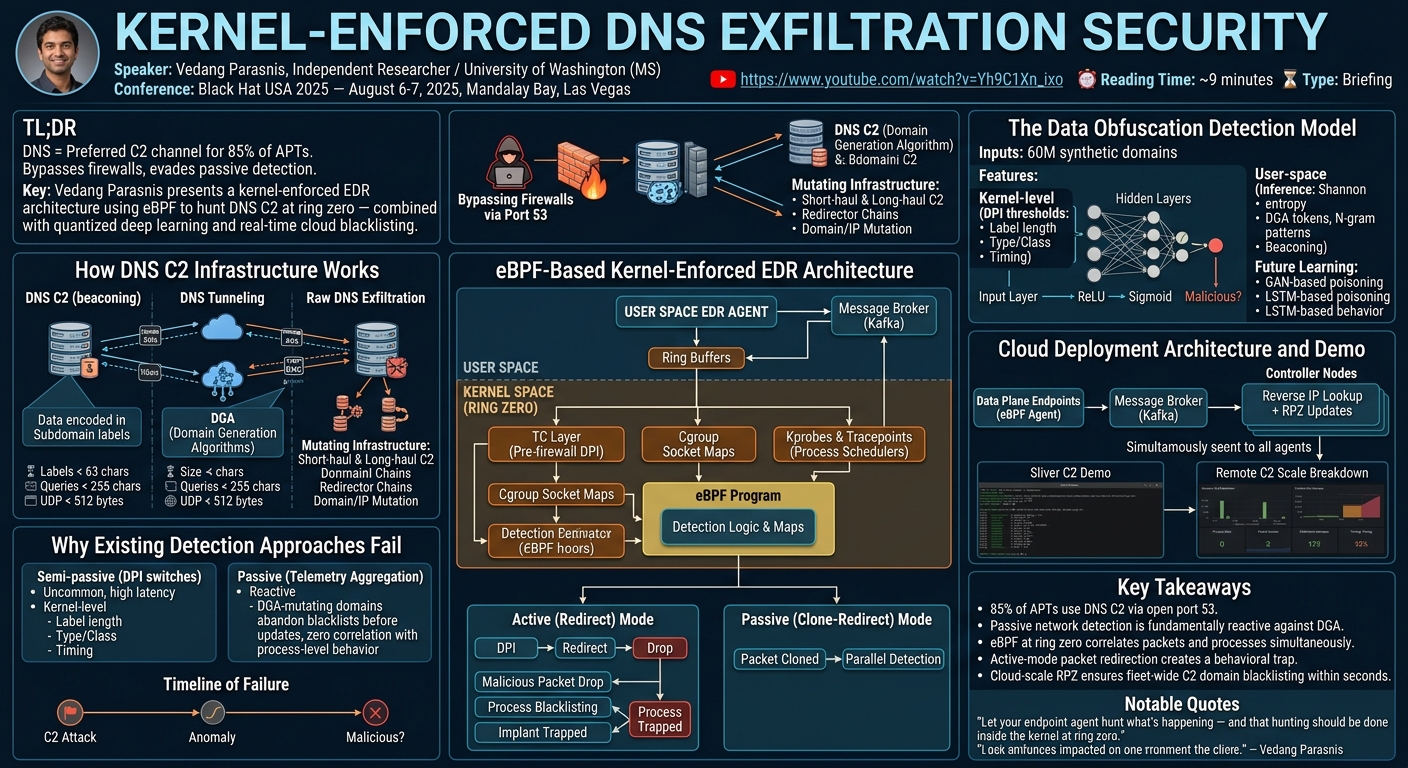
DNS remains the preferred command-and-control channel for 85% of advanced persistent threats because it bypasses firewalls, evades passive detection, and traverses nearly every network. Vedang Parasnis presents a kernel-enforced EDR architecture using eBPF to hunt DNS C2 and tunneling at ring zero — where no user-space evasion can hide — combined with a quantized deep learning model for data obfuscation detection and a cloud deployment architecture that dynamically blacklists domains in real time. ---
Key moments
- 1:59 Key stat: 85% of APTs leverage DNS for stealthy C2 per Unit 42 analysis
- 3:00 DNS C2 attack vectors: tunneling, raw exfiltration, fileless implants explained
- 4:00 DNS C2 enables RCE, shellcode delivery, not just data exfiltration
- 5:59 C2 evasion at scale: redirector fleets plus DGA make static blocklists obsolete
- 8:00 DGA types: wordlist and character-based are hardest to detect or predict
- 8:59 Existing defenses fail: passive NTA is too slow against evolving fileless implants
- 10:00 Novel approach: AI-driven eBPF kernel enforcement for real-time DNS C2 blocking
Kernel-Enforced DNS Exfiltration Security
Speaker: Vedang Parasnis, Independent Researcher / University of Washington (MS)
Conference: Black Hat USA 2025 — August 6-7, 2025, Mandalay Bay, Las Vegas
YouTube: https://www.youtube.com/watch?v=Yh9C1Xn_ixo
Reading Time: ~9 minutes
Type: Briefing
TL;DR
DNS remains the preferred command-and-control channel for 85% of advanced persistent threats because it bypasses firewalls, evades passive detection, and traverses nearly every network. Vedang Parasnis presents a kernel-enforced EDR architecture using eBPF to hunt DNS C2 and tunneling at ring zero — where no user-space evasion can hide — combined with a quantized deep learning model for data obfuscation detection and a cloud deployment architecture that dynamically blacklists domains in real time.
Introduction
Every major APT group has one thing in common: they use DNS. Unit 42 analysis attributes DNS as a C2 channel to 85% of advanced persistent threats. The protocol is ideal for covert communication — DNS ports are open on every firewall, traffic is largely unmonitored, DNS runs primarily over UDP (making it stateless and easy to spoof), and it is the first packet sent by virtually every application. For attackers, DNS is not a fallback channel but a primary weapon.
Parasnis, a recent University of Washington master's graduate focusing on Linux kernel security and eBPF, argues that passive network-level detection is structurally inadequate against modern DNS C2 infrastructure. The attack has already completed by the time a network intrusion system flags it. The only reliable defense requires operating inside the kernel at ring zero — before user-space evasion techniques can activate.
How DNS C2 Infrastructure Works
▶ Watch: DNS C2 Infrastructure and Attack Vectors (02:00)
DNS C2 operates through three primary attack vectors:
- DNS C2 (beaconing): An implant periodically sends DNS queries to an attacker-controlled domain. The C2 server responds with encoded commands in DNS records. The implant exfiltrates data or receives new instructions with each beacon cycle.
- DNS tunneling: Full bidirectional traffic is encoded into DNS query/response pairs, enabling a complete reverse shell over port 53.
- Raw DNS exfiltration: Data is embedded directly into subdomain labels of DNS queries, which are forwarded to attacker-controlled authoritative DNS servers.
DNS has payload size constraints: labels are limited to 63 characters, total query names to 255 characters, and standard UDP DNS packets to 512 bytes. APT operators work within these constraints through chunking, longer XSU labels, and non-dictionary DGA tokens.
Critically, modern C2 operators do not register a single domain. They deploy fleets of redirector servers as proxy chains, rotating across multiple domain registrars and using both short-haul and long-haul C2 infrastructure. Domain Generation Algorithms (DGAs) mutate domains continuously. Combined with IP mutation, this makes static blocklisting fundamentally reactive — by the time a domain is flagged, the implant has already switched.
Why Existing Detection Approaches Fail
▶ Watch: Existing Approaches and Their Limitations (08:00)
Current DNS security falls into two camps:
Semi-passive analysis uses programmable software switches with deep packet inspection middleware, mirroring the SDN topology. This is uncommon and introduces latency.
Passive analysis — the dominant approach — aggregates DNS telemetry from endpoints, runs it through anomaly detection and domain reputation checks over a time window, and produces blacklist updates. The fundamental problem: this process is reactive. By the time an anomaly triggers a response, the implant may have already executed a zero-day payload, spawned child processes, or moved laterally through the network. Against DGA-based C2, the blacklisted domain has already been abandoned before the blacklist is updated.
Additional failure modes include traffic mirroring latency, inability to correlate process-level behavior with network activity, and the ease with which attackers break statistical baselines by varying query classes (TXT, MX, NULL), timing patterns, and encoding schemes.
The eBPF-Based Kernel-Enforced EDR Architecture
▶ Watch: eBPF Architecture and Kernel Hooks (10:00)
The proposed solution operates at ring zero using eBPF — the Linux kernel's sandboxed bytecode execution environment. Rather than mirroring or analyzing traffic passively, the EDR agent injects eBPF programs directly into the kernel's critical paths:
- kprobes and tracepoints attached to process schedulers: detect when C2 implants fork child processes or perform process hollowing, preserving parent-child relationships that user-space agents can lose.
- cgroup socket maps for pre-monitoring DNS socket connections.
- Traffic Control (TC) layer eBPF programs for deep packet inspection of outbound DNS traffic before it leaves the host.
- Kernel keyring and Linux Security Modules for agent integrity verification.
The architecture has two operating modes:
Active (redirect) mode: When a DNS packet hits the TC layer, the eBPF program inspects it and can redirect (not just copy) the packet to user space for analysis. If the EDR agent determines the packet is malicious, it drops the packet and blacklists the process in the eBPF maps. The implant retries — exponential backoff burns telemetry into the maps — and eventually the process is killed. This mode works for UDP DNS traffic and provides zero data loss.
Passive (clone-redirect) mode: For TCP DNS or cases where redirection would cause unwanted congestion, the kernel clones the packet internally at the TC layer and sends the clone to the EDR agent while the original continues. Detection happens in parallel; if confirmed malicious, the process is blacklisted on subsequent packets.
Both modes export rich telemetry via eBPF ring buffers to a user-space message broker (demonstrated with Kafka), which feeds controller nodes that update DNS firewalls dynamically via Response Policy Zones (RPZ).
The Data Obfuscation Detection Model
▶ Watch: Deep Learning Model Architecture (22:02)
At the heart of the user-space EDR agent is a quantized dense neural network for detecting obfuscated DNS data. The model is trained on a dataset of approximately 60 million synthetically generated domain names, balanced between benign and malicious examples.
Kernel-level features (used for DPI thresholds):
- Label length distribution
- Query name total length
- Query class and type distribution
- Packet timing patterns
User-space features (used for inference):
- Shannon entropy (base-2 logarithm), since DNS restricts to ASCII characters and encoded data produces high entropy
- Non-dictionary token ratios
- N-gram patterns characteristic of DGA or Base64 content
- Beaconing interval regularity
Architecture: One input layer, three hidden layers, one output layer, ReLU activation, Sigmoid binary classification.
The model is quantized for deployment inside the kernel agent to minimize latency. Parasnis acknowledges model obsolescence risk and proposes continuous learning using GAN-based poisoning (to expose the model to new obfuscation formats) and LSTM-based behavioral analysis for richer temporal pattern detection.
Cloud Deployment Architecture and Demo
▶ Watch: Cloud Deployment and Sliver C2 Demo (28:02)
The deployment architecture scales horizontally across availability zones. Each data plane endpoint runs an eBPF agent. Telemetry streams to a message broker. Controller nodes consume events, perform reverse IP lookups to analyze redirector infrastructure, and push RPZ updates back to all agents simultaneously — meaning that when one endpoint detects and blacklists a C2 domain, every node in the cluster is updated within seconds.
The live demo used Bishop Fox's Sliver C2 framework (open source adversary emulation) against an on-premises environment with PowerDNS as the DNS server and Kafka as the broker. The attacker established a reverse shell, executed getuid and other remote commands, and forwarded NGINX on port 3200 through the DNS tunnel.
The EDR agent detected the beaconing pattern, trapped the implant in exponential retry loops, and killed the process after accumulating sufficient behavioral telemetry. Process-level data, packet counts, exfiltration attempt counts, and timing were all exported to Prometheus and visualized in Grafana in real time. Response time at ten exfiltration attempts was measured in milliseconds.
Notable Quotes
"Every cloud environment relies on DNS for service discovery — it's the first packet which every protocol sends. But when it comes to C2, it becomes extremely damaging." — Vedang Parasnis ▶ 02:00
"Rather than network hunting, once C2 activities are executed, let your endpoint agent hunt what's happening — and that hunting should be done inside the kernel at ring zero, where no user-land evasion can hide." — Vedang Parasnis ▶ 10:00
"It creates a trap for the implant. It forces it to retry again and again. The kernel is exporting every rich telemetry to user space, and this messes up their beaconing pattern." — Vedang Parasnis ▶ 16:01
"When you want to break down remote C2 scale, it has to be a bottom-up approach: your OS makes the EDR mature, the EDR makes your SIEM mature, and the SIEM makes your firewall intelligent." — Vedang Parasnis ▶ 34:02
Key Takeaways
- 85% of APTs use DNS for C2 because every firewall leaves port 53 open and DNS traffic is rarely monitored at the process level.
- Passive network detection is fundamentally reactive — DGA-based C2 mutates domains faster than network-level blacklisting can respond.
- eBPF at ring zero provides the only vantage point where both packet content and process identity are simultaneously visible, enabling correlation that user-space tools cannot achieve.
- Active-mode packet redirection creates a behavioral trap: the implant retries, burning observable telemetry while the EDR accumulates evidence before terminating the process.
- Cloud-scale RPZ distribution ensures that a domain detected on one endpoint is dynamically blacklisted across the entire fleet within seconds, regardless of DGA mutation.
Slides: No slides PDF was listed for this talk.
Reviews
Dr. Zero (Offensive Security Researcher) — SOLID
Solid eBPF-for-DNS-C2 architecture with a working demo against Sliver. The ideas are sound, the kernel hooks are legitimate, but this is a graduate thesis more than a mature system — and the ML component is a weak link dressed up in deep learning clothes.
Heather Calloway (CISO) — SOLID
eBPF-based DNS detection at ring zero is the right architecture for a threat that passive monitoring can't catch in time. The kernel enforcement story is solid. The gap is deployment reality — most organizations don't have the infrastructure to run this, and the talk doesn't bridge that distance.