Smart Charging, Smarter Hackers: The Unseen Risks of ISO 15118
Black Hat USA 2025 · Day 1 · Briefings
Overview
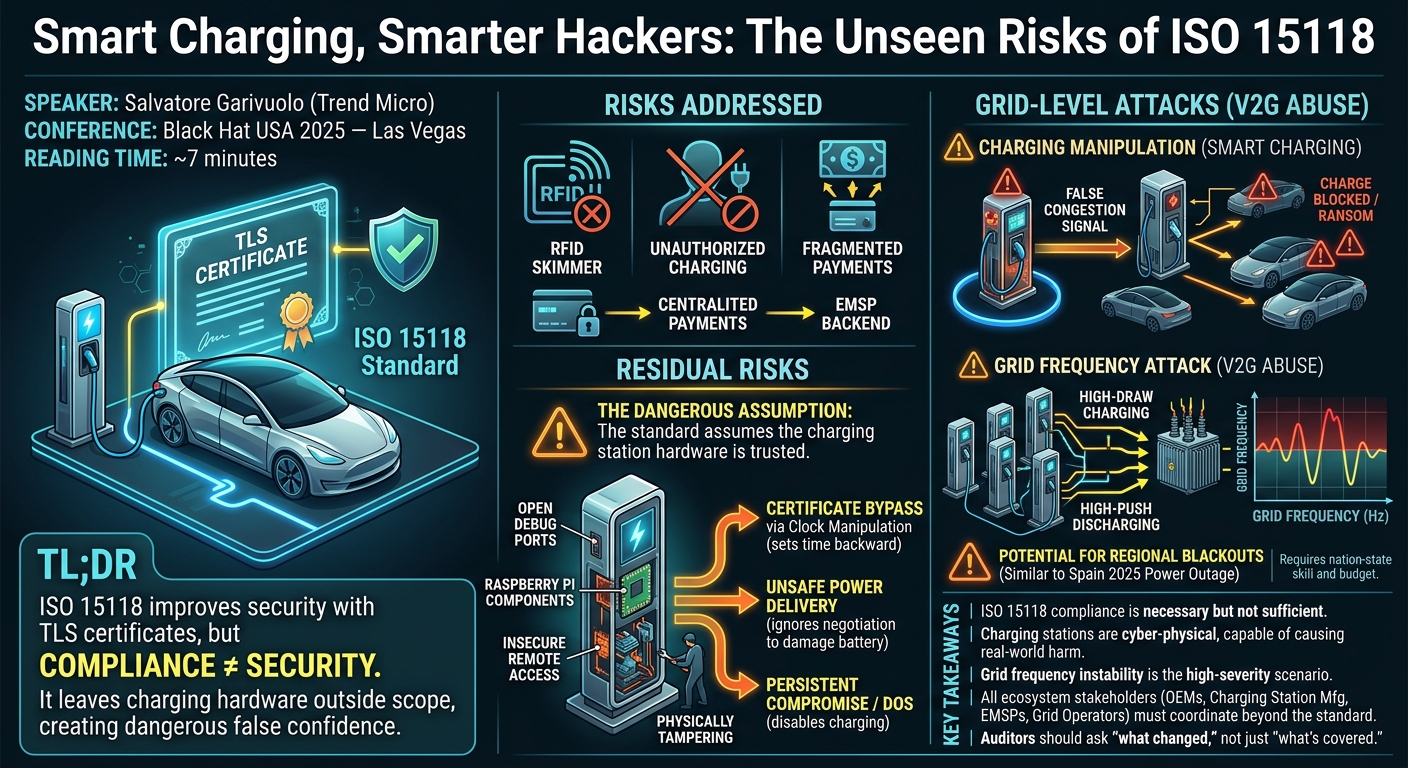
ISO 15118 — the international standard governing communication between electric vehicles and charging stations — meaningfully improves EV charging security by replacing skimmable RFID cards with TLS-protected digital certificates and centralizing payment management. However, Trend Micro researcher Salvatore Garivuolo demonstrates that compliance with ISO 15118 creates a dangerous false sense of security: the standard explicitly leaves charging station hardware outside its scope, and that untrusted hardware becomes the entry point for four distinct attack classes — including grid-frequency manipulation attacks capable of inducing regional blackouts similar to the Spain 2025 power outage. ---
Key moments
- 1:59 Scale: up to 600 million EVs expected by 2040, creating massive grid strain risk
- 4:00 Real incident: Spain 2025 blackout from renewable surplus shows grid fragility
- 6:00 ISO 15118 purpose: vehicle-to-grid bidirectional charging to prevent surplus/shortage outages
- 7:59 New attack surface: plug-and-charge feature introduces PKI identity layer to EVs
- 9:00 Standard introduces unintended risks: new V2G communication protocol expands attack surface
- 9:59 Key finding: vulnerabilities in ISO 15118 implementation enable grid-scale attack scenarios
- 11:30 Conclusion: standard creates false sense of security while introducing new threat vectors
Smart Charging, Smarter Hackers: The Unseen Risks of ISO 15118
Speaker: Salvatore Garivuolo (Senior Threat Researcher, Trend Micro Forward-looking Threat Research)
Conference: Black Hat USA 2025 — August 6-7, 2025, Mandalay Bay, Las Vegas
YouTube: Watch the full talk
Reading time: ~7 minutes
Type: Briefing
TL;DR
ISO 15118 — the international standard governing communication between electric vehicles and charging stations — meaningfully improves EV charging security by replacing skimmable RFID cards with TLS-protected digital certificates and centralizing payment management. However, Trend Micro researcher Salvatore Garivuolo demonstrates that compliance with ISO 15118 creates a dangerous false sense of security: the standard explicitly leaves charging station hardware outside its scope, and that untrusted hardware becomes the entry point for four distinct attack classes — including grid-frequency manipulation attacks capable of inducing regional blackouts similar to the Spain 2025 power outage.
Introduction
The global electric vehicle fleet is projected to reach 600 million vehicles by 2040, comprising 30–40% of all vehicles on the road. That growth creates an acute grid management problem — and a security problem. ISO 15118, introduced in its first major version in 2014 and updated in 2022, addresses both by enabling "smart charging" (grid-responsive charging patterns) and "vehicle-to-grid" communication (bidirectional power flow), while securing the EV-to-charger communication link with TLS and digital certificate-based authentication.
The standard represents a genuine security improvement. But Garivuolo, presenting at Black Hat USA 2025, argues that the security community and EV industry have made a critical mistake: treating "ISO 15118 compliant" as synonymous with "secure." His research systematically maps the gaps the standard leaves behind — and the new attack surfaces it inadvertently creates.
What ISO 15118 Actually Does
▶ Watch: Standard overview (02:00)
ISO 15118 exists in two versions: 15118-2 (2014), which handles smart charging and plug-and-charge but not vehicle-to-grid communication, and 15118-20 (2022), which adds full V2G support.
Its central security mechanism is Plug and Charge (PnC): when a vehicle connects to a charging station, the station automatically identifies the vehicle via TLS-secured digital certificates, authenticates the session, extracts payment information from the certificate, and initiates billing — all without the driver presenting a credit card or RFID token. Authentication, authorization, and billing are delegated to a centralized backend entity called the e-Mobility Service Provider (EMSP).
This represents a concrete security improvement over the previous state of the art. Before ISO 15118:
- Unauthorized charging: Charging stations relied on physical RFID cards and credit cards, all of which can be stolen, skimmed, or cloned. Post-standard, this requires a fraudulent digital certificate — a dramatically higher bar.
- Fragmented security posture: Individual charging stations managed payment data with inconsistent security practices. Under ISO 15118, this responsibility moves to a single EMSP that can enforce policy at scale.
The trade-off acknowledged by Garivuolo: before the standard, a breach at the charging station level might expose data from hundreds or thousands of EV owners. A breach at the EMSP level today could expose millions simultaneously.
What ISO 15118 Leaves Behind
▶ Watch: Threat landscape gaps (14:01)
The standard explicitly limits its scope to the communication link between the EV and the charging station. It makes a critical assumption: that the charging station itself is a trusted, secure entity. This assumption is the source of the residual risks Garivuolo identifies.
Recent security audits of real-world charging stations have found off-the-shelf components (including Raspberry Pi boards), open debug ports, open maintenance interfaces, and insecure remote access configurations. Charging stations are also physically accessible in public spaces — they can be tampered with directly.
Persistent Compromise and Denial-of-Service
An attacker who gains persistent control of a charging station — via its exposed management interfaces or by physically tampering with it — can simply disable charging functionality. The ISO 15118 standard protects the communication channel between the EV and the station, but if the station itself has been disabled, that communication channel is irrelevant.
Unsafe Power Delivery
ISO 15118 includes a power-level negotiation mechanism between the EV and the charging station to ensure a safe charging rate. However, the standard provides no enforcement mechanism. A compromised charging station can accept the negotiated power level and then override it, delivering power at a rate dangerous to the vehicle's battery and potentially creating a safety hazard for the driver.
Certificate Validation Bypass
ISO 15118's digital certificate system depends on proper certificate revocation checks — but a compromised charging station can have its local clock manipulated. By setting the system clock to a time when a now-revoked or expired certificate was still valid, an attacker can trick the station into accepting fraudulent certificates, undermining the authentication system that is the standard's primary security control.
▶ Watch: Certificate bypass via clock manipulation (18:01)
New Risks Created by ISO 15118: Grid-Level Attacks
The most consequential findings concern attack vectors that did not exist before ISO 15118 introduced smart charging and V2G functionality.
Charging Manipulation (Smart Charging Abuse)
Smart charging allows charging stations to respond to grid congestion signals by stopping or reducing EV charging. A compromised charging station can simulate a false congestion signal, artificially inflating prices at the station and forcing nearby EVs to stop charging — effectively a ransom or denial-of-service attack on EV owners, with the attacker able to subsequently offer to charge vehicles at elevated rates.
Grid Frequency Attacks (V2G Abuse)
▶ Watch: Grid frequency attack scenario (20:01)
This is the highest-severity scenario in the presentation. Vehicle-to-grid communication enables EVs to both draw electricity from and return electricity to the grid. An attacker who compromises multiple charging stations connected to the same local power transformer can synchronize them to continuously and rapidly alternate between high-draw charging and high-push discharging.
The result — as demonstrated by the April 2025 Spain power outage, which occurred when a renewable energy surplus shifted grid frequency outside safe operational limits — is the potential to artificially destabilize grid frequency, causing localized or potentially regional blackouts. Garivuolo notes this attack class requires significant skill and resources, but "this doesn't write this type of attack off — it simply narrows the type of attackers to people that have the budget, the skills, and the means to act," i.e., nation-state actors.
The Core Argument: Beyond Standard Compliance
Garivuolo's central message is a call for a shift in how the security community evaluates standards-based systems.
"True security is not simply complying with a standard. We should ask ourselves not just 'What does the standard address?' but 'What does the standard change?' and 'What does the standard leave behind?'"
— Salvatore Garivuolo [[▶ 22:01]](https://www.youtube.com/watch?v=_furvigQmxk&t=1321s)
The ISO 15118 ecosystem involves EV OEMs, charging station manufacturers, EMSPs, and grid operators — all governed by different standards. When one component of this multi-standard ecosystem is left out of scope by a given standard (in this case, the charging station hardware is out of ISO 15118's scope), the security of the entire system degrades to the weakest link.
Notable Quotes
"A standard can also create a false sense of security. You might feel secure even if you're not."
— Salvatore Garivuolo [[▶ 00:00]](https://www.youtube.com/watch?v=_furvigQmxk&t=0s)
"The standard makes an assumption, and this is a very dangerous assumption. The standard assumes that the charging station is a trusted entity — and this is an assumption that can backfire."
— Salvatore Garivuolo [[▶ 14:01]](https://www.youtube.com/watch?v=_furvigQmxk&t=841s)
"We will be able, obviously with skill and budget to act, to disconnect part or the entire national grid."
— Salvatore Garivuolo, on V2G grid frequency attacks [[▶ 20:01]](https://www.youtube.com/watch?v=_furvigQmxk&t=1201s)
Key Takeaways
- ISO 15118 compliance is necessary but not sufficient. The standard meaningfully reduces several pre-existing EV charging attack vectors, but explicitly excludes charging station hardware from scope — and that hardware remains vulnerable to persistent compromise.
- Charging stations are cyber-physical systems. An attacker with control of a charging station can cause real-world harm: disrupted charging, battery damage via unsafe power delivery, or in the most severe scenario, contribution to grid frequency instability.
- The April 2025 Spain power outage illustrates the real-world stakes. A surplus of renewable electricity shifted grid frequency outside safe limits, causing widespread outages. A coordinated V2G-based attack by a sophisticated actor could replicate this artificially.
- All EV ecosystem stakeholders must coordinate on security beyond the standard. EV OEMs, charging station manufacturers, EMSPs, and grid operators each govern different components; a security gap in any one is a gap for all.
- Standards auditors should ask "what changed?" not just "what's covered?" Security gaps consistently emerge in the interfaces and components that fall between standards — the areas where everyone assumes someone else is responsible.
Slides PDF not available for this talk.
Reviews
Dr. Zero (Offensive Security Researcher) — SOLID
Garivuolo correctly diagnoses the false-sense-of-security problem with ISO 15118 compliance and the grid frequency attack scenario is legitimately scary. But the talk is more threat model than research — no live exploits, no CVEs, no PoC — and the 'charging stations use Raspberry Pis' observation is old news in ICS circles.
Heather Calloway (CISO) — MUST SEE
ISO 15118 compliance is not security. This talk documents precisely what the standard covers, what it explicitly left out of scope, and what new attack classes it created — including V2G grid frequency attacks with a real-world precedent in the April 2025 Spain power outage. The governance message is the most important one in the EV space.