Keynote: Threat Modeling and Constitutional Law
Black Hat USA 2025 · Day 1 · Briefings
Overview
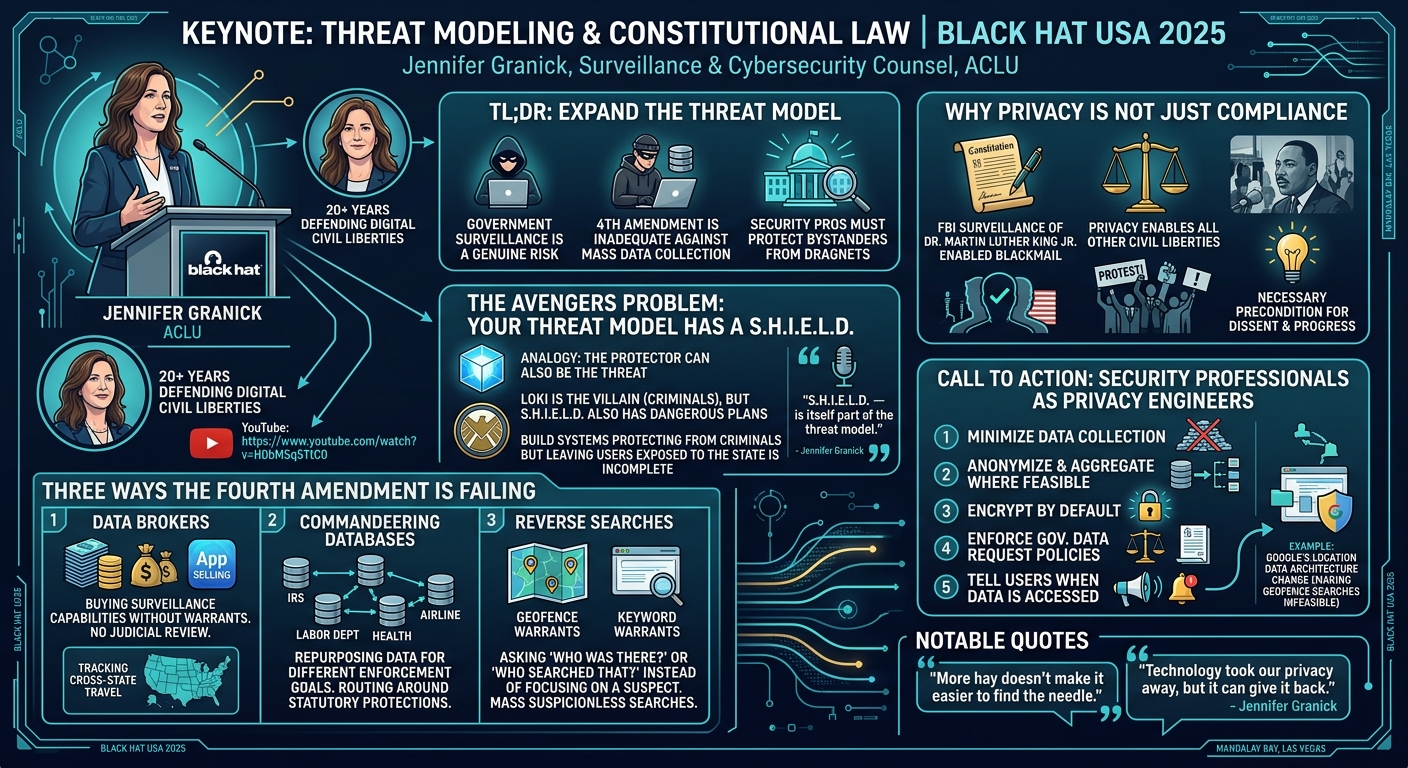
Jennifer Granick, the ACLU's Surveillance and Cybersecurity Counsel, challenged Black Hat attendees to expand their threat models beyond criminals and include government surveillance as a genuine risk to their users. Drawing on the Fourth Amendment's mounting inadequacy against data brokers, commandeered government databases, and reverse location searches, she called on security professionals to use their technical expertise to protect bystanders — not just from hackers, but from suspicionless dragnet surveillance enabled by modern data collection. ---
Key moments
- 3:00 Core thesis: government itself is part of the security threat model, not just criminals
- 5:00 Surveillance expansion: AI analysis tools create categorically new mass surveillance capability
- 7:59 Personal admission: 10 years ago speaker misjudged that Fourth Amendment would protect mass data
- 10:00 FBI blackmailed MLK with wiretap recordings—showing surveillance enables political persecution
- 12:30 2018 Supreme Court ruling: cell phone location data gets Fourth Amendment protection
- 18:00 Third-party doctrine erosion: courts slowly recognizing digital data deserves constitutional protection
- 25:59 Call to action: security engineers who hold data are the last line of defense for civil liberties
- 34:00 Practical ask: minimize data collection, encrypt at rest, and resist overbroad government requests
Keynote: Threat Modeling and Constitutional Law
Speaker: Jennifer Granick, Surveillance and Cybersecurity Counsel, ACLU
Conference: Black Hat USA 2025 — August 6-7, 2025, Mandalay Bay, Las Vegas
YouTube: https://www.youtube.com/watch?v=H0bM5q5TtC0
Reading time: 6 min
Type: Keynote
TL;DR
Jennifer Granick, the ACLU's Surveillance and Cybersecurity Counsel, challenged Black Hat attendees to expand their threat models beyond criminals and include government surveillance as a genuine risk to their users. Drawing on the Fourth Amendment's mounting inadequacy against data brokers, commandeered government databases, and reverse location searches, she called on security professionals to use their technical expertise to protect bystanders — not just from hackers, but from suspicionless dragnet surveillance enabled by modern data collection.
Introduction
Jennifer Granick has been arguing for digital civil liberties in front of courts, Congress, and hacker conferences for over two decades. Known as "the hacker's lawyer," she represented some of the early internet's most consequential CFAA cases, served as Civil Liberties Director at Stanford's Center for Internet and Society, and has championed privacy at the ACLU. The last time she delivered the main Black Hat keynote was ten years ago.
What she said then — that the internet was becoming more centralized and that centralization enables cheaper, easier surveillance — has proven correct. What she underestimated was that governments would be able to acquire not just individual data profiles but fire-hose feeds of data on millions of people simultaneously. Her 2025 return to the main stage was built around that correction to her own threat model, and an appeal to the security community to incorporate government surveillance into theirs.
The Avengers Problem: Your Threat Model Has a S.H.I.E.L.D.
▶ Watch: Threat Model Introduction (02:01)
Granick opened with an extended analogy from the first Avengers film. The heroes assemble to stop Loki, confident in their threat model — Loki is the villain, S.H.I.E.L.D. is the ally. Then they discover that S.H.I.E.L.D. also plans to weaponize the Tesseract and that the World Security Council's contingency plan involves nuking Manhattan. The lesson: your protector can also be a threat actor, and incomplete threat models are dangerous even when they get the primary adversary right.
Security professionals, Granick argued, face an analogous problem. When they build data protection systems, they typically model criminals, hackers, and identity thieves as adversaries. That is correct as far as it goes. But the government — "S.H.I.E.L.D." in her analogy — holds legal authority to demand access to data, is sometimes exempt from the constitutional constraints that would apply in other contexts, and has, historically, abused that authority. Designing systems that protect users from criminals while leaving them fully exposed to state surveillance means the threat model is incomplete.
Why Privacy Is Not Just a Compliance Checkbox
▶ Watch: Why Privacy Matters — MLK Example (10:02)
Granick took time to explain why she views the Fourth Amendment as more than a legal technicality — it is, she argued, an enabler of all other civil liberties. The canonical example she cited was the FBI's surveillance of Martin Luther King Jr., which included recordings of his private life that were then packaged into a blackmail campaign, with an accompanying letter that apparently encouraged King to take his own life to prevent the disclosure. Granick's point was not partisan: the same surveillance infrastructure that can be used against one political movement can be turned against any other, and has been.
"Without deviance from the norm, progress is not possible," she quoted Frank Zappa, tying the argument to the value of privacy as a precondition for social experimentation and dissent. She pointed out, with a directness that landed with the Black Hat audience, that one in three Americans has a criminal record, that everyone in the room had technically violated some law at some point, and that the difference between prosecution and impunity is often surveillance access rather than actual culpability.
Three Ways the Fourth Amendment Is Failing
▶ Watch: Data Brokers, Databases, and Reverse Searches (20:04)
Granick structured the core of her talk around three specific failure modes in current Fourth Amendment doctrine — each representing a vector through which bulk suspicionless surveillance can occur without triggering constitutional protection.
Data brokers. The data broker industry harvests location data from apps, associates it with advertising IDs, and sells it to governments as a commercially purchased product, not a legal demand. Because there is no warrant, there is no judicial review and no particularity requirement. One company harvested location data from hundreds of millions of phones and sold it to both the Trump and Biden administrations to track movement patterns en masse. In 2025, Texas law enforcement reportedly collaborated with Illinois law enforcement to track a woman traveling across state lines for a legal abortion — using commercially purchased location data. The practical consequence: governments can purchase surveillance capabilities that would otherwise require warrants, bypassing the checks-and-balances structure entirely.
Commandeering existing databases. The second failure mode is the repurposing of government databases collected for one legitimate purpose toward different enforcement goals. Granick cited the current effort to give law enforcement access to IRS tax records — statutorily protected information — to support deportation investigations. Labor Department data, housing data, health data, airline records, and medical billing information are all being consolidated for cross-agency use in ways that were never contemplated when the data was originally collected. The statutory protections that were supposed to apply to these specific data types are being routed around by executive action.
Reverse searches. The third failure is the technique of asking not "where was this person?" but "who was in this location?" Geofence warrants compel companies like Google to search through databases of hundreds of millions of users' location histories to identify everyone who was near a particular place at a particular time — whether that place was a crime scene, a protest, or a medical clinic. Keyword warrants apply the same logic to search histories. Courts are deeply divided: one circuit has held that searching a database of 100 million people constitutes a categorically unconstitutional general search; an adjacent circuit has held that the data belongs to Google, not the user, and therefore no Fourth Amendment interest exists.
The Call to Action: Security Professionals as Privacy Engineers
▶ Watch: What Security Professionals Can Do (32:04)
Granick was explicit that she was not there to lecture — she acknowledged that she is a lawyer, not an engineer, and that the audience holds technical expertise she does not. Her ask was specific: include government surveillance in your threat model and use your technical position to make bulk data collection structurally harder.
Concretely, she recommended:
- Minimize data collection. Do not collect data you do not currently need "just in case." Enticing repositories of data are a structural risk — the Dr. Banner principle: narrow the search to where the signal actually is.
- Anonymize and aggregate wherever feasible. Can cross-dataset linkage be made harder? Can data be engineered to be useful for its legitimate purpose without being linkable to individuals across contexts?
- Encrypt by default. Not a novel recommendation, but one she positioned explicitly against government access as a threat vector, not just criminal interception.
- Have and enforce a policy for government data requests. Fight non-disclosure orders where legally viable. Google, Signal, and Facebook notify users of government data demands; most companies do not. Users should have the opportunity to take protective steps.
- Tell users when their data has been accessed. Even when compelled not to, push back on gag orders where possible and build notification policies into platform design.
Google's recently announced change to the way it stores location data — specifically to make geofence warrant searches technically infeasible — was cited as exactly the kind of engineering contribution Granick is calling for.
Notable Quotes
"While law enforcement needs information to investigate crime, sometimes the government — S.H.I.E.L.D. — is itself part of the threat model."
— Jennifer Granick [[▶ 02:01]](https://www.youtube.com/watch?v=H0bM5q5TtC0&t=121s)
"The FBI sent a package of recordings to Dr. King with a note that basically seemed to encourage him to kill himself in order to prevent the disclosure of embarrassing information. That is what unchecked surveillance enables."
— Jennifer Granick [[▶ 10:02]](https://www.youtube.com/watch?v=H0bM5q5TtC0&t=602s)
"More hay doesn't make it easier to find the needle. The particularity requirement of the Fourth Amendment is supposed to prevent exactly this."
— Jennifer Granick [[▶ 16:03]](https://www.youtube.com/watch?v=H0bM5q5TtC0&t=963s)
"Technology really took our privacy away, but I am optimistic that it can give our privacy back as well."
— Jennifer Granick [[▶ 36:05]](https://www.youtube.com/watch?v=H0bM5q5TtC0&t=2165s)
Key Takeaways
- Expand your threat model. Government and law enforcement are not neutral actors with respect to user data — they are a distinct threat vector that belongs in any honest risk assessment alongside criminals and hackers.
- Data brokers are a Fourth Amendment end-run. Commercially purchased surveillance data sidesteps warrant requirements entirely; security professionals who sell or provide data access should implement know-your-customer and abuse-prevention safeguards.
- Reverse search techniques have no consistent legal protection. Courts are split on geofence and keyword warrants — engineers cannot rely on the law to protect users from these techniques; the protection must be structural.
- Data minimization is a privacy defense, not just a compliance checkbox. Not collecting data eliminates the possibility of it being demanded, hacked, or repurposed — Google's location data architecture change is the model.
- Notification policies matter. Proactively fighting gag orders and building user-notification capabilities into data platforms gives individuals a meaningful opportunity to protect themselves when government access occurs.
Slides: No slides PDF is available for this session.
Reviews
Dr. Zero (Offensive Security Researcher) — ACCEPTABLE
Granick's threat-model expansion argument is correct, the Avengers framing lands, and the three Fourth Amendment failure modes — data brokers, commandeered databases, reverse searches — are concrete enough to be useful. But she's a lawyer at a hacker conference, and the technical ask ('minimize data collection, encrypt by default') is 2015 security advice with a 2025 political coat of paint.
Heather Calloway (CISO) — STRONG ACCEPT
Jennifer Granick made the case that government data collection — via data brokers, subpoena, and surveillance programs — belongs in every organization's threat model, not just civil liberties organizations' threat models. Every subpoena served to a data broker is a security event for the 300 million people in that dataset. If your threat model does not include the government, your threat model is incomplete.