2 Cops 2 Broadcasting: TETRA End-To-End Under Scrutiny
Black Hat USA 2025 · Day 1 · Briefings
Overview
Midnight Blue — the team behind the landmark TETRA:BURST disclosures in 2023 — returned to Black Hat with a follow-up that dismantles the mitigations deployed in response to their original research. They demonstrate that TETRA end-to-end encryption, the "expensive solution" recommended for the most sensitive users (intelligence agencies, special forces, SCADA operators), harbors its own design flaws allowing voice injection, SDS replay, and plaintext traffic injection into critical-infrastructure networks. ---
Key moments
- 2:00 2023 research recap: TEA1 cipher had only 32 bits of effective security instead of 80
- 4:00 TETRA end-to-end used by covert police units, special forces, and intelligence agencies over radio
- 6:30 Demo: physical access attack on Sepura TETRA radio achieves full code execution and key extraction
- 8:00 eBay OPSEC fail: researcher purchased working TETRA crypto module from open market
- 10:00 Security through obscurity failure: sanctioned Chinese and Russian universities published NDA-restricted TETRA specs
- 13:59 Finding: TETRA end-to-end key management center is centralized, enabling single-point-of-failure attacks
- 21:59 Cryptographic vulnerability: fundamental weaknesses found in TCCA-specified end-to-end encryption design
- 34:00 Policy conclusion: proprietary NDA security model protects attackers not defenders; open scrutiny needed
2 Cops 2 Broadcasting: TETRA End-To-End Under Scrutiny
Speakers: Jos Wetzels, Carlo Meijer, and Wouter Bokslag — Midnight Blue
Conference: Black Hat USA 2025 — August 6-7, 2025, Mandalay Bay, Las Vegas
YouTube: https://www.youtube.com/watch?v=oUhb2tTgmgg
Reading time: ~10 minutes
Type: Briefing
TL;DR
Midnight Blue — the team behind the landmark TETRA:BURST disclosures in 2023 — returned to Black Hat with a follow-up that dismantles the mitigations deployed in response to their original research. They demonstrate that TETRA end-to-end encryption, the "expensive solution" recommended for the most sensitive users (intelligence agencies, special forces, SCADA operators), harbors its own design flaws allowing voice injection, SDS replay, and plaintext traffic injection into critical-infrastructure networks.
Introduction
When Midnight Blue disclosed the TETRA:BURST vulnerabilities two years ago — including a backdoored cipher (TEA1) with only 32-bit effective security and a keystream-recovery attack — the response from the industry was significant. ETSI revised its standards, governments patched firmware, and operators began migrating away from the broken TEA1 cipher. End-to-end (E2E) encryption was widely recommended as the definitive fix.
This talk examines whether that fix actually holds up. The short answer is that it does not — not for the E2E layer, and not for the remediated air-interface layer either. Two years of "tireless patching," as Jos Wetzels puts it, left TETRA users largely where they started.
Background: TETRA's Opaque Security Model
TETRA (Terrestrial Trunked Radio) is the dominant standard for law-enforcement radio communications globally, and also runs SCADA wide-area networks for electrical substations, pipelines, and railway signaling. It has been standardized by ETSI since 1995 but with a deliberately secretive approach to cryptography: the cipher specifications are proprietary, held under NDA, and inaccessible to independent researchers or end users.
▶ Watch: TETRA Background (00:00)
The TETRA encryption algorithm (TEA) family partitions ciphers by export class. TEA1 — used in export markets — was found to have a deliberately reduced 32-bit effective keyspace. TETRA E2E encryption sits on top of the air-interface layer and is governed not by ETSI but by the TCCA (Critical Communications Association), whose SFPG (Security and Fraud Prevention Group) recommendations are even more tightly controlled. Users of E2E include covert police units, intelligence agencies, and special-forces units across Europe, Latin America, the Middle East, and South Asia.
The TCCA's NDA regime means the very organizations relying on E2E cannot audit what they bought. Midnight Blue found seven Chinese academic publications and at least one Russian paper that appeared based on the restricted TCCA specifications — the NDAs were protecting only the Western end users from scrutiny, not state actors.
Reverse-Engineering the Sepura E2E Implementation
To obtain an E2E implementation to analyze, the team first attempted to acquire a Motorola UCM cryptographic hardware module on eBay. The unit they received turned out to be non-functional — "a great scam-per-weight ratio," Wetzels noted to audience laughter.
▶ Watch: Hardware Acquisition Story (06:00)
They pivoted to Sepura, a UK-based TETRA vendor whose "embedded" E2E solution is software-based rather than hardware-based. Sepura radios run on the OMAP-L138 SoC — the same platform as a Motorola radio the team had previously compromised. Using code-execution vulnerabilities discovered in that prior research, Midnight Blue obtained full code execution on the Sepura devices, built custom tooling for firmware extraction and analysis, and recovered the E2E cryptographic stack entirely in software.
The implementation closely adheres to TCCA SFPG recommendations: the core cryptographic primitives include AES-128, AES-256, and IDEA. Traffic encryption keys (TEKs) are wrapped in key-encryption keys (KEKs) and delivered to radios via a centralized key-management center — fundamentally different from the end-to-end model of Signal or WhatsApp.
One notable finding: export variants of AES within the E2E stack are limited to 56-bit effective security (below the Wassenaar Arrangement threshold), meaning some deployed systems provide substantially weaker protection than operators realize. Public procurement documents reviewed by the team showed zero mention of these weakened variants.
Voice Injection: Breaking E2E Confidentiality
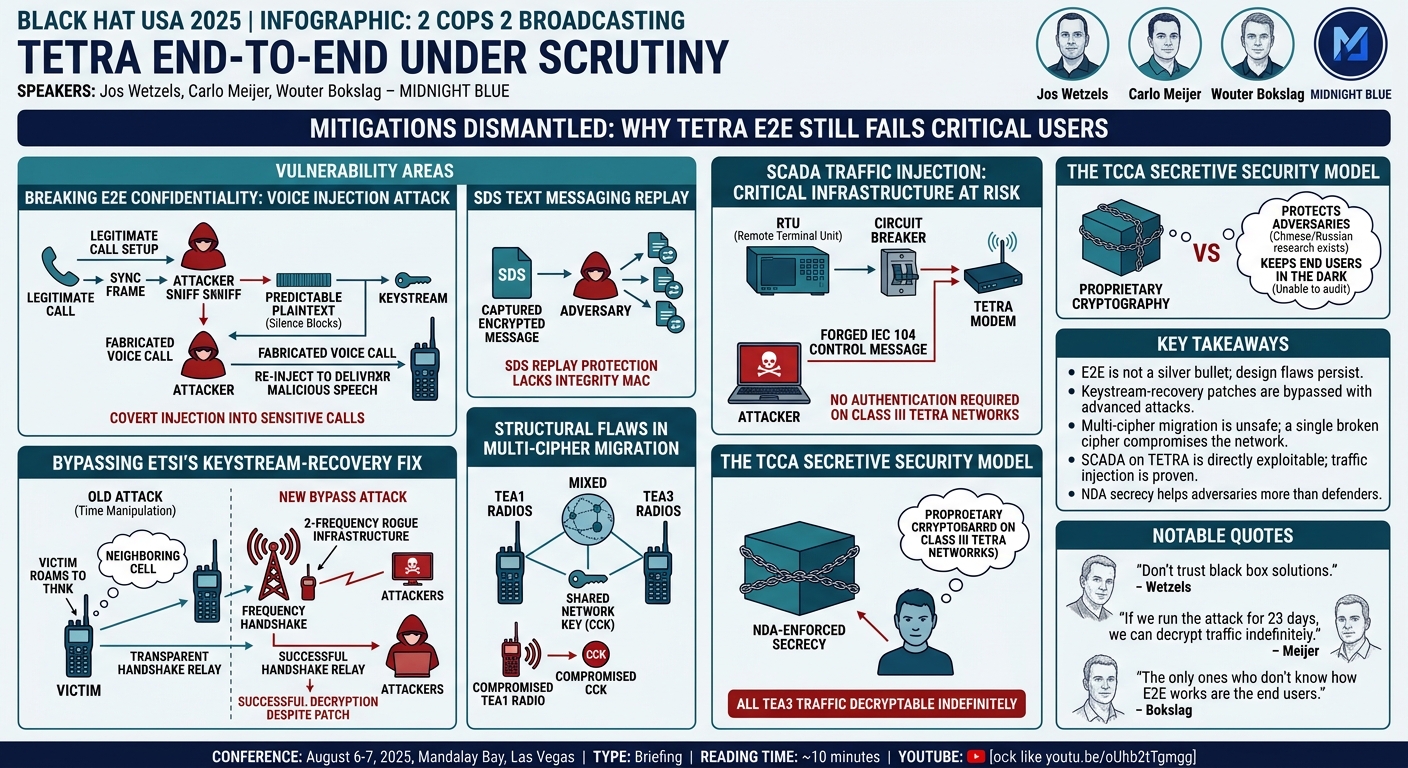
The most dramatic finding is a voice-injection attack against the E2E voice channel. Encrypted TETRA calls are transmitted as sequential "sync frame + voice frame" pairs. The sync frame contains the algorithm ID, traffic key ID, an initialization factor, and a message authentication code.
▶ Watch: Voice Injection Demo (16:01)
The attack exploits a predictable-plaintext weakness: across multiple TETRA radio models from different vendors, the very first voice frames of any new call are invariably a fixed sequence of silence blocks — a reproducible artifact of the TETRA voice codec. An attacker who intercepts the sync frame from a legitimate call recovers the keystream by XOR-ing the known plaintext silence blocks against the observed ciphertext. They can then:
- Open a new call, replay the intercepted sync frame
- Encrypt arbitrary voice content using the recovered keystream
- Reinject the sync frame to extend the attack beyond the initial silent frames
The result is that an off-path attacker with only passive radio access can inject arbitrary speech into an active E2E-encrypted call — a covert communications channel for the most sensitive law-enforcement and intelligence users. The team built a live demo showing a fabricated voice message delivered transparently over a legitimate encrypted channel.
A related flaw affects SDS (Short Data Service, TETRA's text messaging layer): the replay counter in end-to-end SDS messages is not protected by the message authentication code, enabling an attacker to freely replay previously captured encrypted messages.
Circumventing ETSI's Keystream-Recovery Fix
Two years ago, ETSI's keystream-recovery attack allowed decryption of arbitrary downlink messages by manipulating a victim radio's time reference. ETSI issued a standards update adding countermeasures. Midnight Blue's Carlo Meijer demonstrated a revised attack that fully bypasses those countermeasures.
▶ Watch: Improved Keystream Recovery Attack (26:02)
ETSI's fix introduced mandatory reauthentication when switching cells. The bypass uses a two-frequency rogue infrastructure: an attacker-controlled primary cell and a secondary cell at a different frequency. When the victim radio detects the time manipulation and switches to the "neighboring cell" as the standard now requires, it lands on the attacker's secondary frequency. The attacker relays the reauthentication handshake transparently to the legitimate infrastructure, completing authentication while still controlling the IV used for keystream recovery. The demo showed this working end-to-end: "Confidential." was intercepted, keystream recovered, message decrypted.
Multi-Cipher Networks and Traffic Injection
A widespread mitigation for the broken TEA1 cipher was deploying "multi-cipher" networks: running TEA1 and TEA3 simultaneously while gradually migrating radios. Midnight Blue discovered this creates a structural vulnerability. Because TETRA identity encryption uses a network key (CCK) to pseudonymize subscriber identities, and that CCK must be shared across both TEA1 and TEA3 users on the same network, compromising any TEA1 radio compromises the CCK — and therefore all traffic on the network, indefinitely.
Additionally, the team demonstrated a keystream oracle attack exploiting mixed encrypted/unencrypted networks: by injecting an SDS message from an unencrypted subscriber to an encrypted one, the infrastructure encrypts and reflects the known plaintext back on the downlink. Running this attack for 23 days recovers enough keystream to decrypt all traffic indefinitely — if keys aren't rotated, which they rarely are in practice.
▶ Watch: SCADA Traffic Injection Demo (34:02)
The team built a lab replica of a real-world TETRA SCADA setup — an RTU module connected to a circuit breaker controlling a "village," communicating with a SCADA server over TETRA radio modems using IEC 101/104. They demonstrated that an attacker can passively learn the SCADA protocol addressing and then inject a forged IEC 104 control message tripping the circuit breaker, without any registration or authentication on even a Class III TETRA network.
Notable Quotes
"That's how far standards revision and two years of tireless patching and effort got us."
— Carlo Meijer ▶ 26:02
"Don't trust black box solutions. People keep doing this even though they know and should know better."
— Jos Wetzels ▶ 38:03
"If we run the attack for twenty-three days, we can decrypt traffic indefinitely."
— Carlo Meijer ▶ 30:02
"The only ones who don't know how end-to-end works are the end users actually using it."
— Wouter Bokslag ▶ 10:00
Key Takeaways
- E2E encryption is not a silver bullet for TETRA: Design flaws in the TCCA-specified E2E standard enable voice injection and SDS replay even where E2E is deployed.
- The ETSI keystream-recovery countermeasure is bypassed: A dual-frequency rogue infrastructure defeats the reauthentication fix introduced in the 2023 standards revision.
- Multi-cipher migration is unsafe: Sharing a CCK across TEA1 and TEA3 users means TEA1 compromise permanently undermines the entire network.
- SCADA on TETRA is directly exploitable: Traffic injection without authentication is demonstrated against IEC 101/104 telecontrol, enabling circuit-breaker trips and arbitrary network access.
- NDA-enforced secrecy helps adversaries, not defenders: Seven Chinese and Russian academic publications suggest restricted TCCA specs were accessible to state-linked researchers; the NDAs only kept Western operators in the dark.
Slides PDF not available for this talk.
Reviews
Dr. Zero (Offensive Security Researcher) — MUST SEE
Midnight Blue returned with proof that two years of 'tireless patching' on TETRA accomplished essentially nothing. Voice injection into E2E-encrypted law enforcement calls, a working bypass of ETSI's keystream-recovery countermeasure, and a live SCADA circuit-breaker trip. The NDA-enforced secrecy protecting nobody but the vendors is the bitter contextual frame around technically devastating research.
Heather Calloway (CISO) — MUST SEE
Midnight Blue demonstrated live exploitation of TETRA E2E — the encrypted radio protocol used by law enforcement, military, and SCADA operators globally — including a circuit breaker actuation demo via unencrypted voice injection. Two years of vendor patches since the 2023 disclosure have not fixed the underlying protocol design. The NDAs that were supposed to protect this technology only protected the vendors who could afford them.