Taking Control: Four Simple Paths to Own an Entra ID Account
Félix Boulet (Independent Security Researcher), Callum Carney (Microsoft)
BlueHat Asia 2026 · Day 1 · Main Stage
Overview
In an era where cloud identity is the new perimeter, the talk "Taking Control: Four Simple Paths to Own an Entra ID Account" delivered at BlueHat Asia by independent security researcher Félix Boulet and Microsoft's Callum Carney, offered a sobering look at how fundamental misconfigurations and subtle logic flaws can lead to complete compromise of Microsoft Entra ID (formerly Azure AD) accounts. Boulet, known for his expertise in uncovering vulnerabilities within the Microsoft ecosystem, detailed four distinct attack vectors he discovered, three of which were critical or important enough to warrant immediate fixes by Microsoft, and one deemed "low severity" yet possessing significant real-world implications.
Key moments
- 0:00 Introduction to identity security research
- 1:30 Stale Account Takeover Risk Explained
- 6:30 Critical Admin Consent MFA Bypass Vulnerability
- 9:50 MSRC Advice: Quality Over Report Length
- 14:20 Microsoft's Stale Account Mitigation Recommendations
- 18:20 Device Code Flow: Phishing & Blocking Recommendation
- 20:00 Call for More Identity Security Research
Taking Control: Four Simple Paths to Own an Entra ID Account
Speakers: Félix Boulet (Independent Security Researcher); Callum Carney (Microsoft)
Conference: BlueHat Asia
YouTube: https://www.youtube.com/watch?v=v6TLYrTiNEA
Overview
In an era where cloud identity is the new perimeter, the talk "Taking Control: Four Simple Paths to Own an Entra ID Account" delivered at BlueHat Asia by independent security researcher Félix Boulet and Microsoft's Callum Carney, offered a sobering look at how fundamental misconfigurations and subtle logic flaws can lead to complete compromise of Microsoft Entra ID (formerly Azure AD) accounts. Boulet, known for his expertise in uncovering vulnerabilities within the Microsoft ecosystem, detailed four distinct attack vectors he discovered, three of which were critical or important enough to warrant immediate fixes by Microsoft, and one deemed "low severity" yet possessing significant real-world implications.
The core of Boulet's research revolves around feature abuse and the intricate interplay of identity components, revealing how seemingly minor oversights can cascade into full identity breaches and MFA bypasses. Callum Carney of Microsoft's Vulnerabilities and Mitigations (V&M) team provided an invaluable "inside baseball" perspective, elaborating on Microsoft's process for assessing and remediating such findings, emphasizing the rarity and importance of deep identity research. This presentation serves as a critical warning and a practical guide for both defenders and security practitioners navigating the complexities of modern cloud identity management, highlighting that even in highly secured environments, the balance between usability and risk can create exploitable gaps.
Background
▶ Watch: Introduction to identity security research (0:00)
The landscape of enterprise security has dramatically shifted from traditional on-premises Active Directory to cloud-based identity providers like Microsoft Entra ID. This transition introduces new complexities and attack surfaces, where identity becomes the primary control plane. As NIST articulated in 2020 and CISA recently reinforced, the burden of shipping secure systems lies squarely with manufacturers and suppliers, rather than solely with the customer to harden them post-deployment. However, the inherent tension between ease of use and stringent security controls often results in systems that, while functional, present subtle vulnerabilities.
Félix Boulet’s research is rooted in this nuanced understanding of modern identity platforms. Specializing in finding bugs within Microsoft's offerings, Boulet has focused on identity research due to its propensity for "subtle logic flaws and feature abuse." His work underscores that even with robust security features like Multi-Factor Authentication (MFA) and Conditional Access (CA) policies, misconfigurations, or unexpected interactions between system components can create pathways for attackers. The talk aimed to demystify these complex interactions, demonstrating how seemingly simple oversights can lead to profound security compromises, echoing the red team experiences where such vulnerabilities often lead to initial access and privilege escalation within hybrid environments.
Key Findings
▶ Watch: Critical Admin Consent MFA Bypass Vulnerability (6:30)
The presentation unveiled four distinct methods for compromising Entra ID accounts, each leveraging different aspects of the platform's design or implementation:
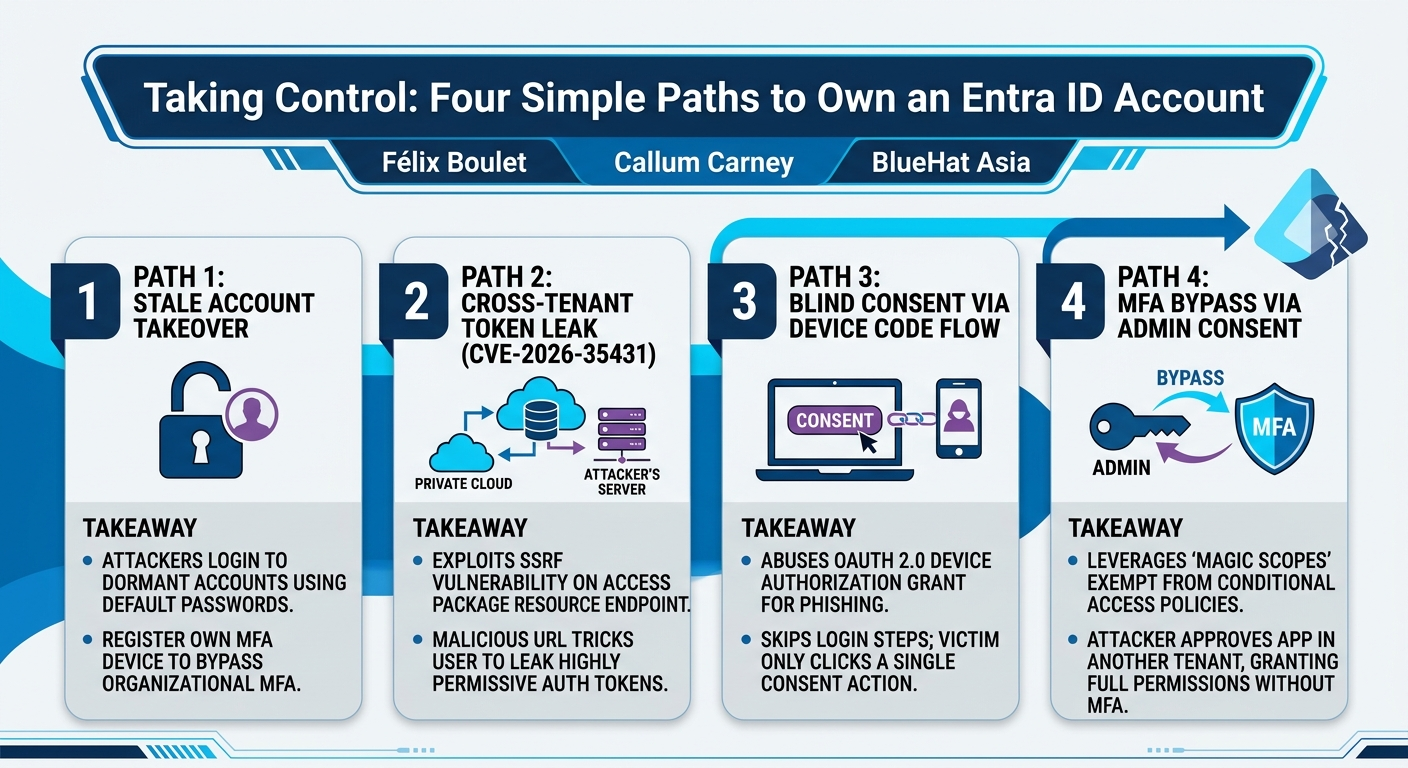
- Stale Account Takeover Risk: This "low severity" issue highlights how dormant user accounts, such as those for delayed hires, external guests, or unmanaged hybrid AD accounts, can be vulnerable to takeover. If these accounts retain default passwords and lack MFA registration, an attacker can easily log in, register their own MFA device, and bypass organizational MFA compliance.
- Cross-Tenant Token Leak (CVE-2026-35431): A critical, multi-layered vulnerability stemming from a self-authenticated Server-Side Request Forgery (SSRF) on
m.ig.azure.com. By crafting a malicious URL containing a second domain and a path traversal, an attacker could trick a user into opening a link, leading to the leakage of highly permissive authentication tokens for that user from a different tenant. This bug was promptly fixed by Microsoft. - Blind Consent Abusing Safe State: This bug exploited the OAuth 2.0 Device Authorization Grant (also known as the device code flow) to reduce the friction of phishing attacks. By initiating the authentication flow on their own account, an attacker could obtain a pre-initialized consent URL. Sending this URL to a victim allowed them to skip several initial authentication steps, requiring only a single consent action for a first-party application, significantly increasing phishing success rates. This vulnerability has also been fixed.
- MFA Bypass via Admin Consent: Described as a "Pandora's Box" discovery, this critical bug allowed an attacker to bypass MFA and conditional access policies during the admin consent flow. By leveraging specific "magic scopes" (e.g.,
device registration,management setup) that were immune to conditional access, an attacker with an admin's username and password (but no MFA) could approve an application in another tenant, granting it full permissions to the victim tenant, effectively achieving app-level super administrator privileges with persistence. This vulnerability was also addressed by Microsoft.
Technical Deep Dive
▶ Watch: MSRC Advice: Quality Over Report Length (9:50)
The technical depth of Boulet's findings illustrates the intricate nature of Entra ID security. Each vulnerability exploited a specific logical flaw or unintended interaction within the platform.
Stale Account Takeover
This issue, while rated low severity by Microsoft, presents a straightforward and potent attack vector. Entra ID accounts, by default, do not have password expiration policies, and newly created accounts (e.g., for new hires, external guests, or accounts synced from on-premises AD via Azure AD Connect) often lack initial MFA registration. If these accounts remain unused for extended periods, an attacker can:
- Discover a default or weak password (e.g., via brute-force, credential stuffing, or leaked credentials).
- Log in to the account.
- Register their own MFA device (e.g., phone number, authenticator app) as the legitimate user's primary MFA method.
- Take full control of the account, bypassing any organizational MFA compliance requirements.
This transforms an "onboarding mistake or hybrid AD configuration mistake into a full-on identity breach," as Boulet noted, recalling its effectiveness in red team engagements. The core problem is the lack of automated lifecycle management and proactive security posture for dormant accounts.
Cross-Tenant Token Leak (CVE-2026-35431)
This was a multi-layered, critical vulnerability. Boulet initially discovered a self-authenticated Server-Side Request Forgery (SSRF) vulnerability on a GET request to the access package resource endpoint located at m.ig.azure.com. This endpoint was part of Entra ID's provisioning features. The critical aspect was finding a way within the Entra portal to call this endpoint indirectly, allowing the URL to be influenced and modified by an attacker.
The exploit chain involved:
- Crafting a malicious URL: This URL would contain a second domain controlled by the attacker and a path traversal sequence.
- User interaction: A victim would open this specially crafted, malformed URL.
- Controlled backend call: The malformed URL would trigger a controlled call to
m.ig.azure.comon the backend. - Token leakage: This call, influenced by the attacker's URL, would result in a highly permissive authentication token for the victim user being sent to the attacker's controlled domain (e.g., via Burp Collaborator). Boulet famously received tokens for Microsoft's own Azure tenants during his testing, highlighting the severity.
The ability to control backend calls and inject external domains, combined with path traversal, allowed for the exfiltration of sensitive authentication material across tenant boundaries.
Blind Consent Abusing Safe State (Device Code Flow)
The OAuth 2.0 Device Authorization Grant (or device code flow) is commonly used for devices with limited input capabilities (e.g., smart TVs, IoT devices) to authenticate by displaying a code that a user enters on a separate browser. Its normal flow involves:
- The device displays a user code.
- The user navigates to a Microsoft login URL (e.g.,
microsoft.com/devicelogin). - The user enters the provided code.
- The user logs into their account.
- The user is prompted to consent to a first-party application (e.g., Azure CLI, Office).
Boulet's bug exploited a flaw in how the "safe state" of this flow was managed. An attacker could:
- Initiate the device code flow on their own account.
- Copy the resulting pre-initialized consent URL (the URL presented after the user has entered the code and logged in, but before consenting).
- Send this URL to a victim.
- Victim interaction: When the victim opens this link, they are taken directly to the final consent page, skipping the initial steps of entering a code and logging in. They only need to click "Accept" for the first-party app.
This "blind consent" significantly reduces the friction for a phishing attack, making it far more likely for a user to fall victim. Microsoft categorized this as a Cross-Site Request Forgery (CSRF)-like issue, where the state was not properly validated. The fix involved ensuring that the user performing the final consent step was also the one who initiated the flow.
MFA Bypass via Admin Consent
This was arguably the most impactful discovery. Boulet built upon prior research (Fabian Bader on cloudbrothers.info) that identified "magic scopes" in Entra ID. These scopes, often used for foundational processes like device registration or tenant management setup, were found to be immune to standard Conditional Access (CA) policies, including MFA enforcement. While Bader's work showed limited impact (getting zero-permission information), Boulet probed deeper.
He found that the admin consent flow for approving applications also supported scope parameters. Crucially, the permissions an app received upon approval were not influenced by these scope parameters. This created a critical vulnerability:
- Attacker obtains admin credentials (username and password), but crucially, does not need MFA for this specific attack.
- Attacker initiates an admin consent flow using one of the "magic scopes" (e.g.,
device registration client). - Due to the magic scope and an incorrect exemption, the admin consent flow bypasses all CA policies, including MFA.
- **The attacker, using the compromised admin credentials, approves an application in another tenant.**
- This approved app instantly gains full permissions to the victim tenant, effectively elevating the attacker to an "app-level super admin with persistence."
Microsoft's internal analysis, as explained by Callum Carney, revealed that the bug occurred because the device registration service client was used to initiate the authentication, and the admin consent flow was incorrectly marked as a foundational or bootstrap process that should be exempt from CA policies. This exemption is necessary for certain operations (e.g., registering a device requires skipping the "must be on a registered device" policy), but it was misapplied to the admin consent flow. The fix involved removing this exemption. Users with per-user MFA (a legacy, always-on MFA enforcement) were not vulnerable to this specific bypass.
Demo / Proof of Concept
▶ Watch: Device Code Flow: Phishing & Blocking Recommendation (18:20)
While no live demonstration was part of the presentation, Félix Boulet frequently referred to his direct exploitation of these vulnerabilities during his research and preparation. For the Cross-Tenant Token Leak, he explicitly stated his excitement upon seeing "the privilege token arriving to my Burp Collaborator," confirming a successful proof of concept that resulted in actual token exfiltration. He further highlighted the severity by mentioning he "received the token for the three Azure for Microsoft" because he accidentally left his domain in the payload, demonstrating cross-tenant impact.
Regarding the MFA Bypass via Admin Consent, Boulet noted that it was still exploitable when preparing his slides in early September and that he "did exploit it twice just before the presentation," indicating a live, repeatable proof of concept. These statements serve as direct evidence of successful exploitation and the demonstration of the attack paths' viability, showcasing the practical impact of his findings.
Defensive Implications
▶ Watch: Call for More Identity Security Research (20:00)
The findings presented by Félix Boulet and the insights shared by Callum Carney offer crucial guidance for organizations managing Entra ID environments.
For Stale Account Takeover Risk:
- Regular Audits: Implement a robust process for regularly auditing Entra ID accounts that have never been logged into or lack registered MFA methods. Proactively identify and disable or remove these accounts.
- Temporary Access Pass (TAP): For new user onboarding, leverage Entra ID P1 subscriptions to utilize Temporary Access Pass (TAP). TAP provides short-lived, time-bound credentials (e.g., 15-20 minutes) that allow new users to log in, set their password, and register their MFA, mitigating the risk of default passwords and unconfigured MFA.
- Lifecycle Workflows: Automate user provisioning and deprovisioning processes using lifecycle workflows to ensure accounts are created and retired securely and efficiently.
lastUsedDateTimesAPI: Utilize the recently addedlastUsedDateTimesAPI property on the user's authentication method endpoint. This API provides granular data on when a user last logged in using a specific proof (e.g., password, passkey), enabling more accurate identification of stale accounts.- Break Glass Accounts: For emergency access accounts, Microsoft's public guidance recommends using passkeys or certificate-based authentication instead of relying on simple passwords that might become stale.
For Cross-Tenant Token Leak (CVE-2026-35431):
- This specific vulnerability has been fixed by Microsoft. The primary defensive implication is the importance of rapid patching and maintaining vigilance for similar SSRF and path traversal vulnerabilities, especially in complex cloud services that interact with external inputs.
For Blind Consent Abusing Safe State (Device Code Flow):
- Block Device Code Flow (DCF): Microsoft strongly recommends blocking the Device Code Flow (DCF) in your tenant wherever possible. This flow is increasingly used as a prevalent method for phishing by threat actors.
- Scope Down Usage: If DCF is required for specific scenarios, restrict its usage to the absolute minimum number of users who genuinely need it. Implement tight conditional access policies to limit its applicability.
- Security Defaults: All new Entra ID tenants created from July 2026 onwards will have DCF blocked by default as part of Microsoft's Security Defaults, indicating its inherent risk. Organizations with existing tenants should proactively implement this blocking.
For MFA Bypass via Admin Consent:
- This specific vulnerability has been fixed. However, it underscores the critical importance of:
- Robust Conditional Access Policies: Regularly review and test CA policies to ensure they apply comprehensively, especially around administrative actions and application consent.
- Understanding Exemptions: Be aware that certain "foundational processes" or bootstrap mechanisms might have inherent exemptions from CA policies. Understand why these exemptions exist and ensure they are narrowly scoped and correctly applied.
- Per-User MFA: While policy-based MFA (Conditional Access, Security Defaults) is generally preferred, the talk highlighted that users with per-user multifactor authentication enabled (a legacy setting that enforces MFA at all times) were not vulnerable to this particular bypass, due to its always-on nature. This offers a point of consideration for highly sensitive accounts, though policy-based MFA is generally more flexible.
Overall, the talk reinforces the need for a holistic security approach in Entra ID, combining diligent auditing, proactive configuration management, leveraging modern security features like TAP, and being aware of the subtle nuances of authentication flows and policy exemptions.
Key Takeaways
- Entra ID Complexity: Modern cloud identity systems like Entra ID are incredibly complex, and seemingly minor logic flaws or feature abuses can lead to significant security vulnerabilities, including MFA bypasses and full account takeovers.
- Stale Accounts are a Major Risk: Dormant user accounts (new hires, guests, hybrid AD) that lack MFA and retain default passwords represent a straightforward path to identity breach. Proactive auditing, automated lifecycle management, and leveraging Temporary Access Pass (TAP) are critical defenses.
- Device Code Flow is a Phishing Vector: The OAuth 2.0 Device Authorization Grant (Device Code Flow) is increasingly abused for phishing. Organizations should block this flow wherever possible or tightly scope its usage to minimize attack surface.
- MFA Bypass Mechanisms Exist: While rare, MFA bypasses can occur when foundational processes or specific "magic scopes" are incorrectly exempted from Conditional Access policies. Continuous scrutiny of policy exemptions and authentication flows is essential.
- Identity Security Research is Vital: The rarity of advanced identity bugs (0.05% of MSRC submissions) highlights the need for more focused research in this area. Such research is crucial for uncovering subtle flaws that Microsoft's internal teams may not immediately identify.
- Quality Over Quantity in Bug Reports: Microsoft's MSRC values concise, focused bug reports with clear attack scenarios and simple reproduction steps, emphasizing impact over length for efficient vulnerability remediation.
About the Speaker(s)
Félix Boulet is an independent security researcher with two years of full-time experience, preceded by many more years of part-time work. He specializes in discovering bugs within the Microsoft platform, with a particular focus on identity research due to his interest in subtle logic flaws and feature abuse. His dedication to this field has earned him recognition, including being first in the tally for Microsoft's 2023/2024 Vulnerability Research Program (VRP). Boulet maintains an automated blog where he shares his findings.
Callum Carney works at Microsoft with the Vulnerabilities and Mitigations (V&M) team within the Microsoft Security Response Center (MSRC). His team is dedicated to analyzing and remediating security reports from external researchers. Prior to joining Microsoft, Callum was a Microsoft Valuable Researcher (MVR) himself, submitting numerous research findings to the company. He plays a crucial role in bridging the gap between external security researchers and Microsoft's engineering teams, ensuring vulnerabilities are understood, prioritized, and fixed efficiently.
Reviews
Dr. Zero (Offensive Security Researcher) — STRONG ACCEPT
Four real bugs, three fixed by Microsoft, one still exploitable in misconfigured environments. Boulet's MFA bypass via admin consent is the standout — genuinely clever abuse of 'magic scopes' that bypasses CA policies entirely. Carney's MSRC perspective adds rare inside color. This is solid identity research with practical defender value.
Heather Calloway (CISO) — STRONG ACCEPT
This is actionable identity security research your IAM team needs to see. Four distinct Entra ID attack paths — three now patched, one a configuration gap you probably have — with clear defensive guidance. The MFA bypass via admin consent is the headline: credentials without MFA could yield tenant-wide app-level admin. Worth your security leadership's time.