Hacktivism during a global pandemic
Marc Rogers (VP of Cybersecurity · Okta)
BruCON 0x0D · Day 1
Overview
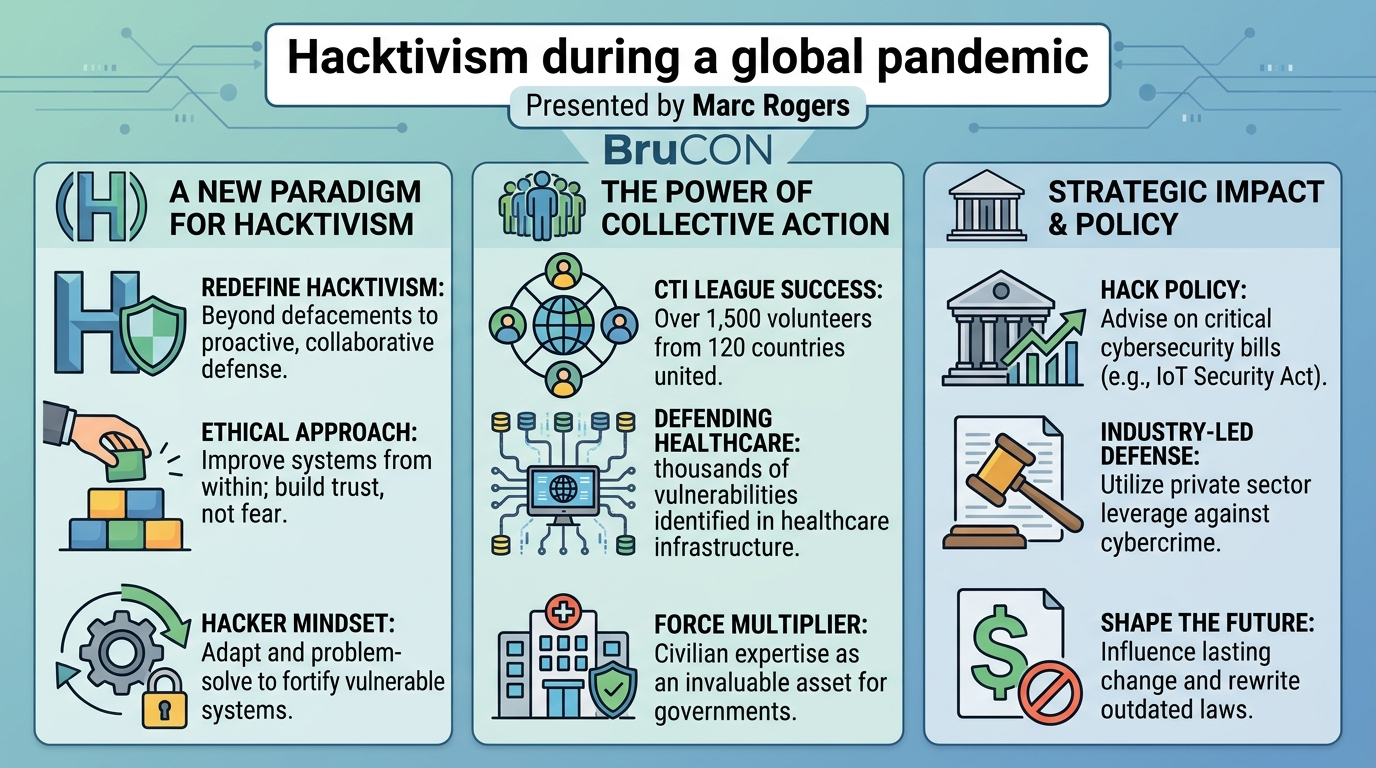
In his compelling BruCON talk, "Hacktivism during a global pandemic," Marc Rogers, VP of Cybersecurity at Okta and Head of Security at Defcon, challenges the conventional understanding of hacktivism. Moving beyond the prevalent image of masked figures defacing websites or dumping data, Rogers advocates for a redefinition of hacktivism as a force for proactive defense and systemic change. The talk, co-presented at times by Nate, a co-founder of the CTI League alongside Rogers, posits that the true power of the hacker mindset lies not in destruction but in adaptation and improvement, working from within to fortify vulnerable systems and influence policy.
Key moments
- 5:30 Traditional hacktivism ineffective for lasting change
- 6:00 Public perception of hackers hinders progress
- 8:20 Founding the CTI League: defending healthcare
- 13:00 CTI League's unprecedented impact on government work
- 16:00 Hacking policy: rewriting laws that affect hackers
- 18:00 Private sector's unique role in counter-cybercrime
- 24:30 Q&A: Helping resource-poor organizations and NGOs
- 30:00 Q&A: Live example of government engagement and trust
Hacktivism during a global pandemic
Speakers: Marc Rogers, VP of Cybersecurity, Okta
Conference: BruCON
YouTube: https://www.youtube.com/watch?v=yS0iHe4MQoU
Overview
In his compelling BruCON talk, "Hacktivism during a global pandemic," Marc Rogers, VP of Cybersecurity at Okta and Head of Security at Defcon, challenges the conventional understanding of hacktivism. Moving beyond the prevalent image of masked figures defacing websites or dumping data, Rogers advocates for a redefinition of hacktivism as a force for proactive defense and systemic change. The talk, co-presented at times by Nate, a co-founder of the CTI League alongside Rogers, posits that the true power of the hacker mindset lies not in destruction but in adaptation and improvement, working from within to fortify vulnerable systems and influence policy.
Rogers argues that traditional hacktivism, while sometimes achieving momentary notoriety, rarely delivers lasting impact or fosters positive change. Instead, he presents a model of collaborative, ethical hacking, exemplified by the CTI League (Cyber Threat Intelligence League), which emerged during the COVID-19 pandemic. This volunteer-driven initiative brought together thousands of cybersecurity professionals to defend healthcare infrastructure from an escalating wave of cyberattacks, demonstrating the profound potential of collective action when aligned with government and industry.
The presentation serves as a critical call to action for the cybersecurity community, urging a shift from adversarial, "us vs. them" mentalities to one of partnership and responsible engagement. Rogers emphasizes that the skills inherent to hackers – the ability to understand, adapt, and improve complex systems – are desperately needed to address global cybersecurity challenges, from protecting critical infrastructure to shaping policy and uplifting under-resourced organizations. By embracing this new paradigm, the hacker community can shed its negative stereotypes and become an indispensable force for good in an increasingly interconnected and vulnerable world.
Background
▶ Watch: Traditional hacktivism ineffective for lasting change (5:30)
The genesis of this re-evaluation of hacktivism stems from a fundamental disagreement with its prevailing definition. Rogers highlights the common perception of hacktivism as "a social or political activist act that's carried out by breaking into or wreaking havoc on a secure computer system," a definition he explicitly rejects. He points to historical examples like the web defacements of the 1990s, such as the CIA homepage or the UK Labour Party website, which, despite being "big deals at the time," ultimately lacked persistence and long-term impact. The exception, he notes, are significant material dumps like the Pentagon Papers, which genuinely exposed information that led to change.
Rogers contrasts this with the original MIT definition of a hacker: someone who can change a system without destroying it, adapting it from within to gain an additional purpose. This ethos forms the bedrock of his proposed new hacktivism. The problem with the traditional, offensive approach is twofold: its limited effectiveness and the creation of a "scary hacker" public image. This image, often perpetuated by media portrayals like those seen in CSI or Scorpion (before Mr. Robot), makes it incredibly difficult for ethical hackers to engage constructively with institutions. As Nate recounts, attempting to warn hospitals directly about critical vulnerabilities often led to suspicion, accusations of shakedowns, or legal threats.
The urgency for this new approach became acutely clear with the onset of the COVID-19 pandemic. As criminal groups increasingly targeted critical healthcare infrastructure with ransomware and other attacks, a glaring gap in defense capabilities emerged. Many hospitals and healthcare facilities, particularly smaller ones, lacked the resources, budget, and personnel to adequately protect themselves. This vulnerability, coupled with the inherent distrust of the hacker community by government agencies and private institutions, created a perilous environment. It was this confluence of factors that spurred Marc Rogers and Nate, along with others, to found the CTI League on March 13, 2020, aiming to leverage the collective skills of the cybersecurity community for defensive purposes.
Key Findings
▶ Watch: Founding the CTI League: defending healthcare (8:20)
The central finding of Rogers' talk is that traditional, offensive hacktivism, characterized by web defacements and opportunistic breaches, is largely ineffective and unsustainable for driving meaningful, lasting change. While spectacular, these actions often contribute to a negative public perception of hackers, hindering productive collaboration with governments, law enforcement, and critical infrastructure operators. The speaker passionately argues that the true power of the hacker mindset lies not in disruption, but in its capacity for adaptive problem-solving and systemic improvement, applied constructively.
The CTI League emerged as a powerful demonstration of this new paradigm. Within a month of its inception, the volunteer organization grew from an anticipated 30-40 members to 1,500 people from 120 countries, including representation from entities as diverse as the Faroe Islands cyber police. This global collective successfully identified and helped remediate thousands of vulnerabilities in healthcare facilities, often achieving in "a month what the US government had tried and failed to do for 10 years." This success underscored several critical points:
- The "Force Multiplier" Effect: Civilian cybersecurity expertise, when organized and channeled effectively, can act as an invaluable force multiplier for under-resourced government agencies.
- Trust and Intermediaries: Direct engagement between hackers and vulnerable organizations is often hampered by distrust. Partnerships with established entities like ISACs (Information Sharing and Analysis Centers) proved crucial for translating vulnerability findings into actionable remediation.
- Policy Hacking: The hacker community can significantly influence legislation. By advising on bills like the Improving IoT Cyber Security Act of 2020 or reviews of the Computer Misuse Act and Computer Fraud and Abuse Act, hackers can help rewrite laws that have historically been used against them, shaping a more beneficial future for the industry.
- Industry-Led Countermeasures: The private sector possesses unique trust relationships and economic levers that government agencies often lack due to due process and international treaties (e.g., MLAT). These can be "weaponized" subtly and lawfully against cybercriminals in ways governments cannot.
- Addressing the Cybersecurity Poverty Line: A vast segment of critical infrastructure, particularly small businesses and NGOs (e.g., two-thirds of American medical infrastructure in 5-10 person facilities), operates below a "cybersecurity poverty line." They lack the resources, budget, and expertise to implement robust security frameworks like the NIST Cyber Security Framework. The hacker community can provide crucial assistance by offering knowledge, monitoring, and guidance on "low-hanging fruit" vulnerabilities.
Ultimately, the key finding is an optimistic one: by adopting a collaborative, "inside-out" approach, the cybersecurity community can move beyond its historical image to become an indispensable partner in global defense, shaping policy, and protecting the most vulnerable.
Technical Deep Dive
▶ Watch: Hacking policy: rewriting laws that affect hackers (16:00)
The technical underpinnings of this new hacktivism, as demonstrated by the CTI League, revolve around leveraging existing tools and collective intelligence for proactive defense rather than offense. The process began with extensive reconnaissance and vulnerability identification. Nate describes using tools like Shodan and "grain noise" (likely referring to similar internet-scanning services like Censys) to "assess network perimeter and find holes in the gaps of your network." This allowed the CTI League to systematically identify exposed infrastructure belonging to healthcare organizations.
Specific examples of vulnerable systems identified included Citrix NetScalers and F5 devices, which, if improperly configured or unpatched, could expose critical network access points. The CTI League's methodology involved:
- Automated Scanning: Continuously scanning internet-facing assets to detect common vulnerabilities. Rogers notes the league was "producing somewhere in the region of two to four thousand vulnerabilities a month" through this method.
- Vulnerability Identification: Pinpointing "low-hanging fruit" vulnerabilities that are often simple yet highly exploitable. These included exposed services like RDP (Remote Desktop Protocol) without proper authentication, weak or default passwords, and a lack of MFA (Multi-Factor Authentication).
- Intelligence Correlation: Combining scan data with threat intelligence to prioritize risks and understand potential attack vectors.
However, identifying vulnerabilities was only part of the challenge. The crucial technical hurdle was remediation guidance and trust. As Nate illustrated with his personal experience trying to warn his hospital, direct outreach was often met with suspicion. To overcome this, the CTI League partnered with trusted intermediaries such as ISACs, Europol, Interpol, and the NHS UK. These partnerships provided the necessary "reporting channels" and "boots on the ground" to facilitate communication and action. The process involved:
- Deconfliction: Coordinating with government agencies to ensure that private sector actions did not interfere with ongoing law enforcement operations. This required a "flow of information" and "trust" that government agencies often struggle to provide bidirectionally.
- Knowledge Transfer: Providing clear, actionable advice to organizations, often acting as "virtual CISOs for a small startup." This involved guiding them on how to implement basic security hygiene, such as disabling unnecessary services, enforcing strong passwords, and deploying MFA.
- Tooling Development: While not explicitly detailed, Rogers mentions "building tooling that will help them with stuff," implying the creation of resources or scripts to assist under-resourced organizations in fixing common issues.
Beyond direct defensive operations, the talk elaborated on "policy hacking" and "counter cybercrime activities" as critical technical avenues. Policy hacking involves cybersecurity experts providing direct input to legislators, influencing bills like the Improving IoT Cyber Security Act of 2020 or reviews of the Computer Misuse Act and Computer Fraud and Abuse Act. This ensures that new laws are technically sound and beneficial to the security community. Counter cybercrime, particularly through initiatives like the Ransomware Task Force, leverages private sector "trust relationships" and "organizational relationships" to target the economic infrastructure of criminal enterprises. This approach bypasses the legal complexities and limitations faced by governments (e.g., reliance on MLAT treaties for international arrests or the limited impact of sanctions on "random Russian dudes"), allowing for more agile and effective countermeasures against financially motivated cybercriminals.
Demo / Proof of Concept
▶ Watch: Private sector's unique role in counter-cybercrime (18:00)
While Marc Rogers' talk did not feature a live technical demonstration of the CTI League's operational methods, it effectively presented several forms of "proof of concept" to illustrate his thesis.
The first, and intentionally critiqued, "demo" was a video from a 1997 conference, Beyond Hope, where Rogers himself, alongside "fibre optic death veggie and cheshire catalyst," demonstrated a traditional act of hacktivism. This involved hacking the sister conference, Hacking In Progress (HIP97.nl), and defacing their campsite diary webpage. The video explicitly shows the audience reacting to the "Hacked Page" message displayed on the screen, complete with applause and laughter. Rogers uses this historical example to highlight the ephemeral nature of such actions, stating, "to most people that's hacktivism... but the reality is out of most of these actions, the only ones that have persistence are things like the pentagon papers." This serves as a conceptual counter-proof, demonstrating what he believes hacktivism should not be.
The true proof of concept for Rogers' new definition of hacktivism was the CTI League itself. While not a live technical demonstration, the extensive details provided about its formation, growth, and impact served as compelling evidence. The league's ability to scale from an initial expectation of "30, 40 people" to 1,500 volunteers from 120 countries within a month, and its success in "stop[ping] a lot of attacks" and partnering with major government agencies (US government, Europol, Interpol, NHS UK), clearly demonstrated the efficacy of collaborative, defensive hacktivism. The anecdote from a US government agency stating that the CTI League "did in a month what the US government had tried and failed to do for 10 years" is the most powerful proof point for the model's viability and impact. This collective effort, leveraging tools like Shodan to scan for vulnerabilities in healthcare infrastructure and providing remediation advice, served as a real-world, large-scale demonstration of the "hacker mindset" applied to proactive defense.
Defensive Implications
▶ Watch: Q&A: Live example of government engagement and trust (30:00)
The implications of Marc Rogers' vision for hacktivism are profound for defenders across all sectors, particularly for those in critical infrastructure and under-resourced organizations.
For Healthcare and Critical Infrastructure Operators:
- Embrace Collaboration: Institutions must overcome the historical distrust of the hacker community. Actively seek partnerships with ethical security researchers and volunteer groups. Recognize that external expertise can be a vital "force multiplier" for internal security teams, especially when internal resources are scarce.
- Prioritize Low-Hanging Fruit: Many vulnerabilities identified by groups like the CTI League are basic, yet critical. Defenders should focus on immediately addressing exposed services like RDP, implementing strong passwords, and mandating MFA. These simple fixes can eliminate a significant percentage of attack vectors.
- Establish Trusted Channels: Work with ISACs and other recognized information-sharing centers to create secure and trusted channels for receiving vulnerability intelligence from external parties. This mitigates the "shakedown" perception and facilitates actionable remediation.
- Budget for Security: Even small facilities need to allocate resources for cybersecurity. If unable to hire dedicated staff, engage with MSSPs or leverage free/low-cost resources and guidance from the security community.
For Cybersecurity Professionals and the Hacker Community:
- Shift Mindset to Defense and Collaboration: Move beyond traditional, often destructive, forms of hacktivism. Focus skills on proactive defense, vulnerability identification, and providing actionable remediation advice.
- Engage with Policy Makers: Leverage expertise to influence legislation. Contact politicians, aides, and government groups to provide informed input on cybersecurity bills (e.g., Improving IoT Cyber Security Act of 2020, reforms to the Computer Misuse Act or Computer Fraud and Abuse Act). This is a powerful way to shape the future regulatory landscape.
- Contribute to Collective Defense Efforts: Join or support initiatives like the CTI League, the Ransomware Task Force, or local equivalents. Your skills are desperately needed, and collective action is far more effective than isolated efforts.
- Educate and Upskill: Recognize the "cybersecurity poverty line" for small businesses and NGOs. Develop and share resources, tools, and guidance that are accessible and actionable for organizations without dedicated security teams or budgets. This could involve creating simple best practice guides, monitoring tools, or offering virtual CISO-like advice.
- Foster Trust with Government: Actively work to build trust with law enforcement and government agencies. Advocate for bidirectional information flow, where intelligence is not just received by government but also shared back to inform private sector efforts, enabling coordinated action against threats like Russian ransomware gangs.
For Government and Law Enforcement Agencies:
- Cultivate Trust and Bidirectional Information Flow: Abandon the "single channel" approach where information only flows in one direction. Establish secure, trusted mechanisms for sharing intelligence and coordinating efforts with the private sector and hacker community.
- Recognize the "Force Multiplier" Value: Acknowledge that government agencies are "swamped" and lack sufficient personnel. Embrace the "force multiplier" effect of civilian expertise and integrate it into national cybersecurity strategies.
- Adopt Collaborative Models: Replicate successful models like the CTI League and the Ransomware Task Force, which bring together diverse stakeholders to address complex cyber threats.
- Engage Openly: Be present and accessible at cybersecurity conferences and forums. The shift from "spot the fed" to open engagement, as seen at Defcon, is a positive development that needs to continue to foster mutual understanding and collaboration.
Key Takeaways
- Redefine Hacktivism: The most effective form of hacktivism moves beyond destructive acts to embrace collaborative, defensive, and systemic change, applying the hacker mindset to improve systems from within.
- Image Matters: The "scary hacker" stereotype is detrimental to progress. Responsible, ethical engagement with governments, industry, and critical infrastructure is essential for building trust and driving impact.
- Collaboration is Key: Private sector expertise and volunteer efforts, as exemplified by the CTI League, can act as a powerful "force multiplier" for under-resourced government agencies, achieving results far beyond what individual entities can accomplish.
- Hack Policy and Industry: Cybersecurity professionals have a crucial role in shaping legislation and driving industry-led countermeasures against cybercrime, leveraging unique relationships and economic levers.
- Address the Cybersecurity Poverty Line: A significant portion of critical infrastructure, particularly small organizations, lacks basic security resources. The community must focus on upscaling knowledge and providing accessible defensive guidance to these vulnerable entities.
- Build Trust and Information Flow: Effective collective defense against sophisticated threats requires deep trust and bidirectional information sharing between government, industry, and the hacker community.
About the Speaker(s)
Marc Rogers is a highly respected figure in the cybersecurity community, currently serving as the VP of Cybersecurity at Okta. He is also the Head of Security at Defcon, one of the world's largest and oldest hacker conventions. Rogers is a co-founder of the CTI League (Cyber Threat Intelligence League), a global volunteer organization dedicated to defending healthcare during the pandemic. His extensive experience includes working as a technical advisor for the critically acclaimed TV series Mr. Robot, where he ensured the realistic portrayal of hacking techniques. Additionally, he is involved with the CDC and the CDC Ninja Strike Force, and is known for his ability to "break stuff," though his current focus, as highlighted in this talk, is on applying those skills for defensive purposes and positive change.
Nate is a co-founder of the CTI League, alongside Marc Rogers. He works at Microsoft and played a pivotal role in the inception and rapid growth of the CTI League, driven by his personal experience of discovering vulnerabilities in his own hospital's infrastructure during the pandemic. Nate's contributions to the CTI League included leveraging tools like Shodan to assess network perimeters and identify critical security gaps, demonstrating a practical, hands-on approach to defensive cybersecurity.