Keynote: The Mobile Malware Maze
Axelle Apvrille (Fortinet)
BruCON 0x0F · Day 1
Overview
Axelle Apvrille, a seasoned mobile malware analyst and researcher at Fortinet, delivered a compelling keynote address at BruCON, tracing the intricate evolution of mobile malware from its nascent stages in the early 2000s to the sophisticated, financially motivated threats of today. The talk, titled "The Mobile Malware Maze," offered a historical perspective spanning two decades, highlighting key technological shifts, changes in attacker methodologies, and the persistent challenges faced by defenders. Apvrville's unique vantage point, having worked in mobile malware analysis since 2008, provided a rare and insightful journey through the "prehistory" of mobile security, revealing how foundational attack techniques have persisted and adapted across different mobile operating systems.
Key moments
- 3:28 Start of mobile malware analysis (2008) and early threats
- 7:00 2009: First internet-accessing malware (Anssi) and its methods
- 16:00 The infamous EKEY malware targeting jailbroken iPhones
- 22:00 The explosive growth of Android malware samples
- 29:30 Abusing Android Accessibility API for powerful malware actions
- 34:00 Evolution of threat actors: from pranks to organized crime
- 41:30 Controversial take: Dynamic analysis is evil, static analysis rules
- 44:00 Future challenges: AI-generated and cross-platform malware
Keynote: The Mobile Malware Maze
Speakers: Axelle Apvrille
Conference: BruCON
YouTube: https://www.youtube.com/watch?v=jCiI52OvtSA
Overview
Axelle Apvrille, a seasoned mobile malware analyst and researcher at Fortinet, delivered a compelling keynote address at BruCON, tracing the intricate evolution of mobile malware from its nascent stages in the early 2000s to the sophisticated, financially motivated threats of today. The talk, titled "The Mobile Malware Maze," offered a historical perspective spanning two decades, highlighting key technological shifts, changes in attacker methodologies, and the persistent challenges faced by defenders. Apvrville's unique vantage point, having worked in mobile malware analysis since 2008, provided a rare and insightful journey through the "prehistory" of mobile security, revealing how foundational attack techniques have persisted and adapted across different mobile operating systems.
This presentation is crucial for anyone involved in cybersecurity, from researchers and analysts to developers and end-users, as it demystifies the complex landscape of mobile threats. By dissecting the origins of mobile malware, Apvrille underscored that many "modern" attack vectors have deep historical roots, merely re-engineered for contemporary platforms. The talk also critically examined the current state of mobile security, emphasizing the overwhelming volume of Android malware, the professionalization of threat actors, and the emerging challenges posed by cross-platform development frameworks and artificial intelligence.
Beyond the technical exposition, Apvrille offered a thought-provoking critique of common analysis methodologies, advocating for a return to rigorous static analysis over an over-reliance on dynamic analysis. She also touched upon the ethical responsibilities of security researchers, urging them to ensure their work genuinely contributes to security rather than inadvertently aiding adversaries. The keynote served not just as a historical review but as a strategic guide for navigating the increasingly complex and financially driven mobile malware maze, offering both practical advice and a call for introspection within the security community.
Background
▶ Watch: Start of mobile malware analysis (2008) and early threats (3:28)
The journey into the mobile malware maze begins long before the ubiquitous smartphones of today. Axelle Apvrille started her tenure as a mobile malware analyst at Fortinet in 2008, a time when the very existence of mobile malware was often dismissed by journalists and some in the industry. However, as she recounted, the threat was already very real and actively evolving. Her research into the "prehistory" of mobile malware proved challenging, with digital artifacts from just 20 years ago being surprisingly difficult to recover due to broken links, defunct websites, and outdated repositories—a stark contrast to the preservation of 4,000-year-old archaeological sites she visited in Greece.
The genesis of mobile malware dates back to 2004, with the emergence of threats targeting Symbian OS, then the dominant mobile operating system. Early infections primarily spread through close-range communication protocols like Bluetooth and messaging services such as MMS. These initial malware strains were often more akin to proofs of concept (PoCs) or pranks rather than sophisticated criminal enterprises. However, they quickly evolved, leading to significant financial implications for victims through unintended MMS charges.
As mobile phones themselves advanced, so did the capabilities of malware. The introduction of internet access on mobile devices marked a pivotal turning point in 2009, enabling more complex attack chains involving remote servers and dynamically delivered payloads. Concurrently, other operating systems like Windows Mobile, Windows CE, and platforms like Java ME also became targets, demonstrating the broad applicability of these early attack principles. The initial years of iOS and Android (starting around 2009) saw malware predominantly targeting jailbroken or rooted devices, leveraging the expanded privileges these modifications offered. This historical context illustrates a continuous arms race, where every technological advancement in mobile devices was swiftly met by innovative—and often familiar—malware adaptations.
Key Findings
▶ Watch: The infamous EKEY malware targeting jailbroken iPhones (16:00)
Apvrille's extensive historical analysis revealed several key findings regarding the evolution and current state of mobile malware:
- Persistent Attack Mechanisms: Despite dramatic shifts in mobile technology, many core attack mechanisms from the Symbian era (e.g., remote server communication, payload downloading, silent installation) remain prevalent in modern Android malware.
- Exponential Growth of Android Malware: The volume of malicious Android samples has seen "sub-exponential" growth, reaching an astonishing 42 million samples by 2023. While acknowledging the complexities of counting malware samples versus families, this figure underscores the immense scale of the threat.
- Professionalization of Threat Actors: Malware authors have transitioned from hobbyists or pranksters to highly organized, financially motivated "companies" with dedicated roles (HR, sysadmins) and sophisticated business models, including product advertising on platforms like YouTube and customer reviews on underground forums.
- Decline of Root Exploits for Commodity Malware: While once common for early Android/iOS malware, root exploits are now rarely seen in mainstream mobile malware, as attackers can achieve their objectives by abusing legitimate system features like the Accessibility API. State-sponsored threats, however, continue to leverage zero-day exploits (e.g., Pegasus, Predator, BlastPass).
- Ubiquity of Spyware: Spyware, exemplified by tools like FlexiSpy (active since 2006 and still prevalent in 2023), has been a constant threat. Furthermore, pervasive adware has normalized the leakage of sensitive user data (IMEI, installed apps, IP/MAC addresses) to the point where such activity alone is no longer sufficient to classify an app as malware.
- Emergence of Cross-Platform Malware: The rise of frameworks like Flutter (developed by Google) for cross-platform development is being exploited by malware authors, creating new challenges for reverse engineers due to inherent obfuscation and non-standard compilation conventions.
- Critique of Dynamic Analysis: Apvrille strongly advocated for prioritizing static analysis over dynamic analysis, arguing that the latter risks malware propagation, leaks analysis methods to adversaries, and only reveals a single execution path.
Technical Deep Dive
▶ Watch: Abusing Android Accessibility API for powerful malware actions (29:30)
The technical evolution of mobile malware, as detailed by Apvrille, is a testament to the adaptability of adversaries.
Early Symbian OS Malware (2004-2009):
The very first mobile malware, Kabir, emerged in 2004 on Symbian OS. It was a simple Bluetooth worm that merely displayed "Karib" and "29A" (a famous hacking group) on the screen, acting more as a proof of concept. Its source code, however, inspired subsequent, more dangerous worms like Bezelo and CommWarrior. These worms, active around 2008, infected over 100,000 phones, propagating via Bluetooth and MMS. Their impact was primarily financial, as they caused phones to send hundreds of costly MMS messages. They also began to use social engineering, posing as system updates (e.g., Nokia updates).
A pivotal shift occurred in 2009 with Anu, the first mobile malware to access the internet. Anu demonstrated mechanisms that are now standard in modern malware:
- Encrypted URLs: It decrypted URLs from its binary to contact a remote server.
- Remote Payload Delivery: From the malicious server, it downloaded and silently installed additional payloads. This multi-stage delivery, with multiple contacts and payloads, is mirrored in contemporary threats like Android Joker.
- Automated Internet Access: Accessing the internet from early mobile phones was complex, requiring manual configuration of access points. Anu intelligently parsed configured access points, selected a working one, and used it.
- Bypassing Security Prompts: Symbian OS had security warnings for internet access. However, Anu leveraged a specific API flag (
do not prompt) to suppress these warnings, allowing silent internet connectivity. Apvrille proudly displayed the assembly code snippet demonstrating this flag being set. - Signed Applications: To gain elevated capabilities (permissions) like
Network ServicesorPower Management, malware authors would sign their applications. They could obtain certificates for around $20 per year through services like Symbian express signs, making their malicious apps appear legitimate on the Symbian store until revocation.
Java ME Malware (2006-2012):
The Java ME platform, widely supported by feature phones, also saw significant malware activity. Trojan dialers were prominent, often disguised as divination or dating applications. One example involved an app in Indonesia that, under the guise of premium services, would send SMS messages to a short number (151) using a special format to transfer funds directly from the victim's bank account to the criminals.
Early iOS and Android Malware (2009-2012):
Initial malware for iOS and Android primarily targeted jailbroken or rooted devices, which were common due to the limited features of early OS versions. The infamous Ikee worm (2009) targeted jailbroken iPhones that hadn't changed the default SSH password ("alpine"). It would change the SSH password and modify the wallpaper (often to a picture of Rick Astley). A later, more dangerous version of Ikee redirected mobile banking requests to attacker-controlled websites. While root exploits were used in Android malware around 2011-2012, their prevalence has significantly decreased, with only "very, very few" malware using them today.
Modern Android Malware (2012-Present):
The "explosion" of Android malware from 2012 onwards brought new technical trends:
- "All-in-One" Botnets: Modern banking botnets have expanded their capabilities to include remote access (taking pictures, providing remote shells), screen locking/ransomware, and data exfiltration, functioning as comprehensive "malware-as-a-product."
- Universal Packing and Obfuscation: Nearly all contemporary Android malware is packed and obfuscated. Unpacked malware is typically a sign of an amateur or an early testing version. This makes static analysis significantly more challenging.
- Abuse of Accessibility API: This is a critical current trend. Android's Accessibility API, designed for users with disabilities, offers powerful controls that malware abuses to:
- Automatically disable Play Protect.
- Display overlay attacks (e.g., phishing overlays over legitimate banking apps to steal credentials).
- The speaker highlighted a crucial visual cue for users: a warning prompt to "Activate Accessibility Services" for an application that is not related to accessibility (e.g., a game or utility app) is a strong indicator of malware.
- Flutter-Based Malware: The use of cross-platform development frameworks like Flutter (using the Dart language) is an emerging challenge. While efficient for developers (single codebase, native compilation), it's a "nightmare" for reverse engineers. Flutter's inherent obfuscation and Dart's non-standard calling conventions and register usage confuse standard disassemblers and decompilers, forcing analysts to treat such malware (e.g., MoneyMonger, FluHorse) as "black boxes."
Threat Actor Operations:
The organization of threat actors has evolved significantly. They've moved from using the darknet (many sites seized) to instant messaging platforms like Telegram to advertise their "products." These are organized "companies" with specialized roles. Malware is sold with demos (often on YouTube) to verify capabilities (bandwidth, infection rates, resilience). Prices range from $100-3000 for Remote Administration Tools (RATs) and $500-4000 for botnets, depending on reputation and included services (installation, sysadmin support). Interestingly, they even review each other's products, much like on Amazon, and occasionally complain about stolen code.
Demo / Proof of Concept
▶ Watch: Evolution of threat actors: from pranks to organized crime (34:00)
While Axelle Apvrille's keynote did not include a live, interactive demonstration of malware analysis or a proof of concept in the traditional sense, she effectively integrated technical examples and visual aids to illustrate her points. Notably, she displayed a specific assembly code snippet from early Symbian malware, demonstrating how attackers leveraged an API flag to suppress security warnings (do not prompt) and silently access the internet. This visual presentation of low-level code served as a technical proof point for the sophisticated bypass techniques employed even in the early days of mobile malware.
Furthermore, Apvrille highlighted the concept of "demos" from the perspective of the malware authors themselves. She described how these criminal enterprises create demonstration videos of their malware products, often advertised on platforms like YouTube. These videos allow potential customers to verify the capabilities of a botnet or RAT, ensuring it delivers the promised functionalities, such as infection rates, bandwidth, and stability. This insight into the adversary's "marketing" and "sales" process underscores the highly professionalized nature of the modern mobile malware ecosystem.
Defensive Implications
▶ Watch: Future challenges: AI-generated and cross-platform malware (44:00)
Apvrille's comprehensive review of mobile malware evolution provides several critical defensive implications for individuals, organizations, and the security community:
- Prioritize Static Analysis: Defenders should reduce their over-reliance on dynamic analysis. While dynamic analysis offers quick answers, it risks malware propagation, leaks analysis techniques to adversaries, and only reveals a single execution path. Static analysis, though initially more challenging, offers a deeper, more comprehensive understanding of malware functionality, allowing for more robust detection signatures and a full view of potential execution paths. Dynamic analysis should be a last resort for heavily obfuscated or native code that resists static methods.
- User Education is Paramount: For highly targeted, sophisticated attacks (e.g., NSO Group's Pegasus), technical prevention can be extremely difficult due to the use of zero-day exploits. In such cases, user education becomes a primary defense. This includes advising VIPs or high-risk individuals to use separate, "clean" phones for sensitive activities, avoid installing unnecessary applications, and be extremely cautious about physical access to their devices.
- Beware of Accessibility API Abuse: Android users must be educated about the dangers of granting Accessibility Service permissions to applications not designed for accessibility (i.e., not for users with disabilities). This is a common and powerful technique used by modern malware for overlay attacks, credential theft, and disabling security features like Play Protect. Any non-accessibility app requesting these permissions should be immediately uninstalled and reported.
- Develop Advanced Reverse Engineering Tools: The security community needs better tools for analyzing modern mobile malware. Specifically, there is a critical need for:
- Improved Android Debuggers: A debugger as robust and feature-rich as GDB for Android is currently lacking, hindering deep behavioral analysis.
- Flutter-Specific Analysis Tools: The rise of Flutter-based malware necessitates new disassemblers and decompilers capable of handling Dart's non-standard compilation conventions and inherent obfuscation.
- Strengthen App Store Vetting: While malware authors find ways around app store controls, continuous hardening and stricter review processes on platforms like the Play Store are necessary to mitigate the distribution of malicious payloads, especially those leveraging common social engineering tactics or abusing legitimate APIs.
- Maintain Historical Awareness: Understanding the historical evolution of mobile malware, from early Symbian worms to modern Android botnets, helps anticipate future trends. Attackers often recycle or adapt older techniques, and a historical perspective can inform proactive defense strategies.
- Ethical Responsibility in Research: Researchers must continuously evaluate whether their work genuinely enhances security or inadvertently aids adversaries. This involves careful consideration of how analysis techniques are shared and how findings are presented to avoid empowering malicious actors.
- Robust Backup and Archiving: The difficulty in retrieving old malware samples and research data highlights the importance of robust digital archiving practices for historical security research.
Key Takeaways
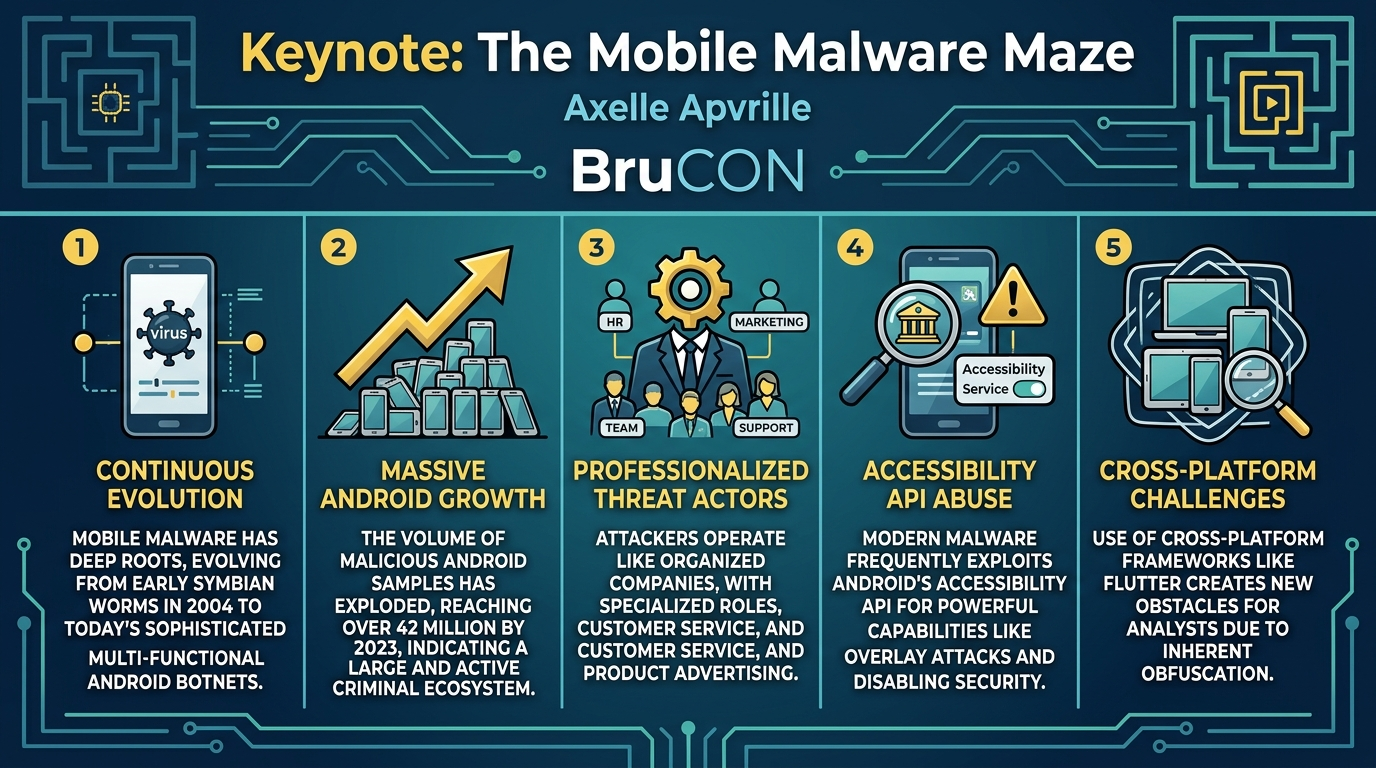
- Mobile malware has a deep and continuous history, evolving from basic Symbian PoCs in 2004 to sophisticated, multi-functional Android botnets today, with many core attack mechanisms persisting across technological generations.
- The mobile threat landscape is dominated by an immense volume of Android malware, with over 42 million samples recorded by 2023, indicative of a highly active and financially lucrative criminal ecosystem.
- Threat actors have professionalized into organized "companies," employing business models that include product advertising, customer service, and even user reviews for their malware, signaling a shift from individual "hackers" to organized cybercrime.
- Modern Android malware heavily abuses legitimate system features, particularly the Accessibility API, for powerful capabilities like overlay attacks and disabling security features, making user awareness of permission requests critically important.
- The emergence of cross-platform development frameworks like Flutter presents significant new challenges for reverse engineers due to inherent obfuscation and non-standard compilation, requiring the development of specialized analysis tools.
- Security researchers should prioritize static analysis for its comprehensive understanding and resilience against anti-analysis techniques, reserving dynamic analysis for specific, intractable obfuscation challenges to avoid risks of propagation and information leakage to adversaries.
About the Speaker(s)
Axelle Apvrille is a distinguished mobile malware analyst and researcher, currently working at Fortinet. She began her career in mobile security in 2008, directly immersing herself in the then-nascent field of mobile malware analysis. Over the past two decades, Apvrille has gained extensive experience tracking the evolution of mobile threats across various operating systems, from early Symbian and Java ME platforms to modern iOS and Android environments. Her deep historical perspective and hands-on expertise make her a leading voice in understanding the complex and ever-changing landscape of mobile cybersecurity.