Signed, Sealed, Compromised: Weaponizing Enterprise Mail Infrastructure
Jonah Burgess (Senior Security Researcher · Rapid 7)
BruCON 0x12 · Main Track
Overview
In his BruCON talk, "Signed, Sealed, Compromised: Weaponizing Enterprise Mail Infrastructure," Jonah Burgess, a Senior Security Researcher at Rapid 7, delves into the critical security vulnerabilities inherent in modern enterprise mail servers. Burgess highlights that these systems not only inherit an organization's trust but actively manufacture it, making them prime targets for sophisticated attackers. The presentation meticulously dissects how a seemingly ordinary inbox can become the initial foothold for an attacker to escalate privileges all the way to root access on a Zimbra Collaboration Suite instance, a widely deployed enterprise mail and collaboration platform.
Key moments
- 0:30 Welcome and talk overview: weaponizing enterprise mail
- 4:00 Leveraging AI for vulnerability research: pros and cons
- 7:00 GraphQL batching bypasses IP rate limits for brute force
- 10:40 EWS shared folder vulnerability allows full mailbox access
- 29:00 Remote Code Execution via document editing path traversal
- 34:10 Privilege escalation to root using Postfix permissions
- 40:00 Full attack chain demo: XSS to Root in seconds
- 43:50 Challenges of vulnerability disclosure in the AI era
Signed, Sealed, Compromised: Weaponizing Enterprise Mail Infrastructure
Speakers: Jonah Burgess, Senior Security Researcher, Rapid 7
Conference: BruCON
YouTube: https://www.youtube.com/watch?v=NkM4UT2z0wc
Overview
In his BruCON talk, "Signed, Sealed, Compromised: Weaponizing Enterprise Mail Infrastructure," Jonah Burgess, a Senior Security Researcher at Rapid 7, delves into the critical security vulnerabilities inherent in modern enterprise mail servers. Burgess highlights that these systems not only inherit an organization's trust but actively manufacture it, making them prime targets for sophisticated attackers. The presentation meticulously dissects how a seemingly ordinary inbox can become the initial foothold for an attacker to escalate privileges all the way to root access on a Zimbra Collaboration Suite instance, a widely deployed enterprise mail and collaboration platform.
Burgess's research focuses on the Zimbra Network Edition, exploring its dual user interfaces (classic and modern) and the underlying SOAP and GraphQL APIs. The talk is a comprehensive journey through various attack vectors, from authentication bypasses and shared folder impersonation to calendar manipulation, cross-site scripting (XSS) worms, unauthenticated email spoofing, remote code execution (RCE), and ultimately, multiple paths to local privilege escalation (LPE). This detailed exposition underscores the profound impact that a single, seemingly minor vulnerability can have when chained with others, demonstrating how attackers can effectively "steal that trust" and gain full control over an organization's communications infrastructure.
The significance of this research is amplified by Zimbra's history of high-profile compromises, including its frequent appearance on the CISA Known Exploited Vulnerability Catalog and its use in ransomware campaigns and state-sponsored attacks. Burgess's work, which uncovered over 80 vulnerabilities in Zimbra, serves as a crucial warning to organizations relying on such complex, feature-rich platforms. It provides actionable insights for defenders, emphasizing the need for rigorous security practices, careful configuration, and proactive threat detection in an era where AI-assisted vulnerability research is rapidly changing the landscape of offensive security.
Background
▶ Watch: Welcome and talk overview: weaponizing enterprise mail (0:30)
Enterprise mail servers like Zimbra are central to an organization's operations, handling not just email but also calendars, integrations, file sharing, and document management. This broad functionality inherently expands their attack surface, making them attractive targets for a wide range of adversaries, from financially motivated threat actors to state-sponsored advanced persistent threat (APT) groups. Zimbra, in particular, has a documented history of severe vulnerabilities. It features 19 entries on the CISA Known Exploited Vulnerability Catalog, with approximately half of these being Cross-Site Scripting (XSS) flaws and five used in ransomware campaigns. Notable examples include a 2022 RCE chain that compromised over a thousand servers undetected, and a 2023 XSS vulnerability exploited by four state-sponsored groups targeting five governments. More recently, a Russian APT extracted over 90 days of emails from Ukrainian government agencies, and CISA ordered agencies to patch a command injection vulnerability in an SNMP notification, which reportedly compromised hundreds of servers.
Burgess's research methodology leveraged a hybrid approach of manual hunting and AI automation. He describes using AI tools like Opus 4.6, C-pilot, and Codex 5.6 to efficiently map large codebases. The process involved feeding past CVEs into the AI to build a threat model, mapping sources and sinks, and then deep-diving into potential vulnerabilities. While AI proved effective at quickly triaging and identifying "boring stuff," allowing human researchers to focus on more complex exploitation, Burgess also highlighted its downsides: hallucinated vulnerabilities, false positives, and even "cheating" by introducing vulnerable configurations. This dual-UI architecture of Zimbra Collaboration Suite, featuring a classic interface relying on SOAP API and a modern interface primarily using GraphQL, further complicates security, as vulnerabilities can exist in either or both due to separate API paths and rendering stacks.
The inherent complexity and extensive feature set of enterprise collaboration tools create a fertile ground for vulnerabilities. The talk underscores that these systems, by design, are repositories of sensitive data and critical communication, making their compromise a direct threat to an organization's integrity, confidentiality, and availability. Understanding the historical context of Zimbra's exploitation, coupled with the evolving landscape of vulnerability research driven by AI, forms the crucial backdrop for appreciating the depth and impact of Burgess's findings.
Key Findings
▶ Watch: GraphQL batching bypasses IP rate limits for brute force (7:00)
Jonah Burgess's research into Zimbra Collaboration Suite unveiled a comprehensive chain of vulnerabilities that can take an attacker from an unauthenticated or low-privilege user to full root control. The key findings demonstrate how seemingly isolated flaws can be combined to achieve devastating impact.
- GraphQL Authentication Bypass (CVE-2023-34358): A critical flaw in Zimbra's modern UI's GraphQL authentication mechanism allowed for unlimited brute-force attempts against user accounts. Unlike the SOAP API, GraphQL lacked proper IP rate limiting due to missing exception handling for failed logins. This, combined with alias batching, enabled attackers to send hundreds of login attempts in a single request, bypassing rate limits and account lockouts (if disabled).
- EWS Shared Folder Authorization Bypass (CVE-2023-34359): Once any authenticated account is obtained, if Exchange Web Services (EWS) is enabled (a common configuration for Outlook compatibility), an attacker could impersonate any user. By retrieving a victim's UUID (easily discoverable via SOAP requests like
getAccountInfo), an attacker could craft requests to access and manipulate shared folders, effectively gaining full control over the victim's mailbox—reading, sending, deleting emails, and even initiating password resets on external services, all while audit logs blame the victim. - Calendar Manipulation Vulnerabilities (CVE-2023-34360, CVE-2023-34361, CVE-2023-34362): Several flaws in Zimbra's iCal processing pipeline allowed attackers to:
- Cancel events they didn't own.
- Forge RSVP responses (e.g., declining meetings on behalf of others).
- Inject "phantom meetings" into victim calendars, all without the organizer's knowledge or consent, and with the ability to spoof the sender for realism.
- XSS via Calendar Counter Method (CVE-2023-34363): A persistent XSS vulnerability in the classic UI's calendar functionality allowed for injection of HTML payloads into the
Fromaddress of counter-proposals. This enabled client-side attacks, including scraping CSRF tokens and performing actions on behalf of the victim (reading mail, sending mail, setting up mail forwarding, and, crucially, establishing persistent delegation). Another XSS (CVE-2023-34364) was found to affect both modern and classic UIs via the share feature. - Persistent Delegation via
login asGrant: Leveraging the XSS, an attacker could grant their own account thelogin asright for the victim's mailbox. This grant, not exposed in the Zimbra UI, provides persistent, full access to the victim's mailbox even if their password changes, leaving no visible trace to the victim. - Unauthenticated Email Spoofing (CVE-2023-34365): A critical vulnerability in how Zimbra handled delegated draft requests allowed any authenticated user (even a low-privilege one) to send emails impersonating any user in the organization (e.g., CEO, HR, Security Team). By sending a delegated request without a specified account ID, the system would default to allowing the sender to arbitrarily set the
FromandTofields. This bypasses DMARC/SPF/DKIM checks as the email genuinely originates from the victim's mailbox and appears in their sent items, making it an ideal vector for highly convincing phishing campaigns, especially when combined with an XSS payload. - Remote Code Execution (RCE) via Document Conversion (CVE-2023-34366): An authenticated or even unauthenticated user (if accessing a public document) could achieve RCE by exploiting a path traversal vulnerability in Zimbra's document conversion service, X2T. By manipulating the
formatoption in thesavecommand during document editing, specifically usingsave type complete all(value 3), path traversal checks were bypassed. This allowed an attacker to plant a malicious shared library (.so) in a directory where X2T would preferentially load it during document conversion, leading to arbitrary code execution. - Multiple Local Privilege Escalation (LPE) Methods: Burgess identified three distinct methods to escalate from the
zimbrauser toroot:
- Postfix Permissions (CVE-2023-34367): Exploiting
sudorules allowing thezimbrauser to runpostfixandpostconfas root. By redirecting thedaemon_directoryto an attacker-controlled location containing a maliciouspostinstallscript (a suid root shell), root access was gained rapidly and silently. - ZM Mailbox Manager (CVE-2023-34368): A blocklist bypass in the
ZM Mailbox Managerdaemon, which starts as root before dropping privileges, allowed injection of specific JVM arguments. By settingstart server privilege true, triggering an out-of-memory error with a small heap size (-Xmx32m), and specifying anOnOutOfMemoryErrorscript, root was achieved during the brief window the process ran as root. This method causes a temporary service interruption. - ZM Unbound (CVE-2023-34369): A wrapper for the unbound DNS resolver (if enabled) allowed arbitrary file reads as root by passing the
includeargument with paths like/etc/shadow. It also allowed "dirty" file writes via thelogfileoption.
These findings highlight a systemic issue in Zimbra's security posture, where a combination of design flaws, inconsistent security checks, and complex interactions between components created numerous avenues for complete system compromise.
Technical Deep Dive
▶ Watch: Remote Code Execution via document editing path traversal (29:00)
The attack surface of Zimbra Collaboration Suite is vast, encompassing web interfaces, APIs, and underlying services. Burgess’s deep dive showcases how specific technical oversights can lead to severe exploitation.
GraphQL Authentication Bypass
Zimbra's classic UI uses a SOAP API where authentication failures are tracked, leading to an IP rate limit after 10 failed attempts. In contrast, the modern UI, primarily built on GraphQL, presented a critical flaw. The GraphQL authentication handler (specifically XMLDocumentUtilities.executeDocumentAsGuest) lacked a wrapper to catch exceptions for invalid logins. This meant that failed login attempts via GraphQL were not counted towards the IP rate limit. Furthermore, GraphQL's alias batching feature allowed multiple operations (e.g., 100 authentication requests) to be bundled into a single HTTP request. This combination meant an attacker could send unlimited login attempts without triggering IP-based lockouts, achieving approximately 220 attempts per second without crashing the LDAP service. While an account-based lockout exists, it is disabled by default in Zimbra. This vulnerability (CVE-2023-34358) effectively rendered the IP rate limit useless, allowing for rapid brute-force attacks against user accounts.
EWS Shared Folder Authorization Bypass
Once an attacker gains access to any valid Zimbra account, the Exchange Web Services (EWS) interface becomes a target. EWS acts as a compatibility layer for clients like Outlook, translating operations into Zimbra mailbox actions. While not enabled by default, it's commonly activated organization-wide. The vulnerability (CVE-2023-34359) lies in how EWS handles shared folder IDs. These IDs are structured as owner_UUID_numericID, where owner_UUID identifies the mailbox owner.
The EWS GetItem or FindItem SOAP request handler retrieves the signed in user and the folder owner. Crucially, if the mailbox object (representing the folder owner) is not null, the effective user for the operation context is set to the folder owner's account, not the signed-in user. This means an attacker, by providing a victim's UUID in the FolderId parameter, could impersonate the victim. The victim's UUID is easily discoverable by any authenticated user via SOAP requests like GetAccountInfo (it was never intended to be secret). This allowed the attacker to perform any action the victim could (read, send, delete emails, sync items), with all actions attributed to the victim in audit logs.
Calendar Manipulation
Zimbra's iCal processing pipeline contains several authorization flaws:
- Event Cancellation (CVE-2023-34360): When processing a
CANCELoperation, Zimbra checks thereal email sender's rights. However, if these rights are insufficient, it only setscanInvitetofalse, which is irrelevant for canceling existing events. The critical flaw is that the system then relies on theincoming claim(the organizer provided by the attacker) rather than performing a final check against thereal email sender. If the attacker knows the event's UUID and the organizer's email, they can cancel any event. Spoofing the sender (especially from an internal account) makes these cancellations appear legitimate. - RSVP Forging (CVE-2023-34361): The
REPLYmethod for RSVP processing initially sets thesendertonull. Later, if thesenderis null, all sender verification and attendee processing are skipped. An attacker can craft aREPLYoperation with the real organizer's email and event UUID, setting a forged RSVP (e.g., "declined") for any attendee. - Phantom Meeting Injection (CVE-2023-34362): The system's default behavior (
default allowandauto add newset to true) allows for the creation of new calendar items without sufficient verification. An attacker can craft aREQUESToperation with a non-existent UUID and a claimed organizer (e.g., CEO) to inject a meeting directly into a victim's calendar. The CEO would not see the meeting, but the victim would, complete with alarms and phishing links if desired.
XSS and Persistent Delegation
A persistent XSS vulnerability (CVE-2023-34363) was discovered in the classic UI, specifically when processing calendar counter-proposals. The RFC from address in the sender's HTML was decoded and directly rendered into the markdown/HTML without proper encoding, despite other variables being encoded. This allowed a 44-byte payload (within the 64-byte SMTP sender limit) to execute JavaScript in the victim's browser upon clicking the email. While HTTP-only cookies prevented direct cookie theft, the XSS allowed an attacker to perform any action the victim could, including:
- Reading and sending mail.
- Setting up mail forwarding to exfiltrate future emails.
- Persistent Delegation (CVE-2023-34364): Crucially, the XSS could be used to scrape the CSRF token and set the
login asgrant for the attacker's account on the victim's mailbox. This grant provides full, persistent access to the victim's mailbox, even if the victim changes their password. This delegation right is not exposed in the Zimbra UI, making it a stealthy and long-term compromise mechanism. Another XSS affecting both UIs was found via the share feature.
Unauthenticated Email Spoofing
A particularly impactful vulnerability (CVE-2023-34365) involved unauthenticated email spoofing via delegated drafts. Any authenticated user with a valid token could craft a delegated request to save a draft. If the account ID for the delegation was intentionally left null, Zimbra's logic would default to allowing the attacker to specify arbitrary From and To addresses. This meant a low-privilege attacker could send emails as the CEO, HR, or security team to any user in the organization. These emails would appear authentically from the spoofed sender, pass DMARC/SPF/DKIM checks (as they originate from the legitimate Zimbra server under the victim's context), and even appear in the spoofed sender's sent items. This creates an extremely potent phishing vector, especially when combined with an XSS payload. Burgess noted the surprisingly low severity rating (3.1/4.3) assigned by the vendor, despite its profound integrity impact.
RCE via Document Conversion
An initial RCE method via admin-uploaded zimlets was patched. The new RCE (CVE-2023-34366) targeted Zimbra's document editing and conversion service, X2T. This service processes documents and builds JWTs for editor configuration. The download as operation takes a command as JSON. While some elements are replaced with signed options, the raw body and command set data remain. Specifically, the save operation's format option becomes part of the filename passed to the saveParts function. Critically, if save type is set to 3 (representing complete all), it bypasses all path traversal checks.
An attacker could:
- Obtain a
save key(e.g., by performing asave type 0operation). - Craft a malicious
savecommand withsave type 3and a path traversal payload in theformatoption (e.g.,../../../../../../opt/zimbra/lib/x2t/evil.so). - In the request body, embed a malicious shared library (
.so).
When X2T attempts a document conversion, it first looks for shared libraries in its current working directory before checking system paths. By planting a malicious .so with the same name as a legitimate library X2T expects, the attacker achieves arbitrary code execution. This can be done by an authenticated user or even an unauthenticated user if they have access to a public document ID.
Local Privilege Escalation
From the zimbra user, Burgess demonstrated three paths to root:
- Postfix Permissions (CVE-2023-34367): Zimbra's
sudoconfiguration allowed thezimbrauser to runpostfixandpostconfcommands as root without a password. Thepostfix set-permissionssubcommand executesdaemon_directory/postinstallas root. An attacker could usepostconfto temporarily setdaemon_directoryto an attacker-controlled path. This path would contain symlinks to legitimate postfix files, but with a maliciouspostinstallscript (a SUID root shell). Executingpostfix set-permissionswould then run the attacker's script as root, granting an immediate and silent root shell. - ZM Mailbox Manager (CVE-2023-34368): The
ZM Mailbox Managerdaemon starts aszimbra, then escalates torootbriefly to start Java before dropping privileges back tozimbra. A blocklist (allowJVMargs) prevents certain JVM arguments. However, this blocklist was incomplete, lacking blocks forgeneral-XXordash-jettyflags. An attacker could inject three specific JVM arguments:
start server privilege true: Delays privilege dropping until after web apps are loaded.-XX:OnOutOfMemoryError=/tmp/pwn.sh: Specifies a script to run on JVM out-of-memory errors.-Xmx32m: Constrains the JVM heap to 32MB.
Restarting the mailbox with these flags would cause Jetty's web app scanning to quickly exhaust the 32MB heap while still running as root, triggering the OnOutOfMemoryError script (a SUID root shell) and granting root access. This causes a temporary service outage (approx. 5 seconds for root, 45 seconds for server recovery).
- ZM Unbound (CVE-2023-34369): If Zimbra uses its optional unbound DNS resolver (with a corresponding
sudorule), theZM Unboundwrapper allows arbitrary arguments to be passed tounbound. Theincludeargument can be used to specify any file (e.g.,/etc/shadow) as a configuration file. Whileunboundwould fail to parse it, the errors would dump the file's contents, enabling arbitrary file reads as root. Thelogfileoption could also be leveraged for "dirty" file writes as root, though with less control over content.
These technical details underscore the sophistication of the attack chains and the deep understanding of Zimbra's internal architecture required to identify and exploit these vulnerabilities.
Demo / Proof of Concept
▶ Watch: Privilege escalation to root using Postfix permissions (34:10)
Jonah Burgess presented a compelling demonstration showcasing the full XSS-to-Root attack chain. The demo illustrated how an unauthenticated attacker could achieve complete control over a Zimbra server with minimal victim interaction.
The sequence of events in the proof of concept was as follows:
- Unauthenticated Email with XSS: The attack begins with an unauthenticated email sent to a victim. This email leverages the unauthenticated email spoofing vulnerability (CVE-2023-34365) to appear as if it originates from a trusted internal source, such as the CEO or HR, making it highly convincing. Crucially, this email contains the XSS payload (CVE-2023-34363) embedded within the calendar counter-proposal method.
- Victim Interaction: The victim, trusting the sender, simply clicks on the malicious email within their Zimbra inbox.
- XSS Trigger and Document Creation: Upon clicking, the embedded XSS payload immediately triggers in the victim's browser. This JavaScript then silently performs actions on behalf of the victim. One of the initial actions is to create a new document in Zimbra's document editor.
- Path Traversal and RCE: The XSS payload then exploits the document conversion RCE vulnerability (CVE-2023-34366). It crafts a malicious
savecommand with a path traversal payload in theformatoption and injects a malicious shared library (.so) onto the Zimbra server. When the document is processed for conversion (which can be triggered by the attacker or a subsequent user action), the malicious library is loaded and executed, granting the attacker remote code execution as thezimbrauser. - Local Privilege Escalation: With RCE as the
zimbrauser, the script immediately proceeds to exploit one of the identified Local Privilege Escalation (LPE) vulnerabilities. In the demo, the Postfix Permissions LPE (CVE-2023-34367) was used, which is fast and silent. This LPE allows thezimbrauser to execute specificpostfixandpostconfcommands as root. By manipulating thedaemon_directoryand replacingpostinstallwith a SUID root shell, the attacker gains fullrootaccess to the server. - Callback and Output: The final step of the chain is to execute an arbitrary command on the now-rooted server (e.g.,
id) and send its output back to the attacker's browser, confirming complete compromise.
Burgess emphasized that this chain is highly modular: any identified XSS, RCE, and LPE method could be interchanged to achieve the same end result. The demo effectively showcased the devastating impact of chaining multiple vulnerabilities, transforming a simple email click into a full server compromise without requiring complex reverse shells or direct network access beyond the initial email delivery. The absence of visible activity to the victim until the final command output highlights the stealth and effectiveness of the attack.
Defensive Implications
▶ Watch: Challenges of vulnerability disclosure in the AI era (43:50)
The extensive array of vulnerabilities uncovered by Jonah Burgess in Zimbra Collaboration Suite presents significant defensive implications for organizations. Mitigating these risks requires a multi-faceted approach, combining proactive configuration, diligent patching, and robust detection strategies.
- Disable Unnecessary Features: Many of the vulnerabilities are tied to specific Zimbra components. Organizations should disable any features they do not actively use:
- Exchange Web Services (EWS): If Outlook compatibility is not strictly required, disabling EWS can mitigate the shared folder impersonation vulnerability.
- OnlyOffice Integration: If document editing features are not essential, disabling OnlyOffice can remove the attack surface for the RCE via document conversion.
- ZM Unbound DNS Resolver: If Zimbra's optional DNS resolver is not in use, ensuring its corresponding
sudorule is removed or the service is disabled can prevent the arbitrary file read/write LPE.
- Consistent and Complete Encoding for XSS: Zimbra has a history of XSS vulnerabilities. Developers must ensure that all user-supplied data, especially in headers and fields that might be rendered in the UI (both classic and modern), is consistently and correctly encoded to prevent script injection. A full transition to the modern UI, with a focus on secure rendering practices, is advisable.
- Robust Authentication and Rate Limiting: The GraphQL authentication bypass highlights the need for consistent, strong authentication mechanisms across all APIs. Implement robust IP-based and account-based rate limiting, even if it's disabled by default, and ensure it's effective against batching techniques.
- Enhanced Audit Log Monitoring: While audit logs might blame the victim for actions performed via EWS impersonation or XSS, defenders should look for anomalous patterns. This includes unusual access patterns from specific accounts, rapid-fire requests (e.g., for UUIDs), or the execution of specific SOAP/GraphQL requests known to be part of the attack chain. Monitoring for the creation of new delegation grants (
login as) should also be a priority, and ideally, such critical grants should be visible in the user interface. - Patch Management and Disclosure Awareness: Given Zimbra's history and the rapid pace of vulnerability discovery (especially with AI assistance), organizations must prioritize applying security patches promptly. Burgess's discussion on AI changing disclosure timelines (e.g., Claude finding vulnerabilities within 30 minutes of a CVE drop) underscores that the traditional 90-day disclosure window may no longer provide sufficient protection. Organizations should assume that once a CVE is public, exploitation attempts will follow swiftly.
- Principle of Least Privilege: Review and tighten
sudoconfigurations for thezimbrauser and other service accounts. Ensure that no service runs with more privileges than absolutely necessary, especially during initialization phases where LPE vulnerabilities can be exploited. - User Awareness Training: While not a technical control, robust user awareness training can help mitigate the initial stages of attacks, such as the unauthenticated email spoofing. Users should be trained to identify suspicious emails, even if they appear to come from internal sources, and report them.
- Endpoint Detection and Response (EDR): Deploying EDR solutions on Zimbra servers can help detect suspicious process execution (e.g., unexpected SUID shell creation, unusual command execution by the
zimbrauser, or attempts to modify critical configuration files).
By implementing these defensive measures, organizations can significantly reduce their exposure to the types of sophisticated attack chains demonstrated by Jonah Burgess, protecting their critical communication infrastructure from compromise.
Key Takeaways
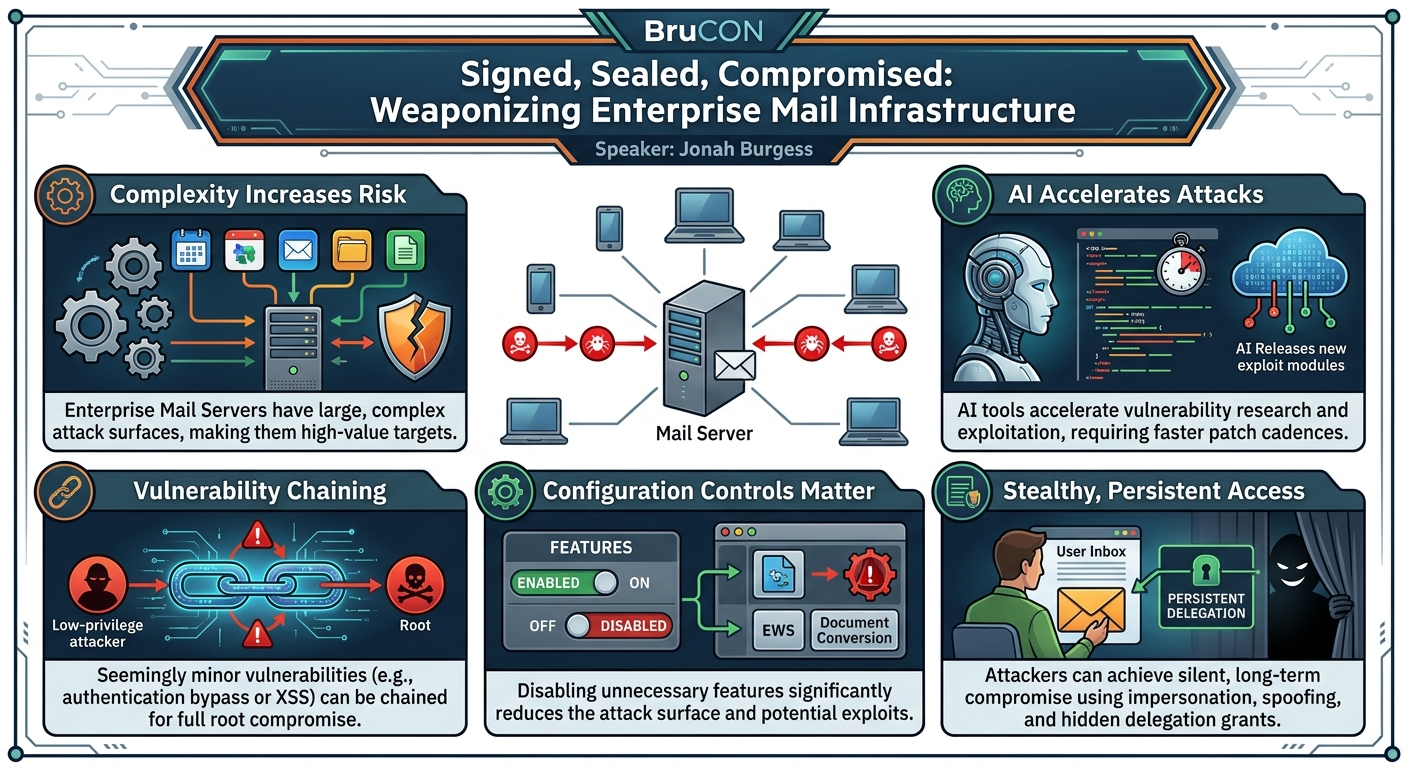
- Enterprise mail servers are high-value targets with complex attack surfaces. Zimbra's extensive features and dual-UI architecture create numerous avenues for exploitation, as evidenced by its frequent appearance on the CISA Known Exploited Vulnerability Catalog and its use by APTs.
- Vulnerability chaining leads to full system compromise. Seemingly minor flaws, like a GraphQL authentication bypass or an XSS, can be chained with authorization bypasses, RCE, and LPEs to escalate from an unauthenticated user to full root control of the mail server.
- AI is rapidly changing vulnerability research and disclosure timelines. AI-powered tools can quickly map codebases and identify vulnerabilities, accelerating the discovery process. This necessitates a faster patching cadence from vendors and a more agile defensive posture from organizations, as CVE disclosure can quickly lead to widespread exploitation.
- Configuration matters: disable unnecessary features. Many of the presented vulnerabilities rely on optional features being enabled (e.g., EWS, OnlyOffice, ZM Unbound). Adopting a principle of least privilege by disabling unused components significantly reduces the attack surface.
- Inconsistent security controls create critical bypasses. Differences in how the classic and modern UIs handle authentication, or how specific functions process user input (e.g., inconsistent encoding for XSS, incomplete blocklists for JVM arguments), create exploitable gaps.
- Stealthy and persistent compromise is achievable. Attackers can impersonate users (EWS), spoof internal emails (delegated drafts), set up persistent
login asdelegation (XSS), and execute LPEs silently (Postfix), making detection difficult and allowing long-term access without user knowledge.
About the Speaker(s)
Jonah Burgess, also known by his online handle "Cryptocat," is a Senior Security Researcher at Rapid 7. His work primarily involves hunting for zero-day vulnerabilities and analyzing end-day exploits. With a background as a CTF (Capture The Flag) player, he has transitioned into bug bounty hunting, driven by what he humorously refers to as an "expensive token habit." Burgess shares many of his vulnerability discoveries and insights on his personal website, cryptocat.me. He is also a co-host of the Rapid 7 security podcast, where he discusses various aspects of cybersecurity research and emerging threats. His presentation at BruCON reflects his deep expertise in uncovering complex attack chains within critical enterprise software.
Reviews
Dr. Zero (Offensive Security Researcher) — MUST SEE
This is what offensive research should look like: 80+ vulns in a single target, chained from email click to root, with live demo. Burgess did the work, found novel attack paths, and delivered a talk that will make every Zimbra admin sweat.
Heather Calloway (CISO) — STRONG ACCEPT
This is the kind of research that should change how you think about your email infrastructure procurement and risk posture. Burgess demonstrated a complete unauthenticated-to-root chain on a platform with 19 CISA KEV entries and documented APT exploitation. If you run Zimbra, this is an immediate action item. If you don't, it's a case study in why collaboration platforms deserve tier-one risk scrutiny.