Don't Run Six Checklists: A 25-Minute Sane Guide to AI + Healthcare GRC
Pran Mata (Senior Security and Compliance Analyst · Headspace)
BSides Seattle 2026 · Day 1 · Track 1
Overview
Pran Mata, a senior security and compliance analyst at Headspace (the mental health app offering meditation, therapy, and psychiatry), presents a practical framework for collapsing the alphabet soup of compliance frameworks -- HIPAA, NIST CSF, HHS guidelines, executive orders, NIST AI RMF, and ISO 42001 -- into five shared outcomes that can be assessed once and mapped across all frameworks simultaneously. The core argument is that treating each framework as a separate project creates duplicative work, slows delivery, and still fails to produce confident results.
Key moments
- 0:00 Introduction and the six-checklist problem
- 2:00 Where LLMs show up in healthcare workflows
- 4:00 The framework alphabet soup and why they overlap
- 6:00 Five shared outcomes that unify all frameworks
- 8:00 Visibility as step zero: inventory and PHI flow mapping
- 12:00 Defensible guardrails: region pinning and data minimization
- 14:00 Scope-Score-Decide lightweight risk analysis
- 18:00 Three minimum artifacts every AI feature needs
Don't Run Six Checklists: A 25-Minute Sane Guide to AI + Healthcare GRC
Speakers: Pran Mata, Senior Security and Compliance Analyst, Headspace
Conference: BSides Seattle 2026
YouTube: https://www.youtube.com/watch?v=KSrhvK2NyOo
Overview
Pran Mata, a senior security and compliance analyst at Headspace (the mental health app offering meditation, therapy, and psychiatry), presents a practical framework for collapsing the alphabet soup of compliance frameworks -- HIPAA, NIST CSF, HHS guidelines, executive orders, NIST AI RMF, and ISO 42001 -- into five shared outcomes that can be assessed once and mapped across all frameworks simultaneously. The core argument is that treating each framework as a separate project creates duplicative work, slows delivery, and still fails to produce confident results.
The talk addresses a real pain point in healthcare AI governance: product and leadership teams want to ship LLM-powered features, security teams face pressure to give quick yes/no answers, and the six different frameworks arriving from different stakeholders (legal wants HIPAA, another team wants NIST, another wants ISO) each use different terminology but demand fundamentally the same evidence. Mata's solution is an intent-based governance model that translates framework-specific subcontrols into a shared language that engineering and product teams will actually engage with.
Background
▶ Watch: Introduction and the six-checklist problem (0:00)
Healthcare organizations are rapidly integrating LLMs into care workflows in three primary patterns: patient chat (support and triage), note assist (drafting clinical summaries and notes), and care operations (routing tasks, automating follow-ups, administrative automation). All of these depend on a service layer that performs inference, applies guardrails, and generates logs. Mata argues that if you are not protecting the service layer, you are not protecting the data or the care workflows.
The compliance landscape for healthcare AI includes HIPAA, NIST Cybersecurity Framework, HHS guidelines, executive orders, NIST AI Risk Management Framework (AI RMF), and ISO 42001. Each uses different terminology and structure, but their intent overlaps heavily. The mistake Mata sees repeatedly is organizations treating these as six different checklists requiring six different work streams, answering the same questions about access control, logging, monitoring, and backup multiple times in different formats.
Leadership, meanwhile, asks only four questions: Are we protecting PHI? Is this secure enough to launch? Who is accountable for the risk? And if we move forward, will we regret it? A good GRC approach should answer these questions directly without requiring anyone at the table to be a framework expert.
Key Findings
▶ Watch: The framework alphabet soup and why they overlap (4:00)
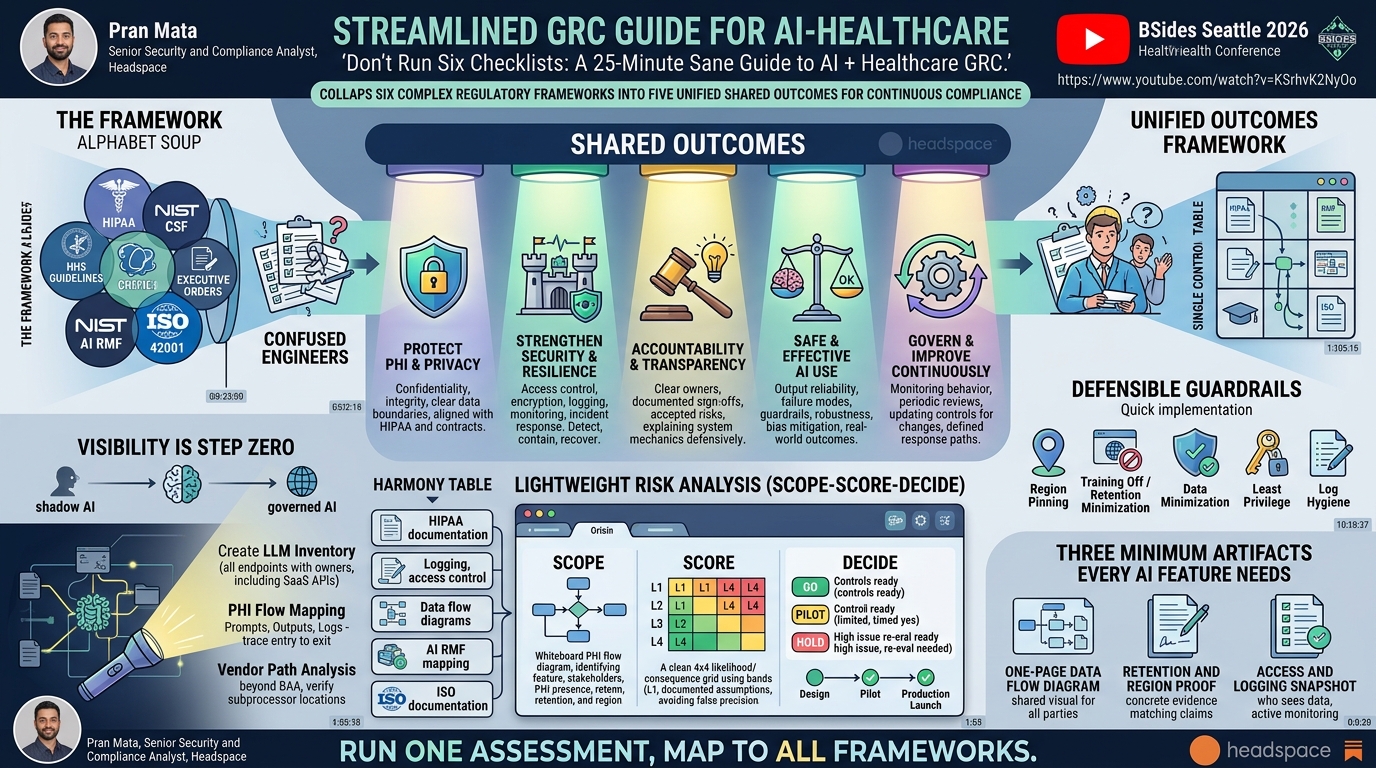
Mata identifies five shared outcomes that unify all six compliance frameworks:
- Protect PHI and Privacy: Confidentiality, integrity, and appropriate use. Clear boundaries on what data goes in and out, aligned with HIPAA and contractual commitments.
- Strengthen Security and Resilience: Access control, encryption, logging, monitoring, and incident response applied to AI workflows. The ability to detect, contain, and recover without chaos.
- Accountability and Transparency: Answering who owns the feature, who signed off, what risks were accepted and why. Transparency means explaining how the system works at a reasonable level and being able to defend decisions later -- not exposing trade secrets.
- Safe and Effective AI Use: An AI-specific dimension covering output reliability, expected failure modes, guardrails for misuse, robustness against manipulation, bias concerns, and whether the system actually does what it claims in real-world outcomes.
- Govern and Improve Continuously: Monitoring system behavior, periodic reviews, updating controls when models or features change, and having a clear response path. AI features are not set-and-forget, so governance cannot be either.
The key psychological insight: when you approach engineering teams with "we need to be compliant with ISO subcontrol X," they disengage. When you say "we need to protect PHI and ensure safe output," they engage and collaborate.
Technical Deep Dive
▶ Watch: Visibility as step zero: inventory and PHI flow mapping (8:00)
Visibility as Step Zero: Before threat modeling or scoring, organizations must establish visibility. This means creating an inventory of every LLM endpoint (internal and external), each with a designated owner -- including API embeddings in third-party SaaS tools. Shadow AI is still AI and creates risk. PHI flow mapping must trace where PHI enters, transforms, is stored, and exits, including prompts, outputs, and logs. Vendor path analysis must go beyond signed BAAs to verify where the LLM endpoint actually lives (subprocessors, regions). Most AI governance problems, Mata argues, are actually visibility problems.
The Harmony Table: A cross-reference showing how different frameworks map to the five shared outcomes. HIPAA, NIST, and HHS cover PHI and resilience. AI RMF and ISO bring explicit governance and AI safety language. Executive orders emphasize visibility and secure practices. Running one system-level assessment and mapping outputs to all frameworks simultaneously eliminates duplicate work -- for example, a single data flow diagram can satisfy HIPAA documentation, AI RMF mapping, and ISO documentation requirements.
Defensible Guardrails: Five low-effort, high-impact controls for AI workflows:
- Region pinning -- reduces regulatory and contractual ambiguity
- Training off / retention minimization -- reduces exposure surface area
- Data minimization -- reduces blast radius
- Least privilege -- limits who can see sensitive inputs and outputs
- Log hygiene -- ensures detection of misuse and abuse
AI-Specific Risks: Prompt injection (input manipulation overriding instructions), jailbreaks (bypassing guardrails), and context leakage (PHI crossing session boundaries when tenant isolation fails). None require exotic AI research teams -- they require discipline, architecture, and monitoring.
Lightweight Risk Analysis (Scope-Score-Decide):
- Scope: Draw the PHI flow on a whiteboard. If you cannot draw it, you are not ready to assess. Identify the feature, trace PHI movement, identify stakeholders, and answer three critical questions: Is there PHI in prompts or outputs? Is there data retention anywhere (including logs and embeddings)? Is it region-pinned?
- Score: A simple 4x4 grid with likelihood on one axis and consequence on the other. Use bands (low/medium/high or L1-L4), not false-precision decimals like 2.4. Write down assumptions: if retention is on by default, likelihood increases; if clinical suggestions lack human review, impact increases. Rescore only when controls change, not when a new stakeholder feels nervous.
- Decide: Go (controls sufficient, evidence exists), Pilot (limited exposure, extra guardrails, defined review date -- not a soft yes but a control decision on a timer), or Hold (unresolved high issue requiring leadership input or workflow redesign). Layer decisions into launch checkpoints at design, pilot, and production stages.
Three Minimum Artifacts:
- One-page data flow diagram -- shared visual for security, compliance, engineering, and auditors
- Retention and region proof -- concrete evidence that data handling settings match claims
- Access and logging snapshot -- who can see sensitive data, active monitoring evidence, and retention accountability
Demo / Proof of Concept
▶ Watch: Defensible guardrails: region pinning and data minimization (12:00)
This talk did not include a live demo. The framework is presented as a practical methodology to be adopted within GRC workflows. Mata notes that these artifacts and the scope-score-decide process have been applied at Headspace and prior organizations including Fair Financials, Engaged Learning, and PCS.
Defensive Implications
▶ Watch: Three minimum artifacts every AI feature needs (18:00)
The framework directly empowers defenders by:
- Eliminating duplicate compliance work across six frameworks, freeing security team capacity
- Providing engineering teams with shared language they will actually engage with, reducing friction between security and product
- Creating defensible, assumption-documented risk decisions that withstand leadership and auditor scrutiny
- Establishing launch checkpoints (design/pilot/production) that give engineering clarity on what must be true before shipping
- Making governance sustainable rather than a document factory -- continuous monitoring and periodic review are built into the fifth shared outcome
The specific guardrails (region pinning, retention minimization, data minimization, least privilege, log hygiene) are immediately implementable and satisfy most framework requirements at a structural level.
Key Takeaways
- Six compliance frameworks (HIPAA, NIST CSF, HHS, executive orders, AI RMF, ISO 42001) can be collapsed into five shared outcomes assessed once and mapped across all frameworks
- Leadership asks four questions, not subcontrol questions: Are we protecting PHI? Is this secure enough? Who is accountable? Will we regret this?
- Visibility is step zero: you cannot govern what you cannot see, including shadow AI and third-party LLM endpoints at subprocessors
- The scope-score-decide lightweight risk analysis replaces massive reports with a repeatable engine backed by small evidence packets
- Score with bands (low/medium/high), not false precision; document assumptions, not opinions; rescore only when controls change
- Three minimum artifacts (data flow diagram, retention/region proof, access/logging snapshot) eliminate the majority of repetitive audit questions
About the Speaker(s)
Pran Mata is a senior security and compliance analyst at Headspace, the mental health app. He has previously worked at Fair Financials, Engaged Learning, and PCS with a focus on healthcare compliance and privacy. He holds a master's degree in cybersecurity and a doctoral certificate in business administration. He has recently started a Substack focused on telehealth security topics.
Reviews
Dr. Zero (Offensive Security Researcher) — WEAK
A well-structured GRC process talk that collapses six compliance frameworks into five shared outcomes for healthcare AI governance. Solid operational advice for compliance teams but zero offensive or defensive technical depth. The AI-specific risk section (prompt injection, jailbreaks, context leakage) is acknowledged but not explored beyond definitions. This is a compliance process talk, not a security research talk.
Heather Calloway (CISO) — STRONG ACCEPT
Exactly the kind of practical, operationally-focused governance talk that healthcare CISOs need right now. Mata's five-shared-outcome model for collapsing six compliance frameworks into a single assessment workflow is immediately implementable and addresses the real bottleneck in healthcare AI deployment: GRC teams drowning in duplicative checklist work while product teams ship without governance. The scope-score-decide methodology and three minimum artifacts give security leaders a concrete playbook.