From Application to Access: Detecting DPRK IT Workers Before They Become Insider Threats
Jesse Buonanno
BSides Seattle 2026 · Day 1 · Track 1
Overview
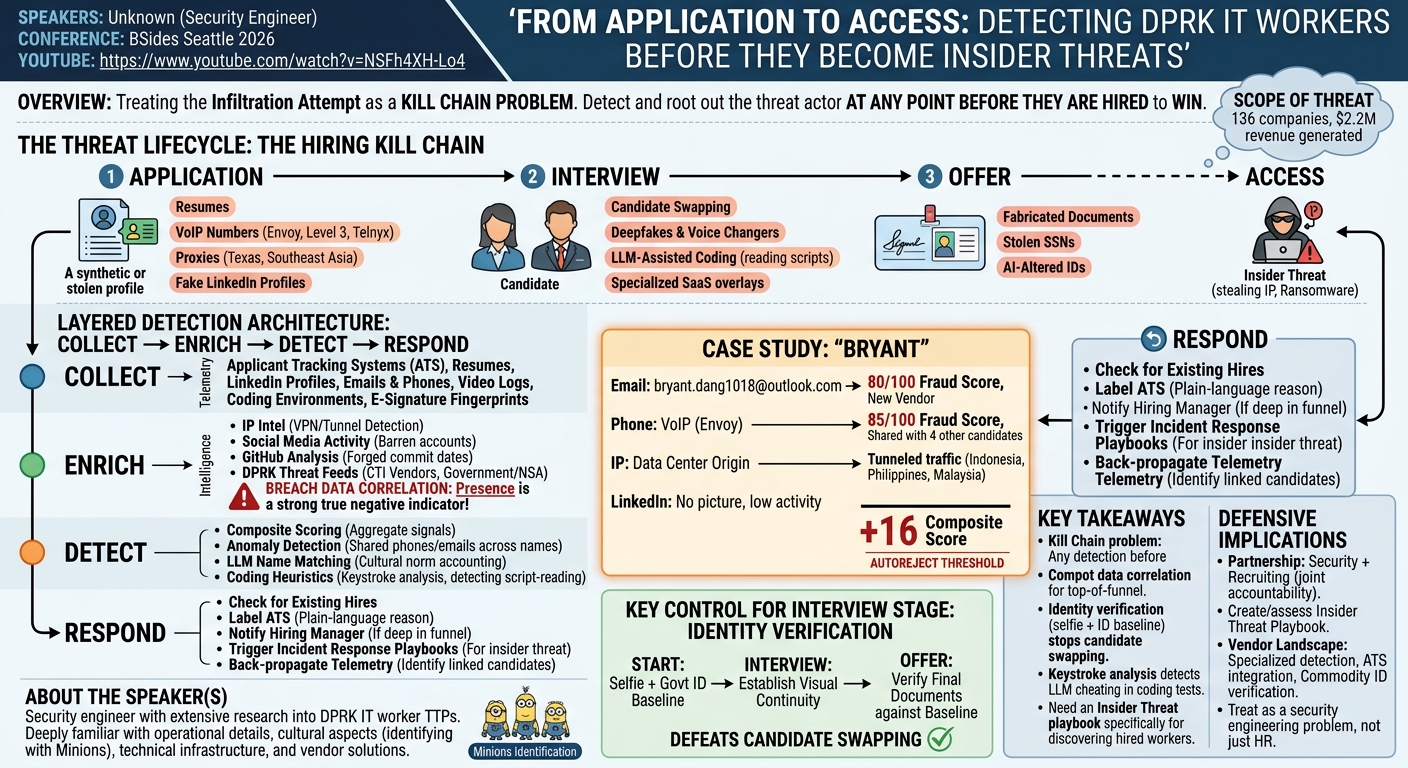
A security engineer presented a comprehensive defensive framework for detecting and blocking DPRK (North Korean) IT worker infiltration attempts across the entire hiring lifecycle -- from initial application through interview to offer stage. The talk treats the DPRK IT worker problem as a kill chain problem: if defenders can detect and root out the threat actor at any point before they are hired, the defenders win. The speaker walked through specific threat actor TTPs at each hiring stage and then presented a layered detection architecture combining identity verification, composite scoring, anomaly detection, and human-in-the-loop decision-making.
Key moments
- 0:00 DPRK IT worker threat scope: 136 companies, $2.2M revenue
- 2:00 Red flags for recruiters: camera refusal, delayed responses, on-site aversion
- 4:00 Interview TTPs: deepfakes, voice changers, candidate swapping
- 8:00 Identity verification system: selfie baseline defeats candidate swapping
- 12:00 Enrichment: IP intel, social media profiling, DPRK threat feeds
- 16:00 Anomaly detection: shared phone numbers, LLM-based name matching
- 18:00 Case study: Bryant composite score walkthrough (+16 autoreject)
- 22:00 Vendor landscape: HireTofu, Endorsed, ATS-integrated solutions
From Application to Access: Detecting DPRK IT Workers Before They Become Insider Threats
Speakers: Unknown (Security Engineer)
Conference: BSides Seattle 2026
YouTube: https://www.youtube.com/watch?v=NSFh4XH-Lo4
Overview
A security engineer presented a comprehensive defensive framework for detecting and blocking DPRK (North Korean) IT worker infiltration attempts across the entire hiring lifecycle -- from initial application through interview to offer stage. The talk treats the DPRK IT worker problem as a kill chain problem: if defenders can detect and root out the threat actor at any point before they are hired, the defenders win. The speaker walked through specific threat actor TTPs at each hiring stage and then presented a layered detection architecture combining identity verification, composite scoring, anomaly detection, and human-in-the-loop decision-making.
This talk is timely and operationally significant. DPRK IT workers are now targeting all remote job openings globally, expanding from the US into Europe. They have shifted to ransomware and extortion when caught, they steal intellectual property for the regime, and the problem extends to US-based facilitators -- five individuals were recently charged with aiding DPRK IT workers in targeting 136 companies and generating over $2.2 million in revenue.
Background
▶ Watch: DPRK IT worker threat scope: 136 companies, $2.2M revenue (0:00)
North Korean IT worker infiltration has evolved from a niche intelligence concern into a widespread operational threat. These actors target remote roles across global job boards, and any organization with an open remote position has very likely received at least one DPRK application. The workers create synthetic identities, use VoIP phone numbers, tunnel through residential proxies (Texas-based addresses are particularly common), and employ deepfake filters and voice changers during interviews.
The threat extends beyond the initial access. Once hired, DPRK workers install VPNs to mask their true location, use remote management software to RDP into machines hosted in US-based laptop farms (maintained by paid American facilitators), deploy mouse jigglers to simulate activity, and funnel funds through potentially sanctioned bank accounts back to the North Korean regime. Critically, these workers are not just earning salaries -- they are stealing intellectual property and R&D, and increasingly deploying ransomware when their cover is blown.
Key Findings
▶ Watch: Interview TTPs: deepfakes, voice changers, candidate swapping (4:00)
The speaker's research identified a detailed set of detection signals across the hiring lifecycle:
Application stage: DPRK actors create profiles that are synthetic (most common), stolen, purchased from willing US participants, or completely fake referencing legitimate LinkedIn profiles. They reuse the same email addresses, use VoIP phone numbers (Envoy, Level 3, Telnyx are favored providers), and tunnel through residential proxies and VPNs to appear US-based.
Interview stage: Candidate swapping is a major TTP -- different individuals handle recruiter calls, peer interviews, and technical interviews. Deepfake filters and voice changers mask identity. For technical interviews using collaborative coding environments (CoderPad, HackerRank), they use specialized SaaS products that overlay LLM-generated answers on their screen in real-time, allowing them to read from a script.
Offer stage: Fabricated government documents (Photoshopped or AI-altered IDs), stolen Social Security numbers, and continued identity fabrication.
A specific case study of a candidate named "Bryant" demonstrated the composite detection in action: the email ([email protected]) matched DPRK email patterns, scored 80/100 on fraud scoring, and had never been seen before by the fraud vendor. The phone number scored 85/100, was a VoIP number on Envoy, and was shared with four other suspicious candidates. IP enrichment showed data center origin with tunneled traffic originating from Indonesia, Philippines, and Malaysia. LinkedIn profile had no picture, low activity, and low connections. Total composite score: +16, well above the autoreject threshold.
A notable cultural detail: DPRK IT workers identify with the Minions franchise, viewing themselves as minions and Kim Jong Un as Gru. Additionally, DPRK workers sometimes infect themselves with infostealer malware, providing the CTI community with identity data dumps directly from the infostealer logs.
Technical Deep Dive
▶ Watch: Enrichment: IP intel, social media profiling, DPRK threat feeds (12:00)
The detection architecture operates in four phases: Collect, Enrich, Detect, and Respond.
Collect: Telemetry from applicant tracking systems (ATS) provides IP addresses, resumes, social media profiles (LinkedIn), email addresses, and phone numbers. Video conferencing logs yield additional email and IP data. Collaborative coding environments are developing their own deception heuristics. Electronic signature platforms (DocuSign) provide browser fingerprinting data.
Enrich: IP intelligence feeds provide geolocation, VPN detection, and tunnel identification. Social media profiling reveals barren accounts with low activity and low connections. GitHub analysis detects forged commit dates designed to simulate development history. Multiple CTI vendors now offer DPRK-specific threat feeds containing full personas. Defense Industrial Base organizations have access to government feeds including NSA-provided data. Research shows a strong true negative correlation with breach data: if an email address appears in known breaches (Drizzly, AT&T, Adobe), it is a strong indicator of a legitimate person, since DPRK actors build fresh synthetic profiles rather than compromising existing ones.
Detect: Composite scoring aggregates signals with weighted scores. Example weights: +1 for known suspicious email, +5 if the same email appears on multiple profiles with sufficiently different names, -5 if the email appears in known data breaches (true negative indicator). Anomaly detection across the ATS identifies shared phone numbers or emails across multiple candidates with different names. The speaker found LLMs effective for semantic name matching -- distinguishing whether "Bob," "Robert," and "Bobby" are sufficiently similar, accounting for cultural naming norms.
Coding platform heuristics are an emerging signal: keystroke analysis can distinguish someone reading from a script and typing from it versus someone writing code from their own knowledge. This detection covers not just DPRK workers but anyone using LLMs to cheat technical interviews.
Respond: Check if the candidate has already been hired (triggering insider threat / incident response playbooks). Label the candidate in the ATS with plain-language reasoning. Notify the hiring manager or recruiter if the candidate is past top-of-funnel. Store telemetry for back-propagation into future detections. For top-of-funnel detections, automated notification is not recommended due to volume -- agentic solutions for automated job applications have made the influx of candidates extremely high.
Identity verification is the key control for the interview stage. At the start of the interview process, candidates take a selfie and provide government ID, establishing a visual baseline. Interviewers then verify that the person on camera matches the baseline, defeating candidate swapping. At offer stage, the final government documents are verified against the established baseline. Rejection triggers: government ID name mismatch with resume, different person than selfie in interview, digitally altered government ID, virtual camera or visual filter detected.
Demo / Proof of Concept
▶ Watch: Anomaly detection: shared phone numbers, LLM-based name matching (16:00)
The talk did not include a live demo but presented the detailed "Bryant" case study as a worked example of the composite detection system in action, showing how each telemetry source contributed to a score that exceeded the autoreject threshold. The speaker also referenced specialized vendors (HireTofu, Endorsed) building SaaS products for this use case, and ATS platforms (Greenhouse, Ashby, Lever) releasing built-in detection features.
Defensive Implications
▶ Watch: Vendor landscape: HireTofu, Endorsed, ATS-integrated solutions (22:00)
Every organization with remote roles should treat DPRK IT worker detection as a security engineering problem, not solely an HR problem. The speaker emphasized partnering with recruiting teams by framing the controls as time-saving (fewer fraudulent applications to review) and risk-reducing (no recruiter wants to be the one who hired a threat actor), with joint accountability and minimal friction to the legitimate candidate experience.
Organizations should immediately assess whether they have an incident response playbook for discovering a DPRK IT worker who has already been hired. The back-propagation of detection telemetry (using confirmed fraudulent candidate data to identify other linked candidates) creates a feedback loop that improves detection over time.
For organizations that prefer to buy rather than build, the vendor landscape includes specialized DPRK detection products (HireTofu, Endorsed), ATS-integrated features (Greenhouse, Ashby, Lever), and commodity identity verification services.
Key Takeaways
- The DPRK IT worker problem is a kill chain problem: detection at any point before hiring is a defender win; the framework covers application, interview, and offer stages
- Composite scoring across IP intelligence, email/phone fraud scores, social media profiling, and breach data correlation provides effective top-of-funnel filtering; breach data presence is a strong true negative indicator
- Candidate swapping is a primary TTP: identity verification (selfie + government ID baseline) at interview start defeats this by establishing visual continuity
- VoIP numbers from Envoy, Level 3, and Telnyx, data center IPs with tunneled traffic, and Texas-based residential proxy addresses are specific detection signals
- Coding platform keystroke heuristics can detect script-reading behavior, covering both DPRK actors and LLM-assisted interview cheating broadly
- Organizations need an insider threat playbook specifically for discovering already-hired DPRK workers, including coordination with incident response teams
About the Speaker(s)
The speaker is a security engineer who has conducted extensive research into DPRK IT worker TTPs and built detection systems for identifying fraudulent candidates in the hiring pipeline. They demonstrated deep familiarity with the operational details of DPRK infiltration campaigns, including the cultural aspects (Minions identification), technical infrastructure (specific VoIP providers, proxy patterns), and the evolving vendor landscape for detection tools.
Reviews
Dr. Zero (Offensive Security Researcher) — SOLID
A well-structured defensive engineering talk that treats DPRK IT worker detection as a kill chain problem with specific, implementable controls at each hiring stage. The composite scoring system with weighted signals, the breach-data-as-true-negative insight, and the keystroke heuristics from coding platforms show genuine detection engineering craft. Not offensive research, but solid blue team work with real operational value.
Heather Calloway (CISO) — STRONG ACCEPT
An immediately actionable talk that addresses a real and growing enterprise risk -- DPRK IT worker infiltration -- with a complete detection and response framework spanning the entire hiring lifecycle. The emphasis on partnering with recruiting, joint accountability, and incident response playbook readiness makes this directly relevant to security program governance. Every organization with remote roles needs this.