Startups: SOC 2 ... Now or Later?
Elyse Libetti (Senior Software Engineer)
BSidesSF 2024 · Day 1
Overview
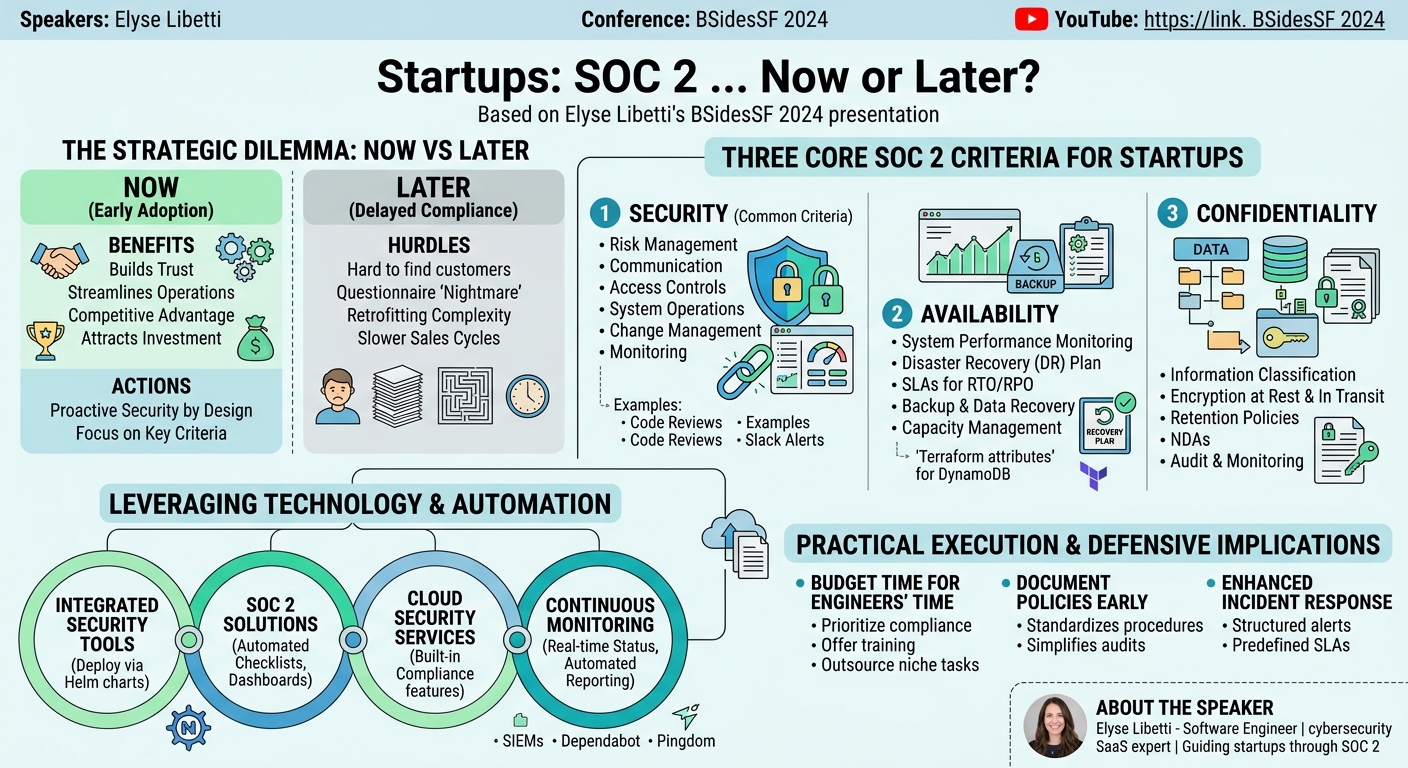
In her BSidesSF 2024 talk, "Startups: SOC 2 ... Now or Later?", Elyse Libetti, a seasoned software engineer with extensive experience in the cybersecurity SaaS space, addresses a critical dilemma faced by early-stage companies: when to prioritize SOC 2 compliance. Libetti argues passionately that rather than viewing SOC 2 as a burdensome, later-stage requirement, startups should embrace it early as a fundamental business growth strategy. She emphasizes that proactive compliance not only builds trust with customers and investors but also streamlines operations and provides a significant competitive advantage.
Key moments
- 0:40 Understanding SOC 2 requirements and the five trust service criteria
- 1:00 Defining scope to reduce complexity and cost
- 2:00 Documenting policies and procedures early
- 2:20 Leveraging technology and automation for continuous monitoring and logging
- 6:00 Change management and code review processes for security and integrity
- 7:00 Disaster Recovery, backup, and data recovery procedures
- 8:00 Information classification, access restrictions, and encryption for confidentiality
- 16:00 Leveraging tooling, automating maintenance, and budgeting engineer time
Startups: SOC 2 ... Now or Later?
Speakers: Elyse Libetti
Conference: BSidesSF 2024
YouTube: https://www.youtube.com/watch?v=aeOlFMo7GtQ
Overview
In her BSidesSF 2024 talk, "Startups: SOC 2 ... Now or Later?", Elyse Libetti, a seasoned software engineer with extensive experience in the cybersecurity SaaS space, addresses a critical dilemma faced by early-stage companies: when to prioritize SOC 2 compliance. Libetti argues passionately that rather than viewing SOC 2 as a burdensome, later-stage requirement, startups should embrace it early as a fundamental business growth strategy. She emphasizes that proactive compliance not only builds trust with customers and investors but also streamlines operations and provides a significant competitive advantage.
The presentation delves into the core components of SOC 2, focusing on the most relevant Trust Service Criteria (TSC) for startups: Security, Availability, and Confidentiality. Libetti provides practical advice on how to implement robust security measures, leverage technology and automation, and establish clear processes to achieve and maintain compliance efficiently. Her insights are particularly valuable for engineering and DevOps teams, offering a roadmap to integrate compliance into daily workflows without hindering rapid development.
This article will explore Libetti's comprehensive framework for navigating the SOC 2 landscape, detailing the technical requirements, the strategic benefits of early adoption, and actionable steps for startups to achieve compliance effectively. By demystifying SOC 2 and presenting it as an enabler rather than an obstacle, Libetti empowers startups to build secure, reliable, and trustworthy products from inception, fostering long-term success in a competitive market.
Background
▶ Watch: Understanding SOC 2 requirements and the five trust service criteria (0:40)
SOC 2 (System and Organization Controls 2) is an auditing procedure that ensures service providers securely manage data to protect the interests of their clients and the privacy of their customers. Developed by the American Institute of Certified Public Accountants (AICPA), SOC 2 reports are crucial for demonstrating a company's commitment to security, availability, processing integrity, confidentiality, and privacy of customer data. For startups, the decision of when to pursue SOC 2 compliance often presents a significant challenge, balancing the need for rapid product development and market entry against the resource-intensive nature of compliance.
Libetti highlights that many startups initially defer SOC 2, viewing it as a "later" problem to be tackled once funding is secured or a certain level of maturity is reached. This delay, however, can lead to significant hurdles, as illustrated by her personal anecdote of a previous role in healthcare cybersecurity where the lack of early compliance made it "hard to find customers" and led to a "nightmare" year-long process to achieve certification, ultimately ending in defunding. The problem arises because potential clients, especially medium to large enterprises, increasingly demand proof of robust security practices before engaging with new vendors. Without SOC 2, startups face extensive questionnaires, on-site visits, and a general atmosphere of mistrust, slowing down sales cycles and hindering growth.
The SOC 2 framework is built around five Trust Service Criteria (TSC):
- Security: Protection against unauthorized access, use, disclosure, modification, or destruction of information. This is considered the "common criteria" and the bare minimum for any SOC 2 report.
- Availability: Ensuring systems are available for operation and use as committed or agreed.
- Processing Integrity: Ensuring system processing is complete, valid, accurate, timely, and authorized.
- Confidentiality: Protecting information designated as confidential from unauthorized access or disclosure.
- Privacy: Protecting personal information in conformity with the entity’s privacy notice and generally accepted privacy principles.
For startups, Libetti advises focusing initially on the top three most common and impactful criteria: Security, Availability, and Confidentiality. These three areas directly address the primary concerns of potential clients regarding data protection and system reliability, making them critical for building early trust and securing foundational business relationships.
Key Findings
▶ Watch: Documenting policies and procedures early (2:00)
Elyse Libetti's presentation distills several critical findings regarding SOC 2 compliance for startups, challenging conventional wisdom and offering a strategic perspective:
- SOC 2 is a Business Growth Strategy, Not Just a Checklist: The most overarching finding is that SOC 2 should not be perceived merely as a regulatory hurdle or a "boring topic," but rather as an essential driver for business growth. Achieving compliance demonstrates a commitment to security, builds customer trust, and significantly eases the sales process, especially when targeting larger enterprise clients ("whales"). It elevates a startup's reputation and can differentiate it from competitors.
- Early Adoption is Crucial for Competitive Advantage: Libetti strongly advocates for pursuing SOC 2 "now" rather than "later." Starting early, even with a minimal viable product or prototype, allows companies to embed security practices from the ground up, avoiding the costly and time-consuming retrofitting efforts later. This proactive approach provides a competitive edge, attracts investment by signaling maturity and readiness for growth, and fosters long-term trust and loyalty with customers, vendors, and partners.
- Automation and Tooling are Key to Efficient Compliance: A central theme is the strategic use of technology and automation to streamline compliance efforts. Libetti emphasizes that leveraging integrated security tools, SOC 2-specific solutions (like automated checklists and dashboards), and cloud-based security services with built-in compliance features can significantly reduce manual workload, save time, and cut costs associated with compliance. Tools that continuously monitor, report, and even automatically submit code changes (e.g., Pull Requests for policy violations) are highlighted as game-changers.
- Budgeting for Time and Resources (Especially Engineers' Time) is Essential: While often seen as a financial cost, Libetti stresses the importance of budgeting for the time and effort of the engineering team. By prioritizing compliance tasks, allocating specific time for them, and providing adequate training and support, startups can integrate compliance into their development lifecycle without causing significant disruption. Outsourcing niche compliance tasks to experts can further alleviate the burden on internal teams.
- Focus on Core Trust Service Criteria First: For early-stage companies, Libetti recommends prioritizing the Security, Availability, and Confidentiality criteria. These three are the most commonly requested and provide the most immediate value in terms of building trust and demonstrating foundational security posture, allowing startups to scope their initial compliance efforts effectively.
Technical Deep Dive
▶ Watch: Change management and code review processes for security and integrity (6:00)
Libetti's talk provides a detailed technical breakdown of the most critical SOC 2 Trust Service Criteria (TSC) for startups: Security, Availability, and Confidentiality. She outlines specific controls and practices that engineering and DevOps teams must implement, emphasizing the role of technology and automation.
Security (Common Criteria)
The Security criterion, often referred to as the common criteria, is the foundational requirement for any SOC 2 report. It encompasses several key areas:
- Risk Management: Startups must assess and manage risks to information systems to prevent, detect, and respond to potential security breaches. This involves identifying vulnerabilities and threats and implementing controls to mitigate them.
- Communication and Information Management: Secure handling, storage, and transmission of information are paramount. Policies must ensure that sensitive data does not leave the organization's defined boundaries without proper controls.
- Access Controls: Implementing strong logical and physical access controls is crucial to restrict unauthorized access to systems and data. Libetti stresses the principle of least privilege: "nobody should have access unless it is required for their job." This includes robust authentication mechanisms, role-based access control (RBAC), and regular review of access privileges.
- System Operations: Maintaining secure system operations involves continuous monitoring, detection, and response to security incidents. Simple yet effective measures include Slack alerts for critical events, utilizing tools like AWS Incident Manager for structured incident response, and Pingdom or DataDog for system health and performance monitoring. These tools help in quickly identifying and addressing operational issues.
- Change Management: This control focuses on managing modifications to systems and software to ensure ongoing security and integrity. Key practices include:
- Code Reviews: Requiring one or two independent reviews before code merges into staging, QA, beta, or production environments.
- Code Quality Standards: Establishing and adhering to guidelines for secure coding practices.
- Documented Processes: Having clear, documented procedures for how changes are proposed, reviewed, tested, and deployed. This is critical for annual audits, as SOC 2 Type 2 requires continuous compliance, not just a "frozen in time" snapshot like Type 1.
- Monitoring and Evaluation: Regularly monitoring security controls for effectiveness and compliance with policies and standards. Libetti suggests leveraging "checklist tools" and "new AI tools" that can automate this process, reducing the need for manual oversight.
Availability
The Availability criterion ensures that systems are operational and accessible when needed, meeting agreed-upon performance criteria.
- Network Performance Monitoring: Tools like DataDog, Sumo Logic, or Pingdom are essential for monitoring network performance and availability, ensuring systems operate as intended and are accessible to users.
- System Availability: Implementing controls to ensure systems are available for operational use as committed. This includes redundancy, failover mechanisms, and robust infrastructure.
- Disaster Recovery (DR): A critical component, often overlooked even by large companies. Startups must have a predefined Disaster Recovery Plan outlining steps to restore operations in the event of a major outage or incident. This includes defining Service Level Agreements (SLAs) for recovery time objectives (RTO) and recovery point objectives (RPO). Libetti poses the crucial question: "What are you going to do? How long is it going to take you to get back online if someone hijacks your SCM?"
- Backup and Data Recovery: Implementing robust backup processes and data recovery procedures to maintain data integrity and availability. For databases, cloud providers often offer simple solutions, such as a Terraform attribute to enable daily, hourly, or even 30-minute snapshots for services like DynamoDB. This "set it and forget it" approach, when properly configured, becomes a policy that ensures data resilience.
- Capacity Management: Regularly evaluating and managing system capacity to handle current and anticipated loads while maintaining system availability. This prevents performance degradation and outages during peak usage.
Confidentiality
The Confidentiality criterion focuses on protecting information designated as confidential from unauthorized access or disclosure. This is particularly vital for B2B startups handling sensitive client data.
- Information Classification: Classifying information to indicate which data is confidential and establishing handling requirements based on its classification. This helps in applying appropriate controls to different data types.
- Access Restrictions: Similar to security, implementing strict access controls to confidential information, ensuring only authorized personnel with a legitimate business need can access it.
- Encryption: Utilizing encryption technologies to protect confidential information both at rest (e.g., encrypted databases, storage volumes) and in transit (e.g., TLS for network communications). While not every piece of data in a front-end application might require encryption, it should be a policy for all sensitive data. Automation tools can flag non-compliance with encryption policies.
- Retention and Disposal Policies: Establishing clear policies and procedures for retaining confidential information only as long as needed and securely disposing of it when no longer required. This requires documenting processes, which Libetti notes is often a challenge for engineers.
- Agreements and Contracts: Utilizing confidentiality agreements (NDAs) and clauses in contracts with third parties to ensure they adhere to the organization's confidentiality requirements.
- Audit and Monitoring: Regularly auditing access and use of confidential information to detect and respond to breaches, ensuring continuous protection of sensitive data.
Leveraging Technology and Automation
Throughout the deep dive, Libetti consistently emphasizes the role of technology and automation in achieving and maintaining compliance:
- Integrated Security Tools: Implementing tools that integrate seamlessly with existing systems to monitor and enforce security controls with minimal manual intervention. Many modern products offer Helm charts for easy deployment in Kubernetes environments.
- SOC 2 Specific Solutions: Choosing software solutions designed specifically for SOC 2 compliance, offering automated checklists, dashboards, and continuous monitoring capabilities.
- Cloud-Based Security Services: Employing cloud services with built-in compliance features, such as automated database snapshots (e.g., Terraform attributes for DynamoDB), reducing the need for internal tool development.
- Continuous Monitoring Systems: Deploying systems that automatically monitor compliance status in real-time, alerting teams to potential non-compliance issues before they escalate.
- Automated Reporting: Using tools that generate compliance reports automatically, saving time and ensuring accuracy.
- Regular Updates and Patches: Setting up systems to automatically handle software updates and patches. SIEMs often have plugins for this, and tools like GitHub Dependabot can automatically create Pull Requests for dependency updates.
By integrating these technical controls and leveraging automation, startups can build a robust security posture that not only meets SOC 2 requirements but also fosters a culture of security and operational excellence from the outset.
Demo / Proof of Concept
▶ Watch: Disaster Recovery, backup, and data recovery procedures (7:00)
While Elyse Libetti's presentation did not feature a live coding demonstration, she effectively illustrated the practical application of automation and tooling in SOC 2 compliance through conceptual examples and screenshots of existing solutions. She highlighted how these tools serve as a "proof of concept" for her core argument: that compliance can be streamlined and integrated into daily engineering workflows.
Libetti presented a screenshot of a generic "checklist tool" (with branding stripped, though she noted many in the audience would recognize it). She explained how such tools function:
- Policy Input: Users input their organizational policies and security requirements.
- IAM Access: The tool is granted appropriate Identity and Access Management (IAM) permissions to monitor the company's cloud infrastructure and systems.
- Continuous Monitoring: It continuously scans the environment against the defined policies.
- Action Item Generation: If a violation or non-compliance is detected (e.g., a resource lacking encryption at rest, or an S3 bucket with public access), the tool generates an "action item" or "Bing" alert. This immediately flags areas needing improvement, whether for an existing system aiming for certification or ongoing compliance.
Furthermore, Libetti mentioned a tool she and her team built, which they used to achieve their own SOC 2 Type 1 and Type 2 certifications. She described its advanced capabilities:
- Automated PR Submission: Instead of just flagging issues, this tool "will submit PRs for you," directly addressing policy violations in the codebase or infrastructure-as-code. This significantly reduces the manual burden on engineers and DevOps teams, making the annual compliance cycle much simpler.
- Policy Enforcement: By integrating organizational-level policies, the tool ensures that security standards are consistently applied.
- Vulnerable Product Testing: She noted that they ran this tool against "purposefully vulnerable products" and immediately identified issues like "no client authentication," "no dedicated tenancy," "no data versioning," and "no encryption at rest." The tool then precisely identified "what resources, etc., that were violating that policy."
These examples serve as a powerful demonstration of how modern compliance tools can bridge the gap between security requirements and engineering practices. They show that SOC 2 doesn't have to be a manual, reactive process but can be an automated, proactive part of the development lifecycle, saving time and ensuring continuous adherence to security standards.
Defensive Implications
▶ Watch: Leveraging tooling, automating maintenance, and budgeting engineer time (16:00)
The insights shared by Elyse Libetti offer critical defensive implications for startups and established organizations alike, shifting the perspective on SOC 2 from a mere audit to a strategic defensive posture.
- Proactive Security by Design: The most significant implication is the call for security by design. By implementing SOC 2 controls early, startups embed robust security measures into their architecture and processes from inception. This is inherently more defensible than attempting to retrofit security later, which often leaves gaps and vulnerabilities. Defenders should advocate for integrating security requirements into the earliest stages of product development, treating them as core features rather than afterthoughts.
- Enhanced Incident Response Capabilities: Early SOC 2 adoption, particularly focusing on the Security and Availability criteria, directly strengthens incident response. Requirements for system operations monitoring (e.g., Slack alerts, AWS Incident Manager, DataDog), change management, and comprehensive Disaster Recovery Plans mean that organizations are better prepared to detect, respond to, and recover from security incidents. Having predefined SLAs for incident response and an on-call schedule ensures that teams can react swiftly and effectively, minimizing downtime and data loss. This proactive planning reduces the "scrambling around" during a crisis, allowing for more efficient use of time and resources.
- Robust Access Control and Data Protection: The emphasis on strong access controls (least privilege) and confidentiality measures (information classification, encryption at rest and in transit, retention policies) directly translates to better data protection. Defenders can leverage these SOC 2 requirements to enforce stricter access policies, ensure sensitive data is appropriately encrypted throughout its lifecycle, and establish clear guidelines for data handling and disposal. This reduces the attack surface and mitigates the risk of unauthorized data access or exfiltration.
- Continuous Compliance and Risk Management: SOC 2 is not a one-time event; Type 2 requires continuous compliance. This necessitates ongoing monitoring and evaluation of security controls. Defenders should implement automated tools (e.g., SIEMs, Dependabot, compliance checklist tools) that provide real-time visibility into compliance status, alert on deviations, and even automate remediation (e.g., submitting PRs for policy violations). This continuous feedback loop allows for proactive risk management, identifying and mitigating vulnerabilities before they can be exploited.
- Improved Operational Resilience: The Availability criterion, with its focus on network performance monitoring, system availability, and robust backup/data recovery procedures, directly contributes to operational resilience. Defenders can use these guidelines to build more fault-tolerant systems, implement effective backup strategies (e.g., automated DynamoDB snapshots via Terraform attributes), and ensure business continuity even in the face of adverse events.
- Documentation as a Defensive Asset: Libetti repeatedly stresses the importance of documenting policies and procedures. For defenders, comprehensive documentation is a critical asset. It ensures consistency in security practices, reduces the learning curve for new team members, and provides a clear record of controls for audits and incident investigations. A well-documented incident response plan, for instance, is invaluable during a stressful security event.
By embracing SOC 2 early and leveraging the technical controls and automation strategies outlined, startups can build a strong defensive foundation that protects their assets, maintains customer trust, and ensures long-term operational integrity.
Key Takeaways
- SOC 2 is a Strategic Business Enabler: View SOC 2 not as a compliance burden, but as a critical business growth strategy that builds trust, attracts investment, and provides a competitive advantage, especially with enterprise clients.
- Early Adoption is Paramount: Implementing SOC 2 controls "now" rather than "later" is significantly more efficient and cost-effective, allowing security to be built in from the ground up and avoiding costly retrofitting.
- Leverage Automation and Tooling: Utilize integrated security tools, SOC 2-specific solutions, and cloud-native features (e.g., Terraform attributes for snapshots, Dependabot for updates) to automate compliance monitoring, reporting, and even remediation, saving time and resources.
- Prioritize Key Trust Service Criteria: For startups, focus initially on the Security, Availability, and Confidentiality criteria, as these address the most common client concerns and provide the most immediate value.
- Budget for Engineer Time and Document Everything: Allocate specific time and resources for engineers to work on compliance tasks, provide training, and outsource where necessary. Crucially, establish robust documentation practices early to standardize procedures and streamline audits.
- Continuous Compliance is Key: SOC 2 Type 2 requires ongoing adherence. Implement continuous monitoring and evaluation processes to ensure controls remain effective and compliant with evolving policies and threats.
About the Speaker(s)
Elyse Libetti is a highly experienced software engineer with a diverse background in various technical roles. She has served as a Senior Software Engineer, Head of R&D, and Team Lead, starting her career as a front-end engineer. Throughout her professional journey, Libetti has consistently worked within the cybersecurity space, focusing on building Software-as-a-Service (SaaS) and niche B2B cybersecurity products. Her expertise lies in navigating the complex landscape of cybersecurity compliance, particularly SOC 2, for startups. She shared personal anecdotes from her previous role in healthcare cybersecurity and her current position as a founding engineer, where she successfully guided her team through rapid SOC 2 Type 1 and Type 2 certifications.
Reviews
Dr. Zero (Offensive Security Researcher) — STRONG ACCEPT
This talk provides a pragmatic, engineer-focused guide for startups navigating SOC 2 compliance, emphasizing early adoption, automation, and strategic resource allocation. While SOC 2 itself is hardly groundbreaking, the speaker's direct approach to integrating compliance into the development lifecycle, leveraging existing tools, and budgeting for it from the outset offers valuable, actionable advice for technical teams. It cuts through the typical compliance fluff to deliver concrete steps.
Heather Calloway (CISO) — STRONG ACCEPT
This session effectively articulates the critical business imperative of early SOC 2 compliance for startups, framing it not as a mere technical checklist but as a strategic advantage for growth, customer trust, and investor attraction. The speaker, drawing from engineering experience, provides a clear, actionable roadmap for integrating compliance into the development lifecycle, emphasizing automation and process standardization to mitigate risk and enhance operational resilience.