Is Q-Day Worse than Y2K? Strategies for Surviving the Quantum Threats
Sandip Dholakia
BSidesSF 2026 · Day 1 · AMC Theatre 02
Overview
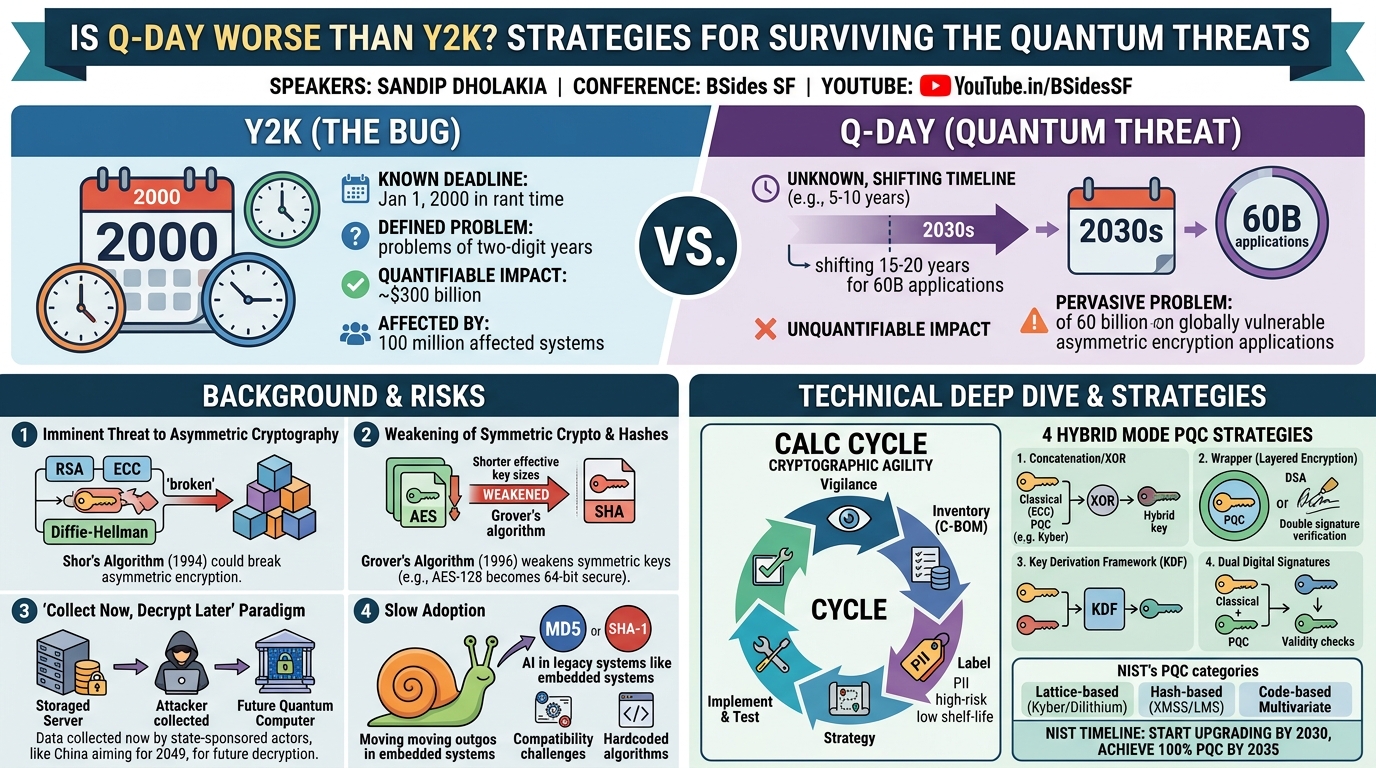
In his compelling talk at BSides SF, Sandip Dholakia, a seasoned expert with 25 years in the cryptography industry, tackled the existential threat of quantum computing to our current cryptographic infrastructure. Titled "Is Q-Day Worse than Y2K? Strategies for Surviving the Quantum Threats," Dholakia systematically dismantled the complacency surrounding the impending "Q-Day"—the moment quantum computers become powerful enough to break conventional encryption. He argues that Q-Day presents a far more complex and insidious challenge than the Y2K bug, primarily due to unknown timelines, unquantifiable impact, and the pervasive nature of vulnerable cryptographic systems.
Key moments
- 0:00 Introduction to Q-Day threats and speaker
- 2:00 Speaker's 25 years experience in cryptography
- 3:30 What is Q-Day and when is it expected?
- 4:15 Comparing Q-Day's uncertainty to Y2K
- 6:20 Understanding quantum superposition explained simply
- 8:00 Quantum entanglement and coherence time explained
Is Q-Day Worse than Y2K? Strategies for Surviving the Quantum Threats
Speakers: Sandip Dholakia
Conference: BSides SF
YouTube: https://www.youtube.com/watch?v=cgBbWQ2TncI
Overview
In his compelling talk at BSides SF, Sandip Dholakia, a seasoned expert with 25 years in the cryptography industry, tackled the existential threat of quantum computing to our current cryptographic infrastructure. Titled "Is Q-Day Worse than Y2K? Strategies for Surviving the Quantum Threats," Dholakia systematically dismantled the complacency surrounding the impending "Q-Day"—the moment quantum computers become powerful enough to break conventional encryption. He argues that Q-Day presents a far more complex and insidious challenge than the Y2K bug, primarily due to unknown timelines, unquantifiable impact, and the pervasive nature of vulnerable cryptographic systems.
Dholakia's presentation served as a critical wake-up call, emphasizing that the theoretical capabilities of quantum algorithms like Shor's and Grover's are rapidly approaching practical realization. He highlighted the significant risk posed by the "collect now, decrypt later" attack paradigm, where adversaries stockpile currently encrypted sensitive data, anticipating future decryption when quantum capabilities mature. The talk not only elucidated the gravity of the quantum threat but also laid out a practical framework for cryptographic agility, urging organizations to adopt proactive strategies and NIST-recommended Post-Quantum Cryptography (PQC) to secure their digital assets before Q-Day arrives.
Background
▶ Watch: Introduction to Q-Day threats and speaker (0:00)
The foundation of modern digital security rests heavily on cryptography, particularly asymmetric encryption algorithms like RSA and Elliptic Curve Cryptography (ECC), which underpin secure communications, digital signatures, and data integrity. These algorithms derive their security from the computational difficulty of certain mathematical problems, such as factoring large prime numbers for RSA or the discrete logarithm problem for ECC. For decades, the assumption has been that even the most powerful supercomputers would take an unfeasibly long time—billions of years—to solve these problems.
However, this assumption is fundamentally challenged by the advent of quantum computing. In 1994, Peter Shor of MIT published a theoretical algorithm, now known as Shor's algorithm, demonstrating that a sufficiently powerful quantum computer could factor large integers exponentially faster than classical computers. This directly threatens the security of RSA, ECC, and Diffie-Hellman key exchange. Two years later, in 1996, Lov Grover at Caltech introduced Grover's algorithm, which can significantly speed up unstructured database searches, effectively weakening symmetric encryption algorithms like AES and hash functions like SHA by reducing their effective key strength.
The comparison to Y2K is illustrative but ultimately highlights the greater complexity of Q-Day. Y2K had a known deadline (January 1, 2000), a clearly defined problem (two-digit year representation), and a quantifiable impact and cost estimate (around $300 billion). In contrast, Q-Day's arrival is uncertain, with academic and industry experts often citing a 5-10 year horizon, a prediction that has consistently shifted. The speaker notes estimates of 60 billion applications globally using asymmetric encryption, making the scope of impact and the cost of remediation largely unknown. This uncertainty, coupled with the long lead times required for cryptographic upgrades, creates a far more precarious situation than Y2K.
Key Findings
▶ Watch: What is Q-Day and when is it expected? (3:30)
Sandip Dholakia's talk underscored several critical findings regarding the quantum threat and the necessary response:
- Imminent Threat to Asymmetric Cryptography: Shor's algorithm, published in 1994, theoretically "breaks" current asymmetric encryption standards like RSA, ECC, and Diffie-Hellman. While practical implementation requires a quantum computer with a sufficient number of stable cubits, the theoretical vulnerability has existed for decades.
- Weakening of Symmetric Cryptography and Hash Functions: Grover's algorithm, developed in 1996, can weaken symmetric algorithms (e.g., AES) and hash functions (e.g., SHA) by reducing their effective key length. This means that existing key sizes might no longer offer adequate protection, necessitating larger key sizes or a move to new algorithms.
- The "Collect Now, Decrypt Later" Paradigm: A primary concern is the collection and storage of currently encrypted sensitive data by adversaries, with the intent to decrypt it once quantum computers are capable. Dholakia cited a blog by Mike Maglin suggesting active state-sponsored espionage, with China reportedly collecting data for decryption by 2049 (a date pushed back from 2040 due to focus on AI). This threat is particularly critical for "long shelf life data" such as birth dates, Social Security Numbers, and mother's maiden names, which remain relevant for decades.
- Rapid Progress in Quantum Hardware: Despite the significant challenge of building stable quantum computers, progress is accelerating. While breaking 256-bit ECC in an hour would require 317 million noise-free cubits (as of August 2023), Google's Craig Gidney projected breaking it in a week with 1 million noisy cubits by May 2025. This indicates that while the target is still distant, the pace of innovation is reducing the estimated requirements.
- Slow Adoption of Cryptographic Updates: Historically, the industry has been slow to replace weakened or broken cryptographic algorithms. Dholakia provided examples like MD5, which was attacked in 2004 but remained in use until 2015, and SHA-1, cracked in 2005 but still present in systems. This inertia is attributed to challenges like backward compatibility, lack of regular upgrades due to performance overhead, resource availability issues, and hardcoding of algorithms in legacy embedded systems (e.g., the Heartbleed vulnerability, discovered in 2012, still affected 150,000 implementations eight years later).
- NIST's PQC Standardization and Timeline: The National Institute of Standards and Technology (NIST) has been actively working on standardizing Post-Quantum Cryptography (PQC) algorithms. Dholakia highlighted NIST's recommendation to start upgrading systems by 2030 and achieve 100% PQC implementation by 2035. This provides a concrete, albeit challenging, timeline for organizations to follow.
These findings collectively paint a picture of an inevitable and complex security transformation that requires immediate attention and strategic planning.
Technical Deep Dive
▶ Watch: Comparing Q-Day's uncertainty to Y2K (4:15)
The core of the quantum threat stems from fundamental differences between traditional and quantum computing. A classical bit can exist in one of two states: 0 or 1. A cubit, however, leverages quantum mechanical phenomena to exist in a superposition of both 0 and 1 simultaneously. This allows a quantum computer to process multiple possibilities concurrently. Furthermore, entanglement allows cubits to become linked, such that the state of one instantaneously influences the state of another, regardless of physical distance. These properties, combined with the ability to maintain their quantum state for a sufficient coherence time, give quantum computers their immense computational power.
Shor's algorithm (1994) is the primary quantum threat to asymmetric cryptography. It efficiently solves the integer factorization problem and the discrete logarithm problem, which are the mathematical underpinnings of RSA, ECC, and Diffie-Hellman. For instance, factoring a 2048-bit RSA key, which is computationally intractable for classical computers, could be achieved in a reasonable timeframe by a quantum computer with enough stable cubits. Dholakia noted that even in 1994, Shor's theoretical work warned the industry, but practical implementation was still far off.
Grover's algorithm (1996) poses a threat to symmetric cryptography and hash functions. While it doesn't "break" these algorithms in the same way Shor's algorithm breaks asymmetric ones, it can reduce the effective key length by a square root factor. For example, a 128-bit AES key would effectively become 64-bit secure against a quantum attack, meaning a brute-force attack would take 2^64 operations instead of 2^128. This necessitates a doubling of key sizes for symmetric algorithms (e.g., moving from AES-128 to AES-256) to maintain equivalent security levels in the post-quantum era.
The transition to Post-Quantum Cryptography (PQC) involves replacing or augmenting current cryptographic primitives with new ones designed to be resistant to quantum attacks. Dholakia emphasized that this primarily involves new math-based problems rather than quantum cryptography (QKD), which relies on quantum physics for secure key distribution. QKD, while theoretically unhackable due to the laws of physics (any eavesdropping distorts the quantum state, alerting the parties), is currently very difficult and expensive to implement, with limited range (e.g., 1 kilometer in a UK lab). Therefore, PQC focuses on classical mathematical problems that are believed to be hard for both classical and quantum computers.
NIST has been leading the standardization effort for PQC, evaluating various candidate algorithms. Dholakia outlined four main categories:
- Code-based cryptography: Based on error-correcting codes, these algorithms (e.g., McEliece) have been around since 1978. They offer strong security but often come with very large key sizes and can be computationally slow. While not selected in NIST's initial PQC "final four," they were contenders.
- Lattice-based cryptography: This category is a prominent choice for NIST's PQC standards. It relies on the difficulty of problems in vector algebra on high-dimensional lattices (e.g., finding the shortest vector in a lattice). Lattice-based schemes are relatively efficient, robust, and support advanced functionalities like Fully Homomorphic Encryption (FHE). Key examples include Kyber for key encapsulation and Dilithium for digital signatures, both part of NIST's recommended algorithms.
- Hash-based cryptography: Primarily used for digital signatures (e.g., XMSS, LMS), these schemes derive their security from the collision resistance of cryptographic hash functions. They are well-understood and offer provable security but are often stateful, meaning the signing key changes after each use, which can complicate implementation.
- Multivariate cryptography: These schemes are based on solving systems of multivariate quadratic equations over finite fields. While potentially very fast for signatures, they often suffer from large key sizes and have faced vulnerabilities in some candidate algorithms, leading to them not being selected in NIST's final four.
To manage the migration to PQC, Dholakia proposed a framework for cryptographic agility, which he termed the CALC cycle:
- Vigilance: Continuously monitor the threat landscape, quantum advancements, and NIST recommendations.
- Inventory (C-BOM): Create a comprehensive Cryptography Bill of Materials (C-BOM) to identify all cryptographic assets, algorithms, key sizes, and protocols in use across applications and systems. This is crucial for understanding the scope of the problem.
- Label: Classify data and applications based on sensitivity, risk, and "shelf life" (e.g., PII, high-risk data, less critical data).
- Strategy: Define a clear strategy for protecting labeled data, deciding whether to use PQC, classical crypto, or a hybrid mode combining both.
- Roadmap: Develop a phased implementation roadmap, prioritizing the most critical data and systems.
- Implement & Test: Execute the migration plan and rigorously test new PQC implementations, emphasizing "kicking the tires" to ensure functionality and security. The cycle then restarts, advocating for continuous vigilance and adaptation.
Dholakia also detailed four main strategies for implementing hybrid mode PQC, which combines classical (e.g., ECC) and PQC algorithms to provide an additional layer of security during the transition:
- Concatenation/XOR: Generate two separate keys, one from a classical algorithm and one from a PQC algorithm. The final shared secret is derived by XORing or concatenating these keys. Security is as strong as the strongest link, meaning if one algorithm holds, the combined key remains secure.
- Wrapper (Layered Encryption): One algorithm acts as a wrapper for the other. For example, a PQC key might encrypt a classical key, or vice-versa. If the outer layer is compromised, the inner layer still needs to be broken. This is similar to the approach for digital signature algorithm (DSA), where both classical and PQC signatures must be valid.
- Key Derivation Framework (KDF): Two keys (classical and PQC) are fed into a Key Derivation Function (KDF), which generates a combined, robust key. An attacker would need to break both original keys to compromise the derived key.
- Dual Digital Signatures: For digital signatures, both a classical and a PQC signature are generated and verified. Both must be true for the signature to be accepted, providing resilience if one algorithm is compromised.
These hybrid approaches, while potentially increasing key sizes and computational overhead, offer a pragmatic way to enhance security during the uncertain transition period to a fully quantum-resistant cryptographic landscape.
Demo / Proof of Concept
▶ Watch: Understanding quantum superposition explained simply (6:20)
The talk did not include a live demonstration or a specific proof of concept of quantum algorithm attacks or PQC implementations. Sandip Dholakia focused on the theoretical underpinnings of quantum threats and strategic planning for cryptographic agility.
Defensive Implications
▶ Watch: Quantum entanglement and coherence time explained (8:00)
The implications for defenders are profound and necessitate a fundamental shift in cryptographic posture from reactive patching to proactive, agile management. Dholakia's CALC cycle provides a robust roadmap for this transformation:
- Vigilance and Awareness: Organizations must stay informed about the latest developments in quantum computing, PQC standardization, and emerging threats. This includes monitoring NIST's PQC recommendations and timelines.
- Comprehensive Cryptographic Inventory (C-BOM): The immediate and most critical step is to develop a complete Cryptography Bill of Materials (C-BOM). This involves identifying every instance of cryptographic usage—algorithms, key lengths, protocols (e.g., TLS 1.0, SHA-1, MD5)—across all applications, systems, and devices. This discovery phase is often the most challenging due to the pervasive and often embedded nature of cryptography.
- Data Classification and Risk Assessment: Once cryptographic assets are inventoried, they must be classified based on the sensitivity and "shelf life" of the data they protect. Long shelf life data (e.g., PII, intellectual property, national security secrets) requires immediate attention due to the "collect now, decrypt later" threat.
- Strategic Planning for PQC Migration: Based on the inventory and risk assessment, organizations need to formulate a clear strategy for migrating to PQC. This involves deciding whether to adopt a pure PQC approach, a hybrid mode (classical + PQC), or a phased transition. The hybrid approach is often recommended as a robust interim solution, providing security even if PQC algorithms have unforeseen vulnerabilities.
- Embrace Cryptographic Agility: Moving away from hardcoded cryptographic parameters to configurable variables is crucial. This allows for rapid swapping of algorithms and key sizes without requiring extensive code recompilation and deployment, addressing the historical inertia in cryptographic updates. Key lengths and algorithms should be managed as configuration variables.
- Resource Allocation and Performance Planning: Implementing PQC, especially in hybrid modes, can lead to larger key sizes and increased computational overhead, potentially slowing down applications. Defenders must plan for necessary hardware upgrades (CPU, RAM) and infrastructure adjustments, particularly for on-premises systems, to maintain performance and user experience. Cloud environments offer more flexibility for scaling resources.
- Compliance and Regulatory Alignment: Adhering to standards like PCI DSS, HIPAA, and emerging regulations like DORA (Digital Operational Resilience Act) will increasingly mandate the use of stronger, quantum-resistant cryptography. Early adoption of PQC will help ensure compliance and avoid future penalties.
- Prioritized Roadmap and Testing: Develop a phased roadmap for PQC implementation, prioritizing high-risk and long shelf life data. Rigorous testing of new PQC implementations is essential to ensure functionality, performance, and security before widespread deployment. The speaker emphasized the need to "kick the tires" thoroughly.
The NIST timeline, urging organizations to start upgrading by 2030 and achieve 100% PQC by 2035, provides a concrete target. Defenders must recognize that the time to act is now, as cryptographic transitions are complex, time-consuming, and cannot be rushed when Q-Day eventually arrives.
Key Takeaways
- Q-Day is a "When," Not an "If": The advent of quantum computers capable of breaking current encryption is inevitable, posing a greater, more complex threat than Y2K due to unknown timelines and unquantifiable impact.
- The "Collect Now, Decrypt Later" Threat is Real: Adversaries are actively collecting long shelf life data, anticipating future decryption when quantum capabilities mature, making immediate PQC migration for sensitive data critical.
- Cryptographic Agility is Essential: Organizations must adopt a framework for continuous cryptographic vigilance, inventory, risk assessment, and flexible implementation (the CALC cycle) to adapt to evolving threats and algorithm changes.
- Hybrid PQC is a Prudent Interim Strategy: Combining classical and post-quantum cryptographic algorithms in a hybrid mode provides enhanced security and resilience during the uncertain transition period, mitigating risks from potential vulnerabilities in new PQC schemes.
- NIST Provides a Clear Timeline: The NIST recommendation to begin PQC upgrades by 2030 and achieve full PQC implementation by 2035 offers a critical deadline for organizations to plan and execute their cryptographic transformation.
About the Speaker(s)
Sandip Dholakia is a highly experienced professional in the technology and security landscape, boasting nearly 25 years in the industry. His deep expertise in cryptography is evident through his significant contributions, including authoring a book on the subject and holding a patent in cryptography. Currently, Sandip chairs SAP's innovation hub for cryptography, where he is actively involved in planning and implementing crypto agility strategies. Despite acknowledging a speech impairment, Dholakia delivered a comprehensive and insightful presentation, leveraging his extensive background to educate the audience on the critical challenges and strategic solutions for surviving quantum threats.
Reviews
Dr. Zero (Offensive Security Researcher) — SOLID
Competent, well-structured survey of PQC threat landscape from someone who clearly knows the material. Nothing here will surprise a practitioner who's followed NIST's PQC process, but the CALC framework and hybrid-mode taxonomy are organized well enough to be useful for an audience still getting their bearings on quantum migration.
Heather Calloway (CISO) — SOLID
Dholakia is a credible practitioner with genuine depth, and the CALC framework and C-BOM concept give defenders something concrete to carry out. But this talk stays firmly in the explainer lane — it covers the quantum threat competently without surfacing the governance failures, organizational accountability gaps, or board-level decision logic that would make it essential for security leaders.