The Misconfig Matrix: From Chaos to Control
Cloud Village @ DEF CON 33 · Day 1 · Cloud Village
Overview
In "The Misconfig Matrix: From Chaos to Control," Ritwick and Harry P. tackle the pervasive challenge of managing security in complex, multi-cloud environments. The talk addresses the overwhelming "word soup" of new security tools emerging daily, which makes it incredibly difficult for product security engineers and cloud engineers to maintain an effective security posture. With limited resources and budgets, organizations must tailor their cloud security models to their size and maturity, all while navigating evolving compliance regulations and diverse threat landscapes across multi-cloud deployments. This session provides a practical framework for evaluating and selecting open-source Cloud Security Posture Management (CSPM) tools to bring order to this inherent chaos.
Key moments
- 0:40 Problem statement: cloud security challenges and limited resources
- 1:40 Lab setup: three vulnerable multi-cloud environments
- 2:00 Workshop agenda: cloud setups, CSPM tools, and comparison
- 2:45 Accessing lab resources: executive summary, keys, GitHub repo
- 6:00 Deep dive into Scout Suite, an open-source CSPM tool
- 10:10 Introduction to Prowler, another CSPM tool with compliance features
The Misconfig Matrix: From Chaos to Control
Speakers: Ritwick, Harry P.
Conference: Cloud Village
YouTube: https://www.youtube.com/watch?v=AJzvuE4KEzA
Overview
In "The Misconfig Matrix: From Chaos to Control," Ritwick and Harry P. tackle the pervasive challenge of managing security in complex, multi-cloud environments. The talk addresses the overwhelming "word soup" of new security tools emerging daily, which makes it incredibly difficult for product security engineers and cloud engineers to maintain an effective security posture. With limited resources and budgets, organizations must tailor their cloud security models to their size and maturity, all while navigating evolving compliance regulations and diverse threat landscapes across multi-cloud deployments. This session provides a practical framework for evaluating and selecting open-source Cloud Security Posture Management (CSPM) tools to bring order to this inherent chaos.
The speakers demonstrate a hands-on approach by showcasing the deployment of intentionally vulnerable resources across three major cloud providers: AWS, GCP, and Azure. Against these realistic, albeit controlled, misconfigured environments, they rigorously test and compare several prominent open-source CSPM tools. Beyond mere feature comparison, a significant contribution of this talk is the introduction of the PU Metrics—a criteria-based decision-making matrix designed to help organizations systematically evaluate and choose the most suitable tools based on their specific functional and non-functional requirements. This enables security teams to move from reactive firefighting to a proactive, controlled management of cloud security misconfigurations.
This talk is crucial for anyone involved in cloud security, from junior analysts to CISOs, as it not only highlights the critical problem of cloud misconfigurations but also offers actionable strategies and tools for addressing it. By focusing on open-source solutions, Ritwick and Harry P. empower organizations to leverage community-driven security innovation, providing a cost-effective yet robust path to enhancing cloud security posture. The emphasis on a structured evaluation process through the PU Metrics ensures that tool selection is data-driven and aligned with organizational priorities, ultimately fostering a more secure and compliant cloud infrastructure.
Background
▶ Watch: Problem statement: cloud security challenges and limited resources (0:40)
The genesis of "The Misconfig Matrix" lies in the escalating complexity of modern cloud environments. As organizations increasingly adopt multi-cloud strategies, they are confronted with a bewildering array of services, configurations, and security tools. This proliferation creates a "word soup" of acronyms and solutions (ZDNA, CSPM, CIM, RASP, CNA, etc.), making it nearly impossible for security professionals to keep pace. The core problem statement articulated by the speakers revolves around several key challenges: limited security resources and budgets, the necessity to customize cloud security models based on organizational size and maturity, the continuous influx of new compliance regulations, and the dynamic nature of threat landscapes across diverse multi-cloud deployments.
To provide a concrete foundation for their analysis, the speakers established three distinct cloud environments—AWS, GCP, and Azure—each intentionally deployed with over 90 misconfigured and vulnerable resources. This simulated real-world scenario allowed for a direct, comparative evaluation of various open-source CSPM tools. The initial setup also included an "executive summary" report, mirroring the type of concise, high-level overview that CISOs and leadership typically require, emphasizing the need for clear communication of security posture.
Prior work in cloud security has largely focused on identifying misconfigurations, often through manual audits or commercial tools. However, a significant gap remains in systematically comparing and selecting the most effective open-source solutions, especially for organizations with multi-cloud footprints and varying needs. This talk builds upon existing knowledge by providing a practical methodology for this evaluation, acknowledging that no single tool is a panacea. The problem exists because while many tools exist, the process of aligning tool capabilities with specific organizational requirements, considering factors like multi-cloud support, ease of use, update frequency, and compliance, often lacks a structured approach. The talk aims to bridge this gap by offering a transparent and reproducible method for making informed decisions in the chaotic world of cloud security.
Key Findings
▶ Watch: Workshop agenda: cloud setups, CSPM tools, and comparison (2:00)
The central finding of "The Misconfig Matrix" is the critical need for a structured, objective methodology to evaluate and select Cloud Security Posture Management (CSPM) tools in multi-cloud environments. Given the "word soup" of available tools and the unique requirements of different organizations, a one-size-fits-all solution is impractical. The speakers highlight that while numerous open-source tools exist, their effectiveness, usability, and suitability vary significantly across different operational contexts.
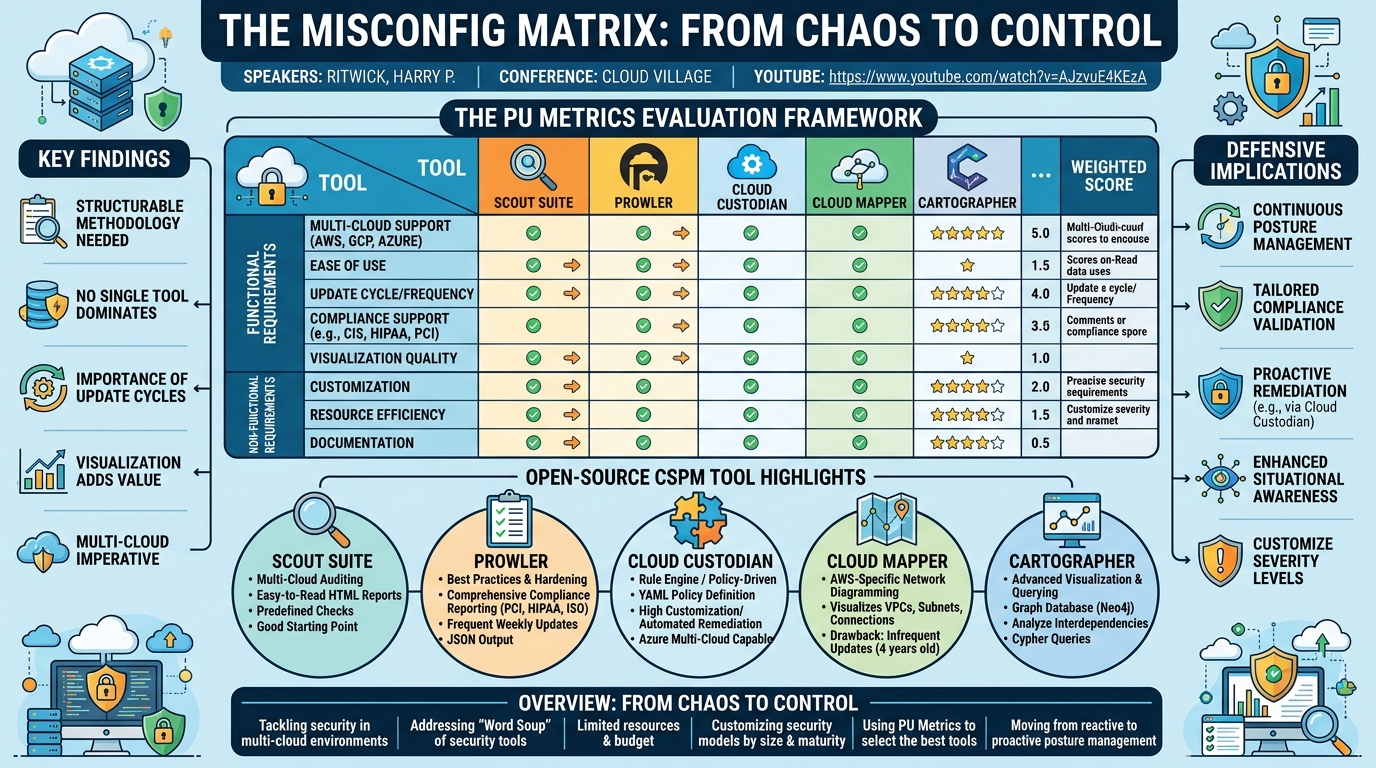
A key contribution is the introduction of the PU Metrics (pronounced "P-U Metrics"), a criteria-based decision-making matrix. This matrix allows organizations to assign weights to various functional and non-functional criteria—such as multi-cloud support, ease of use, update cycle, visualization quality, customization, resource efficiency, and compliance support—and then score different tools against these weighted criteria. The PU Metrics provides a quantitative framework to compare tools like Scout Suite, Prowler, Cloud Custodian, Cloud Mapper, and Cartographer, moving beyond subjective opinions to data-driven choices.
Through their practical demonstrations, Ritwick and Harry P. uncover several specific findings regarding the open-source tools:
- No Single Tool Dominates: Each tool possesses unique strengths and weaknesses. For instance, Prowler excels in compliance reporting and frequent updates, while Cloud Custodian offers powerful, policy-driven customization but requires upfront definition of desired checks. Cartographer provides unparalleled visualization of resource relationships, whereas Cloud Mapper is limited to AWS and shows signs of infrequent updates.
- Importance of Update Cycles: The frequency of tool updates is a critical factor, especially in rapidly evolving cloud environments. Prowler, with its weekly updates, stands out as highly responsive to new threats and cloud service changes, in contrast to Cloud Mapper, which hasn't been updated in four years.
- Customization vs. Out-of-the-Box Checks: Tools like Scout Suite and Prowler offer extensive predefined checks, making them easy to deploy for broad scanning. Cloud Custodian, however, requires users to define custom policies in YAML, offering immense flexibility for targeted checks but demanding more initial effort and domain knowledge.
- Visualization Value: The quality of visualization varies significantly. Scout Suite and Prowler provide detailed HTML reports, while Cloud Mapper and Cartographer offer graphical representations of cloud resources and their interconnections, which can be invaluable for understanding complex architectures.
- Multi-Cloud Imperative: For organizations with hybrid or multi-cloud setups, tools with broad platform support (AWS, GCP, Azure) are essential. Cloud Mapper's AWS-only limitation makes it less suitable for such environments, whereas Scout Suite, Prowler, Cloud Custodian, and Cartographer offer better multi-cloud compatibility.
Ultimately, the key finding reinforces that the "best" tool is context-dependent. The PU Metrics enables organizations to objectively quantify which tool or combination of tools best aligns with their specific operational constraints, security objectives, and compliance requirements, thereby transforming the chaotic process of tool selection into a controlled, strategic decision.
Technical Deep Dive
▶ Watch: Accessing lab resources: executive summary, keys, GitHub repo (2:45)
The core of "The Misconfig Matrix" is a hands-on exploration and comparative analysis of several prominent open-source Cloud Security Posture Management (CSPM) tools. The speakers meticulously detail the functionality, deployment, and output of each tool, demonstrating their application against intentionally vulnerable AWS, GCP, and Azure environments.
Shared Environment and Access
The lab setup involved three distinct cloud platforms (AWS, GCP, and Azure) populated with over 90 intentionally misconfigured resources. To facilitate the workshop, participants were provided with access keys (scoped to read-only or security audit roles to prevent malicious modifications) and a GitHub repository. This repository contained the output of each tool, instructions on how to run them, and a test.sh script for each tool, designed to automate installation and execution across Ubuntu or WSL environments. This script handles dependencies, virtual environments, and Docker setups, streamlining the process significantly.
Open-Source CSPM Tools Explored:
- Scout Suite
- Description: An open-source multi-cloud security auditing tool developed by NCC Group. It's designed to fetch configuration data from cloud environments and identify misconfigurations or vulnerabilities.
- Operation: Users configure an AWS profile (using an IAM user or role with
SecurityAuditor read-only permissions) and pass it to Scout Suite. The tool then runs a series of predefined checks against cloud resources. - Output: Generates an easy-to-read HTML report, which is often preferred by clients and pentesters, and can also output JSON for programmatic consumption. The report categorizes findings by service and region, highlighting issues like "security groups open for all."
- Ease of Use: Considered very easy to run, making it a good starting point for cloud security audits.
- Update Cycle: Updated within a 6-month timeline, indicating reasonable maintenance.
- Prowler
- Description: A CLI tool focused on cloud security best practices, compliance auditing, and hardening. It provides comprehensive checks against various security frameworks.
- Operation: Can be run as a Docker container or installed via
pip. It takes an AWS profile and executes hundreds of predefined checks (e.g., 568 checks mentioned for AWS scan). - Compliance Support: A major strength of Prowler is its ability to report compliance against standards like PCI DSS, HIPAA, ISO 27001, and CIS Benchmarks. It presents compliance as a percentage, indicating how much of the environment is compatible with a given standard (e.g., "69% fail, 30% passing" for a CIS benchmark).
- Output: Generates detailed HTML reports that list findings, affected resources, region, and provides links to cloud documentation for remediation. It also supports JSON output.
- Update Cycle: Highly active, with updates occurring as frequently as weekly, ensuring it keeps pace with new cloud services and threats.
- Severity Calibration: The speakers emphasize that organizations must calibrate the severity of findings based on their unique risk appetite, as a "high" severity for one company might be "medium" for another.
- Cloud Custodian
- Description: A powerful rule engine for managing and enforcing policies in cloud environments. Unlike other tools that have predefined checks, Cloud Custodian operates based on user-defined YAML policy files.
- Operation: Users write YAML files that define specific filters and actions. For example, a policy might look for S3 buckets with public read/write access (
principal: '*') or enabled logging. Cloud Custodian then scans the infrastructure to identify resources matching these conditions. - Output: Primarily outputs results in JSON format, listing the resources that satisfy the defined policy conditions.
- Use Case: Ideal for highly customized, targeted checks and automated remediation, but requires the user to know exactly what they are looking for and to define comprehensive policy sets.
- Ease of Use: Considered less intuitive than Scout Suite or Prowler due to the YAML policy creation requirement, earning a "-1" in the PU Metrics for ease of use.
- Update Cycle: Performs better than Scout Suite in terms of update frequency, indicating good maintenance.
- Cloud Mapper
- Description: An AWS-specific tool designed to create network diagrams of AWS environments, showing how resources are connected and exposed.
- Operation: Scans an AWS account and generates a visual graph database (using Neo4j internally, though Cartographer is the primary Neo4j tool discussed).
- Output: Provides a good visualization of VPCs, subnets, EC2 instances, lambdas, and their connections, including links to public internet.
- Limitation: Exclusively for AWS, making it unsuitable for multi-cloud organizations.
- Update Cycle: A significant drawback is its age; it was last updated four years ago, meaning it cannot keep up with newer AWS services or security features.
- Cartographer
- Description: Developed by Meta, Cartographer is a graph database tool that provides advanced visualization and querying capabilities for cloud resources. It leverages Neo4j, a powerful graph database.
- Operation: Best run using Docker Compose, which sets up the Neo4j database and the Cartographer application. Users interact with it by writing Cypher queries (Neo4j's query language) to explore relationships between cloud resources.
- Output: Generates interactive graph visualizations where nodes represent resources (e.g., EC2 instances) and edges represent relationships (e.g., connections to security groups). Users can query specific relationships (e.g.,
MATCH (i:EC2Instance)-[:HAS_SECURITY_GROUP]->(sg:SecurityGroup) RETURN i.name, sg.name). - Use Case: Invaluable for understanding complex interdependencies, visualizing attack paths, and performing deep security analysis that goes beyond simple misconfiguration checks.
- Ease of Use: Requires familiarity with Neo4j and Cypher queries, making it less "user-friendly" initially compared to tools with simpler CLI interfaces or HTML reports.
- Update Cycle: Updated within 6 months, showing active development.
The detailed exploration of these tools, combined with the practical challenges encountered during the live demo (e.g., Wi-Fi speeds affecting installation), provided a robust technical foundation for the subsequent evaluation using the PU Metrics. Each tool offers a distinct approach to cloud security posture management, underscoring the necessity of a tailored selection process.
Demo / Proof of Concept
▶ Watch: Deep dive into Scout Suite, an open-source CSPM tool (6:00)
The talk itself served as a live, interactive demonstration and proof of concept for evaluating open-source CSPM tools. Ritwick and Harry P. set up three distinct cloud environments—AWS, GCP, and Azure—each intentionally populated with over 90 misconfigured and vulnerable resources. This provided a realistic, albeit controlled, target for the tools under review.
The demonstration began by providing attendees with access keys (read-only/security audit roles) and a public GitHub repository. This repository was crucial, containing the output files from each tool, along with detailed instructions and test.sh scripts for automating the installation and execution of the tools. The test.sh scripts were highlighted as an essential component, designed to handle dependencies, set up virtual environments, and manage Docker containers (for tools like Cartographer), thus simplifying the hands-on experience for participants.
Throughout the session, the speakers ran various open-source CSPM tools against these vulnerable environments:
- Scout Suite: Demonstrated its ease of use, showing how to run it with an AWS profile and then showcasing the generated HTML report, which visually categorized findings by service and region, such as "security groups open for all" in EC2.
- Prowler: Highlighted its CLI execution and the extensive number of checks it performs (e.g., 568 checks for AWS). The output showcased its strong compliance reporting capabilities, displaying percentages of adherence to standards like PCI DSS, HIPAA, and CIS Benchmarks. Specific findings, such as an "exposed KMS key" in US West 2, were detailed with remediation information and links to cloud documentation.
- Cloud Custodian: The demonstration emphasized its policy-driven nature. The speakers explained how YAML policy files define specific conditions (e.g., S3 buckets with public read/write access) and how the tool then identifies resources matching those filters, outputting the results in JSON format. An Azure scan with Cloud Custodian was shown, demonstrating its multi-cloud capability.
- Cloud Mapper: Although not run live due to its age and AWS-only focus, its output was showcased. The visual representation of AWS resources and their interconnections (VPCs, databases, lambdas, public links) was presented, illustrating its strength in network topology visualization.
- Cartographer: Demonstrated as a Docker-compose setup utilizing a Neo4j graph database. The speakers showed how to interact with it via Cypher queries to visualize relationships between GCP resources. While specific query results were not fully displayed live due to time and setup constraints, the concept of querying resource graphs to understand dependencies was clearly articulated, indicating its power for deep architectural analysis.
The live demonstration, despite minor Wi-Fi challenges affecting installation speeds, effectively showcased the diverse outputs and operational models of each tool. It underscored the point that while some tools offer immediate, comprehensive HTML reports (Scout Suite, Prowler), others require more user input for customization (Cloud Custodian) or expertise in querying graph databases (Cartographer). This practical, side-by-side comparison formed the empirical basis for the subsequent evaluation using the PU Metrics, allowing attendees to observe the real-world performance and utility of each open-source solution.
Defensive Implications
▶ Watch: Introduction to Prowler, another CSPM tool with compliance features (10:10)
The insights gleaned from "The Misconfig Matrix" offer several critical defensive implications for organizations striving to secure their cloud environments. The talk moves beyond simply identifying vulnerabilities to providing a strategic framework for managing cloud security posture effectively.
- Structured Tool Selection with PU Metrics: The most significant defensive implication is the introduction of the PU Metrics. Defenders can use this criteria-based matrix to systematically evaluate and select CSPM tools that align precisely with their organization's unique needs, risk appetite, and operational context. Instead of adopting tools based on hype or anecdotal evidence, security teams can now make data-driven decisions by weighting factors like multi-cloud support, ease of use, update frequency, visualization quality, customization capabilities, resource efficiency, and compliance support. This prevents wasted resources on unsuitable tools and ensures optimal security investments.
- Continuous Security Posture Management: The dynamic nature of cloud infrastructure necessitates continuous monitoring. The demonstrated tools, particularly Prowler and Scout Suite, can be integrated into CI/CD pipelines or scheduled as regular scans. By continuously running these tools, defenders can identify new misconfigurations as infrastructure changes, enabling proactive remediation rather than reactive incident response. The JSON output capabilities of tools like Cloud Custodian and Prowler are crucial here, allowing for programmatic ingestion into other security orchestration tools.
- Tailored Compliance Validation: Prowler’s robust support for various compliance frameworks (PCI DSS, HIPAA, ISO, CIS Benchmarks) is a powerful defensive asset. Organizations can leverage it to continuously validate their adherence to regulatory requirements, providing auditable evidence and identifying gaps before they lead to non-compliance penalties. The ability to see compliance as a percentage offers a clear metric for leadership on the organization's security posture.
- Proactive Misconfiguration Remediation: Tools like Cloud Custodian, with its policy-as-code approach, enable defenders to define and enforce security policies automatically. This allows for not just detection but also potential automated remediation of misconfigurations. For instance, a policy could automatically disable public access to an S3 bucket or revoke overly permissive IAM policies, significantly reducing the attack surface.
- Enhanced Situational Awareness through Visualization: Cartographer and Cloud Mapper provide invaluable visualization capabilities. Defenders can use these tools to generate graph-based representations of their cloud infrastructure, revealing complex interdependencies, potential attack paths, and unintended network exposures. This visual context is critical for understanding the blast radius of a misconfiguration and for designing more resilient architectures. For instance, identifying an exposed KMS key (as shown by Prowler) gains deeper context when its connections to other resources are visualized in Cartographer.
- Customization for Organizational Context: The speakers emphasize that "capacity of each company or each service is different" regarding severity. Defenders must calibrate the severity of findings reported by these tools to their organization's specific risk profile. Furthermore, the flexibility offered by tools like Cloud Custodian allows security teams to build custom checks for unique internal policies or specific business risks not covered by generic checks.
- Strategic "Build vs. Buy vs. Adopt" Decisions: The concluding discussion on "buy, build, or adopt" approaches helps defenders make strategic decisions. For highly unique requirements, building custom solutions on top of open-source tools might be necessary. For common challenges, adopting well-maintained open-source tools like Prowler or commercial solutions might be more efficient. The PU Metrics aids in this strategic choice, weighing factors like cost, maintenance, and customization potential.
In essence, "The Misconfig Matrix" equips defenders with both the tools and the methodology to transform cloud security from a chaotic, reactive process into a controlled, proactive, and continuously improving discipline.
Key Takeaways
- Multi-Cloud Complexity Demands Strategic Tooling: The proliferation of cloud services and security tools creates a "word soup" that necessitates a structured approach to cloud security posture management, especially in multi-cloud environments.
- PU Metrics for Data-Driven Tool Evaluation: The PU Metrics provides a robust, criteria-based framework to objectively evaluate and select open-source CSPM tools, considering factors like multi-cloud support, ease of use, update cycle, visualization, customization, resource efficiency, and compliance.
- Open-Source Tools Offer Powerful Capabilities: Tools like Scout Suite, Prowler, Cloud Custodian, and Cartographer provide diverse strengths, from comprehensive compliance checks and frequent updates (Prowler) to policy-driven automation (Cloud Custodian) and advanced graph visualization (Cartographer).
- Context-Specific Decisions are Crucial: No single tool is a perfect fit for every organization. The "best" tool depends on an organization's specific requirements, risk appetite, compliance needs, and existing resource constraints.
- Continuous Monitoring and Automation are Key: Cloud environments are dynamic. Integrating CSPM tools into continuous pipelines, leveraging their JSON outputs for automation, and calibrating finding severities are essential for maintaining an effective security posture.
- Visualization Aids Understanding: Tools that offer graphical representations of cloud resources (Cloud Mapper, Cartographer) can significantly enhance understanding of complex architectures and interdependencies, aiding in identifying critical attack paths.
About the Speaker(s)
Based on their presentation, Ritwick and Harry P. demonstrated expertise in cloud security engineering, product security, and cloud infrastructure management across multi-cloud environments, including AWS, GCP, and Azure. Their work involves understanding and evaluating various security tools and strategies to manage cloud misconfigurations effectively, as evidenced by their detailed comparison of open-source CSPM solutions and the development of the PU Metrics framework.
Reviews
Dr. Zero (Offensive Security Researcher) — WEAK
Competent practitioners doing a useful thing — comparing open-source CSPM tools against intentionally misconfigured lab environments — but the execution never escapes the tutorial lane. The 'PU Metrics' contribution is the talk's main claim to novelty, and it's a weighted scoring matrix that any product manager would recognize from a vendor selection spreadsheet. This is a workshop, not research.
Heather Calloway (CISO) — SOLID
A competent, practitioner-focused tool evaluation that solves a real problem — how to pick among open-source CSPM tools in a multi-cloud environment — with enough structure to be useful. The PU Metrics is a genuine contribution, but the talk stays squarely in the engineering lane and never surfaces the governance or accountability implications that would make it consequential for decision-makers above the team level.