The Deepfake Supply Chain: Weaponizing Synthetic Media into Modern Cybercrime Operation
Niladri Sekhar Hore (Security Researcher · StoneX)
CODE BLUE 2025 · Day 2 · Track 1 (Hall B)
Overview
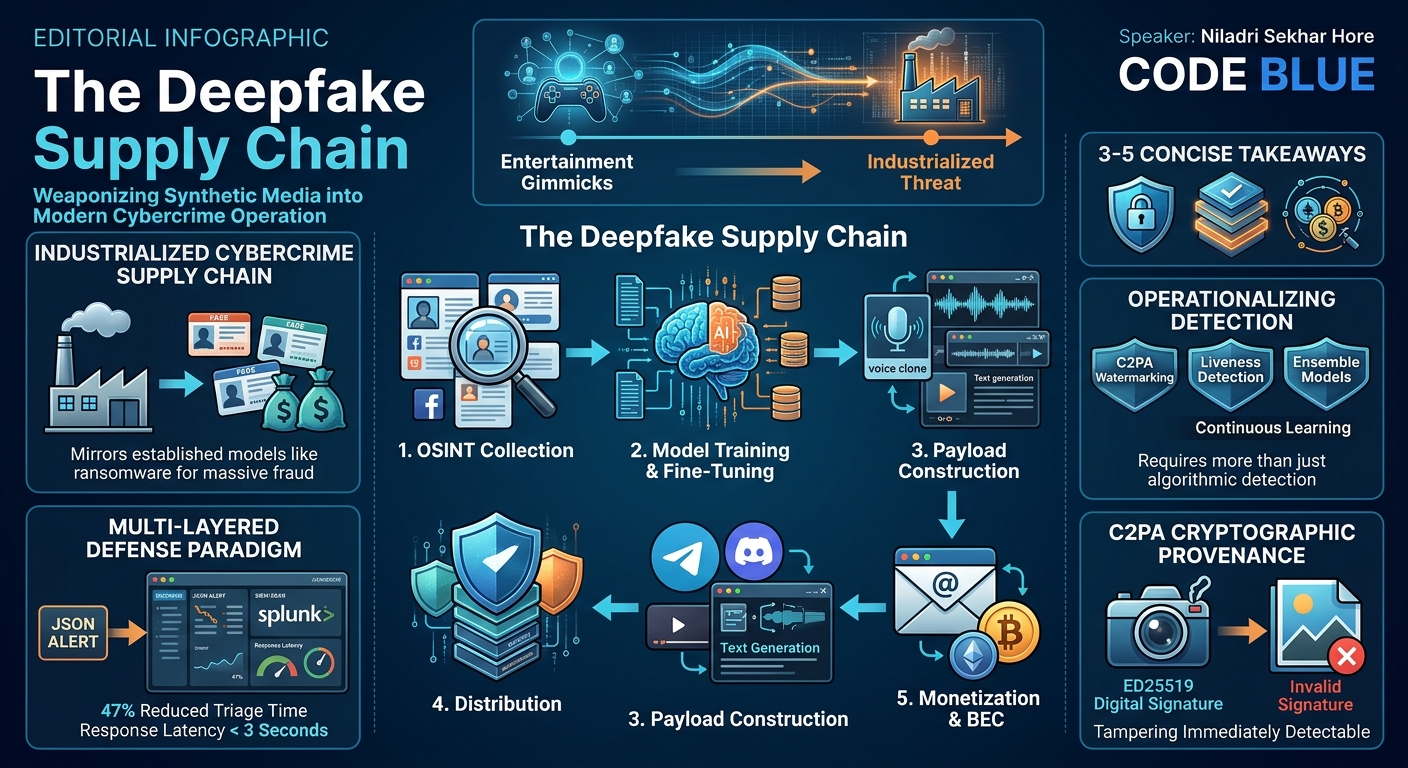
In an era where digital authenticity is increasingly challenged, Niladri Sekhar Hore, a Security Researcher at StoneX, delivered a compelling talk at CODE BLUE, dissecting the alarming rise of deepfake technologies as a sophisticated weapon in modern cybercrime. Titled "The Deepfake Supply Chain: Weaponizing Synthetic Media into Modern Cybercrime Operation," Hore illuminated how what were once considered mere entertainment gimmicks have rapidly evolved into an industrialized threat, driving a projected $40 billion in AI-enabled fraud. This presentation transcends typical deepfake discussions by framing the threat within a comprehensive "supply chain" model, mirroring established cybercrime operations like ransomware.
Key moments
- 0:00 Introduction: $40B lost to deepfakes
- 3:00 Understanding the deepfake cybercrime supply chain
- 7:00 Deepfake-as-a-Service: black market pricing, cloning tools
- 13:00 Technical pipeline for detecting cloned voice samples
- 26:30 Real-time liveness detection to prevent system bypass
- 30:00 C2PA cryptographic watermarking for content authenticity at source
- 36:30 Integrating deepfake detection with SIEM/SOAR for rapid response
The Deepfake Supply Chain: Weaponizing Synthetic Media into Modern Cybercrime Operation
Speakers: Niladri Sekhar Hore, Security Researcher, StoneX
Conference: CODE BLUE
YouTube: https://www.youtube.com/watch?v=1KLBNMbV8gY
Overview
In an era where digital authenticity is increasingly challenged, Niladri Sekhar Hore, a Security Researcher at StoneX, delivered a compelling talk at CODE BLUE, dissecting the alarming rise of deepfake technologies as a sophisticated weapon in modern cybercrime. Titled "The Deepfake Supply Chain: Weaponizing Synthetic Media into Modern Cybercrime Operation," Hore illuminated how what were once considered mere entertainment gimmicks have rapidly evolved into an industrialized threat, driving a projected $40 billion in AI-enabled fraud. This presentation transcends typical deepfake discussions by framing the threat within a comprehensive "supply chain" model, mirroring established cybercrime operations like ransomware.
Hore’s talk is critical for understanding the current and future landscape of cyber security. He meticulously details the stages of a deepfake attack, from initial OSINT (Open Source Intelligence) collection to monetization, emphasizing that once personal biometric data is compromised and publicly available, it is irreversible. The presentation not only highlights the technical sophistication of these attacks, where deepfake detection accuracy can plummet to 60% on unseen data, but also underscores the commoditization of deepfake tools and services on the dark web, making advanced synthetic media creation accessible to a wider array of malicious actors.
The significance of this discussion lies in its proactive approach to defense. Hore argues that combating this evolving threat requires a multi-layered, adaptive strategy that goes beyond mere algorithmic detection. He advocates for robust frameworks encompassing authenticity at source through technologies like C2PA watermarking, real-time liveness detection, continuous model retraining, and seamless integration with existing SIEM/SOAR systems. Ultimately, the talk serves as a stark warning and a practical guide, urging the security community to shift from assuming trust in digital media to actively engineering it, thereby building resilient defenses against the weaponization of synthetic realities.
Background
▶ Watch: Introduction: $40B lost to deepfakes (0:00)
Just five years ago, deepfakes were largely confined to the realm of novelty and entertainment, seen as clever visual tricks. However, as Niladri Sekhar Hore meticulously explained, the rapid evolution of generative models, from early GANs (Generative Adversarial Networks) to today's advanced diffusion architectures, has fundamentally transformed deepfakes into potent operational tools for cyber attackers. This technological leap has removed significant technical barriers, effectively democratizing the creation of highly convincing synthetic media. As Hore noted, anyone with mid-tier GPUs and access to readily available open-source software can now generate sophisticated deepfake images and audio, escalating a niche threat into a global fraud ecosystem.
The financial implications of this evolution are staggering. According to Deloitte, AI-enabled fraud is projected to surge from $12.3 billion in 2023 to an estimated $40 billion, demonstrating an enormous growth rate. Deepfakes are now supercharging traditional cybercrime vectors such as identity theft, misconfiguration, and social engineering. Hore introduced the concept of the "Deepfake Supply Chain," a mature cyber threat model that outlines the lifecycle of a synthetic media attack:
- Data Acquisition: Attackers harvest vast amounts of publicly available voice, video, and image data through OSINT collection. This can include anything shared on open networks, from Facebook photos and posts to notes and scribbles. Once this biometric data is public, it cannot be revoked, providing attackers with irreversible intelligence.
- Model Training and Fine-Tuning: The acquired data is used to train and fine-tune generative AI models, allowing attackers to understand and replicate the victim's baselines and unique characteristics.
- Payload Construction: With a trained model, attackers construct their synthetic media payloads, which can take the form of voice clones, manipulated videos, or crafted text designed to deceive.
- Distribution and Monetization: These deepfake assets are then deployed in various fraud schemes, phishing campaigns, and influence operations, echoing the affiliate models seen in ransomware, involving creators, brokers, and operators.
This industrialization has led to Deepfake-as-a-Service (DaaS), a flourishing black market economy. Hore provided concrete examples of pricing: a cloned video sample sells for $300-$800, a complete business email compromise (BEC) package for $2,000, and a full campaign for $1,500. Payments are often made via cryptocurrency, further obscuring the actors. This commoditization dramatically lowers the barrier to entry for attackers, necessitating that defensive detection pipelines and policies scale at an equivalent speed. Platforms like Telegram, Discord, and dark web marketplaces openly host APIs and cloud-pricing tiers for cloning tools, allowing creation of deepfakes with "just a blink of a finger trip."
However, traditional detection methods are struggling. Hore pointed out that deepfake detection accuracy often drops to a mere 60% when confronted with unseen data, highlighting the critical need for continuous model training. Furthermore, sophisticated voice detectors frequently miss subtle emotional tone shifts, a hallmark of advanced deepfakes. The presentation emphasized that modern deepfakes are so highly classified and tech-oriented that human perception often fails to recognize them, leading to numerous cases of successful social engineering, such as calls to service desks requesting password resets, all powered by convincing synthetic voices. This challenging landscape underscores why the deepfake problem is not just a technical issue, but fundamentally a trust issue that demands engineered solutions.
Key Findings
▶ Watch: Deepfake-as-a-Service: black market pricing, cloning tools (7:00)
Niladri Sekhar Hore's presentation unveiled several critical findings regarding the escalating threat of deepfakes and the necessary defensive countermeasures:
- Deepfakes as Industrialized Cybercrime: The era of deepfakes as mere entertainment is over. They have matured into an integral part of a global fraud ecosystem, operating as a sophisticated "supply chain" that mirrors established cybercrime models like ransomware, complete with specialized roles and black market services.
- Irreversible OSINT Exploitation: Once personal biometric data (voice, image, video) is publicly available through OSINT, it is effectively irreversible. Attackers leverage this data for model training, making early disruption of the deepfake supply chain at the data acquisition phase paramount.
- The Commoditization of Deepfake Tools: The rise of Deepfake-as-a-Service (DaaS) has drastically lowered the technical barrier for entry. Cloud-based cloning tools, subscription tiers (silver, gold, platinum), and readily available APIs on platforms like Telegram and Discord enable even less-skilled actors to generate high-quality synthetic media for fraudulent activities.
- Adaptive, Multi-layered Defense is Imperative: No single algorithm or detection method is sufficient. Effective defense requires multiple overlapping layers, encompassing AI-based detection, identity assurance (behavioral and biometric liveness checks), and robust governance frameworks (e.g., AI Act, NIST AI RMFC).
- Ensemble Models and Cross-Model Validation: Hore demonstrated that combining multiple AI models (e.g., Fnet, Xception, Vision Transformers) and aggregating their probability scores through an ensemble view significantly enhances detection accuracy and confidence. Tools like Grad-CAM and occlusion cam overlays provide crucial interpretability, revealing how models make decisions and identifying blind spots or inconsistencies.
- Authenticity at Source with C2PA: To combat the inherent trust problem, cryptographic watermarking based on standards like C2PA (Content Authenticity Initiative) is essential. Embedding ED25519 digital signatures into media metadata at the point of capture or generation ensures provenance and makes tampering immediately detectable, even if visual watermarks are removed.
- Real-time Liveness Detection: For critical identity verification scenarios (e.g., banking KYC), real-time liveness detection systems using biometric cues such as Eye Aspect Ratio (EAR), Mouth Open Ratio (MOR), and Yaw Angle can effectively differentiate between live human presence and sophisticated deepfake reproductions.
- Continuous Learning and Human-in-the-Loop: Given the rapid evolution of deepfake generation techniques, continuous model retraining with diverse, adversarial datasets is non-negotiable. Furthermore, integrating human analysts into a feedback loop with AI models within Security Operations Centers (SOCs) ensures that detections are verified, false positives/negatives are addressed, and models constantly learn from real-world incidents, leading to self-improving detection capabilities.
- Operationalizing Detection in SOCs: Integrating deepfake detection alerts (via structured JSON) into SIEM/SOAR platforms (e.g., Splunk, Sentinel, QRadar) significantly improves operational efficiency. Hore cited remarkable results: a 47% reduction in average analyst triage time and detection-to-response latency consistently under 3 seconds.
- The Trust Problem: Fundamentally, the deepfake challenge is not just a technical issue but a trust issue. The solution lies in engineering trust into digital media and systems rather than merely assuming it, requiring a cultural shift alongside technological advancements.
Technical Deep Dive
▶ Watch: Technical pipeline for detecting cloned voice samples (13:00)
Niladri Sekhar Hore presented a comprehensive technical framework designed to combat the "Deepfake Supply Chain," emphasizing multi-layered defenses and advanced AI methodologies.
1. Blueprint for Defense:
The proposed blueprint integrates four key pillars:
- Detection and Verification: Utilizes AI-based detectors (e.g., SynthesizeID, Deepware) to identify inconsistencies, frequency distortions, unnatural motion, or missing psychological signals in synthetic media. This is augmented by C2PA watermarking for source authentication.
- Identity Assurance: Focuses on behavioral and biometric liveness checks, crucial for "Know Your Customer" (KYC) processes in banking, to confirm human authenticity.
- Governance: Incorporates adherence to evolving AI regulations (e.g., AI Act), frameworks like NIST AI RMFC, and industry collaborations to guide ethical and secure AI deployment.
- Provenance: Ensures the origin and integrity of media content through verifiable metadata and cryptographic signatures.
This framework maps directly to the MITRE ATT&CK framework, allowing defenders to identify the specific tactics and techniques used by attackers and apply targeted countermeasures.
2. Audio Deepfake Detection Pipeline:
Hore detailed a sophisticated pipeline for detecting cloned voices:
- Pre-processing Stage: Incoming audio undergoes normalization of amplitude, silence removal, and extraction of key features. These features include LFC2 (Linear Frequency Cepstral Coefficients), Constant Q (CQT), and septal coefficients, which capture the unique spectral and temporal characteristics of a voice.
- Detection Model Ensemble: Instead of relying on a single model, an ensemble view combines multiple advanced AI models, such as LCCN (Lightweight Convolutional Neural Network) and Royet 2. Each model processes the extracted features and contributes a probability score indicating authenticity.
- Multimodal Analysis and Authenticity Verdict: The individual scores from the ensemble models are averaged, and this aggregated score is compared against a predefined threshold. If the score falls below this threshold, the audio is flagged as a deepfake.
- Distinguishing Features: The model is trained to recognize specific artifacts in deepfake audio, such as flat energy in the spectrogram, vcoder sawtooth patterns, and repeated phase bands. In contrast, real audio exhibits irregular micro-functions, natural breath sounds, onset noise, and complex speech dynamics. These subtle indicators, particularly natural breath patterns, are critical for proving consistency and authenticity.
3. Image and Video Deepfake Detection Pipeline:
For visual deepfakes, Hore described a hybrid detection pipeline utilizing an ensemble of specialized models:
- Model Selection: The pipeline employs Fnet, Xception, and Vision Transformers (ViT). Each model is designed to focus on different aspects of an image:
- Fnet often scrutinizes skin textures and micron noise patterns.
- Xception emphasizes boundaries around eyes and lips.
- ViT examines broader border context, facial propagation, and lighting consistency.
- Pre-processing: Images undergo face alignment, normalization, and patch extraction to prepare them for analysis.
- Ensemble View and Thresholding: Similar to audio detection, each model outputs a confidence score for authenticity. These are aggregated into an assembled view, which provides a holistic probability score (e.g., a score of 0.54 or above indicates a likely real image). This approach acknowledges that detection is a probability distribution, not a binary yes/no.
- Cross-Model Verification and Interpretability:
- Grad-CAM Overlays: Visualizes the areas of an image that each neural network model "pays attention to" during detection. Red indicates high attention, yellow moderate, and blue low. This moves the AI from a "blackbox" to an "accountable AI," allowing analysts to understand why a model flagged an image.
- Occlusion Cam Overlays: Systematically blurs patches of an image and observes how each model's "fake score" changes. Regions that cause a significant score change (hotter colors) are highly influential in the model's prediction. This technique reveals disagreement zones and model blind spots, indicating potential unseen generation methods or areas where models might be overfitting.
4. Real-time Liveness Detection:
To counter live deepfake bypasses in systems like KYC, Hore outlined a real-time liveness detection system:
- Biometric Cues: The system measures three primary biometric cues computed from real-time MediaPipe face landmarks:
- Eye Aspect Ratio (EAR): For detecting natural blinking. An EAR less than 0.21 indicates a blink.
- Mouth Open Ratio (MOR): For analyzing speech and expression dynamics.
- Yaw Angle: For monitoring head orientation and 3D presence. A deviation beyond +/-15 degrees from a baseline verifies 3D presence.
- Latency: The system boasts a latency of less than 3 seconds, ensuring near-instantaneous authentication.
- Adaptive Checks: The system can also incorporate simple interactive commands (e.g., "turn left," "turn right") to further verify liveness, as any deviation from the subject's place or movement changes the scoring pattern. This data is fed into the AI detectors, providing SOC operators with a unified dashboard of model scores and human motion metrics.
5. C2PA Content Authenticity:
To establish authenticity at source, Hore advocated for cryptographic watermarking aligned with C2PA (Content Authenticity Initiative):
- Digital Signatures: Uses ED25519 digital signatures invisibly embedded into an image's metadata at the time of capture or generation. This binds the pixel data to a private key.
- Tamper Detection: Any alteration—cropping, recomposition, retouching, or even re-saving the file—will invalidate the signature. Even if a visual watermark is removed, the invisible cryptographic one persists.
- Verification Pipeline: The process involves input metadata, cryptographic signing, and metadata embedding (all concealed within the image itself). A multimodel analysis is then combined with cryptographic key verification to produce an authenticity-driven verdict, establishing multiple levels of trust. This is analogous to code signing or SSL certificates for content, ensuring provenance from source to destination.
This comprehensive suite of technical solutions, from multi-model ensembles and interpretability tools to real-time biometrics and cryptographic provenance, forms a robust defense against the evolving deepfake threat.
Demo / Proof of Concept
▶ Watch: C2PA cryptographic watermarking for content authenticity at source (30:00)
Niladri Sekhar Hore's presentation included conceptual demonstrations of the technical pipelines for both audio and image deepfake detection, as well as the critical C2PA watermarking for content authenticity. While actual voice and image samples were not shared live due to security constraints, Hore clearly articulated the scenarios and the model's predicted outcomes, providing a strong proof of concept for the proposed solutions.
For audio deepfake detection, Hore described two scenarios: an "attack" where his voice was delivered via a deepfake, and a "defend" scenario with his actual live voice. The model, an ensemble of LCCN and Royet 2, successfully predicted the deepfake voice as "false" and the live voice as "real," illustrating its ability to differentiate based on probability scoring and the detection of subtle artifacts like flat energy in the spectrogram versus natural breath and speech dynamics.
The image deepfake detection pipeline was demonstrated using Hore's own real image and a deepfake version generated from an open-source tool. The ensemble of Fnet, Xception, and Vision Transformers (ViT) models processed both images. For the real image, the assembled view yielded a probability score indicating it as "likely real." When the deepfake image was passed through, the model also provided a score, with Hore explaining how the pixel-level classifier and frame-by-frame speculation work. Crucially, Hore showcased Grad-CAM and occlusion cam overlays. The Grad-CAM visualized where the AI models focused their attention (e.g., red for high attention on inconsistencies), moving towards "accountable AI." The occlusion cam demonstrated how blurring specific facial regions (like skin textures for Fnet or eye boundaries for Xception) changed the models' fake scores, highlighting their specific areas of focus and revealing potential blind spots.
The most compelling demonstration of provenance was the C2PA authentication process. Hore illustrated how an image is "signed" at the source using ED25519 digital signatures embedded invisibly within its metadata. Upon signing, the system showed a "100% valid" watermark signature and displayed the generated public and private keys, which are used for verification at the destination. The critical part of this demo was showing what happens when the signed image is tampered with—even a simple recompression, retouching, or re-saving. Immediately, the system flagged the watermark signature as "failed," indicating an "unverified origin," even if the image was not technically a deepfake. This powerfully demonstrated that the integrity of the content was compromised, validating the necessity of authenticity at the source.
Finally, while not a direct live demo, Hore described the real-time liveness detection system, explaining how it uses biometric cues like Eye Aspect Ratio (EAR), Mouth Open Ratio (MOR), and Yaw Angle to detect live human presence against deepfake bypasses for applications like banking KYC. The low latency of under 3 seconds and the ability to incorporate simple commands (e.g., "turn left") were highlighted as key features of this system. These demonstrations collectively provided strong evidence for the efficacy and necessity of the multi-layered, adaptive defense mechanisms proposed.
Defensive Implications
▶ Watch: Integrating deepfake detection with SIEM/SOAR for rapid response (36:30)
The insights shared by Niladri Sekhar Hore carry profound defensive implications for organizations grappling with the escalating deepfake threat. Addressing the "Deepfake Supply Chain" requires a paradigm shift from reactive detection to proactive, multi-layered defense and an engineered approach to trust.
- Proactive OSINT Monitoring and Disruption: The deepfake supply chain begins with data acquisition through OSINT. Defenders must prioritize proactive monitoring of open sources for sensitive biometric data and implement strategies to minimize public exposure of such information. While revoking publicly shared data is impossible, understanding the initial collection phase allows for early disruption and awareness campaigns.
- Adopt Multi-layered, Adaptive Defenses: Relying solely on a single detection algorithm is insufficient. Organizations must implement a comprehensive framework that integrates AI-based detection with identity assurance (behavioral and biometric liveness checks) and strong governance (adhering to AI regulations like the AI Act, NIST AI RMFC). This layered approach, as demonstrated by the ensemble models and cross-model validation, provides greater resilience.
- Prioritize Continuous Model Retraining: Deepfake generation techniques are constantly evolving (e.g., StyleGAN 2, new diffusion models). Defensive AI models must undergo continuous adversarial retraining with diverse datasets, including the latest deepfake engines, real-world noise (compression, social media artifacts), and a balanced mix of real and synthetic samples. This adaptive strategy prevents models from becoming overfit to past artifacts and ensures they can detect unseen generation methods.
- Implement Authenticity at Source with C2PA: To combat the fundamental trust issue, organizations, particularly those dealing with sensitive media, should adopt C2PA-aligned cryptographic watermarking. Embedding ED25519 digital signatures into content metadata at the point of capture or generation ensures provenance and makes any tampering immediately detectable. This shifts verification from post-incident response to ingestion, establishing trust from the origin.
- Deploy Real-time Liveness Detection: For critical identity verification processes, such as banking KYC or secure access, deploying real-time liveness detection systems that analyze Eye Aspect Ratio (EAR), Mouth Open Ratio (MOR), and Yaw Angle is crucial. These systems can effectively distinguish between a live human and sophisticated deepfake attempts, adding a robust physical layer of defense.
- Integrate Deepfake Intelligence into SOC Operations: Deepfake detection is not an isolated function; it must be fully integrated into existing security operations. Structured JSON alerts from detection systems should feed directly into SIEM/SOAR platforms (e.g., Splunk, Sentinel, QRadar). This enables automated triage, triggers remediation playbooks, notifies threat teams, and isolates suspicious media before it spreads. Hore’s data showed a 47% reduction in analyst triage time and sub-3-second detection-to-response latency post-integration, highlighting significant operational gains.
- Foster a Human-in-the-Loop Feedback Cycle: Human analysts are indispensable. Their feedback on false positives and negatives, combined with interpretability tools like Grad-CAM and occlusion cam, helps refine AI models and improve future accuracy. This "continuous learning" philosophy ensures that the SOC doesn't just consume alerts but actively teaches the models, building trust through accountability.
- Red Team with Deepfake Technologies: Organizations should proactively red team their own defenses using video and voice cloning techniques. Simulating deepfake attacks helps identify vulnerabilities in existing systems and human processes, informing policy adjustments and enhancing overall resilience.
- Cultivate a Culture of Authenticity and Awareness: The deepfake problem is ultimately a trust problem. Beyond technology, organizations must build a culture of authenticity through policy, employee training, and awareness campaigns. Educating users about the risks of synthetic media and the importance of verification is as crucial as technical controls. As Hore concluded, "We must teach humans not to trust systems" blindly, but rather to critically evaluate digital content.
By implementing these defensive strategies, organizations can move beyond reactive measures and build a robust, adaptive framework to counter the sophisticated and evolving threat posed by the deepfake supply chain.
Key Takeaways
- Deepfakes are a Weaponized Cybercrime Operation: No longer just entertainment, deepfakes have evolved into an industrialized "supply chain" for cybercrime, driving billions in fraud and supercharging identity theft and social engineering attacks.
- Multi-Layered, Adaptive Defense is Essential: Effective countermeasures require more than just algorithms; a comprehensive framework integrating AI-based detection, identity assurance (liveness checks), and robust governance, continuously retrained against new threats, is paramount.
- Ensemble AI Models Enhance Detection and Interpretability: Combining multiple specialized AI models with cross-model validation and interpretability tools like Grad-CAM and occlusion cam significantly improves deepfake detection accuracy and provides critical insights into how models make decisions, moving towards "accountable AI."
- Authenticity at Source through C2PA is Critical: Implementing cryptographic watermarking (e.g., ED25519 digital signatures) via C2PA standards ensures content provenance and integrity from the point of capture, making tampering immediately detectable and engineering trust into digital media.
- Real-time Liveness Detection and SOC Integration Drive Operational Efficiency: Deploying real-time biometric liveness checks for identity verification and integrating deepfake detection alerts into SIEM/SOAR platforms dramatically reduces analyst triage time (by 47%) and response latency (under 3 seconds), making defenses actionable.
- Continuous Learning and Human-in-the-Loop are Non-Negotiable: Given the rapid evolution of deepfake technology, continuous model retraining with adversarial datasets and a feedback loop where human analysts refine AI models are vital for maintaining effective, self-improving detection capabilities.
About the Speaker(s)
Niladri Sekhar Hore is a Security Researcher at StoneX, where he is a key member of the Threat Detection and Automation team. His work primarily focuses on the intersection of threat detection and artificial intelligence. Hore is responsible for building and scaling AI models designed to identify and mitigate cyber threats across both cloud and hybrid environments. His expertise lies in understanding evolving cyber threats, particularly those leveraging advanced AI technologies like deepfakes, and developing robust, adaptive defenses to counter them.
Reviews
Dr. Zero (Offensive Security Researcher) — SOLID
Competent survey of deepfake threats and detection pipelines, but this is synthesis, not original research. The talk maps known techniques (ensemble CNNs, C2PA, liveness detection) onto a 'supply chain' framework without dropping novel exploits, novel defenses, or data you couldn't find in a dozen Medium posts.
Heather Calloway (CISO) — SOLID
Competent overview of the deepfake threat landscape with a reasonable defensive framework, but the operational guidance stays at architecture-deck level. Worth the time for teams who haven't yet built a detection strategy; less useful for those who have.