Security at Scale: Lessons from the Frontlines
Joe Sullivan (Chief Security Officer (former) · Cloudflare (former CSO))
Stanford CS153: Technology Entrepreneurship — Infra @ Scale (Winter 2025) · Day 10 · Jordan Hall 420-040
Overview
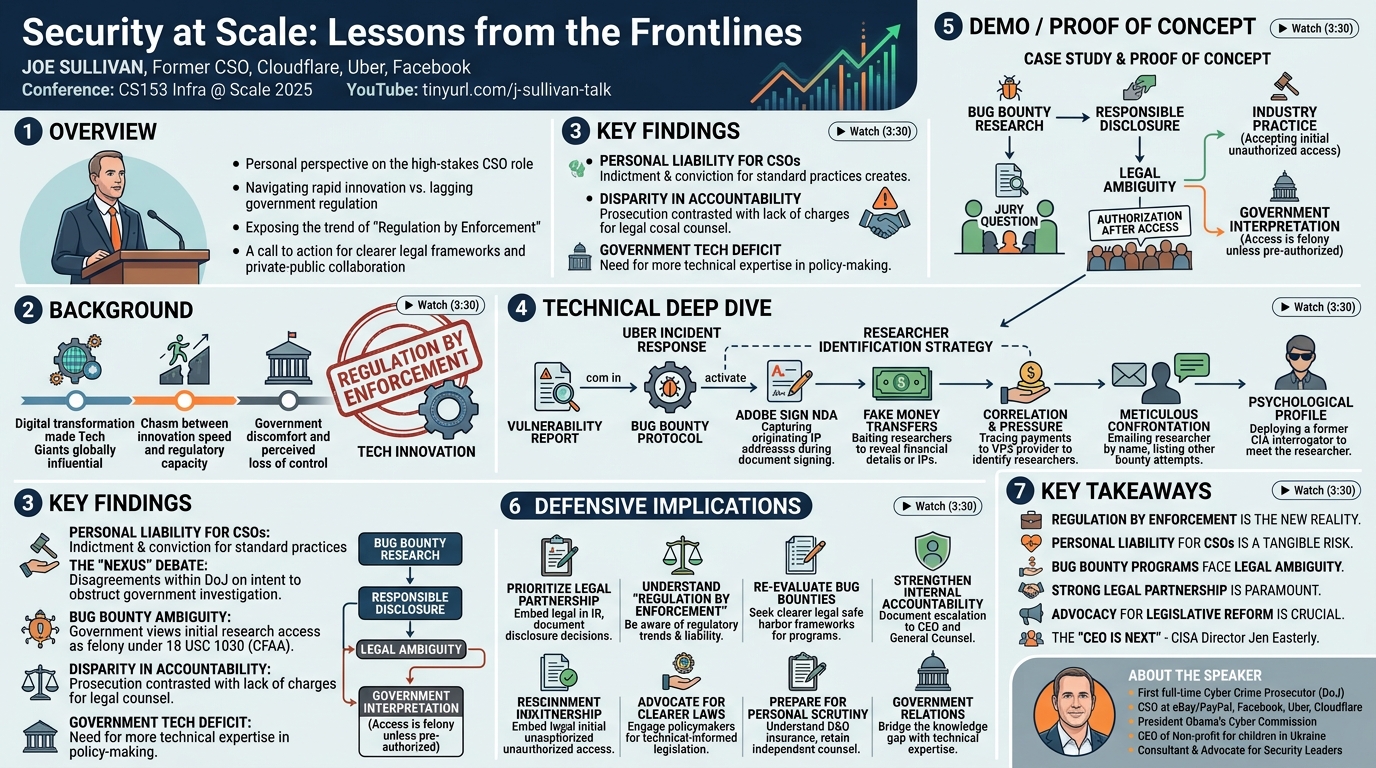
In "Security at Scale: Lessons from the Frontlines," Joe Sullivan, a veteran Chief Security Officer (CSO) who has led security initiatives at some of the world's largest technology companies, offers a candid and sobering perspective on the evolving landscape of cyber security leadership. The talk delves into the increasing tension between rapid technological innovation in the private sector and the government's struggle to regulate it, leading to a phenomenon Sullivan terms "regulation by enforcement." This often results in security leaders facing unprecedented personal liability and scrutiny, even when acting in good faith to protect their organizations and users.
Key moments
- 0:00 Speaker's unique path into cybersecurity and scaling expertise
- 2:15 Fascinating collision between public and private tech sectors
- 3:30 Government's discomfort and perceived loss of control over tech
- 4:50 Biden-Harris policy: Shifting cybersecurity responsibility to corporations
- 6:00 Escalating regulatory actions against major tech companies
- 7:00 The increasing risks and reluctance for security executives
Security at Scale: Lessons from the Frontlines
Speakers: Joe Sullivan, Chief Security Officer (former), Cloudflare (former CSO)
Conference: CS153 Infra @ Scale 2025
YouTube: https://www.youtube.com/watch?v=u4E6qdWIkYI
Overview
In "Security at Scale: Lessons from the Frontlines," Joe Sullivan, a veteran Chief Security Officer (CSO) who has led security initiatives at some of the world's largest technology companies, offers a candid and sobering perspective on the evolving landscape of cyber security leadership. The talk delves into the increasing tension between rapid technological innovation in the private sector and the government's struggle to regulate it, leading to a phenomenon Sullivan terms "regulation by enforcement." This often results in security leaders facing unprecedented personal liability and scrutiny, even when acting in good faith to protect their organizations and users.
Sullivan's presentation is unique in that it is not merely an academic discussion but a deeply personal account of his own legal battle. Having served as CSO at Facebook, Uber, and Cloudflare, he shares the harrowing experience of being criminally indicted and convicted for his handling of a security incident at Uber, despite following established industry practices. His story serves as a stark warning and a call to action for the security community, underscoring the critical need for clearer legal frameworks, stronger collaboration between public and private sectors, and a reevaluation of the personal risks borne by security executives. The talk illuminates why the role of CSO has become one of the most challenging and high-stakes positions in modern corporations.
Background
▶ Watch: Speaker's unique path into cybersecurity and scaling expertise (0:00)
The digital transformation of the past two decades has elevated technology companies to unparalleled global influence, with almost all of the world's top market cap companies being tech giants. This rapid ascent has created a significant chasm between the pace of innovation and the capacity of government to understand and regulate it effectively. For years, the prevailing mantra from Silicon Valley to Congress was "we don't need regulation; it will stifle innovation." This approach largely succeeded, resulting in a dearth of specific cyber security laws compared to other sectors.
However, as the internet became an indispensable part of daily life, the consequences of security incidents and data breaches began to impact individuals and national security profoundly. Governments, feeling a loss of control and a failure in their fundamental role as protectors of citizens, have begun to react. The Biden-Harris Administration's 2023 cyber security policy explicitly aimed to "rebalance the responsibility to defend cyberspace by shifting the burden away from individuals... away from governments to the corporations." In the absence of clear legislative guidance from Congress, the executive branch has increasingly resorted to regulation by enforcement, applying existing, often decades-old, laws to novel technological scenarios. This trend is evident in actions by the SEC against companies like Coinbase and Elon Musk, and FTC investigations into entities like OpenAI, signaling an aggressive posture towards tech companies in areas like crypto, AI, and cyber security. This environment creates immense pressure on security leaders, who must navigate a complex legal landscape without clear "bright-line rules," leading to uncertainty and, as Sullivan's case exemplifies, potential personal liability.
Key Findings
▶ Watch: Government's discomfort and perceived loss of control over tech (3:30)
The central finding of Sullivan's talk is the demonstrable shift towards regulation by enforcement by government agencies, particularly in cyber security. This approach, where existing laws are retrofitted to address emerging technological challenges, places significant personal risk on security executives. Sullivan's own experience highlights several critical points:
- Personal Liability for CSOs: His indictment and conviction for Obstruction of Justice and Misprision of a Felony, despite following standard industry practices for bug bounty programs, illustrates the severe personal consequences security leaders can face. This creates a chilling effect, making many executives reluctant to take on CSO roles.
- The "Nexus" Debate in Obstruction of Justice: A key legal battle in Sullivan's case revolved around the concept of "Nexus" – whether the prosecution needed to prove that his actions were specifically intended to obstruct a government investigation. The government initially argued no Nexus was needed, a stance later contradicted by a Supreme Court clarification in a separate January 6th case. This highlights fundamental disagreements within the Department of Justice itself regarding legal standards applicable to cyber incidents.
- Ambiguity of "Unauthorized Access" in Bug Bounties: The government's interpretation that initial access to a system, even for security research, constitutes a felony under 18 USC 1030 (Computer Fraud and Abuse Act) unless prior explicit authorization is granted, directly challenges the established practice of responsible disclosure and bug bounty programs. The jury's specific question about a company's right to grant "authorization after the access occurred" underscores the legal uncertainty surrounding post-hoc permission, which is foundational to how many bug bounties operate.
- Disparity in Accountability: Sullivan points out the stark contrast between his prosecution and the lack of charges against legal counsel who were ultimately responsible for government disclosure decisions at Uber. This raises questions about who bears the ultimate legal burden in corporate incident response.
- Lack of Technical Expertise in Government: Sullivan argues that the U.S. government suffers from a deficit of technical expertise among policymakers and enforcers, leading to policies and legal interpretations that misunderstand the realities of technology and cyber security operations. He contrasts this with European governments, where engineers and technical experts are more frequently involved in policy development.
These findings collectively paint a picture of a legal and regulatory environment that is ill-equipped to handle the complexities of modern cyber security, disproportionately burdens security professionals, and urgently requires reform.
Technical Deep Dive
▶ Watch: Biden-Harris policy: Shifting cybersecurity responsibility to corporations (4:50)
The technical deep dive in Sullivan's talk centers not on offensive exploits, but on the sophisticated incident response and threat intelligence techniques employed by his Uber security team, juxtaposed with the legal interpretations that ultimately led to his conviction.
At the core of the incident was a vulnerability reported to Uber in 2016. Sullivan's team, inheriting a nascent security posture at Uber, had swiftly implemented industry-standard programs: a responsible disclosure policy (pioneered by Sullivan at PayPal in 2007 and Facebook in 2009) and a bug bounty program (launched privately in 2015 due to fears of being overwhelmed, then made public). These programs were designed to encourage security researchers to report vulnerabilities directly to the company without fear of prosecution, fostering a collaborative approach to security.
When the vulnerability report came in, Sullivan's team, including Rob Fletcher, whose role was specifically to engage with researchers, followed established protocol. The researchers, later identified as Brandon (20) and Vasil (19), were using Proton Mail and VPNs to obfuscate their identities, a common practice for security researchers concerned about legal repercussions.
Uber's security team then initiated a sophisticated researcher identification process. Recognizing the need to establish a contractual relationship for the bug bounty payment, they employed several tactics to de-anonymize the individuals:
- Adobe Sign for NDA: The team sent a Non-Disclosure Agreement (NDA) via Adobe Sign. The theory, which proved successful, was that document signing platforms like Adobe Sign or DocuSign often capture the originating IP address during the signing process, even if the user is attempting to mask their identity through other means. This method leveraged a common oversight by less sophisticated attackers.
- Fake Money Transfers: Another tactic involved offering to send "test" amounts of money, anticipating that the researchers might expose financial details or IP addresses during the transaction process. This is a common investigative technique to bait subjects into revealing identifying information.
- Engaging in Extensive Back-and-Forth: The team engaged in prolonged communication with the researchers, overwhelming them with requests and information, hoping for a slip-up. Sullivan noted that "usually people screw up around the cryptocurrency Bitcoin stuff," though in this case, the Adobe Sign proved decisive.
Once an IP address was obtained, the team correlated it with other online activities and put pressure on an overseas Virtual Private Server (VPS) provider, Liquid Sigma, which the researchers had used. By tracing payments made to the VPS service, they were able to definitively identify Brandon.
The confrontation was meticulously planned. Uber sent an email directly addressing "Brandon" by his real name, detailing their knowledge of his other bounty attempts with companies like StubHub, Angie's List, and Mircat, to demonstrate the extent of their intelligence and that their servers had effectively been "hacked from the outside" to gain this information. The team even deployed a former CIA interrogator to meet Brandon in Florida to secure the signed research agreement and conduct a psychological profile.
From a security practitioner's standpoint, these actions represented a highly effective, albeit aggressive, incident response and identification strategy, designed to bring an unauthorized access event under control, protect user data, and secure a legal agreement with the researchers. However, the legal system's interpretation, particularly concerning the initial "unauthorized access" under 18 USC 1030 and whether a company could retroactively authorize such access through a bug bounty program, became the crux of Sullivan's subsequent legal battle, fundamentally challenging the operational underpinnings of many modern bug bounty initiatives.
Demo / Proof of Concept
▶ Watch: Escalating regulatory actions against major tech companies (6:00)
While Joe Sullivan's talk did not feature a live technical demonstration or a traditional proof of concept for an exploit, the entire narrative serves as an in-depth case study and a "proof of concept" for the legal and operational challenges facing security leaders. Sullivan meticulously walked the audience through the exact steps of the Uber security incident, from the initial vulnerability report to the sophisticated methods used to identify the researchers, and subsequently, the detailed legal arguments and proceedings that led to his conviction.
The "demonstration" was the detailed recounting of the Adobe Sign NDA tactic and the fake money transfer strategy used by his team to de-anonymize the researchers. He explained how these techniques worked to grab origin IP addresses and why they were effective against individuals attempting to remain anonymous. This provided practical insight into real-world threat intelligence and incident response methodologies.
Furthermore, his presentation of the actual jury question regarding a company's right to grant authorization after an access occurred served as a powerful "proof of concept" for the legal ambiguity inherent in current cyber security laws. It highlighted the disconnect between common industry practices (like bug bounties accepting initial unauthorized access as a premise for research) and the strict legal interpretations that can deem such access a felony. Thus, the talk itself was a comprehensive demonstration of the "lessons from the frontlines," illustrating complex technical and legal intersections through a lived experience.
Defensive Implications
▶ Watch: The increasing risks and reluctance for security executives (7:00)
Joe Sullivan's experience offers critical defensive implications for Chief Security Officers (CSOs), security teams, and organizations operating in today's increasingly litigious and regulated environment:
- Prioritize Legal Partnership: CSOs must cultivate an extremely close and transparent working relationship with their legal counsel, especially regarding incident response and disclosure decisions. Legal teams must be deeply embedded in security processes, and security leaders should ensure legal is making the ultimate call on government notification, with clear documentation. Sullivan's case suggests that security teams should not operate under assumptions about legal interpretations, but rather seek explicit guidance.
- Understand "Regulation by Enforcement": Security leaders can no longer solely focus on technical defenses. They must be acutely aware of the evolving regulatory landscape and the potential for government agencies (SEC, FTC, DOJ) to apply existing laws to novel cyber incidents. This requires staying informed about enforcement actions in the broader tech industry.
- Re-evaluate Bug Bounty Programs and Responsible Disclosure: The legal interpretation in Sullivan's case challenges the fundamental premise of many bug bounty programs – that initial "unauthorized access" can be retroactively authorized. Companies must review their bug bounty terms and conditions, potentially seeking more explicit legal frameworks to protect researchers and themselves from charges under statutes like 18 USC 1030. Clearer language around "implied consent" or "safe harbor" might be necessary.
- Strengthen Internal Accountability and Escalation: Organizations need clear policies dictating who is responsible for government disclosure decisions and how these decisions are escalated, especially to the CEO and General Counsel. The judge's question, "Why isn't the CEO here?" underscores the potential for CEO accountability. CSOs should ensure that senior leadership is fully briefed on significant security incidents and the associated legal risks.
- Advocate for Clearer Cyber Laws: Sullivan's story is a powerful argument for the need for modern, bright-line cyber security laws that reflect technological realities. Security professionals and industry bodies should actively engage with policymakers to help shape legislation that provides clarity and protects good-faith security efforts, rather than relying on ambiguous historical statutes.
- Prepare for Personal Scrutiny: CSOs must prepare for the possibility of personal legal scrutiny. This includes understanding the nuances of their employment contracts, D&O (Directors and Officers) insurance, and having access to independent legal counsel. Building a strong ethical track record and maintaining meticulous documentation of decisions and processes are also crucial.
- Invest in Government Relations with Technical Expertise: Sullivan highlights the lack of technical talent within government agencies. Organizations should consider fostering relationships with government bodies, potentially seconding technical experts or participating in advisory roles, to help bridge this knowledge gap and ensure that future policies are informed by practical cyber security realities.
Ultimately, the defensive implications extend beyond technical controls to a profound re-evaluation of the governance, legal strategy, and public policy engagement required for effective and safe security leadership in the digital age.
Key Takeaways
- Regulation by enforcement is the new reality: In the absence of clear cyber security laws, government agencies are aggressively applying existing, often outdated, statutes to novel tech incidents, creating significant legal uncertainty for companies and executives.
- Personal liability for CSOs is a tangible risk: Security leaders can face criminal charges, even when adhering to industry-standard practices like bug bounty programs, making the CSO role increasingly high-stakes and potentially deterrent for experienced professionals.
- Bug Bounty programs face legal ambiguity: The government's interpretation of "unauthorized access" under 18 USC 1030 challenges the foundational premise of bug bounties, where initial access without prior explicit permission is often the starting point for vulnerability discovery.
- Strong legal partnership is paramount: CSOs must integrate legal counsel deeply into incident response planning and decision-making, ensuring clear communication and accountability regarding government disclosure to mitigate personal and corporate risk.
- Advocacy for legislative reform is crucial: The tech industry and security community must actively engage with policymakers to develop modern, clear cyber security laws that align with technological realities and protect good-faith security efforts.
- The "CEO is next": There is a growing consensus, even among government officials like Jen Easterly of CISA, that accountability for cyber incidents will increasingly extend to the highest levels of corporate leadership, including CEOs, not just CSOs.
About the Speaker(s)
Joe Sullivan is a highly distinguished and experienced figure in the cyber security landscape, with a career spanning over two decades at the forefront of both government and private sector security. He began his career as the First Federal Prosecutor in the United States dedicated full-time to cyber crime at the U.S. Department of Justice.
Transitioning to the private sector, Sullivan held critical security leadership roles at some of the world's most influential technology companies. He served at eBay from 2002 to 2008, moving into a security practitioner role on the PayPal side. He then became the Chief Security Officer (CSO) at Facebook in 2008, where he scaled the security team from five people to a substantial organization. Following Facebook, he took on the CSO role at Uber in 2015, again building out the security team from a small group to a large-scale operation. His most recent CSO position was at Cloudflare from 2018, where he also led the company through its public offering.
Beyond his corporate roles, Sullivan has contributed significantly to public service, including serving on President Obama's Cyber Commission. He is currently the CEO of a non-profit that donates used laptops to children in Ukraine, providing mental health guidance for kids living in a war zone. Post his legal challenges, he has become a vocal advocate for cyber security leaders, running his own security consulting company, Joe Sullivan Security, advising multiple public and private companies, including several in the AI security space. He is also a sought-after public speaker, sharing his unique perspective on the intersection of technology, law, and security leadership.
Reviews
Simon Wisk (Open Source Developer & AI Tooling Expert) — SOLID
Joe Sullivan's talk is a genuinely important first-person account of what happens when cybersecurity practice collides with criminal prosecution, and the legal/policy implications are real and underappreciated. But this is a policy and leadership talk, not an engineering talk — and evaluated as engineering content, it's thin. The incident response tradecraft described (Adobe Sign IP capture, NDA-as-deanonymization vector, VPS payment tracing) is interesting practitioner lore, but it's presented as narrative, not methodology. Engineers leave with a chilling effect and some career advice, not a changed mental model for how to build systems.
Jensen Hitch (AI Compute Platform CEO) — WEAK
Joe Sullivan is a credible speaker with a genuinely important personal story about regulatory risk and CSO liability. The talk delivers real value for security practitioners navigating the legal landscape around incident response and bug bounties. But evaluated against an infrastructure-at-scale conference lens, this is a policy and governance talk dressed in security clothing — it reasons almost entirely at the legal and organizational layer, never touches physical infrastructure, deployment economics, or what any of this means for how AI systems or large-scale platforms are actually built and protected. The 'scale' in the title refers to organizational scale of a CSO career, not compute…
→ Top-rated talks at Stanford CS153: Technology Entrepreneurship — Infra @ Scale (Winter 2025)
All talks from Stanford CS153: Technology Entrepreneurship — Infra @ Scale (Winter 2025)