Cyber(trade)war: Paradigm Shift In Economic Espionage
Patrick Whitsell (Senior Security Engineer · Google)
CYBERWARCON 2025 · Day 1 · Main Stage
Overview
Patrick Whitsell, a Senior Security Engineer with the Google Threat Intelligence Group, delivered a compelling talk at CYBERWARCON, shedding light on a significant evolution in the tactics and objectives of state-sponsored threat actors, specifically APT41. Titled "Cyber(trade)war: Paradigm Shift In Economic Espionage," Whitsell's presentation argues that while intellectual property (IP) theft remains a pervasive threat, a discernible shift is occurring towards the collection of strategic economic intelligence. This pivot reflects a broader geopolitical landscape where economic policy and trade relations are increasingly weaponized, transforming traditional cyber espionage into a tool for economic warfare.
Key moments
- 0:40 APT41's historical IP theft and scale
- 1:40 Paradigm shift: APT41 targeting US trade groups
- 2:25 Attack chain for US trade group campaign
- 4:15 Campaign 2 TTPs: SVG attachments, MacOSS directories
- 5:40 Unique obfuscation using hidden Windows message queue
- 7:00 APT41's evolving tactics: legitimate tools, precision targeting
Cyber(trade)war: Paradigm Shift In Economic Espionage
Speakers: Patrick Whitsell, Senior Security Engineer, Google
Conference: CYBERWARCON
YouTube: https://www.youtube.com/watch?v=tFmTonv8LYY
Overview
Patrick Whitsell, a Senior Security Engineer with the Google Threat Intelligence Group, delivered a compelling talk at CYBERWARCON, shedding light on a significant evolution in the tactics and objectives of state-sponsored threat actors, specifically APT41. Titled "Cyber(trade)war: Paradigm Shift In Economic Espionage," Whitsell's presentation argues that while intellectual property (IP) theft remains a pervasive threat, a discernible shift is occurring towards the collection of strategic economic intelligence. This pivot reflects a broader geopolitical landscape where economic policy and trade relations are increasingly weaponized, transforming traditional cyber espionage into a tool for economic warfare.
The talk highlights how APT41, a prolific and sophisticated Chinese state-sponsored group, is at the forefront of this shift. Historically known for stealing blueprints, formulas, and design plans across critical sectors like defense, aerospace, pharmaceuticals, and biotechnology, APT41 is now actively targeting entities involved in economic, trade, and foreign policy discussions. Whitsell's analysis, grounded in Google's extensive threat intelligence, underscores the group's adaptability and continued capability to pose a significant threat by leveraging both advanced techniques and readily available legitimate tools to achieve its evolving strategic objectives.
This paradigm shift is crucial for cybersecurity defenders, policymakers, and businesses alike. The financial implications of IP theft are already staggering, estimated to be in the trillions of dollars. The expansion into strategic economic intelligence gathering—aimed at understanding negotiations, policy recommendations, and market vulnerabilities—introduces a new layer of complexity and risk. Whitsell's insights provide a critical understanding of this evolving threat landscape, urging a re-evaluation of defensive strategies to counter nation-state actors who are increasingly blurring the lines between traditional espionage and economic warfare.
Background
▶ Watch: APT41's historical IP theft and scale (0:40)
For decades, People's Republic of China (PRC) threat actors have been inextricably linked with large-scale intellectual property (IP) theft. This activity has historically focused on acquiring sensitive blueprints, proprietary diagrams, complex formulas, and innovative design plans from a wide array of strategic industries. Key targets have included the defense and aerospace sectors, where advancements in military technology and aviation design hold immense national security and economic value, as well as the pharmaceutical and biotechnology industries, where groundbreaking research and drug formulations represent significant competitive advantages. A CBS News article cited in the talk estimates the cumulative financial impact of this IP theft to run into the trillions of dollars, underscoring the immense scale and economic motivation behind these campaigns.
Among the most prominent and successful PRC state-sponsored groups implicated in this activity is APT41. This group has earned a reputation for its prolific and global targeting across multiple industries. Their operational methodology is characterized by a remarkable duality, demonstrating proficiency in both highly sophisticated and comparatively less advanced tactics. On the sophisticated end of the spectrum, APT41 has been observed engaging in supply chain compromise, exploiting vulnerabilities in software or hardware development processes; digital certificate abuse, misusing trusted digital identities to sign malicious code; and deploying zero-day exploits, leveraging unknown vulnerabilities in software. Conversely, they also readily employ less sophisticated, yet still effective, techniques such as mass spam-style phishing campaigns and the deployment of open-source malware in their operations.
A defining characteristic of APT41's activity is its routine alignment with PRC economic development plans. This strategic synchronization suggests a direct linkage between the group's cyber operations and the broader national goals of China. Furthermore, APT41 appears to operate with a dual initiative, simultaneously pursuing both traditional espionage objectives and financially motivated attacks. This unique combination, as Whitsell points out, ideally positions them for the paradigm shift now being observed in economic espionage. Their existing expertise in data exfiltration, coupled with a proven track record of adapting to evolving strategic priorities, makes them exceptionally well-suited to transition from stealing specific IP to gathering broader, more strategic economic intelligence that can influence trade negotiations, market dynamics, and international policy. This background sets the stage for understanding why APT41 is the ideal candidate to spearhead the "Cyber(trade)war" described in the talk.
Key Findings
▶ Watch: Attack chain for US trade group campaign (2:25)
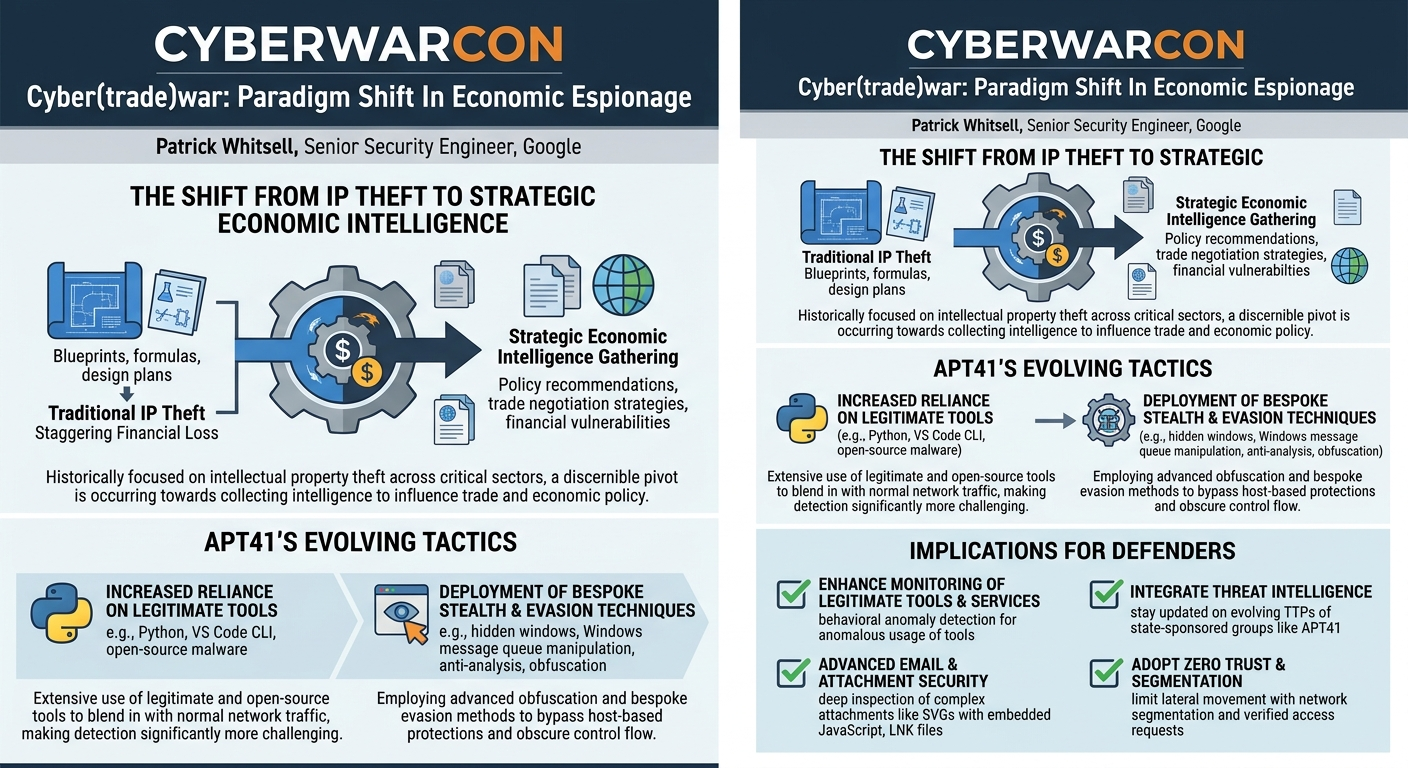
The central and most critical finding presented by Patrick Whitsell is the paradigm shift in the objectives of PRC state-sponsored threat actors, particularly APT41. While traditional intellectual property (IP) theft remains a significant concern, APT41 has demonstrably expanded its focus to encompass the collection of strategic economic intelligence. This represents a move from acquiring specific blueprints or formulas to understanding the broader economic landscape, including policy recommendations, trade negotiation strategies, and financial vulnerabilities. This shift was prominently highlighted in September of the year, when the Wall Street Journal reported on APT41's targeting of US trade groups, a story that Google confirmed based on its own threat intelligence findings.
Whitsell detailed two primary campaigns that exemplify this evolving strategic focus:
- Targeting US Trade and Policy Groups: The first campaign, initiated in early July, primarily focused on US-based Non-Governmental Organizations (NGOs), trade groups, and think tanks specializing in economics, trade, and foreign policy. This targeting coincided with a period of complex and evolving economic policies, including a back-and-forth of tariffs between the US and China, culminating in trade dialogues hosted in Sweden. While direct causal links between the cyber activity and geopolitical events are hard to definitively prove, the timing and specific targeting strongly suggest an aim to gain an "inside look" at the recommendations and strategies being considered by US officials and their external advisors. This represents a clear departure from traditional IP theft, focusing instead on intelligence relevant to economic policymaking and international trade negotiations.
- Targeting Latin and South American Financial and Legal Sectors: The second campaign, also commencing in July, targeted financial institutions, corporate legal departments, and law firms across Latin and South America. This region is strategically important to China, being one of its top trading partners and a significant recipient of investments through the Belt and Road Initiative. Similar to the US campaign, the timing and targets suggest an interest in gathering strategic economic information about the region, potentially concerning investments, financial flows, legal disputes, or market vulnerabilities that could impact China's extensive economic interests there.
Beyond the shift in targeting, Whitsell also identified significant changes in APT41's operational tactics, techniques, and procedures (TTPs):
- Increased Reliance on Legitimate and Open-Source Tools: A hallmark of these recent campaigns is the extensive use of tools that are legitimate and often found legitimately on target networks. This includes utilities like Arya 2 for file downloads, Python interpreters, VS Code CLI for remote development tunnels, and even legitimate penetration testing frameworks like Adpatics C2. This tactic aids in blending malicious activity with normal network traffic, making detection significantly more challenging.
- Deployment of Bespoke Stealth and Evasion Techniques: APT41 continues to innovate in anti-analysis and obfuscation. Whitsell detailed a particularly interesting technique involving the use of a hidden window and the Windows message queue to evade host-based protections and obfuscate control flow, demonstrating a high level of technical sophistication.
- Precision Targeting: There's a clear move away from the "mass spam-style phishing" previously associated with APT41 towards more precision targeting of specific users and entities. This refined approach indicates a greater investment in reconnaissance and tailored attacks, increasing their success rate against high-value targets.
- Continued Activity and Adaptability: Despite other prominent threat groups like "Silk, Salt, and Volt Typhoons" garnering recent attention, APT41 remains an active and prolific group. Whitsell emphasized their continued capability and adaptability, highlighting that they remain a significant threat for the foreseeable future, consistently supporting strategic PRC economic objectives through these evolving methods.
These findings collectively paint a picture of an adaptable and persistent adversary that is redefining the scope of state-sponsored cyber espionage, moving into the realm of overt economic intelligence gathering to support national trade and policy agendas.
Technical Deep Dive
▶ Watch: Campaign 2 TTPs: SVG attachments, MacOSS directories (4:15)
Patrick Whitsell provided a detailed technical breakdown of two distinct campaigns attributed to APT41, showcasing their evolving TTPs and strategic objectives. Both campaigns demonstrated a strong reliance on legitimate tools and sophisticated obfuscation techniques to achieve their goals.
Campaign 1: Targeting US Trade and Policy Groups
This campaign primarily focused on US-based NGOs, trade groups, and think tanks involved in economics, trade, and foreign policy. The attack chain was designed to establish persistent remote access and exfiltrate information.
- Initial Access and Execution: The attack began with an LNK file. This LNK file was crafted to execute Arya 2, a legitimate command-line utility for downloading files.
- Multi-Stage Downloads: Arya 2 was then leveraged to download multiple components from various legitimate web hosting locations:
- A decoy PDF from Open Drive, likely to distract the user or provide a plausible cover story.
- An obfuscated Python script from Pastebin.
- The Python interpreter from python.org, ensuring the target system had the necessary environment to run the script.
- The VS Code CLI (Visual Studio Code Command Line Interface) from the Visual Studio website.
All malware components were hosted in public cloud hosting services like Open Drive and Dropbox, often as encrypted malware archives, adding a layer of stealth and making initial detection harder.
- Remote Access Establishment: Once all components were downloaded, the obfuscated Python script executed. This script utilized the VS Code CLI to open a remote developer tunnel. Crucially, it then exfiltrated the access pin code for this tunnel to requestreo.com, another legitimate website.
- Actor Control: The threat actor could then collect this pin code from requestreo.com, connect to the remote tunnel, and gain persistent, interactive access to the target device. This method effectively bypassed traditional firewall rules by leveraging legitimate remote access tools and protocols.
The motivation for this campaign, as theorized by Whitsell, was to provide Chinese officials with an "inside look" at the recommendations and discussions US policy groups were having during a period of intense US-China trade tensions and tariff exchanges.
Campaign 2: Targeting Latin and South American Financial and Legal Sectors
This campaign demonstrated similar TTPs but with a distinct initial access vector and a more intricate obfuscation method. The targets were financial institutions, corporate legal departments, and law firms in Latin and South America.
- Initial Access via SVG Attachments: The attack began with targeted spear phishing emails containing SVG (Scalable Vector Graphics) attachments. SVGs, being XML-based, can embed JavaScript, which APT41 exploited.
- Embedded JavaScript and Data Exfiltration: The embedded JavaScript within the SVG attachment was designed to:
- Run automatically when the SVG was opened.
- Exfiltrate sensitive host data, cookies, and local storage information to XSS.report, a legitimate service used for testing Cross-Site Scripting vulnerabilities. This provided the attackers with valuable reconnaissance and potential session hijacking capabilities.
- Malware Delivery and Misdirection: The SVG attachment also contained Base64 encoded malware archives. Upon execution of the JavaScript, these archives were dropped onto the system. A notable misdirection technique observed was the presence of hidden
MacOSSdirectories within the dropped archive, even though the targets were Windows devices. This was likely intended to confuse analysts or deter casual inspection, making them think the files were irrelevant to a Windows environment. - DLL Sideloading and In-Memory Payload: The dropped archive contained an LNK file. This LNK file, when executed, achieved two objectives:
- It deployed a decoy PDF, similar to the first campaign, to maintain a façade of legitimacy.
- It initiated DLL sideloading on a legitimate executable. This technique involves placing a malicious DLL in a location where a legitimate application expects to load a benign DLL, causing the legitimate application to load the malicious one instead.
- Adapt Agent and Adpatics C2 Framework: The malicious DLL, once loaded, injected and loaded a tool referred to as adapt agent directly into memory. This
adapt agentwas designed to utilize the Adpatics C2 framework, a legitimate penetration testing tool used for adversary emulation. The use of such a legitimate tool further complicates detection by security software. - Advanced Obfuscation and Evasion: The intermediate stages of this attack chain incorporated multiple anti-analysis and obfuscation techniques. Whitsell highlighted a particularly intricate method:
- The malware created a hidden window.
- This hidden window was assigned a window procedure (a callback function).
- The malware then used the Windows message queue to send messages to this hidden window.
- Only when a very specific message was sent to the window did the window procedure activate, leading to the loading of the
adapt agentin memory. - The primary motivations for this technique were to obfuscate the control flow of the malware and to evade host-based protections that might monitor direct process injections or suspicious file operations. By relying on a legitimate OS mechanism (the message queue) and an obscure trigger, the malware could bypass many heuristic and signature-based detections.
Both campaigns underscore APT41's commitment to using a blend of legitimate tools, sophisticated custom obfuscation, and precision targeting to achieve strategic economic intelligence objectives. The shift away from easily detectable custom malware towards living-off-the-land techniques and legitimate infrastructure represents a significant challenge for defenders.
Demo / Proof of Concept
▶ Watch: Unique obfuscation using hidden Windows message queue (5:40)
While Patrick Whitsell's talk did not feature a live demonstration or proof of concept in the traditional sense, he provided highly detailed technical diagrams and explanations of the observed attack chains. These visual aids, combined with his in-depth descriptions, effectively served to illustrate the intricate steps and sophisticated techniques employed by APT41.
Specifically, Whitsell walked the audience through the multi-stage execution flow of both campaigns, detailing how LNK files initiated legitimate download utilities, how Python scripts leveraged VS Code CLI for remote tunnels, and how SVG attachments embedded JavaScript for data exfiltration and subsequent DLL sideloading. He also presented a diagram of the particularly complex obfuscation technique involving a hidden window and the Windows message queue, breaking down its mechanics and rationale. These detailed technical expositions, while not interactive, provided a clear and comprehensive understanding of the adversaries' methods, serving as a robust "proof of concept" through analytical reconstruction.
Defensive Implications
▶ Watch: APT41's evolving tactics: legitimate tools, precision targeting (7:00)
The detailed analysis of APT41's evolving tactics presented by Patrick Whitsell offers critical insights for cybersecurity defenders. The shift towards strategic economic espionage and the increased reliance on legitimate tools necessitate a re-evaluation of traditional defensive strategies.
- Enhanced Monitoring of Legitimate Tools and Services:
- Baseline Normal Activity: Organizations must establish robust baselines for the normal usage of legitimate tools like Arya 2, Python interpreters, VS Code CLI, and even legitimate penetration testing frameworks like Adpatics C2.
- Behavioral Anomaly Detection: Implement Endpoint Detection and Response (EDR) solutions that can detect anomalous usage patterns. For instance,
python.exemaking outbound connections to unusual domains,VS Code CLIinitiating remote tunnels from unexpected systems, orArya 2downloading executables from public cloud storage should trigger alerts. - Network Flow Monitoring: Monitor network traffic for connections to known legitimate but frequently abused services like requestreo.com and XSS.report, especially if originating from internal hosts.
- Advanced Email and Attachment Security:
- SVG Analysis: Email gateways and sandboxing solutions must be capable of deeply inspecting SVG attachments for embedded JavaScript and other malicious content. Static and dynamic analysis should be applied to all attachments, not just common executable types.
- LNK File Scrutiny: LNK files, often overlooked, are a persistent threat vector. Implement policies to block or heavily scrutinize LNK files, particularly if they are delivered via email or downloaded from untrusted sources.
- User Education: Conduct regular security awareness training emphasizing the risks of opening suspicious attachments, even if they appear to be common file types or from seemingly legitimate senders.
- Robust Host-Based Protections Against Obfuscation and Evasion:
- Memory Forensics and Process Monitoring: Deploy advanced EDR and Extended Detection and Response (XDR) solutions that can detect in-memory injection, DLL sideloading, and unusual process behavior, such as the creation of hidden windows or the manipulation of the Windows message queue for code execution.
- Application Control/Whitelisting: Consider implementing strict application control policies to prevent unauthorized executables and scripts from running, thereby limiting the effectiveness of legitimate tool abuse.
- Supply Chain Security: Given APT41's history with supply chain compromise, organizations should extend their security posture to vet third-party software, hardware, and services for potential vulnerabilities.
- Threat Intelligence Integration and Geopolitical Awareness:
- Stay Updated on APT41 TTPs: Continuously integrate the latest threat intelligence on APT41's evolving TTPs, targeting patterns, and chosen legitimate tools into security operations.
- Contextual Understanding: Develop an understanding of the geopolitical and economic landscape relevant to your industry. Knowing potential strategic interests can help anticipate targeting and tailor defenses.
- Network Segmentation and Zero Trust:
- Limit Lateral Movement: Implement strong network segmentation to restrict lateral movement if an adversary gains initial access, such as through a remote developer tunnel.
- Zero Trust Architecture: Adopt a Zero Trust security model, where every access request is verified regardless of its origin, minimizing the impact of compromised credentials or legitimate tools used maliciously.
By adopting these proactive and adaptive defensive measures, organizations can better position themselves to detect and respond to sophisticated adversaries like APT41 who are increasingly blurring the lines between traditional cyber espionage and economic warfare.
Key Takeaways
- APT41 Remains a Potent and Evolving Threat: Despite less recent spotlight compared to other groups, APT41 is highly active, prolific, and continues to pose a significant threat, demonstrating remarkable adaptability.
- Shift to Strategic Economic Objectives: APT41 has pivoted from primarily intellectual property theft to collecting strategic economic intelligence, targeting entities involved in trade, economics, and foreign policy to support PRC economic objectives.
- Increased Reliance on Legitimate Tools: A defining characteristic of recent campaigns is the extensive use of legitimate and open-source tools (e.g., Arya 2, Python, VS Code CLI, Adpatics C2), making detection challenging by blending in with normal network activity.
- Sophisticated Evasion and Obfuscation: APT41 employs bespoke stealth techniques, including complex obfuscation methods like using hidden windows and the Windows message queue to evade host-based protections and obscure control flow.
- Precision Targeting over Mass Attacks: The group has moved towards more precise targeting of specific users and high-value entities, indicating increased reconnaissance and tailored attack methodologies over their past mass spam-style phishing campaigns.
- Defenders Must Adapt Monitoring Strategies: Organizations need to enhance monitoring for anomalous usage of legitimate tools, strengthen email security against complex attachments like SVGs with embedded JavaScript, and integrate advanced threat intelligence on evolving TTPs.
About the Speaker(s)
Patrick Whitsell is a Senior Security Engineer with the Google Threat Intelligence Group. He brings a decade of experience in cybersecurity, with four years specifically dedicated to threat research focused on cyber espionage. Whitsell is an active contributor to the cybersecurity community, having published several pieces of research and recently delivered a talk at Rukcon. His expertise lies in analyzing sophisticated threat actors and their evolving tactics, making him a credible voice on the subject of state-sponsored cyber espionage.
Reviews
Dr. Zero (Offensive Security Researcher) — SOLID
Competent threat intel briefing on APT41's pivot toward economic policy targeting. Good operational detail on two campaigns, but the 'paradigm shift' framing oversells what is ultimately incremental evolution in targeting scope. Fills a slot, won't change how most defenders operate tomorrow.
Heather Calloway (CISO) — STRONG ACCEPT
This is the kind of threat intelligence briefing I'd send to my board chair before a risk committee meeting. APT41's pivot from IP theft to strategic economic intelligence collection — targeting trade groups, think tanks, and policy advisors — changes the risk calculus for any organization adjacent to US-China economic policy. If you're in financial services, legal, or have any exposure to trade policy discussions, this talk tells you why your threat model needs updating.