Bypassing BitLocker: Full Disk Decryption for less than $5
Allen Cook, Dale Cook
Overview
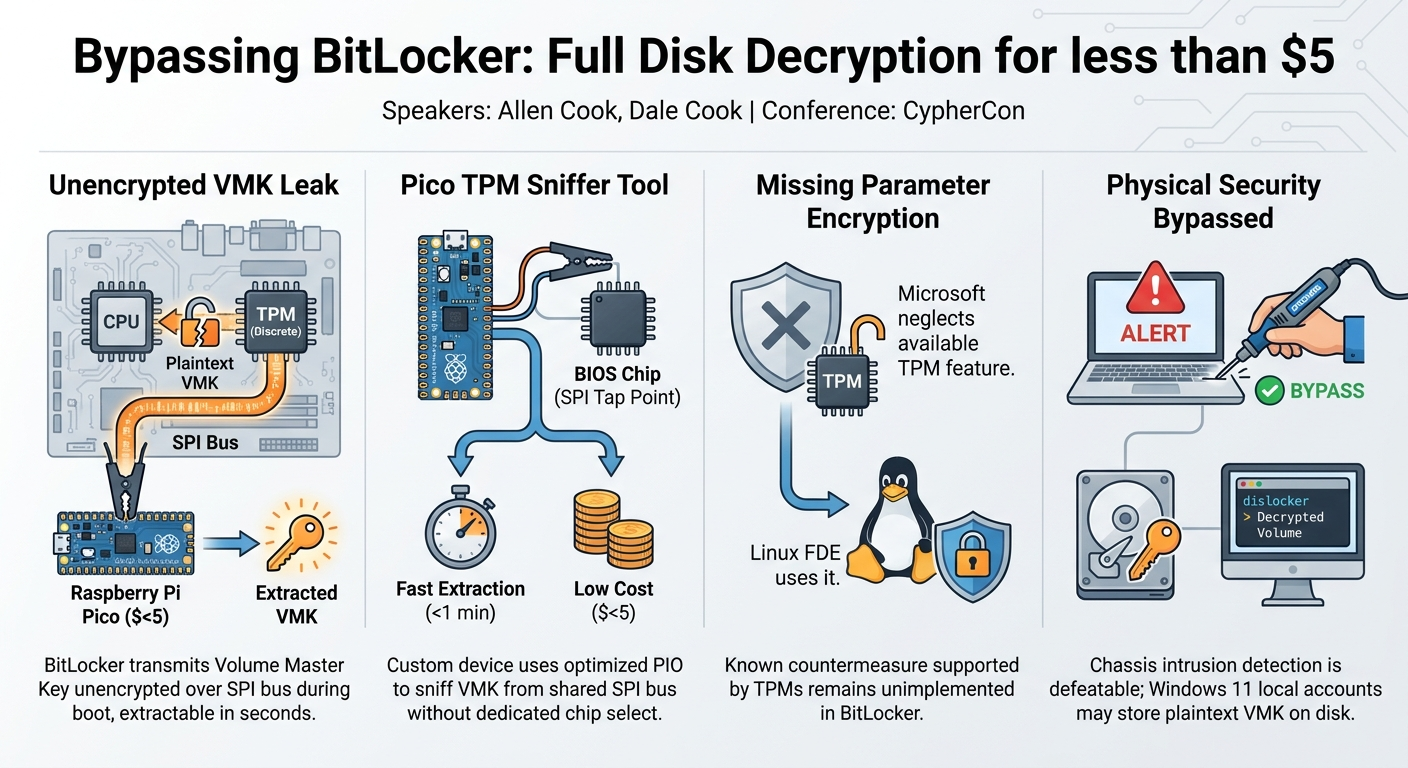
In this compelling CypherCon talk, security researchers Allen Cook (Dozer) and Dale Cook (Voot) unveil a refined and alarmingly accessible method to bypass Microsoft's BitLocker full disk encryption. Titled "Bypassing BitLocker: Full Disk Decryption for less than $5," the presentation dissects a fundamental flaw in BitLocker's key management, specifically how the Volume Master Key (VMK) is handled during the boot process on systems equipped with a discrete Trusted Platform Module (TPM). The speakers demonstrate a physical attack that leverages a custom device, dubbed the Pico TPM Sniffer, built from a Raspberry Pi Pico costing less than $5, to extract the VMK and subsequently decrypt a BitLocker-protected drive in minutes.
Key moments
- 2:00 BitLocker, TPM, and SPI bus vulnerability explained
- 4:00 Traditional SPI sniffing attack challenges
- 10:00 Raspberry Pi Pico TPM Sniffer solution details
- 13:40 Live demo: VMK extraction with Pico Spider
- 14:30 Live demo: Full disk decryption using stolen VMK
- 16:00 Microsoft's BitLocker flaws and physical bypasses
- 38:00 Default BitLocker weakness for local Windows accounts
Bypassing BitLocker: Full Disk Decryption for less than $5
Speakers: Allen Cook, Security Researcher, Programmer, Electronics Hobbyist; Dale Cook, Security Engineer, Former Systems and Network Administrator
Conference: CypherCon
YouTube: https://www.youtube.com/watch?v=U-wuOeI9vQg
Overview
In this compelling CypherCon talk, security researchers Allen Cook (Dozer) and Dale Cook (Voot) unveil a refined and alarmingly accessible method to bypass Microsoft's BitLocker full disk encryption. Titled "Bypassing BitLocker: Full Disk Decryption for less than $5," the presentation dissects a fundamental flaw in BitLocker's key management, specifically how the Volume Master Key (VMK) is handled during the boot process on systems equipped with a discrete Trusted Platform Module (TPM). The speakers demonstrate a physical attack that leverages a custom device, dubbed the Pico TPM Sniffer, built from a Raspberry Pi Pico costing less than $5, to extract the VMK and subsequently decrypt a BitLocker-protected drive in minutes.
The significance of this research cannot be overstated. BitLocker is Microsoft's default encryption solution, automatically enabled on many modern Windows 11 installations, and is widely deployed across enterprises for data protection. The demonstrated attack undermines the core promise of BitLocker's security by providing a low-cost, high-speed method for an attacker with physical access to compromise encrypted data. This work highlights a critical oversight by Microsoft, who, despite being involved in the TPM's reference specification, has yet to implement readily available countermeasures like parameter encryption.
The talk not only exposes the vulnerability but also provides practical, actionable insights for both attackers and defenders. It delves into the technical intricacies of the SPI bus, the limitations of traditional sniffing tools, and the innovative engineering behind the Pico TPM Sniffer. Furthermore, the speakers outline various methods to circumvent common physical security measures like chassis intrusion detection, underscoring the severity of the threat model. This research serves as a stark reminder that even robust cryptographic algorithms can be rendered ineffective by flaws in key management and implementation, urging organizations to re-evaluate their BitLocker deployments and consider more secure alternatives or supplementary controls.
Background
▶ Watch: BitLocker, TPM, and SPI bus vulnerability explained (2:00)
BitLocker stands as Microsoft's widely adopted full disk encryption (FDE) solution for Windows operating systems, often enabled by default in Windows 11. While the cryptographic strength of BitLocker's underlying encryption algorithms is generally considered robust, the speakers contend that its key management implementation exhibits significant weaknesses. At the heart of this discussion is the Trusted Platform Module (TPM), a specialized microcontroller designed to store cryptographic keys and protect platform integrity. On a BitLocker-enabled system, the TPM is responsible for securely storing the Volume Master Key (VMK), which is essential for decrypting the hard drive at boot.
The TPM stores the VMK in a "sealed" state, meaning it can only be unsealed and released if the system's BIOS confirms that the platform has not been tampered with. This integrity check is crucial; if successful, the BIOS convinces the TPM to unseal the VMK. It is during the subsequent exchange, when the Windows Boot Manager retrieves the VMK from the TPM, that the system becomes vulnerable. The talk specifically focuses on systems utilizing discrete TPMs, where the TPM chip is a separate component on the motherboard, as opposed to integrated TPMs built directly into the CPU. The researchers note that discrete TPMs are prevalent in the majority of systems they examined.
Communication between the CPU and a discrete TPM occurs over various protocols, with Low Pin Count (LPC) being common on older systems and Serial Peripheral Interface (SPI) dominating newer hardware. The speakers identified SPI as the primary target for their attack due to its characteristics: it is "slow enough to be sniffed" and its connections are often "exposed on the board." SPI typically involves four essential signals: Master Out Slave In (MOSI) for CPU-to-TPM data, Master In Slave Out (MISO) for TPM-to-CPU data, a Clock signal for synchronization, and a Chip Select (CS) line that designates which slave device on the bus should be active.
The concept of sniffing the SPI bus to extract cryptographic keys is not entirely novel. Previous attacks have demonstrated this feasibility, often requiring intricate micro-soldering, prohibitively expensive logic analyzers (costing upwards of a thousand dollars), and considerable patience. However, these traditional methods are time-consuming and complex, rendering them impractical for rapid, on-site exploitation scenarios. The core motivation behind this research was to refine this existing attack methodology, transforming it into a fast, economical, and significantly more accessible threat.
Key Findings
▶ Watch: Raspberry Pi Pico TPM Sniffer solution details (10:00)
The research presented by Allen and Dale Cook reveals several critical findings that collectively redefine the threat landscape for BitLocker-protected systems:
- Unencrypted VMK Transmission: The fundamental vulnerability lies in BitLocker's design choice to transmit the Volume Master Key (VMK) in an unencrypted state over the SPI bus between the TPM and the CPU during the boot process. This exposes the VMK to passive eavesdropping by an attacker with physical access, allowing for complete decryption of the drive.
- Practical and Low-Cost Attack Vector: The speakers successfully developed and demonstrated a method to extract the VMK using a Raspberry Pi Pico, a microcontroller that costs less than $5. This dramatically lowers the barrier to entry for such an attack, moving it from the realm of specialized, expensive equipment to easily obtainable, inexpensive hardware.
- Bypassing Traditional Sniffing Challenges:
- Accessible Tap Point: Instead of attempting to probe the often-hidden and difficult-to-access TPM chip directly, the researchers found that the BIOS chip (also on the SPI bus) provides a more convenient and standardized tap point. This simplifies the physical connection process, allowing for the use of readily available clips.
- Chip Select (CS) Omission Solution: A key challenge with tapping the BIOS chip is the absence of the TPM's dedicated CS line. Traditional SPI decoders struggle with this, leading to unreliable data due to interference and clock pulse loss. The researchers innovated by rewriting the SPI decoder to intelligently monitor the clock signal's frequency, effectively inferring transaction boundaries and correcting for errors without needing the CS line.
- The Pico TPM Sniffer's Superior Performance: Their custom device, the Pico TPM Sniffer, addresses performance limitations inherent in previous Raspberry Pi Pico-based SPI sniffers. By utilizing two separate Programmable I/O (PIO) state machines for synchronous data capture, highly optimized code (supporting up to 50 MHz bus speeds), DMA channels for efficient memory transfer, and a dual-core processing approach for parsing, the Pico TPM Sniffer achieves "basically perfect throughput" without overclocking. This enables reliable VMK extraction even on TPMs operating at the 24 MHz standard, which previously posed challenges for other projects.
- Microsoft's Negligence in Implementing Known Solutions: A significant finding is Microsoft's apparent disinterest in implementing parameter encryption for TPM communications within BitLocker. This feature is supported by TPMs, and Microsoft was even involved in defining the TPM reference specification. This omission leaves BitLocker vulnerable to an attack for which a known and available countermeasure exists, a countermeasure that Linux's full-disk encryption solutions have reportedly utilized for years.
- Bypass of Physical Security Measures: The talk details multiple ingenious methods to circumvent chassis intrusion detection mechanisms found in many laptops. These techniques allow an attacker to physically access the motherboard and probe the BIOS chip without triggering security alerts or rendering the system unbootable, further undermining physical security controls often relied upon in corporate environments.
- BitLocker's Default Configuration Flaw on Windows 11: The speakers highlighted a particularly egregious flaw: if a Windows 11 user operating with a local administrator account has not explicitly saved their BitLocker recovery key, the VMK is stored in plaintext on the hard drive. In such a scenario, the drive is encrypted, but not secure, as tools like
dislockercan automatically locate and use this plaintext VMK to decrypt the drive without any physical sniffing.
These findings collectively paint a concerning picture for BitLocker's effectiveness against determined attackers with physical access, especially given the ease and low cost of the demonstrated exploit.
Technical Deep Dive
▶ Watch: Live demo: VMK extraction with Pico Spider (13:40)
The technical core of this attack revolves around exploiting the SPI (Serial Peripheral Interface) bus, a synchronous serial communication interface commonly used for short-distance data transfer. The SPI bus operates with four key signals: MOSI (Master Out Slave In), MISO (Master In Slave Out), Clock (CLK), and Chip Select (CS). In a typical TPM transaction, the CPU (master) pulls the TPM's CS line low to initiate communication. It then sends commands and data via MOSI, synchronized by the CLK signal. The TPM (slave) responds with data via MISO, also synchronized by the CLK.
Previous SPI sniffing attacks typically utilized expensive, high-end logic analyzers (e.g., a $1,000 Saleae device) connected directly to the TPM's SPI pins. These analyzers would capture all four signals, including the crucial CS line. The CS line is vital because it delineates individual transactions. Without it, a basic SPI decoder, which simply counts eight clock pulses for every byte, can easily lose synchronization due to minor electrical interference or a dropped clock pulse. As demonstrated in the talk, an error in one transaction without CS can "trash all of the rest of the data," making reliable VMK extraction impossible. The CS signal, by indicating transaction boundaries, allows decoders to reset and confine such errors.
The primary innovation of this research is overcoming the need for the TPM's dedicated CS line, enabling tapping at the more accessible BIOS flash memory chip. Since the BIOS chip is also an SPI slave, it shares the common MOSI, MISO, and CLK lines with the TPM, but it has its own CS line, distinct from the TPM's. To compensate for the missing TPM CS, the researchers developed a novel approach: their custom SPI decoder constantly monitors the frequency of the clock signal. When the clock signal goes idle for an extended period, it indicates the end of a transaction, allowing the decoder to reset its internal state, effectively mimicking the error-confining behavior of a CS line. This technique allows reliable decoding of data from the shared SPI bus based solely on the easily accessible signals.
The implementation of this technique on a Raspberry Pi Pico is a testament to clever embedded systems programming. The Pico, costing less than $5, features a unique hardware component called Programmable I/O (PIO) state machines. Unlike traditional microcontrollers that rely on CPU-intensive bit-banging for high-speed serial protocols, the Pico's PIO allows for highly optimized, hardware-level handling of I/O. The Pico TPM Sniffer leverages this by:
- Dual PIO State Machines: Two separate PIO state machines are employed to synchronously capture both the MOSI and MISO data streams. This parallel capture eliminates the data interleaving issues common in single-state-machine designs, which simplify data processing.
- Optimized PIO Code: The state machine code is meticulously optimized to sniff SPI buses operating at speeds up to 50 MHz. This significantly surpasses the ~20 MHz limit often observed in other Pico-based SPI sniffing projects, making it compatible with the 24 MHz standard specified by the Trusted Computing Group and higher frequencies encouraged by manufacturers.
- DMA Channels: The Pico's Direct Memory Access (DMA) channels are crucial for efficiency. DMA controllers automatically transfer data from the PIO state machines directly into the Pico's memory without requiring any CPU intervention. This means the SPI data "appears fully formed in two giant buffers as if by magic," freeing the processor cores to focus entirely on data analysis.
- Dual-Core Processing: The Raspberry Pi Pico features two ARM Cortex-M0+ processor cores. The Pico TPM Sniffer utilizes this by dedicating one core to identifying SPI transactions belonging to the TPM and extracting the relevant data. The second core then specializes in parsing this extracted TPM data to pinpoint and retrieve the VMK. This parallel processing architecture ensures high throughput and responsiveness, enabling the device to handle high data rates without requiring overclocking.
The speakers contrasted their solution with other microcontrollers like the ESP32, which, despite its speed, lacks a similar PIO architecture suitable for sniffing. Its built-in SPI hardware is designed for active communication, not passive listening, and bit-banging GPIOs would be too inefficient. The unique capabilities of the Pico's PIO state machines, described as a "very small FPGA," are central to the success of the Pico TPM Sniffer. This detailed technical approach transforms a complex, expensive attack into a fast, cheap, and highly effective tool for BitLocker decryption.
Demo / Proof of Concept
▶ Watch: Microsoft's BitLocker flaws and physical bypasses (16:00)
The live demonstration at CypherCon served as a powerful validation of the researchers' claims, showcasing the speed and efficacy of the Pico TPM Sniffer in a real-world scenario. The setup involved a Dell laptop protected by BitLocker and the custom-built sniffing device, which, as a playful touch, was integrated into a hacked CypherCon badge (a Raspberry Pi Pico).
The demonstration proceeded in two main phases:
- VMK Extraction:
- Physical Connection: Allen Cook connected the Pico TPM Sniffer (the badge) to the laptop's motherboard using a clip attached to the BIOS flash memory chip. This connection provided access to the shared SPI bus signals (MOSI, MISO, Clock) without needing to directly probe the TPM.
- Live Sniffing: With a serial terminal open on a separate machine, connected to the Pico TPM Sniffer, Dale Cook powered on the BitLocker-enabled Dell laptop.
- Instant Decryption Key: Within seconds of the standard Dell boot splash appearing on the laptop screen, the Volume Master Key (VMK), a string of hexadecimal characters, appeared in plaintext in the serial terminal. This live capture vividly illustrated the unencrypted transmission of the VMK during the boot sequence.
- Full Disk Decryption and Data Access:
- Hard Drive Removal: After the VMK was successfully captured, the laptop was shut down, and its BitLocker-encrypted hard drive was physically removed.
- External Connection: The hard drive was then connected to a separate Linux machine.
- Automated Decryption: Dale Cook ran a prepared script on the Linux machine. This script first wrote the recently captured VMK to a binary file. It then utilized the open-source utility
dislockerto mount the BitLocker-encrypted volume using the stolen VMK. - Data Access: Following the successful mounting of the encrypted volume, the underlying NTFS volume was also mounted. A file browser was then opened, revealing full, unhindered access to the Windows user's home directory. This demonstrated that an attacker could now exfiltrate sensitive data, plant malware, or perform any other malicious action on the compromised system.
The entire process, from VMK extraction to gaining full access to the encrypted drive's contents, was completed rapidly and seamlessly on stage, eliciting applause from the audience. This compelling proof of concept underscored the practicality, speed, and low cost of the attack, moving it from a theoretical vulnerability to a demonstrated, actionable threat. The use of the CypherCon badge as the attack tool further emphasized the accessibility and ingenuity of the solution.
Defensive Implications
▶ Watch: Default BitLocker weakness for local Windows accounts (38:00)
The findings presented in this talk carry profound defensive implications for organizations and individuals relying on BitLocker for data protection. The core message is clear: BitLocker, in its current implementation on discrete TPM systems, does not provide robust protection against an attacker with physical access.
The most critical defensive measure, which the speakers highlight as a proper and long-term fix, is the implementation of parameter encryption for TPM communications over the SPI bus. TPMs already support this feature, and it would ensure that sensitive data like the VMK is never transmitted in plaintext. The fact that Microsoft, despite its involvement in the TPM specification, has not implemented this for BitLocker is a significant concern. Until Microsoft addresses this fundamental flaw, BitLocker will remain vulnerable to this class of physical attack.
For users and organizations that prioritize security and have the flexibility, the speakers strongly recommend adopting Linux-based full-disk encryption (FDE) solutions. Linux distributions have reportedly used parameter encryption in their FDE for years, making them inherently more resilient to this specific SPI sniffing attack.
For those unfortunately "stuck using Windows," particularly in enterprise environments, the available mitigations are imperfect and come with trade-offs:
- Pre-boot Authentication (PBA) with a PIN: Enabling a PIN that must be entered before the operating system boots will prevent the VMK from being unsealed by the TPM until the correct PIN is provided.
- Limitation: This does not protect against insider threats who know the PIN (e.g., an IT administrator or the legitimate user themselves). If an insider knows the PIN, they can still boot the machine, extract the VMK during the boot process, and later decrypt the hard drive.
- Chassis Intrusion Detection: Many enterprise-grade laptops include hardware features that detect if the machine's chassis has been physically opened. If an intrusion is detected, the system may refuse to boot, and the TPM might refuse to unseal the VMK.
- Limitation: The speakers demonstrated multiple methods to bypass chassis intrusion detection without triggering an event or rendering the system unbootable. These methods include:
- Dremel Cutout: Carefully cutting a small hole (the size of the BIOS chip) in the case, ensuring the chassis intrusion pins remain bridged, then probing the exposed BIOS chip. The hole can be covered with a "tactical sticker."
- Case Sectioning: Cutting across the bottom of the laptop case, leaving the top section (where intrusion pins are often located) intact and bridged. This allows access to the hard drive and BIOS chip from the bottom, followed by reassembly and more "tactical stickers."
- Solder Paste: Boring a tiny, inconspicuous hole next to the intrusion pins, then injecting solder paste and applying heat to permanently bridge the pins. This effectively disables the intrusion detection without leaving obvious external signs, making the attack potentially "completely undetectable" if a new cover is applied.
Beyond these specific mitigations, the talk also uncovered a critical default configuration flaw in Windows 11. If a local administrator account is used and the BitLocker recovery key has not been explicitly saved, the VMK is stored in plaintext on the hard drive itself. In this scenario, simply pulling the hard drive and connecting it to a Linux machine allows dislocker to automatically locate and use the plaintext VMK to decrypt the drive, bypassing any need for SPI sniffing. Defenders must ensure that BitLocker is fully enabled and recovery keys are securely backed up, even for local accounts.
In summary, organizations should:
- Strongly advocate for Microsoft to implement parameter encryption for BitLocker.
- Consider Linux-based FDE where feasible.
- Implement PBA with strong PINs, but understand its limitations against insiders.
- Recognize that chassis intrusion detection is not a foolproof defense against determined physical attackers.
- Verify BitLocker's full enablement and recovery key backup procedures for all Windows 11 deployments, especially those using local accounts.
- Be aware that physical access to a device, even if encrypted, can lead to complete data compromise with readily available tools and techniques.
Key Takeaways
- BitLocker's Fundamental Flaw: Microsoft's BitLocker transmits the Volume Master Key (VMK) unencrypted over the SPI bus during the boot sequence on systems with discrete TPMs, creating a critical vulnerability for physical attacks.
- Low-Cost, High-Speed Exploitation: The Pico TPM Sniffer, built from a Raspberry Pi Pico for less than $5, enables rapid (seconds-long) extraction of the VMK, transforming a complex attack into an accessible and practical threat.
- Microsoft's Neglected Solution: Microsoft has failed to implement parameter encryption for TPM communications in BitLocker, despite TPMs supporting this feature and Microsoft's involvement in the TPM specification, leaving a known vulnerability unaddressed.
- Bypassable Physical Security: Common physical security measures like chassis intrusion detection can be circumvented using simple tools and ingenious techniques, allowing attackers to access internal components without triggering alerts.
- Linux FDE as a Secure Alternative: Linux-based full-disk encryption solutions already utilize parameter encryption, offering a more robust defense against this type of physical attack.
- Windows 11 Default Configuration Risk: On Windows 11 systems using local administrator accounts, if the BitLocker recovery key isn't explicitly saved, the VMK can be stored in plaintext on the hard drive, allowing for trivial decryption with tools like
dislockerafter physical removal.
About the Speaker(s)
Allen Cook, who goes by "Dozer" in the security community, is a dedicated security researcher. He identifies himself as a "pretty decent programmer" and an "electronics hobbyist," skills that were evidently crucial in the design and development of the Pico TPM Sniffer.
Dale Cook, known as "Voot," is a security engineer. His background includes experience as a former systems and network administrator, providing him with a practical understanding of IT infrastructure and security challenges that informed the research and its implications.
Reviews
Dr. Zero (Offensive Security Researcher) — STRONG ACCEPT
This is exactly what hardware research should look like. Allen and Dale Cook took a known, expensive attack vector—SPI sniffing the BitLocker VMK—and engineered a $5 weapon that drops the need for the TPM's Chip Select line entirely. It's an elegant, highly reproducible physical bypass that rightfully drags Microsoft for ignoring parameter encryption.
Heather Calloway (CISO) — STRONG ACCEPT
BitLocker’s default TPM-backed encryption can be bypassed in minutes using $5 of hardware. This fundamentally breaks the threat model for stolen corporate laptops unless Pre-Boot Authentication is enforced.