Gateways to Chaos - How We Proved Modems Are a Ticking Time Bomb
Chiao-Lin Yu
DEF CON 33 · Day 1 · Main Stage
Overview
Home modems and residential gateways occupy a uniquely dangerous position in modern network architecture: they sit entirely outside the security perimeter that organizations and consumers meticulously
Key moments
- 0:03 Introduction: Why modems are an overlooked attack surface
- 16:02 Firmware analysis methodology for modem devices
- 1:04 CVE disclosures: critical vulnerabilities found in modem gateways
- 18:17 Authentication bypass vulnerability demonstration
- 22:30 Remote code execution via modem management interfaces
- 27:29 Supply chain issues: same vulnerable firmware across multiple vendors
- 32:29 Live exploit demonstration against modem hardware
- 2:04 Vendor response and patching status discussion
- 42:29 Responsible disclosure timeline and recommendations
Gateways to Chaos — How We Proved Modems Are a Ticking Time Bomb
Speakers: Chiao-Lin Yu (Steven Mao)
Conference: DEF CON 33
YouTube: https://www.youtube.com/watch?v=kItqWJHN_dI
Slides: https://media.defcon.org/DEF%20CON%2033/DEF%20CON%2033%20presentations/Chiao-Lin%20Yu%20-%20Gateways%20to%20Chaos%20-%20How%20We%20Proved%20Modems%20Are%20a%20Ticking%20Time%20Bomb%20That%20Hackers%20Can%20Access%20Everywhere.pdf
Overview
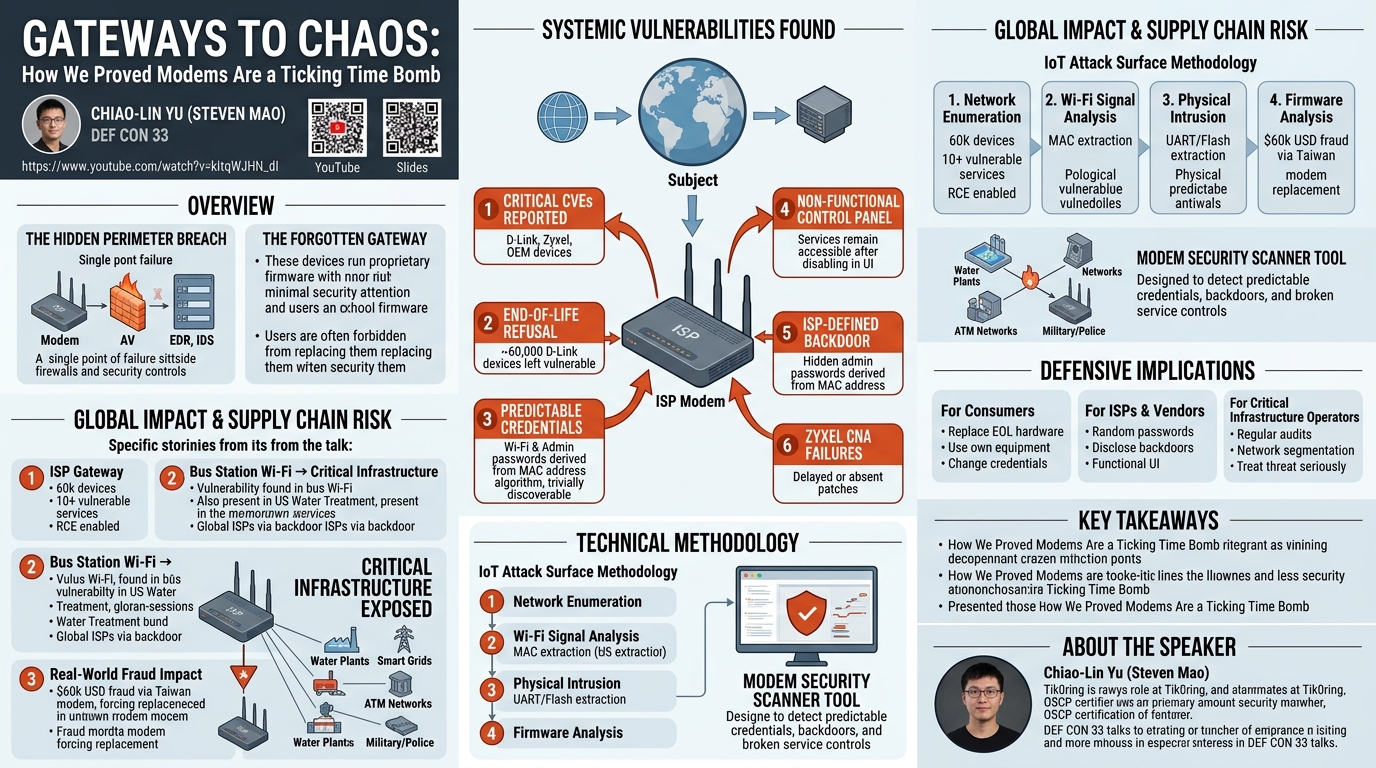
Home modems and residential gateways occupy a uniquely dangerous position in modern network architecture: they sit entirely outside the security perimeter that organizations and consumers meticulously construct for their interior devices, yet they are the single point through which all internet-bound traffic flows. Unlike laptops, servers, and IoT sensors — which can be protected by antivirus software, EDR agents, firewalls, and configuration management — embedded gateway hardware running proprietary firmware receives almost none of this attention, and in many countries, users are legally or contractually prohibited from replacing their ISP-provided equipment.
Chiao-Lin Yu (who goes by Steven Mao), a senior researcher at Tik0ring in Taiwan, delivered a systematic indictment of this state of affairs at DEF CON 33. His talk documented multiple CVEs discovered across several modem and residential gateway products — including devices from D-Link, Zyxel, and ISP-specific OEM hardware — demonstrating that these devices are exploitable from anywhere in the world. More alarming still, the talk highlighted cases where ISPs and vendors refused to patch known critical vulnerabilities affecting tens of thousands of deployed devices, leaving users with no recourse. A companion story revealed that the same vulnerability class found in a bus station's free Wi-Fi network was also present in a water treatment company's internet gateway and in ISP infrastructure serving Europe, Asia, and the United States.
Background
▶ Watch: Introduction: Why modems are an overlooked attack surface (0:03)
The architecture of internet connectivity follows a consistent pattern: a user's device connects to a wireless router, the router connects to a modem or residential gateway (sometimes the same device), and the modem bridges the home network to the ISP's infrastructure via DSL, coaxial cable, fiber, or cellular (4G LTE/5G). In enterprise environments, the pattern is similar — a modem sits at the network edge, typically in front of even the external firewall.
The security implication is stark: any device sitting "in front of" the firewall is, by definition, exposed to the open internet. The firewall and all devices it protects are only as secure as the gateway device that precedes them. A compromised modem gives an attacker a foothold on the network that bypasses every security control deployed inside the perimeter — EDR agents, network monitoring, DLP solutions, and SIEM platforms will see nothing if the gateway itself is under adversarial control.
This research was catalyzed by a personal experience: in 2023, Yu moved to a new house and received a modem from his ISP. Following his standard practice of security-testing new devices before using them, he identified more than ten distinct vulnerable services on the ISP-provided equipment within a short time frame — an experience he described as "a textbook-level example for even an IoT penetration testing beginner."
The business reality that makes this problem systemic is the residential proxy underground economy. Cybercriminals and fraud operations pay for access to compromised home devices to use as residential proxies — IP addresses that appear to originate from legitimate home ISP connections rather than commercial data centers. This allows them to bypass fraud detection systems (including 3D Secure credit card verification, which checks whether a purchase originates from the cardholder's usual geographic region) and legitimize otherwise suspicious traffic. The demand for compromised residential endpoints creates a strong economic incentive for large-scale modem exploitation.
Key Findings
▶ Watch: Vendor response and patching status discussion (2:04)
- Multiple CVEs reported across D-Link, Zyxel, and ISP OEM devices. Additional CVEs remained in the disclosure pipeline at the time of the DEF CON 33 presentation.
- D-Link end-of-life refusal: Critical vulnerabilities were found in D-Link devices; D-Link declined to patch them, citing end-of-life status. Approximately 60,000 such devices were in active deployment at the time of discovery, with neither the vendor nor the ISP willing to replace or patch them.
- Hardcoded credentials derived from MAC addresses: ISP-provided gateways were found to generate both the Wi-Fi passphrase and the web console administrator password algorithmically from the device's MAC address. Since the MAC address is broadcast in Wi-Fi beacon frames (as the BSSID) and is visible in ARP packets on the LAN, it is trivially discoverable — making the "random" credentials effectively predictable.
- Non-functional control panel: Even when the web console theoretically allowed disabling vulnerable services, those services remained accessible after "disabling" them from the UI. The control panel was cosmetically functional but operationally useless.
- ISP-defined backdoor credentials: Hidden administrative passwords (not displayed in the user interface) were found on devices, intended for ISP maintenance purposes. These passwords were also derived from the MAC address using the same algorithm.
- Zyxel handling failures: Despite being a CVE Numbering Authority (CNA) — meaning Zyxel has the authority to assign CVE identifiers to vulnerabilities in its own products — Zyxel was found to have handled reported vulnerabilities inadequately, with delayed or absent patches and insufficient communication.
- Critical infrastructure exposure: Through threat intelligence work, Yu's team found that water treatment plants, smart grid systems, oil and gas infrastructure, ATM networks, vehicle management systems, and even government, military, and police systems were using vulnerable modem hardware exposed to the internet.
- Real-world fraud impact: In February (year of the talk), a home modem in Taiwan was used by a fraud group to commit fraud worth approximately $60,000 USD. This single incident finally forced the ISP to begin replacing vulnerable devices.
Technical Deep Dive
▶ Watch: Firmware analysis methodology for modem devices (16:02)
IoT Attack Surface Methodology
Yu's approach to assessing modem security followed a structured methodology applicable broadly to embedded systems:
- Network asset enumeration: Port scanning both WAN and LAN interfaces, identifying listening services (HTTP/HTTPS management interfaces, Telnet, SSH, TR-069/CWMP, FTP, SNMP, etc.).
- Wi-Fi signal analysis: Capturing beacon frames to extract the BSSID (MAC address), which, as described, directly enables password derivation.
- Physical intrusion: Disassembling device casings to expose UART debug headers, flash memory chips, and JTAG interfaces for firmware extraction.
- Firmware analysis: Using tools like binwalk to unpack firmware images and analyze the embedded file system, services, and configurations.
Vulnerability Chain — Story 1: ISP Gateway (60,000 Devices)
The first case involved Yu's own ISP-provided residential gateway. He identified:
- Predictable credential algorithm: The web console password and Wi-Fi password were both generated as a function of the MAC address. Given the MAC, password derivation was immediate.
- MAC address disclosure vectors: The BSSID in Wi-Fi frames, ARP packets on the LAN, the physical label on the device itself, or any WAN-level address visible during routing.
- Hidden ISP backdoor credential: A separate administrative account, not shown in the UI, also derived from the MAC address.
- Broken web console access control: Even after disabling services through the administrative interface, the services remained reachable on their ports.
- Chained remote code execution: By chaining credential disclosure (MAC → password) with an authentication bypass or another service vulnerability, full RCE was achievable on the device without physical access.
This combination of weaknesses was assessed at approximately 10+ distinct vulnerable services on a single device, constituting what Yu called a "textbook" IoT pentest target.
Vulnerability Chain — Story 2: Bus Station Free Wi-Fi → Water Company → Global ISPs
The second story began with a connection to free Wi-Fi on a bus. Yu identified a vulnerability in the bus's gateway device and subsequently discovered the same bug class in:
- A water treatment company's internet-facing gateway in the United States.
- Multiple major ISP networks in Europe, Asia, and the United States.
- A backdoor in the product used by these ISPs, allowing an attacker with knowledge of the backdoor to control gateway devices globally.
This illustrates a critical supply-chain problem: a single OEM hardware platform or firmware codebase, deployed across multiple ISP brands and geographic markets, means that one vulnerability affects millions of devices simultaneously. The backdoor discovery in this product was particularly significant — it represented an intentional, non-disclosed access mechanism that, once known to an attacker, enables arbitrary device compromise at global scale.
Vulnerability Chain — Story 3: Zyxel and CNA Failures
The third story examined Zyxel, which holds CNA status from MITRE, granting it authority to assign CVEs to its own product vulnerabilities. Yu's team reported critical vulnerabilities to Zyxel and documented the subsequent handling. Despite the structural advantage of being a CNA (theoretically enabling faster, better-coordinated disclosure), Zyxel's response was assessed as inadequate — patches were delayed, scope of impact was underacknowledged, and the coordination process was opaque.
Modem Security Scanner Tool
In addition to the vulnerability disclosures, Yu developed and introduced a modem security scanner tool designed to detect the specific vulnerability classes discussed in the talk. The tool can identify:
- Predictable credential patterns (MAC-derived passwords)
- Backdoor authentication paths
- Services that remain exposed despite being administratively disabled
- Known CVEs in modem firmware versions
The tool was presented as a practical defensive resource for security teams and ISPs wanting to audit the exposure of their deployed device inventory.
Demo / Proof of Concept
▶ Watch: Remote code execution via modem management interfaces (22:30)
The talk included live demonstrations of:
- MAC-to-password derivation: Given only a Wi-Fi BSSID observed from outside the network, deriving the web console password and authenticating to the management interface.
- Backdoor credential authentication: Using the hidden ISP maintenance credentials to gain administrative access to a device where normal user credentials were changed.
- Service availability after "disable": Demonstrating that services toggled off in the web UI remained reachable on their ports.
- Remote code execution: Chaining the above weaknesses to achieve full device control, including demonstrating that the same exploit worked against devices from different ISPs in different countries.
The water company scenario was presented with evidence that critical OT/IT infrastructure was reachable via the same vulnerability class, making the implications extend well beyond home users.
Defensive Implications
▶ Watch: Supply chain issues: same vulnerable firmware across multiple vendors (27:29)
For consumers:
- Request that your ISP replace end-of-life gateway hardware, especially if it is known to be unpatched.
- If you have the option to use your own equipment (promoted under the EU's "Router Freedom" initiative), do so — ISP-provided hardware prioritizes support cost reduction over security.
- Change default credentials immediately, though note that if passwords are derived from the MAC address, changing them may require also changing the underlying algorithm (typically only possible via firmware update).
For ISPs and vendors:
- Credential generation algorithms must not use publicly observable values (MAC addresses) as inputs. Passwords must be truly random and not algorithmically reproducible.
- Administrative backdoor accounts must be disclosed to customers and must be subject to the same security requirements as user accounts.
- Control panel functionality must be tested to ensure administrative actions (service disablement) take effect. Non-functional UI controls create false assurance.
- Vendors reaching end-of-life must provide ISPs and customers with clear migration plans; unilaterally declaring devices EOL and refusing to patch critical vulnerabilities while those devices remain in active mass deployment is an unacceptable response.
For critical infrastructure operators:
- Internet-facing network equipment in water treatment, power grid, oil and gas, and other OT environments should be subject to regular security audits equivalent to those applied to IT systems.
- Segmentation that places modems/gateways in isolated network segments with limited ability to reach OT systems reduces blast radius.
- The threat intelligence data presented in this talk confirms that adversaries are actively targeting critical infrastructure via vulnerable gateway hardware — this is not a theoretical concern.
For security researchers:
- The modem security scanner tool released by Yu provides a starting point for systematic auditing of residential gateway fleets.
- The MAC-to-credential vulnerability class should be treated as a distinct CVE category during firmware security review.
Key Takeaways
- ISP-provided residential gateways and modems are frequently the most vulnerable devices on a network, yet they sit outside every security control deployed to protect interior devices.
- Credential generation algorithms that derive passwords from the MAC address are fundamentally broken — MAC addresses are publicly observable and render credentials predictable.
- ISP-defined backdoor credentials, when derived from the same MAC-based algorithm, give any knowledgeable attacker global device access.
- Vendors and ISPs have proven willing to leave tens of thousands of devices in a critically vulnerable state rather than incur replacement costs — a policy failure that directly enables real-world fraud and critical infrastructure attacks.
- Server-side web control panels that do not actually enforce their settings create dangerous false assurance for device owners who believe they have disabled vulnerable services.
- The same vulnerability class can appear in a bus station's Wi-Fi gateway, a water treatment plant, and major ISP infrastructure simultaneously, demonstrating the systemic risk of shared OEM hardware platforms.
About the Speaker(s)
▶ Watch: Responsible disclosure timeline and recommendations (42:29)
Chiao-Lin Yu, known professionally as Steven Mao, is a senior security researcher at Tik0ring, a cybersecurity firm based in Taiwan. He holds multiple certifications including OSCP (OSCP3 as referenced in the talk). He has received CVE acknowledgments from major vendors including VMware, D-Link, and Zyxel. His conference appearances include BSides Tokyo, HITCon (Hacks in Taiwan Conference), and CyberSack. At DEF CON 33, he delivered three separate talks: one on the main stage (this presentation), one at the Car Hacking Village, and one at the IoT Village — reflecting the breadth of his research across embedded systems and IoT security. He is also a training speaker at HITCon.
Reviews
Dr. Zero (Offensive Security Researcher) — SOLID
Systematic audit of ISP-provided residential gateways reveals MAC-derived predictable credentials, non-functional UI controls, ISP backdoors, and wide critical infrastructure exposure. Important work undermined by a scattered presentation structure and a vendor/ISP response story that's depressingly familiar.
Heather Calloway (CISO) — STRONG ACCEPT
Systematic research exposing ISP-provided residential gateways as globally exploitable infrastructure — credentials derived from MAC addresses, backdoors baked in by design, control panels that do nothing, and vendors who refuse to patch. Critical infrastructure confirmed affected. Real fraud documented.