Carding, Sabotage & Survival: A Darknet Market Veteran's Story
Godman666
DEF CON 33 · Day 1 · Main Stage
Overview
In a candid and often harrowing first-time DEF CON talk, the speaker known as Godman666 delivered an unfiltered, first-person account of over 15 years in the underground economy — spanning carding, da
Key moments
- 0:59 Speaker's origin story: entering the darknet market world
- 0:11 Carding techniques and how stolen card data is monetized
- 0:13 Inside darknet market operations and trust systems
- 8:44 Law enforcement operations and how markets are taken down
- 0:12 Sabotage tactics used against competitors and markets
- 2:28 Near-miss with law enforcement and survival strategies
- 16:14 Key lessons learned from years in darknet ecosystem
- 18:44 Closing thoughts on the future of darknet markets
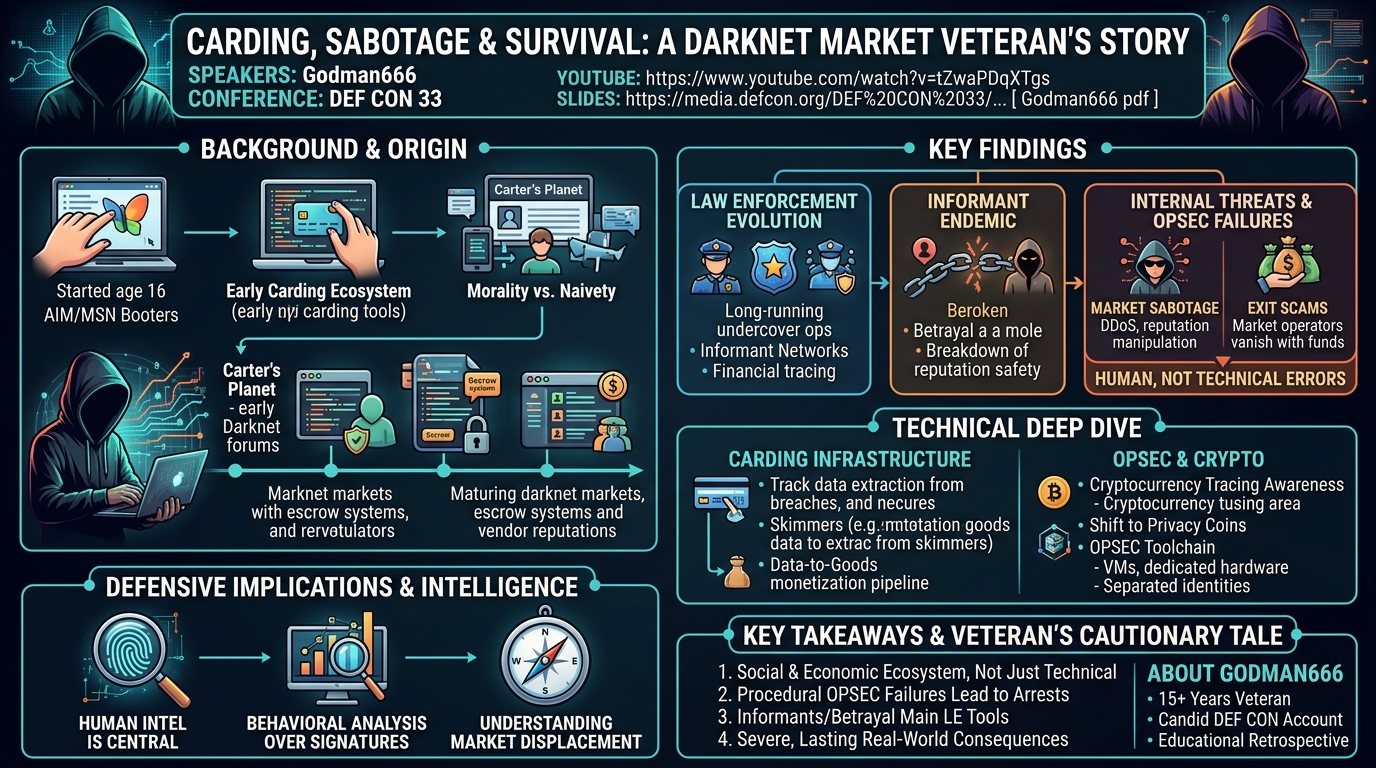
Carding, Sabotage & Survival: A Darknet Market Veteran's Story
Speakers: Godman666
Conference: DEF CON 33
YouTube: https://www.youtube.com/watch?v=tZwaPDqXTgs
Slides: https://media.defcon.org/DEF%20CON%2033/DEF%20CON%2033%20presentations/Godman666%20-%20Carding%2C%20Sabotage%20%26%20Survival%20A%20Darknet%20Market%20Veteran%E2%80%99s%20Story.pdf
Overview
In a candid and often harrowing first-time DEF CON talk, the speaker known as Godman666 delivered an unfiltered, first-person account of over 15 years in the underground economy — spanning carding, darknet market operations, market sabotage, internal betrayals, law enforcement encounters, and the operational security lessons learned from watching colleagues get arrested. Unlike sanitized threat-intelligence presentations, this talk was a boots-on-the-ground narrative from someone who lived the adversarial side of cybercrime, framed explicitly as an educational retrospective aimed at helping others understand real consequences. The speaker's stated motivation: to put the past behind him and use the platform constructively.
Background
▶ Watch: Carding techniques and how stolen card data is monetized (0:11)
The speaker began his journey at age 16, starting with writing AIM and MSN booters — tools to kick friends off instant messaging services — before being introduced to carding through a contact he describes as "the most malicious person I've ever met." This was the era of Carter's Planet, an early online carding community, and the broader underground that thrived before major law enforcement crackdowns reshaped the landscape.
Carding in this context refers to the acquisition and monetization of stolen payment card data. The underground ecosystem evolved considerably over the speaker's career: from direct card usage and fraud to the emergence of structured darknet markets, escrow-based transactions, and vendor reputations. The speaker provided historical context about how these markets matured, what operational security looked like in practice (and why it repeatedly failed), and how trust — or the abuse of it — became the central theme of the ecosystem.
A recurring theme is the moral and practical naivety of people who entered this world young, when, as the speaker put it, "your moral compass is not really developed all the way." The talk is simultaneously a confession, a case study, and a warning.
Key Findings
▶ Watch: Inside darknet market operations and trust systems (0:13)
- Law enforcement evolution is the existential threat. Law enforcement agencies have become significantly more sophisticated over the years. Where early investigators might miss operational security mistakes, modern agencies conduct long-running undercover operations, build informant networks within markets, and use financial tracing to identify participants who believed themselves anonymous.
- Informants are endemic. The speaker described multiple occasions when people within trusted circles were either working for or turned by law enforcement. The trust model of darknet markets — where reputation-based pseudonymous identity was supposed to provide safety — repeatedly broke down when individuals were arrested and offered deals to inform.
- Market sabotage is a significant underground tactic. Beyond external law enforcement pressure, markets faced sabotage from within: competitors, disgruntled participants, and exit scammers. The speaker described specific sabotage operations — including distributed denial of service attacks against rival markets, reputation manipulation, and deliberate destruction of competing infrastructure — that shaped the competitive landscape.
- Operational security failures are almost always human, not technical. The speaker catalogued a consistent pattern: people who were caught made mistakes that had nothing to do with cryptography or network security. They shipped to their real address, they reused usernames, they bragged to the wrong people, they paid for things with traceable funds, or they trusted someone who was already compromised.
- Exit scams are the market's internal threat. Multiple market operators the speaker worked with or knew of eventually performed exit scams — disappearing with customer and vendor escrow funds. The speaker discussed the warning signs in retrospect and how difficult it was to distinguish a legitimate market going offline from a deliberate theft.
Technical Deep Dive
▶ Watch: Speaker's origin story: entering the darknet market world (0:59)
The speaker described the technical infrastructure of darknet market participation with operational detail accumulated over a decade and a half. Key technical elements discussed included:
Carding infrastructure: The pipeline from stolen card data acquisition (through skimmers, data breaches, or purchased dumps) to monetization involved multiple layers. Encoding stolen track data onto blank cards, using cards at point-of-sale systems, purchasing goods for resale, and extracting value through gift card chains were all described. The speaker noted that the quality of card data — track 1 vs. track 2, whether PINs were included, the freshness of the data — directly affected its value on market.
Darknet market operations: The speaker described operating as both a vendor and, at points, having a role in market administration. Market infrastructure required Tor hidden services, escrow wallets, PGP-encrypted communications, and reputation systems. The speaker explained how disputes were handled, how escrow release timing was manipulated by dishonest operators, and how markets distinguished themselves through user experience and security posture.
Cryptocurrency tracing awareness: The speaker discussed the evolution of Bitcoin tracing and how the community's initial assumption — that Bitcoin was anonymous — proved catastrophically wrong. Chain analysis firms and law enforcement techniques to cluster addresses and follow money flows caused numerous arrests. The shift toward privacy coins and coin mixers was described, along with their limitations.
OPSEC toolchain: Practical OPSEC discussed included: dedicated hardware not used for personal activity, VMs for market interaction, never logging in from a consistent location, using separate cryptocurrency wallets per transaction, avoiding patterns in shipping addresses, and using intermediaries for physical deliveries.
Demo / Proof of Concept
▶ Watch: Near-miss with law enforcement and survival strategies (2:28)
This talk did not include technical demonstrations in the traditional sense. Instead, the speaker used detailed narrative examples that function as operational case studies:
- A detailed account of a specific market sabotage campaign, describing the targeting of a competitor's infrastructure, the methods used to disrupt operations, and the fallout.
- A walkthrough of how a close associate was arrested — tracing backward through the OPSEC failures that made the arrest possible, most of which were mundane: shipping to a known address, reusing a phone number, and trusting a third party who was cooperating with investigators.
- A first-person account of encountering law enforcement contact and navigating the consequences, illustrating the psychological pressure that leads many people to cooperate with investigators.
Defensive Implications
▶ Watch: Key lessons learned from years in darknet ecosystem (16:14)
While this talk comes from the adversarial perspective, the defensive and investigative takeaways are significant for practitioners in fraud detection, financial crime investigation, and threat intelligence:
- Human intelligence remains central. Technical defenses are secondary to the social engineering and informant dynamics that drive most successful investigations and market disruptions. Understanding the social structure of underground markets — vendor hierarchies, dispute systems, market administration roles — is more valuable for intelligence purposes than purely technical analysis.
- Behavioral analysis outperforms signature matching. The arrests described in this talk resulted from behavioral analysis: shipping address patterns, communication metadata, financial flows, and real-world linkages. Defenders and investigators building detection capabilities should prioritize these vectors.
- Understanding the economics of carding improves fraud detection. The speaker's detailed description of the value chain — from data acquisition pricing to the resale of physical goods — provides context for anomaly detection. Freshness of data, geographic arbitrage in card usage, and the role of money mules in laundering are all intelligence-useful details.
- Market disruption creates criminal displacement. The speaker observed that when a market was taken down, vendors and buyers simply migrated to the next. Understanding this displacement pattern is important for law enforcement strategy and for fraud teams tracking recurring threat actors.
Key Takeaways
- The underground economy is not a technical problem, it is a social and economic ecosystem with its own incentive structures, trust mechanisms, and failure modes.
- Virtually all the arrests described over the speaker's 15-year career resulted from OPSEC failures that were procedural or social — not cryptographic.
- Informants and internal betrayal are the primary mechanisms through which law enforcement penetrates these communities.
- Market sabotage by competitors is a persistent threat to darknet market stability, independent of law enforcement.
- Exit scams represent a structural vulnerability in escrow-based trust systems that pseudonymous reputation alone cannot fully mitigate.
- The speaker frames this talk as a cautionary narrative: the real-world consequences — legal, financial, personal — are severe and lasting.
About the Speaker(s)
▶ Watch: Closing thoughts on the future of darknet markets (18:44)
Godman666 is a pseudonymous security figure with over 15 years of direct experience in carding operations and darknet market participation. This was his first DEF CON talk, presented as a deliberate effort to transition away from his past and contribute constructively to the security community. He spoke openly about the choices that led him into this world and the legal and personal consequences he faced, making the talk an unusually honest account of a life in the underground economy.
Reviews
Dr. Zero (Offensive Security Researcher) — SOLID
A 15-year veteran of carding and darknet markets delivers a first-person narrative on underground economy operations, OPSEC failures, informant dynamics, and market sabotage. Not a technical research talk — a primary-source oral history with genuine intelligence value.
Heather Calloway (CISO) — SOLID
A first-person retrospective on 15+ years in the underground carding economy — darknet markets, exit scams, OPSEC failures, and law enforcement evolution — framed as a cautionary account for the security community.