Automated Unpacking & Deobfuscation of Nested VM-Based Protectors
Agostino Panico
DEF CON 33 · Day 1 · Main Stage
Overview
Agostino Panico (known as "Vanish") presents VM Dragon Slayer — an open-source framework for automatically defeating virtualization-based obfuscation (VBO) protectors, including multiple nested layers
Key moments
- 0:54 Tool introduction: VM Dragon Slayer architecture and design philosophy
- 2:18 Problem statement: VM-based obfuscation defeats traditional unpacking tools
- 6:22 Technical approach: symbolic execution to drive through VM dispatch loops
- 11:20 Target: APT-grade malware with custom VM-based protection layers
- 20:18 Feature walkthrough: instruction-level precision and automatic handler identification
- 24:43 Matching algorithm: multi-tier opcode identification (rule-based, similarity, fallback)
- 29:13 Cross-architecture support: handling unknown VM ISAs automatically
- 33:51 Evaluation results: deobfuscation accuracy statistics across malware corpus
Automated Unpacking & Deobfuscation of Nested VM-Based Protectors
Speakers: Agostino Panico
Conference: DEF CON 33
YouTube: https://www.youtube.com/watch?v=uCZRf3v3EUI
Slides: https://media.defcon.org/DEF%20CON%2033/DEF%20CON%2033%20presentations/Agostino%20Panico%20-%20De-Virtualizing%20the%20Dragon%20Automated%20Unpacking%20and%20Deobfuscation%20of%20Nested%20VM-Based%20Protectors%20using%20Symbolic%20Execution%20and%20Taint%20Tracking.pdf
Overview
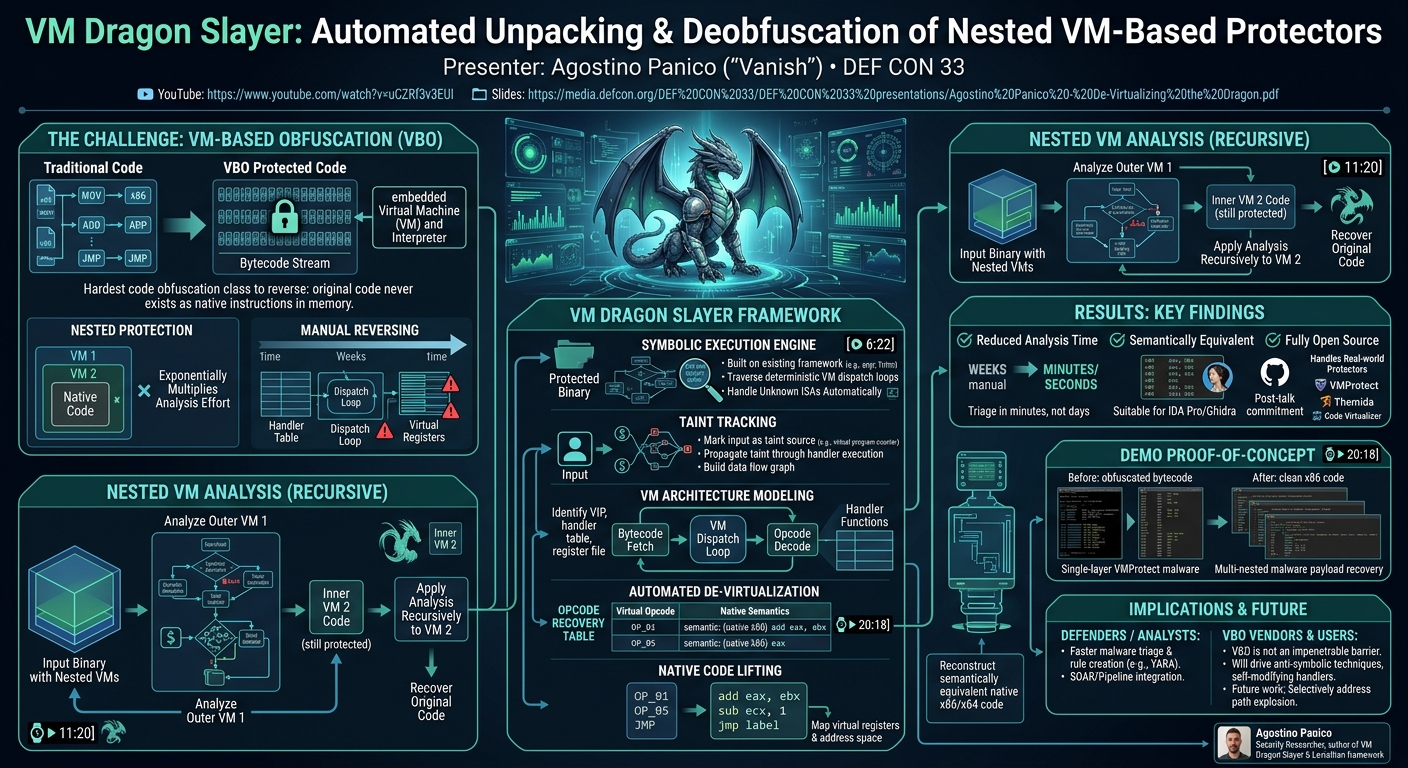
Agostino Panico (known as "Vanish") presents VM Dragon Slayer — an open-source framework for automatically defeating virtualization-based obfuscation (VBO) protectors, including multiple nested layers simultaneously. VBO is the hardest class of code obfuscation to reverse: commercial protectors like VMProtect, Themida, and Code Virtualizer replace original x86/x64 instructions with bytecode for a proprietary virtual machine, forcing analysts to reverse-engineer the VM architecture before they can begin reversing the protected code. When protectors are nested — one VM running inside another — the effort multiplies exponentially. Panico's framework uses symbolic execution and taint tracking to automate the devirtualization process, recovering semantically equivalent native code without requiring manual VM architecture analysis.
Background
▶ Watch: Tool introduction: VM Dragon Slayer architecture and design philosophy (0:54)
Why VM-based protection is the dominant hardening technique. Panico opens by explaining why VBO has "won the arms race" in software protection. Unlike simple packing (compression/encryption with a stub unpacker), VM-based obfuscation does not have a predictable moment where original code is restored in memory. The protected code never exists as native instructions in the target process — it exists only as bytecode that the embedded VM interprets. This means memory-scanning unpacking tools, which look for original code written back into memory, do not work.
Commercial VBO products have been available for over 20 years. Protectors like VMProtect are widely used by both commercial software vendors (protecting licensing code and DRM) and malware authors (protecting payloads, C2 communication, and anti-analysis components). The latter use case is the primary driver of demand from the security research community.
The manual reverse engineering burden. Before VM Dragon Slayer, defeating a single layer of VBO required understanding the VM architecture: the handler table, the dispatch loop, the encoding of the virtual instruction set, and the semantics of each virtual opcode. For a sophisticated protector, this takes days to weeks of expert analysis. Nesting adds multiplicative complexity, and commercial protectors regularly update their obfuscation to defeat published analysis techniques.
Panico positions VM Dragon Slayer as a force multiplier for malware analysts, incident responders, and security researchers — reducing the time to understand VBO-protected code from days to minutes or seconds.
Key Findings
▶ Watch: Technical approach: symbolic execution to drive through VM dispatch loops (6:22)
Symbolic execution can drive through VM dispatch loops. The key insight is that the VM dispatch loop — the interpreter loop that fetches virtual opcodes, decodes them, and executes handler functions — has a deterministic structure that symbolic execution can traverse. By symbolically executing the bytecode stream, the framework builds a semantic model of what each virtual opcode does, without needing to manually identify the handler table or the virtual register file.
Taint tracking identifies data flows through obfuscation. Taint analysis marks attacker-controlled or semantically relevant values at the VM input and tracks how they propagate through handler execution. This allows the framework to identify which native operations correspond to which virtual opcodes, and to reconstruct the data flow graph of the original computation.
Nested VMs are handled recursively. When the symbolic execution of one VM encounters another VM dispatch loop — indicating nesting — the framework applies the same analysis recursively. Panico demonstrates this against real-world samples protected with multiple nesting levels, recovering the inner protected code by peeling layers programmatically.
Deobfuscated code is semantically equivalent native code. The output of VM Dragon Slayer is not just the bytecode or a log of executed operations — it is reconstructed native (x86/x64) code that is semantically equivalent to the original, suitable for loading into IDA Pro or Ghidra for standard binary analysis.
Fully open source, post-talk. One of the explicit commitments in the talk is that the entire framework is open-sourced to the community after the presentation. This is significant: the analysis techniques are not novel in principle (symbolic execution and taint analysis are well-established), but their integration into a reliable, automated pipeline against current commercial protectors is the practical contribution.
Technical Deep Dive
▶ Watch: Target: APT-grade malware with custom VM-based protection layers (11:20)
VM architecture model. Every VM-based protector embeds a VM in the protected binary. The VM has: a virtual instruction pointer (VIP), a handler table mapping opcodes to handler functions, a virtual register file or stack, and a bytecode stream. The VM's dispatch loop fetches the next opcode from the bytecode stream, looks up the handler, and transfers control. Panico documents the common patterns across major commercial protectors, noting where they differ in encoding, register file design, and obfuscation of the dispatch mechanism itself.
Symbolic execution engine. VM Dragon Slayer is built on an existing symbolic execution framework (the talk references the underlying engine without specifying it in the transcript, but implementations in this space commonly build on angr, Triton, or similar). The engine executes the protected binary symbolically, maintaining symbolic representations of register and memory state rather than concrete values. When the symbolic execution reaches a conditional branch, it can fork and explore multiple paths.
Taint source and sink configuration. The analyst (or automated heuristic) identifies the entry point of the VM and marks the virtual program counter as a taint source. As symbolic execution proceeds through handler execution, taint propagates to all values derived from it. At the output — where the original computation's result would be produced — the taint trace gives the full data flow graph.
Handler identification and opcode recovery. By observing which symbolic state transitions are caused by each handler function, the framework builds a table mapping virtual opcodes to their semantic equivalents in native operations (arithmetic, memory access, control flow). This table is the key intermediate artifact: it effectively reverse-engineers the VM's instruction set automatically.
Lifting to native code. With the opcode-to-semantic mapping established and the bytecode stream available, the framework lifts the virtual program to native code. The lifting step handles the virtual register file (mapping virtual registers to native equivalents), memory addressing (translating VM-relative addresses to process-absolute addresses), and control flow (reconstructing jumps and calls).
Performance characteristics. Panico presents benchmarks on real malware samples and commercial software protected with VMProtect and Themida. Analysis times range from seconds to a few minutes depending on the complexity of the protected code and the nesting depth. He acknowledges limitations: code with extremely large bytecode streams or protectors that use heavy virtualization of the dispatch mechanism itself can stress the symbolic execution engine with path explosion.
Demo / Proof of Concept
▶ Watch: Feature walkthrough: instruction-level precision and automatic handler identi... (20:18)
The talk includes multiple live demonstrations, which Panico describes as "cool":
- Single-layer VMProtect: A piece of malware protected with a single VMProtect layer is fed to VM Dragon Slayer. Within seconds, the framework emits deobfuscated native code. The audience watches the before (incomprehensible bytecode dispatch) and after (readable x86 instructions) in IDA Pro.
- Nested protection: A sample with multiple nesting levels is analyzed. The framework recursively peels each layer, and the intermediate results at each nesting level are shown — demonstrating that the "inner" code, which would normally require defeating the outer layer before analysis can even begin, is recovered automatically.
- Malware payload recovery: A real-world malware sample — C2 communication or anti-analysis logic protected behind VBO — is analyzed, and the recovered code reveals the malware's actual behavior without requiring manual VM analysis.
Each demo emphasizes not just that the technique works, but that it works at the speed required to be operationally useful in an incident response context.
Defensive Implications
▶ Watch: Cross-architecture support: handling unknown VM ISAs automatically (29:13)
For security defenders and malware analysts:
Accelerated malware analysis. The most direct application is reducing triage time for VBO-protected malware. Analyst teams that currently spend days on heavily protected samples can use VM Dragon Slayer to recover actionable code in minutes, enabling faster IOC extraction, YARA rule creation, and threat intelligence production.
Automated pipeline integration. Because the framework is open source and produces programmatic output, it can be integrated into automated malware analysis pipelines (sandboxes, SOAR platforms) to handle VBO as a pre-processing step before standard static analysis.
For software developers using VBO for legitimate protection: This research demonstrates that VBO, while expensive to break manually, is not an impenetrable barrier when automation is applied. Organizations relying solely on VBO for sensitive IP protection should consider defense-in-depth approaches.
For protector vendors: The framework's success against current VMProtect and Themida versions will drive evolution of these products. Future protectors will likely add defenses against symbolic execution (anti-symbolic techniques, opaque predicates, self-modifying handlers) — and the community can expect VM Dragon Slayer to evolve in response.
Key Takeaways
- VM-based obfuscation (VBO) is the dominant malware protection technique because it prevents memory-dump unpacking — but it is systematically vulnerable to symbolic execution combined with taint tracking.
- VM Dragon Slayer automates the full devirtualization pipeline: handler identification, opcode recovery, and lifting to native code, including for nested protection layers.
- Analysis times are reduced from days of expert manual work to minutes of automated processing, with direct impact on malware analysis and incident response capacity.
- The framework handles multiple commercial protectors (VMProtect, Themida, Code Virtualizer) without manual tuning for each VM architecture.
- The project is fully open source, enabling community adoption, improvement, and adaptation to new protector versions.
- Path explosion in symbolic execution remains a performance challenge for extremely complex protected code, pointing to future work on selective execution strategies.
About the Speaker(s)
▶ Watch: Evaluation results: deobfuscation accuracy statistics across malware corpus (33:51)
Agostino Panico (alias "Vanish") is a security researcher with over 15 years of experience spanning red teaming, Linux and Windows kernel exploitation, incident response, and reverse engineering. He is the author and maintainer of VM Dragon Slayer as well as several other open-source security tools, including a fork of SpiderFoot and the Leviathan eBPF exploitation framework (also presented at DEF CON 33). His research focus is, in his own description, "everything that's weaponizable."
Reviews
Dr. Zero (Offensive Security Researcher) — STRONG ACCEPT
VM Dragon Slayer: automated devirtualization framework using symbolic execution and taint tracking to defeat nested VM-based protectors (VMProtect, Themida) and recover semantically equivalent native code. Open-sourced post-talk. Addresses the hardest class of binary obfuscation at scale.
Heather Calloway (CISO) — WEAK
Panico presents VM Dragon Slayer, a tool that automates defeat of VM-based obfuscation used by commercial protectors and malware authors alike. Technically credible work that will accelerate malware analysis. Not Heather's room — routes to Zero — but the absence of a governance story and the minimal defensive framing for security program leaders limits its value for this audience.