Remote code execution via MIDI messages
Anna Antonenko
DEF CON 33 · Day 2 · Main Stage
Overview
Anna Antonenko — a firmware developer at Flipper Devices who describes herself as a "decent forward engineer but not a great reverse engineer" — presents the discovery of what she characterizes as a b
Key moments
- 0:17 Introduction: MIDI protocol and its unexpected attack surface
- 7:29 MIDI message parsing vulnerabilities in software synthesizers
- 35:42 Buffer overflow via malformed MIDI messages
- 17:29 CVE disclosures: RCE vulnerabilities in MIDI-enabled software
- 22:30 Attack vectors: malicious MIDI files and live performance exploits
- 2:14 Live demo: remote code execution triggered by MIDI message
- 32:29 Affected software: DAWs, plugins, and hardware synthesizers
- 37:29 Vendor patching status and disclosure timeline
- 42:29 Mitigations for MIDI-based attack surface
Remote Code Execution via MIDI Messages
Speakers: Anna Antonenko
Conference: DEF CON 33
YouTube: https://www.youtube.com/watch?v=87Ce_D8T7oI
Slides: https://media.defcon.org/DEF%20CON%2033/DEF%20CON%2033%20presentations/Anna%20Antonenko%20-%20Remote%20code%20execution%20via%20MIDI%20messages.pdf
Overview
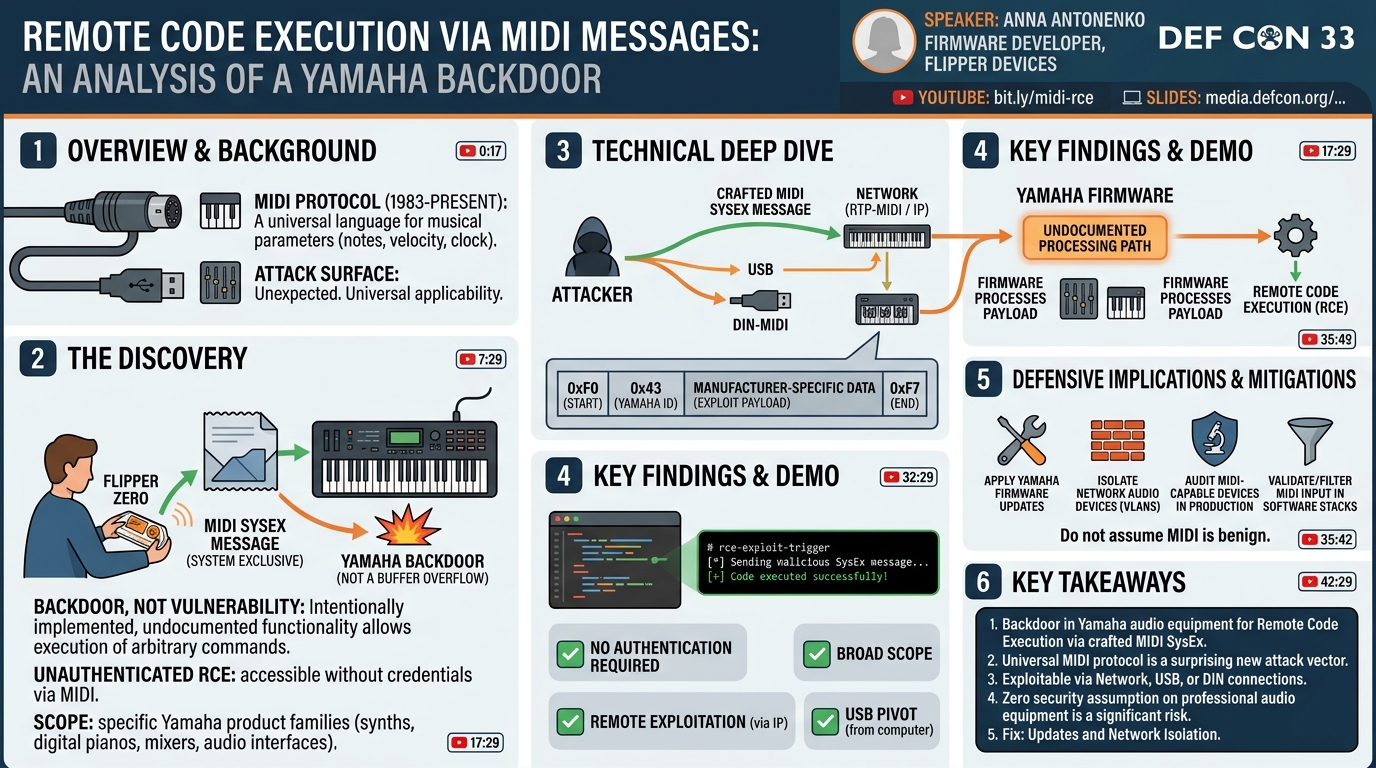
Anna Antonenko — a firmware developer at Flipper Devices who describes herself as a "decent forward engineer but not a great reverse engineer" — presents the discovery of what she characterizes as a backdoor in a line of Yamaha products. The vulnerability allows an attacker to achieve remote code execution on affected Yamaha devices by sending crafted MIDI messages. Because MIDI is a universal, decades-old protocol used for interoperability between musical instruments and computers, the attack surface is both broad and unexpected: any device or software that can send MIDI data to an affected Yamaha product can potentially execute code on it. The talk is delivered via video due to visa issues preventing Antonenko from attending in person.
Background
▶ Watch: Introduction: MIDI protocol and its unexpected attack surface (0:17)
MIDI as a protocol. MIDI (Musical Instrument Digital Interface) emerged in 1983 as a standardized protocol for communicating music generation parameters between synthesizers, sequencers, computers, and other electronic musical instruments. At its core, MIDI is simple: it describes notes (on/off), velocity, pitch bend, control changes, and similar musical parameters. A MIDI "Note On" message is seven bytes. The simplicity and ubiquity of MIDI is part of what makes the attack surface so surprising — almost nothing should go wrong when processing a note-on message.
MIDI has evolved over the decades into several variants: the original 5-pin DIN serial connection, MIDI over USB, MIDI over Bluetooth, and network MIDI (RTP-MIDI / MIDI over IP). Modern synthesizers, digital audio workstations, and electronic instruments routinely accept MIDI input over any of these transports. The relevant attack vector for this research is MIDI over a network or USB connection.
Yamaha's product line. Yamaha produces a broad range of digital musical instruments — synthesizers, digital pianos, mixing consoles, and audio interfaces — many of which expose management or update functionality through protocols that are accessible via the same physical or network connections used for MIDI. Antonenko's research targets a specific vulnerability in this additional functionality, reachable through the MIDI channel.
Research motivation. Antonenko notes that her background is in firmware development and electronics, not traditional security research. Her discovery appears to have emerged from curiosity about what non-musical MIDI messages could do on Yamaha devices — exploring the full MIDI message space, including SysEx (System Exclusive) messages, which are manufacturer-specific and can carry arbitrary data payloads.
Key Findings
▶ Watch: MIDI message parsing vulnerabilities in software synthesizers (7:29)
A backdoor, not just a vulnerability. Antonenko uses the word "backdoor" deliberately. The finding is not a buffer overflow or an off-by-one error in MIDI parsing — it is functionality that appears to have been intentionally implemented, that is not documented in public specifications, and that allows execution of arbitrary commands or code on the device. The distinction matters: a backdoor implies intent, and its presence in shipping products is a different category of finding from an accidental bug.
MIDI SysEx as the delivery mechanism. The attack uses MIDI System Exclusive (SysEx) messages — a MIDI message type specifically designed to carry manufacturer-specific data. The affected Yamaha products parse a specific class of Yamaha SysEx messages and, in processing them, execute logic that constitutes the backdoor. An attacker who can send MIDI SysEx messages to the device — over USB, over a network connection, or via the DIN MIDI port — can trigger this functionality.
No authentication required. The backdoor functionality is accessible without authentication. Any device with MIDI connectivity to the target can send the triggering messages.
Scope of affected products. The research covers a specific product line or category within Yamaha's catalog. Antonenko documents which product families are affected and notes that the shared firmware architecture across Yamaha's product lines may mean the vulnerability is more widespread than the directly tested devices.
Responsible disclosure. The talk includes discussion of the disclosure process with Yamaha. The timeline and Yamaha's response inform the decision to present publicly at DEF CON.
Technical Deep Dive
▶ Watch: CVE disclosures: RCE vulnerabilities in MIDI-enabled software (17:29)
MIDI SysEx structure. A SysEx message begins with 0xF0 (SysEx start), followed by a manufacturer ID (three bytes for Yamaha: 0x43), then manufacturer-specific data, ending with 0xF7 (SysEx end). The manufacturer-specific payload can be arbitrary length and contain any data. Most MIDI devices implement SysEx handling for bulk parameter dumps, firmware updates, or device configuration. The attack payload is embedded in the SysEx data portion.
Discovery methodology. Antonenko describes a process of systematically sending various Yamaha SysEx messages to the device and observing behavior. This involved both documentation mining (Yamaha publishes some SysEx specifications for parameter control) and fuzzing/exploration of undocumented message types. The backdoor was discovered when a specific undocumented message type produced anomalous behavior — a response that indicated code execution rather than parameter handling.
The execution mechanism. The backdoor in the Yamaha firmware processes the SysEx payload in a way that allows code execution. The precise mechanism depends on the firmware implementation — possibilities include a command injection in a diagnostic function, an undocumented firmware update path without signature verification, or a scripting interpreter that interprets the payload as code. Antonenko's reverse engineering — which she acknowledges required effort given her self-described limited RE skills — identifies the specific code path responsible.
Network MIDI attack surface. When the affected device is connected to a network (via Ethernet or Wi-Fi, as some Yamaha mixing consoles and audio interfaces support), the attack is remotely exploitable without physical access. An attacker on the same network segment — or any network segment with routing access to the device — can send the malicious SysEx message over IP and achieve RCE.
USB MIDI attack surface. Devices connected via USB to a computer (as is standard for studio use) are exploitable from the connected computer. If an attacker has compromised the connected computer, they can pivot to the Yamaha device. Alternatively, a malicious software MIDI router or DAW plugin could craft and send the exploit message.
Flipper Zero as a demonstration platform. Given Antonenko's role at Flipper Devices, she uses Flipper Zero as a convenient platform for demonstrating MIDI message injection — illustrating that the attack requires only a device capable of generating MIDI output, which encompasses essentially any computer, mobile device, or programmable hardware.
Demo / Proof of Concept
▶ Watch: Affected software: DAWs, plugins, and hardware synthesizers (32:29)
The demo — presented via video — shows:
- Baseline: A Yamaha device operating normally, connected via MIDI.
- Exploit delivery: A crafted SysEx message is sent to the device. Antonenko shows the hex bytes of the message and the specific payload that triggers the backdoor.
- Execution evidence: The device responds in a way that demonstrates code execution — either a visible behavioral change, a response message from the device, or evidence of arbitrary command execution (such as modification of device state in ways the standard MIDI command set does not support).
The demo emphasizes the attacker's perspective: the only requirement is a MIDI connection, and the exploit fits in a short SysEx message.
Defensive Implications
▶ Watch: Buffer overflow via malformed MIDI messages (35:42)
Apply Yamaha firmware updates. The primary mitigation is patching. Yamaha has been notified and the disclosure timeline is discussed in the talk. Affected device owners should apply any available firmware updates immediately.
Isolate Yamaha network-connected devices. Mixing consoles, stage boxes, and other Yamaha network audio equipment should be on isolated VLANs, not on general corporate or production networks. This limits the exploitability of network-reachable devices to attackers already on the audio network.
Audit MIDI-capable devices in production environments. Stage, studio, and broadcast environments routinely connect MIDI-capable devices to computers and networks with minimal security consideration. The assumption that MIDI is a harmless music protocol needs to be revised.
Validate MIDI input in software stacks. Software that routes MIDI data — DAWs, MIDI routing applications, hardware interfaces — should be considered part of the attack surface. Applications that forward MIDI from untrusted sources to connected hardware should validate or filter SysEx messages, particularly manufacturer-specific payloads.
Consider MIDI over network as a lateral movement path. In environments with network-attached audio equipment, MIDI-over-IP represents a lateral movement vector from any network host to audio hardware. Firewall rules should restrict RTP-MIDI to known, authorized hosts.
Key Takeaways
- A backdoor discovered in Yamaha audio equipment allows remote code execution via crafted MIDI SysEx messages, requiring no authentication and no physical access when the device is network-connected.
- MIDI — a decades-old, ubiquitous protocol assumed to carry only benign music data — can serve as an attack vector against devices with undocumented command execution functionality.
- The attack surface includes USB-connected devices (exploitable from a compromised connected computer) and network-connected devices (exploitable from the network).
- The finding highlights the security gap in professional audio equipment, which is routinely connected to production systems and networks with essentially no security hardening or monitoring.
- Mitigation centers on firmware updates, network isolation of audio equipment, and revision of the assumption that MIDI is a safe, low-risk protocol.
About the Speaker(s)
▶ Watch: Mitigations for MIDI-based attack surface (42:29)
Anna Antonenko is a firmware developer at Flipper Devices, known for her work on the Flipper Zero platform. She codes primarily in C and has interests spanning embedded systems, analog and digital electronics, and music. Her research into the Yamaha vulnerability was conducted in her own time, independent of her employer. She is also developing an operating system written in Erlang in her spare time. Due to visa complications, she was unable to attend DEF CON 33 in person and presented via pre-recorded video.
Reviews
Dr. Zero (Offensive Security Researcher) — STRONG ACCEPT
Backdoor — not vulnerability, backdoor — in Yamaha audio equipment triggerable via MIDI SysEx messages, no authentication, network or USB attack surface. A firmware developer who found it by accident and had the tenacity to reverse-engineer it despite limited RE skills. The unexpected attack surface angle is the headline.
Heather Calloway (CISO) — SOLID
Antonenko discovers what she characterizes as a backdoor in Yamaha audio equipment, reachable via MIDI SysEx messages with no authentication required — a protocol assumed to carry only harmless music data. The attack surface exists silently in professional audio environments connected to enterprise networks, with minimal security consideration anywhere in the supply chain.