Tunnelpocalypse
Rich Compton
DEF CON 33 · Day 1 · Main Stage
Overview
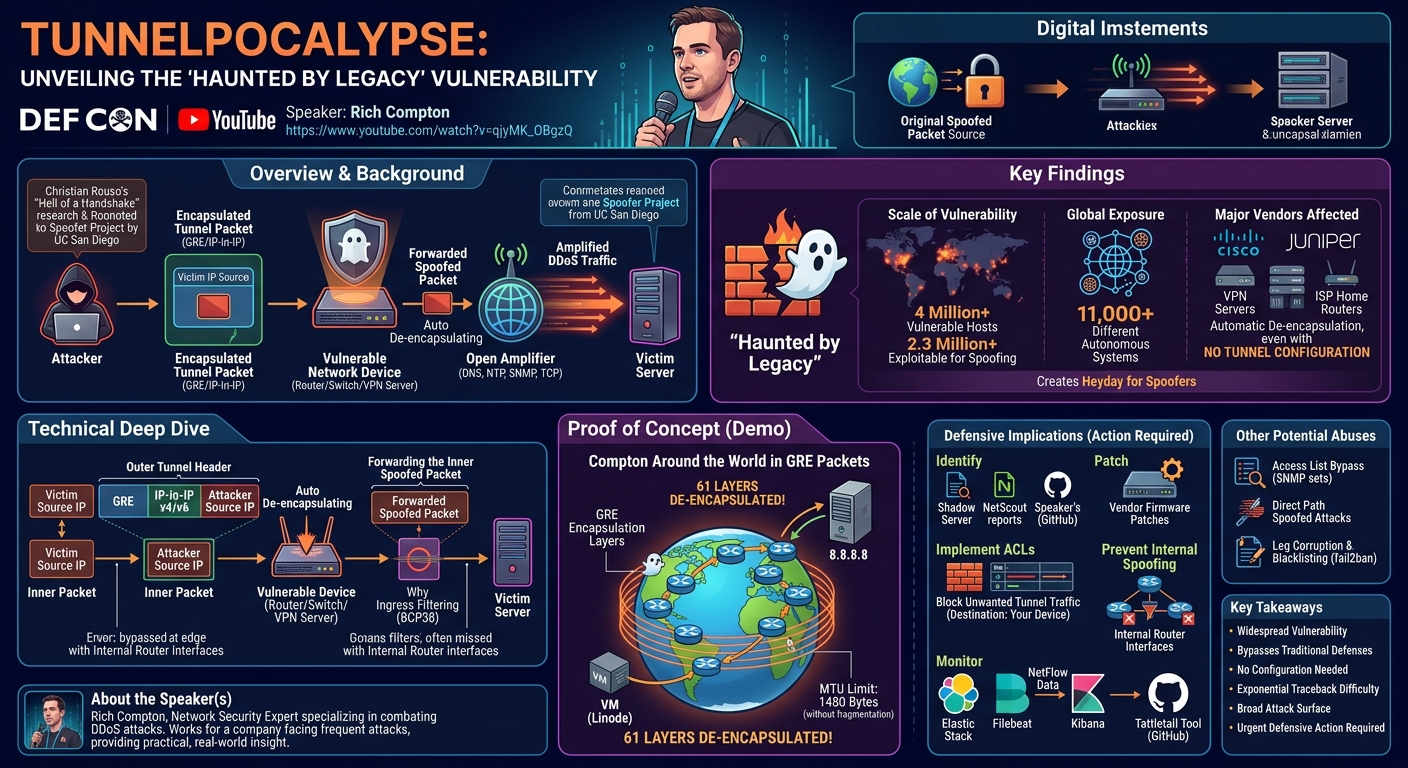
Rich Compton's DEF CON talk, "Tunnelpocalypse," unveils a critical and pervasive vulnerability that significantly escalates the threat of IP spoofing and, consequently, distributed denial-of-service (DDoS) amplification attacks. The talk highlights how millions of internet-connected devices, including routers, switches, and VPN servers from major vendors, are inadvertently configured to de-encapsulate tunneled network traffic even when no explicit tunnel configuration exists. This oversight allows attackers to encapsulate spoofed IP packets within legitimate tunnel protocols like GRE (Generic Routing Encapsulation) or IP-in-IP, bypass traditional anti-spoofing filters, and unleash amplified attack traffic.
Key moments
- 0:00 Introduction and overview of DOS amplification attacks
- 2:40 How attackers discover and utilize spoofing networks
- 4:10 Challenges and progress in tracing back spoofed attacks
- 6:15 Introducing the 'Tunnelpocalypse' new tunnel vulnerability
- 7:00 Detailed explanation of tunnel spoofing via encapsulation
- 8:10 Identification of 4 million vulnerable hosts and devices
Tunnelpocalypse
Speakers: Rich Compton
Conference: DEF CON
YouTube: https://www.youtube.com/watch?v=qjyMK_OBgzQ
Overview
Rich Compton's DEF CON talk, "Tunnelpocalypse," unveils a critical and pervasive vulnerability that significantly escalates the threat of IP spoofing and, consequently, distributed denial-of-service (DDoS) amplification attacks. The talk highlights how millions of internet-connected devices, including routers, switches, and VPN servers from major vendors, are inadvertently configured to de-encapsulate tunneled network traffic even when no explicit tunnel configuration exists. This oversight allows attackers to encapsulate spoofed IP packets within legitimate tunnel protocols like GRE (Generic Routing Encapsulation) or IP-in-IP, bypass traditional anti-spoofing filters, and unleash amplified attack traffic.
Compton, a network security expert with extensive experience combating DDoS attacks, emphasizes that this "Haunted by Legacy" vulnerability represents a substantial setback in the ongoing fight against network abuse. While the security community has made strides in reducing the prevalence of directly spoofed traffic, this new vector effectively re-opens the floodgates, offering attackers an unprecedented ability to obscure their true origins and launch potent attacks. The talk serves as an urgent call to action for network operators, urging them to identify and remediate vulnerable devices before this tunneling exploit becomes a widespread tool in the arsenal of malicious actors.
The implications extend far beyond mere amplification, potentially enabling access list bypasses, direct path spoofed attacks, and even log corruption. Compton not only details the technical mechanics of the vulnerability but also provides practical tools and defensive strategies for identifying and mitigating the risk, underscoring the severity of a problem that fundamentally undermines assumptions about network ingress filtering and traffic validation.
Background
▶ Watch: Introduction and overview of DOS amplification attacks (0:00)
For years, IP spoofing has been a foundational element of many large-scale cyberattacks, particularly DDoS amplification attacks. In a typical amplification attack, an attacker spoofs the source IP address of a victim, sending a small request packet to an "open amplifier" – a server or device configured to respond with a much larger packet. Common amplifiers include open DNS servers, NTP servers, and even vulnerable HTTP middle boxes like web content filtering devices. Even a standard TCP stack can act as a small amplifier, as a spoofed SYN packet can trigger multiple SYN-ACK responses if the final ACK is never received. Researchers like Christian Rouso have delved into these nuances, with papers such as "Hell of a Handshake" detailing the amplification factors possible even within TCP.
The challenge for attackers has traditionally been finding networks that permit IP spoofing. While some hosting companies or poorly configured ISPs might allow it, the community has actively worked to identify and shut down these "spoofing-capable" networks. Projects like the Spoofer Project out of UC San Diego aim to identify such networks, encouraging operators to implement ingress filtering (BCP38) to prevent spoofed traffic from leaving their networks. However, attackers also leverage this information, using identified vulnerable networks to set up DDoS stressor or booter sites, offering malicious services for a fee.
Tracing back spoofed traffic has always been a manual, tedious process. Unlike legitimate traffic with a verifiable source IP, spoofed packets require deep dives into network flow records (Neflow) to determine the ingress interface and upstream ISP. This often involves cross-organizational communication, which can be slow and uncooperative. Despite these challenges, collective efforts over the past few years have shown some success in curbing the growth of amplification traffic, leading attackers to increasingly rely on botnets and residential proxies. However, as Compton warns, the "Tunnelpocalypse" vulnerability threatens to reverse this progress, providing a new, potent vector for IP spoofing that bypasses many existing defenses.
Key Findings
▶ Watch: Challenges and progress in tracing back spoofed attacks (4:10)
The central revelation of Rich Compton's talk is the "Haunted by Legacy" vulnerability, initially uncovered by researchers Angelos Veritus and Matthew Vanho from KU Leven in Belgium. This research revealed a widespread and critical flaw in how many network devices handle tunneled traffic. The core finding is that numerous devices, including Cisco routers and switches, Juniper devices, various VPN servers, and even ISP home routers, are configured to automatically de-encapsulate packets arriving via common tunneling protocols like GRE, IP-in-IP (both IPv4 and IPv6), and GU (Generic UDP Encapsulation), even if no explicit tunnel configuration exists on the device.
This behavior is problematic because it effectively creates an open relay for spoofed traffic. An attacker, whose local network would normally block any attempts to send a packet with a spoofed source IP, can now encapsulate that spoofed packet within a legitimate-looking tunnel protocol header. When this encapsulated packet reaches a vulnerable device, the device "helpfully" de-encapsulates it, stripping away the tunnel header and then forwarding the inner (spoofed) packet as if it originated legitimately from the device itself. This bypasses all traditional ingress filtering designed to prevent spoofing from edge networks or customer interfaces.
The scale of this vulnerability is staggering. The researchers identified approximately 4 million vulnerable hosts on the internet. More critically, 2.3 million of these hosts are specifically exploitable to send spoofed traffic. These vulnerable devices are not confined to a single region or network; they are distributed across 11,000 different autonomous systems globally, as documented by organizations like Shadow Server, which actively scans the internet for such vulnerabilities. This widespread exposure means that attackers no longer need to seek out specific, poorly configured hosting providers that permit spoofing; they can now leverage any of these millions of vulnerable tunneling hosts as a proxy to launch attacks with an arbitrary source IP address. This significantly increases the attacker's ability to remain anonymous and complicates traceback efforts exponentially, making it a "heyday for spoofers."
Technical Deep Dive
▶ Watch: Introducing the 'Tunnelpocalypse' new tunnel vulnerability (6:15)
The technical heart of the "Tunnelpocalypse" vulnerability lies in the default, often unconfigured, behavior of many network devices when encountering traffic encapsulated in certain tunneling protocols. The protocols specifically implicated are Generic Routing Encapsulation (GRE), IP-in-IP (both IPv4 and IPv6 variants), and Generic UDP Encapsulation (GU). These protocols are designed to encapsulate one IP packet within another, often to create virtual private networks, bypass network restrictions, or transport traffic across incompatible networks.
The critical design flaw is that many devices from major vendors, including Cisco routers and switches, Juniper devices, various VPN servers, and even consumer-grade ISP home routers, are programmed to automatically de-encapsulate these packets upon receipt. This de-encapsulation occurs even if the device has no explicit tunnel interface configured for the specific source or destination of the tunnel, or indeed, no tunnel configuration at all. The routers are, in essence, "trying to be helpful" by processing what they recognize as encapsulated traffic, regardless of whether they were explicitly instructed to do so. This contrasts with expected secure behavior, where a device should only de-encapsulate a tunnel packet if it corresponds to an actively configured tunnel interface.
The attack flow proceeds as follows:
- Attacker crafts a spoofed packet: The attacker generates an IP packet with a forged source IP address (e.g., the victim's IP) and a legitimate destination IP (e.g., an amplification server). This packet would normally be dropped by the attacker's egress router due to ingress filtering.
- Encapsulation: The attacker then encapsulates this spoofed inner packet within an outer header using one of the vulnerable tunneling protocols (GRE, IP-in-IP, or GU). The outer header has a legitimate source IP (the attacker's) and a destination IP that points to one of the 2.3 million vulnerable tunneling hosts identified on the internet.
- Transmission to Vulnerable Host: The attacker sends this encapsulated packet to the vulnerable host. Since the outer packet has a legitimate source and destination, it traverses the internet unimpeded by standard anti-spoofing measures.
- De-encapsulation by Vulnerable Host: Upon receiving the encapsulated packet, the vulnerable device performs an automatic de-encapsulation. It strips away the outer tunnel header, exposing the inner, originally spoofed, IP packet.
- Forwarding of Spoofed Packet: Crucially, the vulnerable device then treats this de-encapsulated inner packet as if it originated from itself or a directly connected interface. It forwards the spoofed packet towards its intended destination (the amplifier). Because the packet now appears to originate from an internal interface of the vulnerable router, it often bypasses any internal anti-spoofing filters that might otherwise be present.
- Amplification and Attack: The amplifier receives the spoofed packet and responds with a much larger volume of traffic, directed at the victim's spoofed IP address.
This mechanism allows attackers to effectively proxy their spoofed traffic through millions of unwitting devices, making traceback significantly more challenging. Each vulnerable device acts as a potential jump point, obscuring the true attacker's origin. Compton highlighted that the issue stems from "bad programming" where routers simply de-encapsulate any incoming GRE or IP-in-IP packet without checking if the source or destination IP aligns with a configured tunnel, or if de-encapsulation is even intended. They "should be checking to make sure that the GRE IP address, you know, whatever whatever tunnel IP address it is that it's, you know, that they're supposed to de-encapulate it. They're just [...] let any IP address as long as it comes in. Okay, we'll do the de-encapsulation on it." This fundamental lack of validation creates the wide-open spoofing channel.
Demo / Proof of Concept
▶ Watch: Detailed explanation of tunnel spoofing via encapsulation (7:00)
While a live demonstration was not performed during the talk due to technical presentation constraints, Rich Compton vividly described a "fun hack" he developed to illustrate the profound implications of the "Tunnelpocalypse" vulnerability, which he dubbed "around the world in GRE packets." This proof-of-concept demonstrated the recursive de-encapsulation capability of vulnerable devices and the extreme difficulty it introduces for traceback.
The experiment involved sending a simple ICMP ping request destined for Google's public DNS server at 8.8.8.8 (Quad 8). Instead of sending this ping directly, Compton encapsulated it within a GRE packet. He then took that entire GRE packet and encapsulated it within another GRE packet, and repeated this process multiple times. The goal was to see how many layers of encapsulation a packet could sustain while still successfully reaching its target and receiving a reply.
Compton reported that he was able to achieve an astonishing 61 different layers of encapsulation. This super-encapsulated packet was then sent from a virtual machine (e.g., on a service like Linode) out to the internet. It bounced between multiple vulnerable routers, each one de-encapsulating one layer of GRE, then forwarding the partially de-encapsulated packet to another vulnerable router, and so on. This process continued for 61 hops until the final vulnerable router de-encapsulated the outermost GRE layer, revealing the original ping packet, which was then forwarded to Google's 8.8.8.8. Google then sent its reply back, which ultimately found its way back to Compton's originating machine.
The primary limitation encountered in this experiment was the Maximum Transmission Unit (MTU) size, specifically 1480 bytes. Beyond this size, the packet would have required fragmentation, which Compton did not implement for this particular hack. Theoretically, with fragmentation, even more layers of encapsulation could be achieved, making the packet even larger and potentially more complex to trace.
This "around the world" hack, while presented as a playful exploration, powerfully illustrates the danger of the "Haunted by Legacy" vulnerability. It demonstrates that not only can vulnerable devices de-encapsulate spoofed traffic, but they can also chain this behavior, creating a daisy-chain of de-encapsulations across the internet. This multi-hop de-encapsulation makes it exponentially more difficult for defenders to trace the true origin of a spoofed attack, akin to an attacker bouncing through multiple compromised servers to hide their tracks. It highlights that the problem is not just about a single device acting as a proxy, but about a global network of devices that can be orchestrated to create an untraceable path for malicious traffic.
Defensive Implications
▶ Watch: Identification of 4 million vulnerable hosts and devices (8:10)
The "Tunnelpocalypse" vulnerability demands immediate attention from network defenders due to its widespread nature and the ease with which it facilitates IP spoofing. Rich Compton outlined several critical steps organizations should take to protect their networks:
- Identify Vulnerable Devices:
- Shadow Server: This non-profit organization scans the internet for vulnerable hosts, including those susceptible to the "Haunted by Legacy" flaw. Network operators can contact Shadow Server to receive free reports detailing vulnerable devices within their autonomous system.
- NetScout: A commercial provider of DDoS detection and mitigation services, NetScout recognizes the severity of this vulnerability. They offer free reports, even to non-customers, to help organizations identify vulnerable devices on their networks.
- Speaker's Script: Rich Compton has developed and shared a script on his GitHub repository specifically designed to test whether a device is vulnerable to this de-encapsulation issue. Network operators are encouraged to use this tool for internal auditing.
- Patch Vulnerable Devices: The most straightforward and effective defense is to apply vendor-supplied patches. Organizations should contact their equipment vendors (e.g., Cisco, Juniper) to inquire about firmware updates that address the "Haunted by Legacy" vulnerability. These patches should ideally ensure that de-encapsulation only occurs for explicitly configured tunnels.
- Implement Access Control Lists (ACLs): Even if patches are unavailable or as an additional layer of defense, ACLs can be deployed. Compton recommends applying an ACL to block unwanted tunnel traffic where your devices are the destination. The logic would be to deny incoming GRE, IP-in-IP, or GU packets unless they originate from or are destined for explicitly configured and trusted tunnel endpoints. This prevents unknown, potentially malicious, encapsulated traffic from reaching and being processed by your routers.
- Prevent Router-Originated Spoofing (Internal Ingress Filtering): A critical insight from Compton's talk is that while many networks implement ingress filtering (BCP38) at their edge to prevent customer-originated spoofing, they often neglect to apply similar filters to traffic originating from internal routers themselves. Since the de-encapsulated spoofed packet appears to originate from the vulnerable router, it will bypass edge filters. Therefore, network operators must ensure that internal interfaces on routers also have filters in place to prevent the forwarding of packets with source IPs that do not legitimately belong to that interface or directly connected networks. Compton estimates that perhaps 90% of networks may be overlooking this internal spoofing vector.
- Monitor for Spoofed Traffic:
- NetFlow Analysis: Continuous monitoring of network flow data (Neflow) is essential to detect the presence of spoofed traffic.
- Tattletail Tool: Rich Compton developed a free tool called Tattletail, available on his GitHub. This tool integrates with the Elastic Stack (Elasticsearch, Logstash, Kibana) and uses Filebeat to collect and analyze Neflow data. Tattletail specifically looks for patterns indicative of spoofed traffic and logs this information into the Elastic database, allowing defenders to visualize and trace back the source of spoofing, even if it's coming from a peer network.
Beyond DDoS amplification, Compton warned of other potential abuses:
- Access List Bypass: For stateless protocols like SNMP (UDP), attackers could encapsulate SNMP sets with a spoofed source IP that is permitted by a router's ACL. This could allow unauthorized configuration changes or TFTP copies of sensitive configurations.
- Direct Path Spoofed Attacks: Attackers can hide their true origin for targeted attacks, making forensic investigations exceedingly difficult.
- Log Corruption and Blacklisting: By spoofing various source IPs, attackers could flood systems like fail2ban with malicious traffic, causing legitimate IP addresses to be mistakenly blacklisted, thereby disrupting services.
The "Tunnelpocalypse" represents a significant shift in the landscape of IP spoofing, requiring a multi-faceted and proactive defensive posture.
Key Takeaways
- Widespread Vulnerability: Millions of internet-connected devices, including routers, switches, and VPN servers from major vendors, are vulnerable to the "Haunted by Legacy" flaw, enabling IP spoofing via tunneling protocols.
- Bypasses Traditional Defenses: The vulnerability allows attackers to encapsulate spoofed IP packets within GRE, IP-in-IP, or GU headers, bypassing standard ingress filtering designed to prevent spoofing from edge networks.
- No Configuration Needed: Critically, devices de-encapsulate these tunnel protocols even if no explicit tunnel configuration exists, acting as unwitting proxies for malicious traffic.
- Exponential Traceback Difficulty: The ability to chain de-encapsulations across multiple vulnerable devices (demonstrated by the "61 layers of GRE" hack) makes tracing the true origin of an attack exponentially more challenging.
- Broad Attack Surface: Beyond DDoS amplification, the vulnerability can be exploited for ACL bypass (e.g., for SNMP sets), direct path spoofed attacks, and log corruption/blacklisting.
- Urgent Defensive Action Required: Network operators must identify vulnerable devices using tools like Shadow Server, NetScout, or the speaker's script, apply vendor patches, implement ACLs for tunnel traffic, and critically, extend anti-spoofing filters to internal router interfaces. Monitoring with Neflow and tools like Tattletail is essential for detection.
About the Speaker(s)
Rich Compton is a network security professional with extensive experience in combating DDoS attacks. He works for a company that frequently faces such attacks, giving him practical, real-world insight into the evolving landscape of network security threats. His expertise lies in network security, particularly in understanding and mitigating complex attack vectors like IP spoofing and amplification. His work on the "Tunnelpocalypse" vulnerability reflects his ongoing commitment to identifying and addressing significant issues that impact internet security.
Reviews
Dr. Zero (Offensive Security Researcher) — STRONG ACCEPT
Compton takes genuine original research (credit to Veritus/Vanho at KU Leuven) and translates it into an operationally grounded DEF CON talk with real numbers, a working PoC, and concrete defensive tooling. The 4M vulnerable hosts across 11K ASes figure, the 61-layer GRE stacking demo, and the internal-ingress-filtering blind spot (his own 90% estimate) are all substantive contributions that justify the slot.
Heather Calloway (CISO) — SOLID
Compton surfaces a real and measurable infrastructure problem — 2.3 million devices that will happily forward spoofed traffic — and backs it with credible research and usable tooling. The defensive guidance is specific and actionable for network operators. But this talk doesn't reach the governance layer, and the people who most need to act on it probably weren't in the room.