ReclaimTech: A community movement
Janet Vertesi (Sociology Professor · Princeton), Andy Hull
DEF CON 33 · Day 1 · Main Stage
Overview
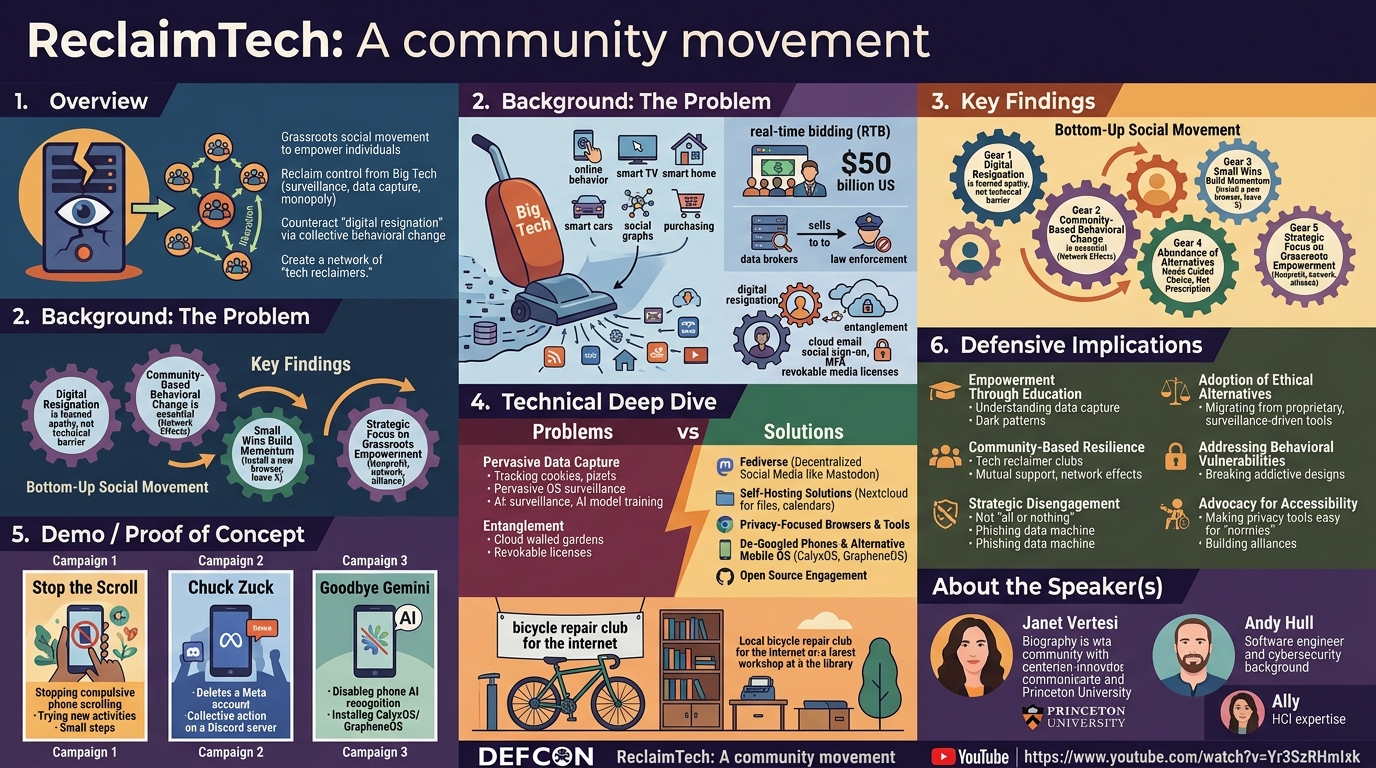
The "ReclaimTech: A community movement" talk at DEF CON presented a compelling vision for a grassroots social movement aimed at empowering individuals to reclaim control over their digital lives from the pervasive influence of Big Tech. Led by Janet Vertesi, a sociology professor at Princeton, and Andy Hull, a veteran software engineer, the Tech Reclaimers initiative seeks to counter the widespread data capture, surveillance, and monopolistic practices that have come to define the modern internet. The speakers argue that the promise of liberation from centralized control, famously heralded by Apple's 1984 advertisement against IBM, has been broken, with the very companies once seen as liberators now embodying the "Big Brother" they once fought.
Key moments
- 0:00 Introduction: Reclaiming technology from Big Tech
- 1:00 Who are the Tech Reclaimers? Speakers' background
- 2:00 Our vision: Control over data, devices, and services
- 2:50 The problem: How Big Tech captures all data
- 4:15 The entanglement problem: Why leaving Big Tech is hard
- 5:20 Privacy paradox: The need for community action
- 6:30 Acknowledging the cost of open-source alternatives
ReclaimTech: A community movement
Speakers: Janet Vertesi (Sociology Professor, Princeton); Andy Hull
Conference: DEF CON
YouTube: https://www.youtube.com/watch?v=Yr3SzRHmIxk
Overview
The "ReclaimTech: A community movement" talk at DEF CON presented a compelling vision for a grassroots social movement aimed at empowering individuals to reclaim control over their digital lives from the pervasive influence of Big Tech. Led by Janet Vertesi, a sociology professor at Princeton, and Andy Hull, a veteran software engineer, the Tech Reclaimers initiative seeks to counter the widespread data capture, surveillance, and monopolistic practices that have come to define the modern internet. The speakers argue that the promise of liberation from centralized control, famously heralded by Apple's 1984 advertisement against IBM, has been broken, with the very companies once seen as liberators now embodying the "Big Brother" they once fought.
This movement is not merely about individual privacy settings or technical fixes; it's a call to action for collective behavioral change, fostering communities that share knowledge, skills, and tools to transition away from proprietary, surveillance-driven platforms. The ReclaimTech project operates on the premise that while the deck is currently stacked against individual users, a coordinated, bottom-up effort can leverage network effects to create meaningful change. By building a network of "tech reclaimers" through clubs, workshops, and online campaigns, the initiative aims to dismantle the apathy of "digital resignation" and restore agency to technology users worldwide.
The talk highlighted the urgent need for a shift in perspective, moving beyond the individualistic burden of privacy to a communal responsibility. It outlined a strategic approach that acknowledges the complexities of disentanglement from deeply embedded digital services while providing practical, step-by-step pathways for users of all technical comfort levels. The ultimate goal is to foster an ecosystem where ethical, open-source alternatives thrive, and individuals can make informed choices about their data, devices, and services without succumbing to the manipulative designs of Big Tech.
Background
▶ Watch: Introduction: Reclaiming technology from Big Tech (0:00)
The problem, as articulated by the Tech Reclaimers, is multifaceted and deeply entrenched in the architecture of the modern internet. Big Tech companies are described as "capturing everything"—our online behaviors, race, sexual preferences, religion, politics, social graphs, purchases, media consumption, location data, and associations. This extensive data collection spans across web browsers, phones, smart TVs, smart homes, and even smart cars, creating a staggering scale of information hoarding and analysis. A prime example of this pervasive data exploitation is real-time bidding (RTB), where advertisers bid in milliseconds for ad impressions based on granular user profiles. Research and Markets estimates the global spend on RTB in 2024 to be approximately $50 billion US, underscoring the immense economic incentive behind this surveillance infrastructure.
Beyond direct collection, data brokers further exacerbate the problem by harvesting information from public sources, buying data from entities like the DMV, supermarkets, and airlines, and then reselling it to Big Tech or even law enforcement, often bypassing the need for warrants. This vast trove of personal data is increasingly fed to train powerful AI models, which are then sold back to us as products, creating a self-perpetuating cycle of data extraction and monetization.
Users find themselves in a state of deep entanglement with these systems. Our reliance on cloud-hosted email, social sign-ons with MFA, social media for communication, maps, navigation, and document storage from the same dominant companies makes disentanglement a complex challenge. Furthermore, surveillance is often built into the very foundations of the operating systems on our devices. The concept of media ownership has eroded, replaced by revokable licenses for books, music, and video, which can be withdrawn at the whim of copyright holders or contract disputes.
This environment has led to what researchers call the privacy paradox: people are deeply uncomfortable with data collection but feel powerless to act, often resorting to superficial changes like "rearranging deck chairs on the Titanic" with Facebook privacy settings. The speakers highlight that successful behavioral change typically occurs in groups, leveraging network effects—a phenomenon Big Tech itself capitalized on (e.g., Facebook starting in an elite social setting at Harvard, Twitter in Silicon Valley). The pervasive narrative that services are "free" in exchange for data, coupled with the perceived high cost and inaccessibility of self-hosting or open-source alternatives, reinforces this power imbalance. Ultimately, these technical, economic, and social pressures contribute to a widespread sense of digital resignation, where users feel there's "nothing they can do," a form of apathy actively influenced by the tech industry.
Key Findings
▶ Watch: Our vision: Control over data, devices, and services (2:00)
The ReclaimTech movement's core "finding" is the critical need for a bottom-up social movement to counteract the pervasive influence and data capture of Big Tech. The speakers assert that individual actions, while important, are insufficient to address systemic issues, and that collective, community-based action is the most effective pathway to change. They identify several key insights that underpin their approach:
- Digital Resignation is a Learned Apathy, Not a Technical Barrier: A significant finding is that the widespread feeling of helplessness ("What can I do? It's too hard. I've got nothing to hide.") is not an inherent user limitation but a manufactured state of digital resignation, actively cultivated by the tech industry. This apathy can be overcome through community support and shared knowledge.
- Community-Based Behavioral Change is Essential: Drawing parallels with groups like Alcoholics Anonymous and Weight Watchers, the movement emphasizes that sustained behavioral change is far more successful when undertaken in communities. Leveraging existing or newly formed network effects is crucial, allowing people to move away from Big Tech in groups rather than feeling isolated. This forms the basis for their "bicycle repair club for the internet" model.
- Small Wins Build Confidence and Momentum: The ReclaimTech approach recognizes that radical, all-or-nothing changes are often daunting. Instead, encouraging "small wins"—like installing a new browser, leaving a specific platform like X (formerly Twitter), or trying a Linux distribution like Ubuntu—is vital. These initial successes build user confidence and motivation for more significant steps, such as installing CalyxOS or GrapheneOS on a phone.
- Abundance of Alternatives Requires Guided Choice, Not Prescription: Unlike years past, there are now numerous viable alternatives to Big Tech services. The challenge is not a lack of options but the overwhelming task of discerning the "right" choices. ReclaimTech aims to provide information and guidance, encouraging experimentation rather than endorsing a single tool or approach, adhering to the principle that "perfect can't be the enemy of the good."
- Strategic Focus on Grassroots Empowerment: The movement explicitly defines what it will not do: fix individual phone settings, engage in legal work or lobbying, build new tools, or duplicate existing efforts. Instead, its "finding" is that its most impactful role is to be a nonprofit focused on building a network of reclaimers, amplifying existing alternative tools, and fostering alliances among like-minded groups to push a consumer-based movement forward. This bottom-up pressure is seen as complementary to, and necessary for, effective top-down regulation.
Technical Deep Dive
▶ Watch: The problem: How Big Tech captures all data (2:50)
The technical deep dive within the ReclaimTech movement focuses less on specific vulnerabilities and more on the systemic technical mechanisms employed by Big Tech for data capture and control, alongside the technical alternatives available for users seeking liberation.
At the core of the problem is Big Tech's sophisticated infrastructure for pervasive data capture. This includes ubiquitous tracking cookies and invisible pixels embedded across websites and apps, continuously monitoring user behavior. The data collected spans a vast array of personal information, from online activities and demographics to location and purchasing habits. This information is aggregated and analyzed on a massive scale, feeding into the real-time bidding (RTB) ecosystem, where advertisers bid for ad placements in milliseconds based on highly detailed user profiles. The speakers highlight the chilling reality that this data is not only used for advertising but also fuels the training of powerful AI models and can be accessed by law enforcement, often through backdoors, circumventing traditional legal processes.
The technical entanglement is further compounded by the integration of surveillance into the very fabric of our digital lives. Modern operating systems (OS) on smartphones and computers often have surveillance mechanisms built-in, making it difficult for users to fully opt out. Reliance on proprietary cloud services for email, document storage, and backups (e.g., Google, Apple) creates walled gardens that are hard to leave. Features like social sign-ons and MFA tied to these platforms further embed users, making migration complex. Moreover, the shift from owning media to holding revokable licenses means that access to books, music, and video can be technically withdrawn, underscoring a loss of digital sovereignty.
To counter these technical challenges, ReclaimTech advocates for a strategic adoption of alternative, open-source, and privacy-respecting technologies:
- Decentralized Social Media: The Fediverse is presented as a viable alternative to corporate social media platforms. Platforms within the Fediverse, such as Mastodon, allow for self-hosting and offer a more pleasant, less algorithmically curated experience, free from the constant assault of attention-hijacking designs.
- Self-Hosting Solutions: For data storage and services, the movement encourages self-hosting platforms like Nextcloud. This allows individuals and small businesses to maintain direct control over their files, calendars, and communication tools, migrating away from Google or similar proprietary suites.
- Privacy-Focused Browsers and Tools: The adoption of alternative web browsers and password managers is a foundational step. While not explicitly named beyond general categories, the emphasis is on tools that prioritize user privacy and minimize tracking.
- De-Googled Phones and Alternative Mobile OS: A significant technical leap involves transitioning to de-googled phones running privacy-centric Linux distributions like CalyxOS or GrapheneOS. These operating systems offer enhanced security and privacy features, giving users greater control over their devices, minimizing data leakage, and reducing the influence of pervasive monitoring. The talk mentions experimenting with these alternatives as part of their "Goodbye Gemini" campaign.
- Open Source Engagement: The movement also encourages participation in open-source projects, recognizing that contributing to and utilizing these communities is key to building and sustaining robust alternatives.
The technical deep dive highlights that while these alternatives exist, they often require a higher degree of technical comfort or a learning curve. Therefore, ReclaimTech's strategy involves providing the necessary knowledge, skills, and community support to make these technical transitions accessible to a wider audience, moving beyond just early adopters to the "early majority."
Demo / Proof of Concept
▶ Watch: Privacy paradox: The need for community action (5:20)
The "ReclaimTech: A community movement" talk did not feature a traditional technical demonstration or a software proof of concept in the conventional security conference sense. Instead, the speakers presented the movement's ongoing and planned campaigns as practical "proofs of concept" for their strategy of fostering collective behavioral change and disentanglement from Big Tech. These campaigns serve as tangible examples of the steps individuals can take and the types of activities the ReclaimTech community will facilitate.
Three specific campaigns were highlighted:
- "Stop the Scroll" (Previous Month's Campaign): This initiative encouraged participants to "interrupt your everyday activities online" and try a "behavioral switch." The goal was to promote reflection on digital habits and inspire participants to try something new—which could range from taking a walk to installing a new web browser or even experimenting with a Linux distribution like Ubuntu. This campaign demonstrated the movement's focus on breaking addictive digital patterns and encouraging initial, manageable steps towards digital autonomy.
- "Chuck Zuck" (Current Month's Campaign): This campaign directly targets Meta's ecosystem, urging individuals to "get off at least one of the Zuckerverse products." The speakers explicitly aimed to understand the barriers preventing people from deleting their accounts and to facilitate this process collectively. The plan included launching a Discord server later in the fall to provide an online community for mutual support during such transitions. This campaign serves as a demonstration of focused, platform-specific disengagement, emphasizing that even partial disentanglement is valuable.
- "Goodbye Gemini" (September Campaign): This upcoming campaign focuses on mobile device privacy. It involves helping people make specific setting changes on their phones to disable automated AI recognition systems. More ambitiously, it encourages experimentation with de-googled phones, prompting users to consider "what it would look like to put CalyxOS or GrapheneOS or some other alternative on your phone." This campaign demonstrates the movement's commitment to guiding users towards more advanced technical alternatives for device-level control.
Beyond these campaigns, the speakers outlined their plan to build local community through workshops—both online and offline—in association with libraries and college campuses. These workshops will serve as hands-on demonstrations of how to implement the principles and use the tools advocated by ReclaimTech, providing practical guidance and fostering peer-to-peer learning. While not a code demo, these initiatives collectively serve as a powerful demonstration of ReclaimTech's methodology for empowering users and building a resilient network of digital freedom advocates.
Defensive Implications
▶ Watch: Acknowledging the cost of open-source alternatives (6:30)
The ReclaimTech movement offers profound defensive implications, not in the traditional sense of patching vulnerabilities or deploying security software, but by empowering users to build resilience against pervasive surveillance, data exploitation, and the manipulative designs of Big Tech. The core defensive strategy is to foster digital sovereignty through education, community, and the adoption of ethical alternatives.
- Empowerment Through Education: Defenders (in this context, informed users and privacy advocates) must educate themselves and others about the technical mechanisms of data capture. Understanding real-time bidding (RTB), the function of tracking cookies and invisible pixels, how personal data feeds AI models, and the inherent surveillance in proprietary operating systems is the first line of defense. ReclaimTech aims to demystify these processes, exposing dark patterns and equipping individuals with the knowledge to navigate and evade them.
- Community-Based Resilience: The most critical defensive implication is the shift from individual responsibility to collective action. Individuals attempting to escape Big Tech often face isolation and technical hurdles, leading to digital resignation. By forming "tech reclaimer" clubs and associations, users create a mutual support network. This community provides shared expertise, encouragement, and accountability, making the daunting task of disentanglement manageable. This approach leverages network effects to build a robust defense against the isolating and overwhelming nature of the problem.
- Strategic Disengagement and Phased Migration: Rather than advocating for an "all or nothing" approach, ReclaimTech promotes strategic, phased disengagement. This means understanding that users don't need to quit all Big Tech services at once. Instead, they can gradually migrate to alternatives, focusing on sabotaging the "big data machine" by minimizing the information they feed it. For instance, using a dedicated, walled browser for a specific social media platform if necessary, and limiting the data shared to only what's essential. This reduces the attack surface of personal data over time.
- Adoption of Ethical Alternatives: Actively seeking out and supporting open-source, decentralized, and privacy-focused alternatives is a crucial defensive posture. This includes migrating to the Fediverse for social media, utilizing self-hosting solutions like Nextcloud for personal data, and adopting privacy-hardened mobile operating systems such as CalyxOS or GrapheneOS. By choosing these alternatives, users reduce their reliance on systems designed for surveillance and regain control over their digital infrastructure.
- Addressing Behavioral Vulnerabilities: Big Tech platforms are designed to be addictive, leveraging techniques of persuasive design and algorithmic curation to hijack user attention. A key defensive strategy involves recognizing this "behavioral addiction" and applying behavioral change techniques to break free from compulsive scrolling and engagement. Campaigns like "Stop the Scroll" are direct defenses against these manipulative designs, encouraging intentional interaction and alternative activities.
- Advocacy for Accessibility and Alliance Building: For these defensive strategies to scale, alternatives must become more accessible and user-friendly for "normies." The movement's commitment to building alliances with other nonprofits, tool builders, and influencers helps amplify these efforts, creating a broader ecosystem of support. This collective advocacy strengthens the overall defense against Big Tech's dominance by fostering a diverse and robust landscape of user-centric technologies.
In essence, ReclaimTech frames digital defense not just as technical security, but as a holistic, community-driven effort to restore individual and collective agency in the face of pervasive corporate and governmental surveillance.
Key Takeaways
- Pervasive Data Capture and Digital Resignation: Big Tech extensively captures personal data across all digital interactions, fueling a multi-billion dollar real-time bidding (RTB) industry and AI models, leading to widespread user apathy known as digital resignation.
- The Power of Community and Network Effects: Individual efforts to reclaim privacy are often insufficient; a grassroots social movement leveraging network effects and community support (like a "bicycle repair club for the internet") is essential for successful, sustained behavioral change.
- Strategic Disentanglement and Small Wins: Users should adopt a phased, "not all or nothing" approach to leaving Big Tech, focusing on achieving "small wins" (e.g., trying a new browser, deleting one social media account) to build confidence and momentum.
- Embrace Open-Source and Privacy-Focused Alternatives: Viable alternatives exist for almost all Big Tech services, including the Fediverse for social media, Nextcloud for self-hosting, and de-googled phones running CalyxOS or GrapheneOS. The challenge is guiding users to these options.
- Address Behavioral Addiction: Big Tech platforms are designed to be addictive through persuasive design and algorithmic curation. Breaking these behavioral addictions requires intentional strategies and community support, as demonstrated by campaigns like "Stop the Scroll."
- Amplify and Collaborate: ReclaimTech's role is not to build new tools or duplicate efforts but to amplify existing work, build alliances with other groups, and make privacy-enhancing technologies more accessible to the "early majority" of users.
About the Speaker(s)
Janet Vertesi is a sociology professor at Princeton University and a leading figure in the Tech Reclaimers movement. She has been a conscientious objector to Big Tech since 2012 when she opted out of Google. In 2014, she famously kept her privacy undetected from the internet, an experiment that went viral. Vertesi has since continued her work in this area, running opt-out experiments online through optoutpro.net for many years. Her expertise lies in understanding the social dimensions of technology use and the challenges individuals face in maintaining digital privacy.
Andy Hull brings three decades of experience in software engineering to the ReclaimTech initiative. His professional background spans environmental work and cybersecurity, giving him a deep understanding of technological systems and their societal impacts. Hull has personally opted out of Facebook twice and is committed to reclaiming his media and other digital effects online, demonstrating a practical commitment to the movement's goals.
The Reclaimers team also includes Ally, who contributes expertise in not-for-profit management, training, and human-computer interaction. Her skills are crucial for developing accessible resources and fostering community engagement, ensuring the movement can effectively reach and support a wide variety of people.
Reviews
Dr. Zero (Offensive Security Researcher) — WEAK
A well-intentioned privacy advocacy pitch dressed up as a movement launch, but it's thin on substance and belongs at a library community night, not DEF CON. Vertesi has legitimate academic credentials and the RTB/data broker framing is accurate, but the 'research' here is a repackaging of things this audience has known for a decade.
Heather Calloway (CISO) — WEAK
A sincere, well-framed consumer privacy advocacy talk that belongs at SXSW or a digital rights conference, not on my watchlist as a security leader. The problem diagnosis is accurate but not novel, and the movement itself is the product — there is no finding here that changes how a security program, board, or institution operates.