Quiet Confidence An Introvert's Journey to Technical Public Speaking
Emma Fang (Senior Security Architect · EPAM)
DEF CON 33 · Day 1 · Main Stage
Overview
In her compelling DEF CON talk, "Quiet Confidence: An Introvert's Journey to Technical Public Speaking," Emma Fang, a Senior Security Architect at EPAM, shared her transformative experience of evolving from a public speaking novice to delivering ten conference talks in a single year. While initially conceived with a focus on empowering women in tech, Fang adeptly broadened her narrative to resonate with a wider audience, particularly those who identify as introverts. This presentation transcends typical technical security discussions, instead delving into the often-overlooked soft skills and psychological barriers that prevent many talented professionals from sharing their expertise on a public stage.
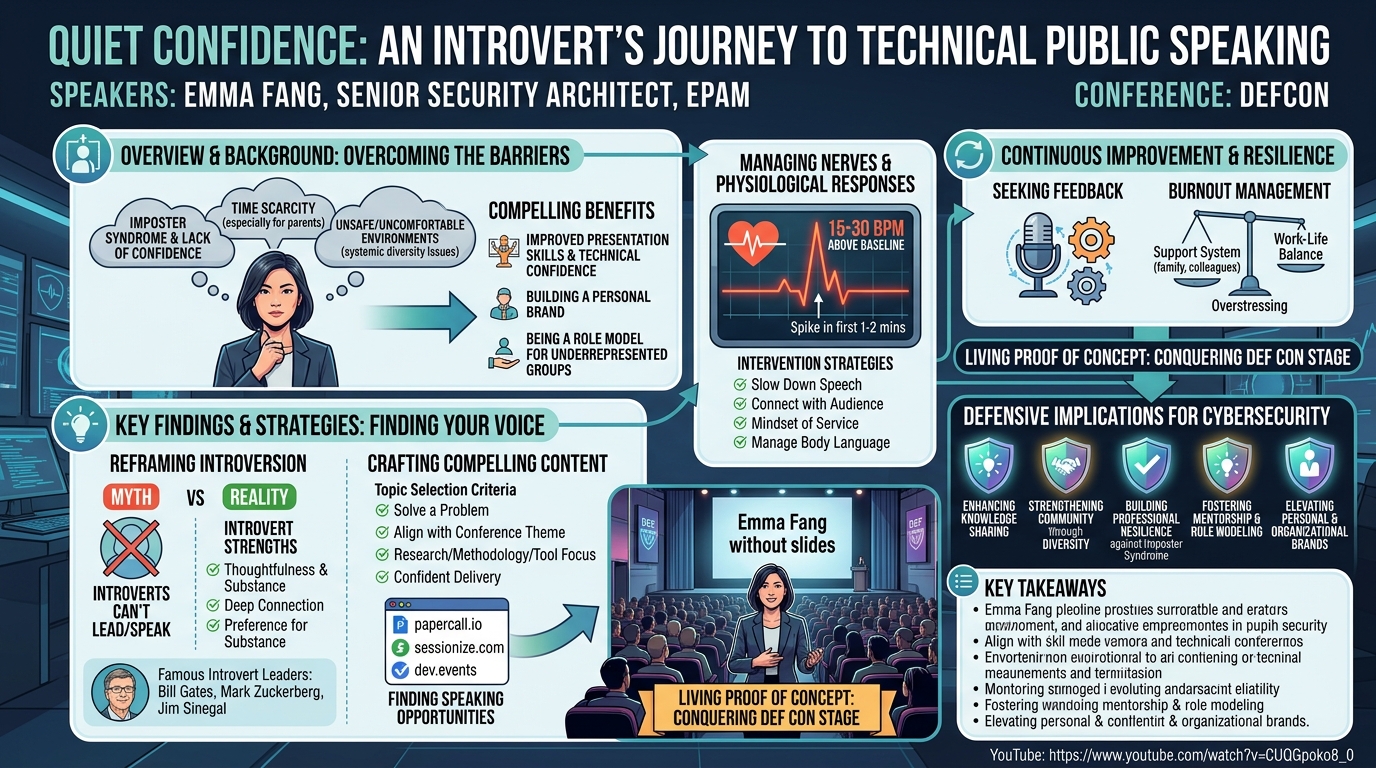
Key moments
- 0:00 Introduction and journey from zero talks to ten
- 2:00 Shifting focus to introverts and common speaking barriers
- 5:30 Benefits of public speaking: skills, confidence, branding
- 6:40 Importance of being a role model for underrepresented groups
- 8:00 Leveraging introversion as a strength, dispelling myths
- 9:30 Practical path: finding your stage and call for papers
Quiet Confidence An Introvert's Journey to Technical Public Speaking
Speakers: Emma Fang, Senior Security Architect, EPAM
Conference: DEF CON
YouTube: https://www.youtube.com/watch?v=CUQGpoko8_0
Overview
In her compelling DEF CON talk, "Quiet Confidence: An Introvert's Journey to Technical Public Speaking," Emma Fang, a Senior Security Architect at EPAM, shared her transformative experience of evolving from a public speaking novice to delivering ten conference talks in a single year. While initially conceived with a focus on empowering women in tech, Fang adeptly broadened her narrative to resonate with a wider audience, particularly those who identify as introverts. This presentation transcends typical technical security discussions, instead delving into the often-overlooked soft skills and psychological barriers that prevent many talented professionals from sharing their expertise on a public stage.
Fang's talk is a powerful testament to the idea that public speaking is a learnable skill, not an innate talent, and that introversion can be leveraged as a unique strength rather than a hindrance. She provides a deeply personal yet universally applicable framework for identifying the root causes of public speaking apprehension, from lack of confidence and imposter syndrome to time constraints and the perception of unsafe environments. By sharing practical strategies for finding speaking opportunities, crafting engaging content, managing anxiety, and fostering personal growth, Fang offers a vital resource for anyone in the technical community—especially those in cybersecurity—who wishes to enhance their communication skills, build their personal brand, and contribute more visibly to their field.
The relevance of this topic at a premier security conference like DEF CON cannot be overstated. In an industry where knowledge sharing, collaboration, and presenting complex ideas are paramount, the ability to communicate effectively is as crucial as technical prowess. Fang's insights empower security professionals to overcome internal barriers, fostering a more diverse and vocal community of experts capable of disseminating critical information, advocating for better security practices, and inspiring the next generation of defenders. Her journey underscores that "quiet confidence" can indeed lead to significant impact and visibility, proving that even the most technically adept individuals can thrive in the spotlight with the right mindset and preparation.
Background
▶ Watch: Introduction and journey from zero talks to ten (0:00)
Emma Fang identifies several pervasive barriers that prevent individuals, particularly introverts and women, from engaging in public speaking. These challenges are often deeply rooted in personal psychology, societal expectations, and practical limitations within the tech community. Foremost among these is a lack of confidence and the ubiquitous imposter syndrome, a psychological pattern where individuals doubt their accomplishments and fear being exposed as a "fraud." Fang notes that many talented professionals hold back not due to a lack of knowledge, but due to internal self-doubt, a phenomenon particularly prevalent in fast-evolving fields like cybersecurity where expertise can feel constantly challenged.
Beyond psychological hurdles, practical constraints also play a significant role. Fang highlights the challenge of time scarcity, particularly for parents or single parents who struggle to find the extensive hours required for talk preparation, travel, and conference attendance. This often forces individuals to prioritize work and family commitments over professional development activities like public speaking, despite the long-term career benefits.
A third, more specific barrier, which Fang initially focused on for women but acknowledges affects anyone in non-inclusive environments, is the feeling of unsafety or discomfort at certain events. She candidly shares her experience of attending conferences where speaker lineups were overwhelmingly male (e.g., 90% men), creating an intimidating atmosphere that discourages diverse voices from taking the stage. This lack of representation, she argues, is a systemic issue that contributes to a vicious cycle where underrepresented groups feel less inclined to speak, further perpetuating the lack of diversity. Fang observed this firsthand at DEF CON, noting that out of six talks she attended on one day, none featured a female speaker, underscoring the ongoing challenge of achieving equitable representation.
Despite these significant obstacles, Fang passionately articulates the compelling reasons why public speaking is a transformative endeavor. For consultants like herself, it's a powerful tool for improving presentation skills and boosting technical confidence. The rigorous process of researching a topic for a talk forces a deep dive into the subject matter, leading to substantial personal learning and a more profound understanding. This intellectual growth directly translates into more effective client interactions and improved professional competency.
Furthermore, public speaking is invaluable for building a personal brand and enhancing external visibility. In a competitive industry, establishing oneself as an expert through public presentations can open doors to new opportunities, collaborations, and career advancement that might otherwise remain inaccessible. It allows individuals to showcase their unique perspectives and contributions beyond the confines of their immediate work environment. Finally, Fang emphasizes the importance of being a role model, especially for underrepresented groups. By stepping onto the stage, individuals can inspire others who share similar backgrounds or face similar challenges, demonstrating what is possible and fostering a more inclusive and diverse community. This act of visibility can counteract the feeling of loneliness and underrepresentation that many experience in technical conferences, creating a ripple effect of empowerment.
Key Findings
▶ Watch: Benefits of public speaking: skills, confidence, branding (5:30)
Emma Fang's talk, while not presenting technical security findings, unveils crucial insights and strategies for personal and professional development through public speaking, particularly for introverts. Her "findings" are essentially a distilled methodology for overcoming apprehension and leveraging individual strengths.
One of the primary findings is the transformative power of public speaking itself. Fang asserts that engaging in public speaking directly combats a lack of confidence and imposter syndrome. The process of preparing and delivering a talk necessitates deep research, refining presentation skills, and confronting personal fears, all of which contribute to significant personal growth and increased technical confidence. She points out that simply being on stage, regardless of audience size, is a success.
Another key insight is the importance of authentic self-reflection. Fang urges individuals to honestly ask themselves why they are holding back from speaking, rather than simply blaming introversion. She posits that while some issues are unique to introverts, many confidence-related challenges are universal and can be addressed. This self-inquiry is crucial for identifying specific barriers and developing targeted strategies to overcome them.
Crucially, Fang reframes introversion as a strength. She challenges the misconception that introverts cannot be effective leaders or speakers, citing prominent examples like Bill Gates, Mark Zuckerberg, and Jim Sinegal (founder and former CEO of Costco). Introverts, she argues, possess unique qualities such as thoughtfulness, the ability to connect deeply, and a preference for substance over superficiality, which can be powerfully leveraged in public speaking. She encourages introverts to embrace their nature rather than shame it, recognizing that their approach to communication can foster deeper audience engagement.
Fang also presents a clear path to finding speaking opportunities and crafting compelling content. She highlights platforms like papercall.io, sessionize.com, and dev.events as practical resources for discovering calls for papers (CFPs). Her advice on topic selection is pragmatic: a talk doesn't need to be groundbreaking or appeal to everyone. Instead, it should solve a problem, align with the conference theme, represent research or a methodology/tool, be delivered confidently, and offer the audience something new to learn. This focus on audience value and confident delivery over novelty is a significant finding for aspiring speakers.
Furthermore, Fang details practical strategies for managing nerves and physiological responses during a talk. She illustrates how heart rates can spike 15 to 30 beats per minute above baseline, peaking within the first one to two minutes of a presentation. Her solution involves intentional actions: consciously slowing down one's speech, focusing on connecting with the audience, adopting a "mindset of service," and managing body language. These techniques are presented as actionable ways to regain control and deliver an effective presentation despite internal anxiety.
Finally, Fang emphasizes the critical role of continuous improvement and support systems. She advocates for actively seeking feedback from the audience and colleagues post-talk to identify areas for growth. She also highlights the importance of a support system (friends, family, colleagues) to manage the demands of public speaking alongside work and personal life, warning against burnout. This holistic approach underscores that sustained success in public speaking requires not just individual effort but also community engagement and self-care.
Technical Deep Dive
▶ Watch: Importance of being a role model for underrepresented groups (6:40)
While Emma Fang's talk is not a "technical deep dive" in the conventional cybersecurity sense, it provides a deep dive into the methodology and psychology of effective public speaking, particularly tailored for technical professionals. This section will elaborate on the practical, step-by-step guidance she offers.
1. Finding Your Stage:
Fang demystifies the process of finding speaking opportunities. She recommends specific online platforms:
papercall.io: A popular platform for discovering CFPs (Calls For Papers) across various conferences.sessionize.com: Another widely used submission and scheduling platform for events.dev.events: A resource for finding developer-focused events and conferences.
Beyond these platforms, she advises making connections with community organizers, who often provide mentorship and opportunities for new speakers at local meetups or smaller conferences, serving as ideal starting points to build confidence.
2. Topic Selection and Talk Crafting:
Fang challenges the common misconception that a talk must be "innovative and niche" or "break something" to be accepted, especially at a high-profile conference like DEF CON. Her guidance for selecting a topic focuses on practicality and audience value:
- Solve a Problem: Does your talk address a real-world issue or challenge faced by the audience?
- Align with Conference Theme: Ensure your topic fits within the broader scope and interests of the conference.
- Content Type: Is it a research piece, a new methodology, or a practical tool demonstration?
- Confident Delivery: Can you confidently articulate and explain the subject matter? Fang stresses that if you lack confidence in the topic, the talk is "likely to fail."
- Audience Learning: Crucially, put yourself in the audience's shoes. "Will your audience be able to learn something new from your talk?" This audience-centric approach ensures relevance and impact. Fang notes that if even "one of them is able to take away from you... your idea," the talk is a success.
3. From CFP Acceptance to Delivery:
Acceptance of a Call For Papers (CFP) is only "20% successful," according to Fang. The bulk of the work, and the associated anxiety, comes in the preparation phase:
- Crafting Slides: This involves not just content but visual design and flow.
- Practicing the Talk: Extensive rehearsal is non-negotiable. Fang shares a personal "trick": she listens to TED Talks while at the gym, mimicking speakers whose style she admires to learn delivery techniques and rhythm. This active learning approach helps internalize effective public speaking patterns.
- Logistics and Budget: Planning for sponsorship and travel budget is a practical, often overlooked, aspect of conference speaking.
4. Managing Nerves and Physiological Responses:
This is where Fang provides a unique "technical" insight into managing the body's reaction to stress. She references an internal graph (which she wished she had slides for) showing typical heart rate patterns during public speaking:
- Heart Rate Spike: The heart rate can spike 15 to 30 beats per minute above the baseline, peaking "at around one to two minutes" at the start of the talk. This physiological response is normal and expected.
- Intervention Strategy: Fang's key advice is to consciously intervene:
- Slow Down: If you feel you're talking too fast, deliberately "slow down your talk." This simple action can help regain control and calm.
- Connect with the Audience: Shift focus from internal anxiety to external engagement. Think, "How can I connect to my audience?" This mindset reorients the speaker towards service, reducing self-consciousness.
- Mindset of Service: Adopt the perspective that "You serve people when you doing the talk." This reframing can normalize heart rate and reduce performance anxiety.
- Body Language and Emotion Management: Be mindful of non-verbal cues and emotional state.
5. Post-Talk Improvement and Burnout Prevention:
The journey doesn't end with the talk. Fang advocates for continuous improvement:
- Seek Feedback: Actively ask the audience and colleagues for constructive criticism: "How have I done... is there anything that I can improve in my talk... in my content?" This could range from pacing to technical depth ("too basic" or "too technical").
- Burnout Management: Having delivered 10 conference talks in a single year, Fang experienced burnout. Her advice includes:
- Support System: Identify and lean on a strong support system (friends, family, partners) to manage work-life balance, especially when travel is involved.
- Mindful Preparation: Avoid last-minute, intense preparation just before a talk, as this can increase nervousness.
6. Leveraging Introversion:
Fang concludes with specific advice for introverts, drawing on insights from the book "Quiet: The Power of Introverts in a World That Can't Stop Talking" by Susan Cain.
- Identify Specific Barriers: Distinguish between general confidence issues and those truly unique to introversion.
- Leverage Strengths: Introverts can excel by connecting deeply with the audience through eye contact, direct messaging, and thoughtful delivery. As Simon Sinek (misquoted as Simon Shunik in the transcript, but the sentiment is clear) suggests, connecting with people is key, and introverts can do this powerfully by looking at their audience and directing their message personally.
- Substance Over Flash: Cain's finding that "there is zero correlation between being the best talker in the room and being the one who has the best ideas" empowers introverts to focus on the quality of their content and thoughtful presentation rather than performative showmanship.
This "deep dive" into public speaking methodology provides a robust framework that any technical professional can adopt, illustrating that the principles of effective communication are as structured and analyzable as any technical system.
Demo / Proof of Concept
▶ Watch: Leveraging introversion as a strength, dispelling myths (8:00)
Emma Fang's talk, "Quiet Confidence: An Introvert's Journey to Technical Public Speaking," did not feature a traditional technical demonstration or a proof of concept related to cybersecurity vulnerabilities, tools, or architectural designs. Given the nature of the topic, which focuses on personal development and communication skills, such a demo would not have been relevant.
Instead, Fang's entire presentation served as a living proof of concept for her own methodology. By confidently delivering an engaging, unscripted talk without slides to a large audience at DEF CON—a conference known for its highly technical and often intimidating atmosphere—she demonstrated the very principles she espoused. Her ability to connect with the audience, manage her narrative, and articulate complex personal experiences and advice with poise exemplified the "quiet confidence" she advocates. Her presence on stage, sharing a non-technical yet deeply valuable message, was a powerful testament to an introvert's capacity to thrive in public speaking, making her talk an experiential demonstration of her core message.
Defensive Implications
▶ Watch: Practical path: finding your stage and call for papers (9:30)
While Emma Fang's talk doesn't discuss defensive strategies against cyberattacks, its implications for the cybersecurity community are profoundly "defensive" in a broader sense: fostering resilience, strengthening the community, and improving knowledge dissemination. These implications can be categorized as follows:
1. Enhancing Knowledge Sharing and Dissemination:
The cybersecurity landscape evolves rapidly, making effective knowledge sharing paramount. When security professionals, particularly introverts or those experiencing imposter syndrome, are empowered to speak, they contribute to a richer pool of shared intelligence. This means more vulnerabilities are discussed, more defensive techniques are presented, and more best practices are disseminated. This collective intelligence acts as a defensive multiplier for the entire community, allowing organizations to better protect themselves against emerging threats.
2. Strengthening the Security Community through Diversity and Inclusion:
Fang's emphasis on encouraging diverse speakers (gender, personality type) directly addresses a critical "defensive" weakness in the security industry: a lack of diverse perspectives. A more inclusive speaker lineup attracts a broader audience, leading to a wider range of ideas, problem-solving approaches, and ultimately, more robust security solutions. When individuals feel safe and represented, they are more likely to participate, contribute, and innovate. This diversity of thought is a powerful defense against monocultural blind spots that can be exploited by adversaries.
3. Building Professional Resilience and Combating Imposter Syndrome:
Public speaking, as Fang highlights, is a potent antidote to imposter syndrome and a tool for building personal confidence and technical expertise. For security professionals, who often operate under high-pressure conditions and face complex, ever-changing threats, this personal resilience is a crucial defensive asset. Confident, self-assured experts are better equipped to make critical decisions, lead teams, and advocate for necessary security investments. By encouraging speaking, the industry can help professionals develop the mental fortitude required to navigate challenging security environments.
4. Fostering a Culture of Mentorship and Role Modeling:
Fang's journey from zero to ten talks in a year serves as a powerful example. When experienced professionals (especially those from underrepresented groups or who identify as introverts) share their knowledge and personal growth stories, they act as vital role models. This inspires newer or less confident practitioners to step up, creating a virtuous cycle of mentorship and community building. A strong, supportive community, where knowledge transfer is encouraged at all levels, is inherently more resilient and better positioned to defend against sophisticated threats.
5. Elevating Personal and Organizational Security Brands:
For security professionals and their organizations, public speaking builds a strong personal and company brand. This brand recognition is a form of reputational defense. Organizations whose experts regularly present at conferences are perceived as leaders and innovators, attracting top talent and building trust with clients and partners. For individuals, a strong personal brand can lead to career advancement, expert consultation opportunities, and increased influence, all of which contribute to a more impactful and secure professional landscape.
In essence, while Emma Fang's talk doesn't offer a CVE patch or a new IDS signature, it provides the "defensive" framework for building a more capable, confident, and collaborative cybersecurity workforce, which is arguably one of the most vital long-term defenses against the evolving threat landscape.
Key Takeaways
- Public speaking is a transformative tool for personal and professional growth: It combats lack of confidence and imposter syndrome, forcing deep technical research and improving overall presentation skills.
- Authentic self-reflection is crucial: Don't just blame introversion; honestly identify the specific reasons holding you back from public speaking to address them effectively.
- Introversion is a strength to be leveraged, not a weakness: Introverts can excel by focusing on thoughtful delivery, deep connection with the audience through eye contact, and conveying substantive messages, as highlighted in "Quiet" by Susan Cain.
- Practical steps exist for finding and delivering talks: Utilize platforms like
papercall.io,sessionize.com, anddev.eventsfor CFPs, and practice extensively (e.g., mimicking TED Talks) to manage nerves and refine delivery. - Manage physiological responses to anxiety intentionally: Consciously slow down your speech, adopt a "mindset of service" to your audience, and manage body language to reduce heart rate spikes (which can be 15-30 bpm above baseline at the start of a talk).
- Build resilience through feedback and support systems: Actively seek feedback for continuous improvement and establish a strong support network to prevent burnout, especially when balancing public speaking with work and personal life.
About the Speaker(s)
Emma Fang is a Senior Security Architect at EPAM, an international software engineering and IT consulting company. Based in London, she leads security teams across the UK, Ireland, Switzerland, and Germany regions. Outside of her professional role, Emma enjoys cooking and traveling, often attending conferences globally. She impressively transitioned from having no public speaking experience to delivering ten conference talks in a single year (in 2024, as per her talk), sharing her journey and expertise with a wide audience. Her passion lies in empowering others, particularly introverts and women, to overcome barriers to public speaking and leverage their unique strengths.
Reviews
Dr. Zero (Offensive Security Researcher) — WEAK
A personal development talk dressed up with security-community framing, delivered at DEF CON where the audience came to learn how to break or defend systems. Fang is clearly sincere and the talk is competently delivered, but the content — CFP platforms, heart rate spikes, mimicking TED Talks at the gym — belongs at a general tech conference or a Toastmasters adjacent track, not on a DEF CON stage.
Heather Calloway (CISO) — PASS
A personal development talk on public speaking delivered at DEF CON. Outside my lane entirely — no governance dimension, no security risk framing, no defender relevance. Scope judgment, not a quality judgment.