FEAR: A Novel Framework for Representing Digital Forensic Artifacts in Knowledge Graphs
Allan Korol (Doctoral researcher · Edith Cowan University)
DFDS 2025 (DFRWS Doctoral Symposium) · Day 1 · Main Stage
Overview
In the rapidly evolving landscape of digital forensics, investigators are constantly challenged by the sheer volume, heterogeneity, and complexity of data. Allan Korol, a doctoral researcher at Edith Cowan University, introduced the Forensic Extraction and Representation (FEAR) framework at DFDS, proposing a novel approach to transform raw digital forensic artifacts into machine-interpretable knowledge graphs. This presentation highlights a critical shift towards leveraging semantic web technologies to enhance the efficiency, automation, and analytical depth of forensic investigations.
Key moments
- 4:20 Benefits of knowledge graphs in digital forensics
- 8:00 The problem: Lack of shared DF artifact mapping knowledge
- 10:40 Industry examples of open-source knowledge sharing
- 12:20 Introducing the FEAR framework and its purpose
- 14:00 FEAR's agnostic, spoken-language-mimicking framework
- 15:10 Autopsy module and web-based visualization capabilities
- 16:50 Demonstrating inference with Semantic Web Rule Language
FEAR: A Novel Framework for Representing Digital Forensic Artifacts in Knowledge Graphs
Speakers: Allan Korol, Doctoral researcher, Edith Cowan University
Conference: DFDS
YouTube: https://www.youtube.com/watch?v=uJZKRy__Acs
Overview
In the rapidly evolving landscape of digital forensics, investigators are constantly challenged by the sheer volume, heterogeneity, and complexity of data. Allan Korol, a doctoral researcher at Edith Cowan University, introduced the Forensic Extraction and Representation (FEAR) framework at DFDS, proposing a novel approach to transform raw digital forensic artifacts into machine-interpretable knowledge graphs. This presentation highlights a critical shift towards leveraging semantic web technologies to enhance the efficiency, automation, and analytical depth of forensic investigations.
FEAR addresses a significant bottleneck in the field: the lack of a standardized, open-source, and platform-agnostic method for mapping diverse forensic data into a unified, semantically rich representation. By moving beyond siloed, proprietary tools and developer-specific coding styles, FEAR aims to democratize the creation and sharing of artifact-to-knowledge graph transformation logic. This innovation promises to accelerate the transition of cutting-edge research into practical forensic applications, enabling more sophisticated automated reasoning and seamless integration with emerging artificial intelligence (AI) and large language model (LLM) technologies without the risk of "hallucinations."
The significance of FEAR extends to fostering a collaborative ecosystem within digital forensics. By providing a common language and an open-source library for defining artifact transformations, the framework empowers researchers and practitioners to contribute to a shared repository of knowledge. This collective effort can lead to more comprehensive and robust forensic analysis capabilities, ultimately strengthening incident response, threat hunting, and intelligence gathering efforts across the cybersecurity domain.
Background
▶ Watch: Benefits of knowledge graphs in digital forensics (4:20)
The concept of applying semantic knowledge graphs to digital forensics is not entirely new, but its widespread adoption has been hampered by significant practical challenges. Knowledge graphs, fundamentally, are statements of truths, representing entities and their relationships in a structured, machine-readable format. They operate under an open world assumption, meaning that the absence of a statement does not necessarily imply its falsehood, acknowledging that any given graph is likely incomplete. The Resource Description Framework (RDF) is a common standard for representing these statements, often structured as subject-predicate-object triples.
A cornerstone of semantic knowledge graphs is the use of ontologies. Ontologies serve to remove ambiguity, providing a formal, explicit specification of a shared conceptualization. For example, an ontology can differentiate between a "destination port" as a network address versus a physical location for a ship. They also incorporate background knowledge and constraints, such as those defined by RDFS (RDF Schema), which specify valid types and relationships between entities.
Previous research has explored the utility of knowledge graphs in digital forensics. Early efforts included data mining frameworks that used ontology-based systems with rule filters to process forensic data. Other work focused on developing ontologies specifically for digital forensic investigations, often leveraging existing tools like log2timeline to construct these graphs. Research in collaboration with organizations like Lead Spec and West Yorkshire Police demonstrated the ability to extract information from exported FTK reports using HTML parsers to generate knowledge graphs. More recent proposals have suggested pluggable architectures for extending data sources in ontology engineering for advanced forensic analysis.
The benefits of using knowledge graphs in digital forensics are well-documented: they enable machine interpretability, facilitate the aggregation of heterogeneous evidence, aid in the discovery of hidden relationships, support automated reasoning, and allow for deduction from implicit knowledge. With the rise of AI and LLMs, knowledge graphs offer a crucial advantage by providing a foundation of factual statements, thereby mitigating the risk of AI "hallucinations" often associated with models trained on less structured data. Recent work in 2024 has even focused on generating Python code to convert ontologies like the Unified Cybersecurity Ontology (UCO) and the Cyber-investigation Analysis Standard Expression (CASE) into executable forms, further exploring the synergy between AI and ontologies for automated analysis.
Despite these advancements, common challenges persist. Existing frameworks often rely on leveraging intermediate formats from established tools like log2timeline, Volatility, Autopsy, or FTK. However, the crucial step of mapping raw artifact data to its knowledge graph representation is typically embedded within platform-specific code, reflecting individual developer coding styles. This logic is often obscured, difficult to extend, and frequently locked within proprietary or closed-source systems, significantly hindering further research and knowledge sharing. Allan Korol noted his personal experience encountering this barrier when trying to address knowledge graph incompleteness in his own PhD research, leading to the realization that a more open and standardized approach was desperately needed.
The continuous evolution of computing environments and the emergence of new digital artifacts present an ongoing challenge. If artifact-to-knowledge graph conversion logic is hardcoded in languages like Python, C++, or Java, it requires constant, labor-intensive updates. This contrasts sharply with other areas of cybersecurity, where knowledge sharing is highly developed. Examples include Snort and Bleeding Snort rules for rapid threat intelligence distribution, VirusTotal and Hybrid Analysis for malware hash lookups, and Velociraptor for sharing hundreds of forensic queries. The digital forensics community lacks a similar, universally accessible mechanism for sharing the complex logic required to map artifacts into knowledge graphs, compounded by the perennial debate over which programming language is "best" for forensic tooling. The FEAR framework emerges as a direct response to these foundational issues.
Key Findings
▶ Watch: Industry examples of open-source knowledge sharing (10:40)
The FEAR framework represents a significant step forward in addressing the challenges of digital forensic artifact representation. Its core contribution lies in providing a structured, open-source, and platform-agnostic method for integrating traditional forensic processes with semantic knowledge graphs.
The central component of FEAR is the graph-codify forensic extraction and representation library. This library is designed to load and compile open-source scripts that define the transformation logic from digital forensic artifacts into knowledge graph representations. By externalizing this logic from specific forensic tools, FEAR aims to accelerate the transition of research discoveries into practical applications. Researchers can now focus on developing novel analytical techniques rather than reinventing the wheel by building custom data ingestion frameworks for knowledge graphs.
A pivotal innovation within FEAR is its fifth-generation language. Modeled after familiar Java or C-style syntax, this language is designed to mimic spoken language, making it intuitive for defining actions to transform artifacts into knowledge graphs. The benefits of this language are substantial: it moves the transformation logic out of platform-specific code files and binaries, making it inherently agnostic from the underlying system or framework. This means whether a forensic tool is written in Python, C++, or Java, the FEAR language can be used to define artifact mappings without being tied to a particular programming environment.
To complement the language, FEAR includes a library of open-source scripts. This library is intended to be a community-driven repository, allowing researchers and practitioners to share and reuse artifact transformation definitions. This fosters a collaborative environment akin to Snort rule repositories or Velociraptor query packs, promoting rapid knowledge dissemination.
The framework also features an Autopsy module, demonstrating practical integration. This module serves two primary functions: a bridge component designed for minimal integration, efficiently extracting information from Autopsy and sending it for FEAR processing; and a web-based user interface (UI) for querying and visualization. This UI provides syntax highlighting for Sparkle queries and visual representations of the knowledge graphs, showcasing the power of semantic data. The web-based nature of the UI further enhances its portability, allowing it to be dropped into various platforms, as demonstrated by its integration into a Java FX web control.
Finally, FEAR highlights the power of Semantic Web Rule Language (SWRL) for automated reasoning. Korol presented an example demonstrating how SWRL rules can infer relationships between entities. For instance, if two metadata entities (A and B) share the same MD5 hash and both have created timestamps, and the creation time of A is earlier than B, an SWRL rule can infer that these are the same file, with one being created before the other. This capability, applied to a large dataset of approximately 200,000 statements, underscores FEAR's potential to uncover implicit knowledge and automate complex deductions, significantly enhancing the analytical capabilities of digital forensics.
Technical Deep Dive
▶ Watch: Introducing the FEAR framework and its purpose (12:20)
At the heart of the FEAR framework lies the robust application of semantic knowledge graphs and a custom-designed language to facilitate their construction from diverse forensic data sources. Knowledge graphs fundamentally represent information as a network of interconnected entities, leveraging RDF (Resource Description Framework) triples (subject-predicate-object) to express statements of truth. A critical aspect of these graphs, as highlighted in the talk, is the open world assumption, which acknowledges that a knowledge graph is rarely complete; the absence of a statement does not necessarily mean it is false.
The precision and utility of knowledge graphs are heavily reliant on ontologies. Ontologies provide the formal definitions of concepts and their relationships within a specific domain, effectively removing ambiguity that often plagues natural language or loosely structured data. For example, an ontology would explicitly define the properties and relationships of a "process" entity, distinguishing it from a "file" or "network connection." They also incorporate background knowledge and constraints, often expressed through RDFS (RDF Schema), which define the types of entities and the permissible relationships between them. While FEAR itself does not define new core ontologies, it is designed to work seamlessly with established ones like the Unified Cybersecurity Ontology (UCO) and the Cyber-investigation Analysis Standard Expression (CASE), which provide a common vocabulary for cyber-related information.
The FEAR framework architecture is designed for integration and extensibility. It aims to work in conjunction with existing forensic tools and processes rather than replacing them. The core mechanism involves containerizing the method of constructing knowledge graphs from data sets. This containerization isolates the transformation logic, making it portable and independent of the host forensic platform.
The graph-codify library is the central processing unit of FEAR. It acts as an interpreter and compiler for the custom FEAR language scripts. These scripts, retrieved from specified repository URLs, contain the explicit instructions for how raw digital forensic artifacts (e.g., registry keys, file metadata, process lists) should be parsed, extracted, and then mapped into knowledge graph triples according to a target ontology.
The FEAR language itself is a fifth-generation language, a high-level programming paradigm that focuses on solving problems rather than specifying exact procedural steps. Its syntax is deliberately modeled after common languages like Java and C, aiming for familiarity, but its purpose is highly specialized: to mimic spoken language to describe artifact transformations. For example, a FEAR script might contain statements like "extract file path from MFT entry" or "create relationship between process and network connection." This abstraction is key to its platform-agnostic nature. By defining transformations in this specialized language, the logic is decoupled from the underlying implementation language (e.g., Python for Volatility, Java for Autopsy, C++ for Wireshark). This means a single FEAR script can define a transformation that is applicable across different forensic suites, provided they can export the necessary raw data to the FEAR processing bridge.
The power of the resulting knowledge graphs is truly realized through automated reasoning, specifically demonstrated using the Semantic Web Rule Language (SWRL). SWRL allows for the definition of rules that infer new facts or relationships based on existing ones within the knowledge graph. Korol provided a compelling example:
This rule states that if two metadata entities (A and B) share the same source file MD5 hash, both have created date/time attributes, and the created date/time of A is less than that of B, then it can be inferred that A was created before B. This seemingly simple rule, when applied across a large dataset (e.g., 200,000 statements as mentioned in the talk), can automatically establish temporal relationships between files, even if those relationships were not explicitly recorded in the original forensic artifact. This capability is crucial for reconstructing event timelines, identifying precursors to malicious activity, and building more comprehensive narratives of an incident. By encoding such expert knowledge into SWRL rules, FEAR enables automated deduction, freeing investigators from tedious manual correlation tasks and allowing them to focus on higher-level analysis.
Demo / Proof of Concept
▶ Watch: Autopsy module and web-based visualization capabilities (15:10)
Allan Korol demonstrated the practical application of the FEAR framework through an Autopsy module and a vivid illustration of Semantic Web Rule Language (SWRL) inference. The Autopsy module serves as a tangible proof of concept for FEAR's integration capabilities and user interface.
The Autopsy module comprises two key elements:
- Bridge Component: This part of the module is designed to extract relevant information from the Autopsy environment. The talk emphasized that this integration requires minimal coding within the host platform (Autopsy, in this case). This "bridge" effectively translates Autopsy's internal data structures into a format suitable for processing by the FEAR framework, showcasing how the containerized nature of FEAR significantly reduces the integration burden on existing forensic tools.
- Web-based User Interface (UI): This UI is presented as the primary interface for interacting with the knowledge graphs generated by FEAR. Its functionalities include:
- Sparkle Querying: The UI provides a dedicated environment for writing and executing Sparkle queries, which are the standard query language for RDF graphs. Crucially, it offers syntax highlighting, making complex queries easier to read and debug.
- Visualization: Beyond raw query results, the UI also visualizes the relationships within the knowledge graph, presenting entities and their connections in an intuitive, graphical format. This visual representation is invaluable for investigators to quickly grasp complex relationships that might be obscured in tabular data or raw logs.
- Portability: Korol highlighted the web-based nature of the UI, demonstrating its flexibility by stating it could be "dropped into essentially any other platform." In the specific demonstration, it was integrated into a Java FX web control, illustrating its adaptability across different technological stacks.
The power of FEAR was further underscored by a demonstration of SWRL-based inference. Using a simplified example, Korol walked through how a rule could automatically deduce relationships. The scenario involved two metadata entities (A and B) that shared the same MD5 hash for their source file and both possessed "created date and time" attributes. An SWRL rule was then applied: if the created date/time of file A was earlier than that of file B, the system would infer that "file A was created before file B."
This inference was not explicitly stated in the raw data but was derived through logical reasoning on the structured knowledge graph. The demonstration utilized a significantly cut-down version of a much larger dataset, which contained approximately 200,000 statements. Even with this large volume of data, the SWRL rules could efficiently identify and infer these implicit relationships, showcasing FEAR's ability to automate complex analytical tasks. The visual representation in the web UI then allowed investigators to see these inferred relationships, such as the temporal ordering of files, which might indicate stages of an attack or data manipulation. This proof of concept clearly illustrates how FEAR transforms disparate forensic artifacts into a cohesive, machine-interpretable narrative, greatly enhancing the depth and speed of investigations.
Defensive Implications
▶ Watch: Demonstrating inference with Semantic Web Rule Language (16:50)
The FEAR framework offers profound implications for cybersecurity defenders, moving beyond reactive analysis to proactive and intelligent incident response and threat hunting. By standardizing and automating the conversion of raw digital forensic artifacts into machine-interpretable knowledge graphs, FEAR provides a powerful new lens through which to understand and respond to cyber threats.
Firstly, FEAR enables significantly enhanced forensic analysis. Defenders often grapple with heterogeneous data sources – logs from various systems, network traffic, endpoint artifacts, and cloud telemetry, each in its own format. FEAR's ability to aggregate and contextualize this diverse evidence into a unified knowledge graph allows for a holistic view of an incident. This means an analyst can quickly see connections between a suspicious process, a network connection, and a specific file modification, which might otherwise require tedious manual correlation across multiple tools.
Secondly, the framework directly contributes to faster investigations and incident response. By automating the crucial, time-consuming step of artifact-to-knowledge graph mapping, FEAR frees up human analysts from repetitive data manipulation tasks. This allows them to focus on higher-level analytical reasoning, hypothesis testing, and strategic decision-making. The ability to automatically infer relationships using SWRL, such as identifying precursor events or reconstructing timelines from fragmented data, drastically reduces the time to understand an attack's scope and impact.
Thirdly, FEAR is a game-changer for proactive threat hunting. By transforming raw forensic data into a structured knowledge base, defenders can more easily query for complex patterns and anomalies that might indicate sophisticated threats. Instead of searching for individual indicators of compromise (IOCs), threat hunters can formulate queries that look for chains of events, specific sequences of actions, or unusual relationships between entities, leveraging the full power of graph databases to uncover hidden threats.
Moreover, the framework provides a robust foundation for AI and Machine Learning (ML) integration. As AI-driven security tools become more prevalent, the quality of their input data is paramount. Knowledge graphs, by representing factual statements and explicit relationships, offer a structured and semantically rich data source for AI models. This significantly reduces the risk of "hallucinations" – where AI models generate plausible but incorrect information – by grounding their analysis in verified facts and defined ontologies like UCO and CASE. This enables more reliable automated detection and response systems.
The emphasis on an open-source, platform-agnostic language and a shared script repository fosters a community-driven approach to defensive capabilities. Similar to how Snort rules or Velociraptor queries are shared globally, defenders can contribute and benefit from a collective intelligence regarding how specific artifacts should be interpreted and mapped into knowledge graphs. This collaborative model accelerates the development of new detection techniques and ensures that the forensic community can rapidly adapt to new attack methodologies and evolving digital artifacts.
Finally, by abstracting the mapping logic from specific programming languages, FEAR ensures interoperability across diverse security toolsets. Whether an organization uses Autopsy for endpoint analysis, Volatility for memory forensics, or custom C++ tools, FEAR provides a unified layer for knowledge graph generation. This eliminates data silos and promotes a more integrated security posture, allowing defenders to leverage the best tools for each task while maintaining a coherent, machine-interpretable view of their environment.
Key Takeaways
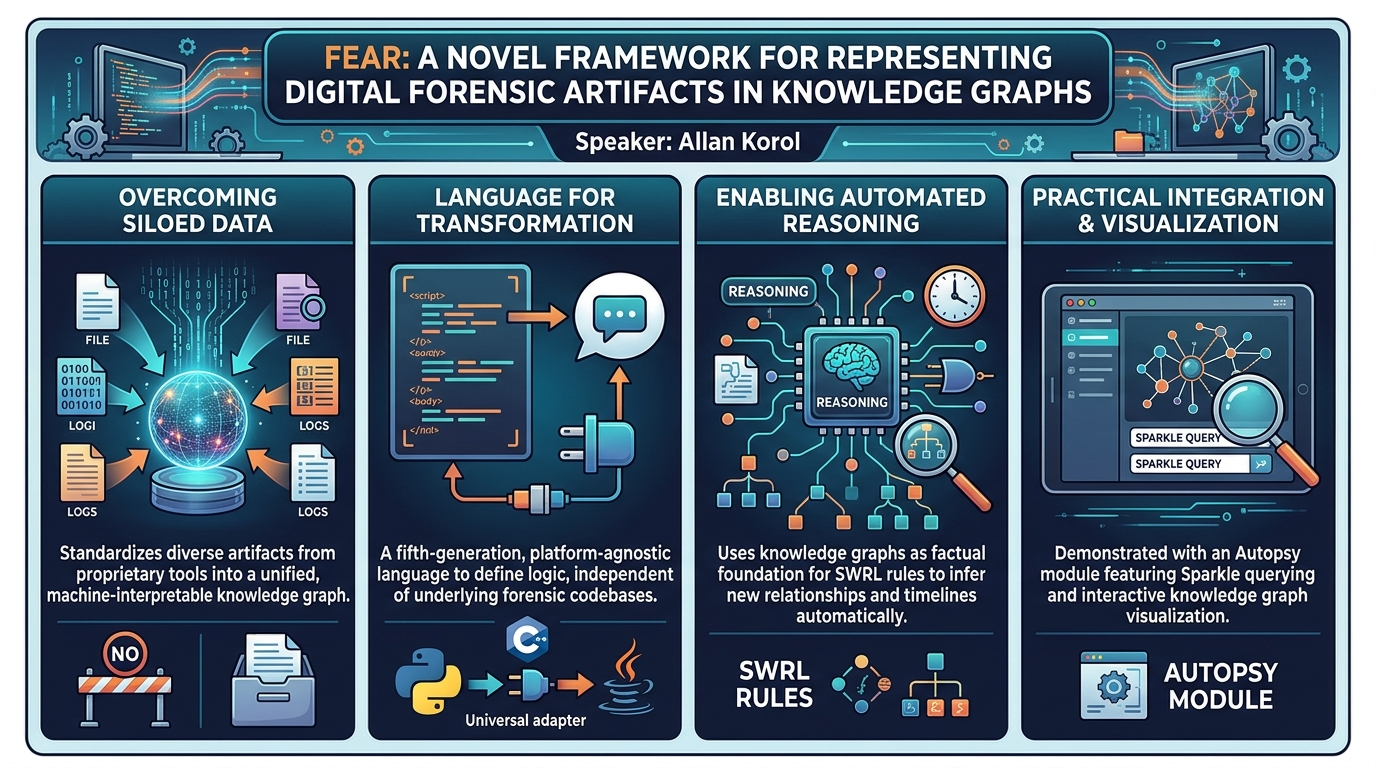
- Standardized Artifact Mapping: The FEAR framework addresses the critical need for a standardized, open-source, and platform-agnostic method to convert diverse digital forensic artifacts into machine-interpretable knowledge graphs, overcoming limitations of proprietary and siloed solutions.
- FEAR Language for Transformation: Central to FEAR is its fifth-generation, C/Java-style language, designed to intuitively define artifact-to-knowledge graph transformations. This language externalizes logic from codebases, making it independent of underlying programming languages (Python, C++, Java).
- Enabling Automated Reasoning and AI: Knowledge graphs provide a factual, semantically rich foundation for automated reasoning using tools like SWRL, allowing for the deduction of implicit relationships (e.g., file creation timelines). This structured data also significantly reduces the risk of hallucinations in AI and LLM applications within forensics.
- Practical Integration and Visualization: The framework includes an Autopsy module with a minimal integration bridge and a portable web-based user interface. This UI supports Sparkle querying with syntax highlighting and visualizes knowledge graphs, demonstrating practical application and enhancing analytical clarity.
- Fostering Community Knowledge Sharing: FEAR promotes a collaborative ecosystem through its open-source script library. This allows researchers and practitioners to share artifact transformation logic, accelerating the transition of forensic research into practice and building a collective intelligence similar to Snort or Velociraptor.
- Accelerating Investigations: By automating the complex process of data correlation and inference, FEAR empowers forensic investigators and threat hunters to focus on higher-level analysis, reconstruct event timelines more efficiently, and uncover sophisticated attack patterns hidden within vast, heterogeneous datasets.
About the Speaker(s)
Allan Korol is a dedicated PhD candidate at Edith Cowan University, located in Western Australia. He is currently in his third year of doctoral research, focusing on the development and refinement of the FEAR framework, which he plans to open-source towards the end of the year. Allan holds a Master's degree in digital forensics and possesses a number of GX certifications, underscoring his expertise in the field. His professional background is rooted in software engineering, a discipline he engaged in before transitioning into the domain of cybersecurity, bringing a unique blend of development and forensic analytical skills to his research.
Reviews
Dr. Zero (Offensive Security Researcher) — SOLID
Competent PhD research solving a real irritation in the forensic tooling space — artifact-to-knowledge-graph mappings locked inside proprietary code. The framework design is sensible, the Autopsy integration is practical, but the 'fifth-generation language' claim needs deflating and the talk stops short of proving this actually scales or beats existing approaches.
Heather Calloway (CISO) — SOLID
Useful research addressing a real pain point in forensic tooling interoperability. The framework has merit for teams doing heavy artifact correlation, but it's early-stage academic work that won't change how most shops run investigations this year.