Understanding Strategies and Challenges of Timestamp Tampering for Improved Digital Forensic Event Reconstruction
Céline Vanini (Doctoral researcher · University of Lausanne)
DFDS 2025 (DFRWS Doctoral Symposium) · Day 1 · Main Stage
Overview
In digital forensics, the temporal integrity of event data is paramount for accurate reconstruction. However, as demonstrated by high-profile cases like the World Anti-Doping Agency (WADA) investigation into the Russian Anti-Doping Agency (RUSADA), timestamps and other timing information are highly susceptible to manipulation. This talk, presented by Céline Vanini, a doctoral researcher at the University of Lausanne, delves into the intricate strategies employed by adversaries to tamper with timestamps and the inherent challenges they face, particularly within live systems. Her research, part of a five-year PhD program, aims to understand the factors that lead to incorrect timing information and to develop solutions to mitigate the risk of misinterpretations in forensic analyses.
Key moments
- 0:00 WADA case: Illustrating real-world timestamp tampering impact
- 2:00 PhD research focus: Mitigating timestamp misinterpretations
- 4:10 User study design: Investigating live timestamp tampering strategies
- 8:00 Manipulation sequence: Adversaries target higher abstraction layers first
- 11:50 Factors of temporal resistance: Making artifacts harder to tamper
- 14:00 Future work: Exploring timestamp creation and server reliability
Understanding Strategies and Challenges of Timestamp Tampering for Improved Digital Forensic Event Reconstruction
Speakers: Céline Vanini, Doctoral researcher, University of Lausanne
Conference: DFDS
YouTube: https://www.youtube.com/watch?v=06udImUtIps
Overview
In digital forensics, the temporal integrity of event data is paramount for accurate reconstruction. However, as demonstrated by high-profile cases like the World Anti-Doping Agency (WADA) investigation into the Russian Anti-Doping Agency (RUSADA), timestamps and other timing information are highly susceptible to manipulation. This talk, presented by Céline Vanini, a doctoral researcher at the University of Lausanne, delves into the intricate strategies employed by adversaries to tamper with timestamps and the inherent challenges they face, particularly within live systems. Her research, part of a five-year PhD program, aims to understand the factors that lead to incorrect timing information and to develop solutions to mitigate the risk of misinterpretations in forensic analyses.
The core of Vanini's presentation focuses on a qualitative user study conducted with graduate students at FAU, designed to observe and analyze timestamp tampering behaviors. Unlike prior research that often assumed full system control by perpetrators, this study explored scenarios where manipulation occurs on a running system, introducing new complexities and generating additional forensic traces. By investigating how adversaries attempt to alter the temporal order of events and manage the resulting digital footprints, the research provides critical insights into what makes certain artifacts more resistant to tampering than others.
Ultimately, this work is crucial for improving digital forensic event reconstruction. By identifying "factors of temporal resistance," investigators can better assess the reliability of various artifacts and predict the likelihood of their manipulation. This understanding empowers forensic practitioners to enhance detection capabilities and refine their interpretation of digital evidence, ensuring that the reconstructed timeline of events accurately reflects reality, even in the face of sophisticated adversarial tactics.
Background
▶ Watch: WADA case: Illustrating real-world timestamp tampering impact (0:00)
The foundational premise of digital forensics relies heavily on the accurate reconstruction of events, where timestamps serve as critical anchors for establishing chronology. However, the integrity of these timestamps is frequently compromised, either inadvertently through system misconfigurations (e.g., incorrect system clocks, time zone settings) or intentionally through malicious tampering. The WADA case, which opened the presentation, serves as a stark illustration of the latter. In this incident, a laboratory database was meticulously manipulated – system clocks backdated, timestamps falsified, and entries inserted or deleted – to falsely accuse former employees and mislead an investigation. Such sophisticated temporal inconsistencies underscore the profound challenge forensic analysts face in distinguishing authentic event sequences from fabricated ones.
Prior academic work in this domain has largely focused on the difficulty of tampering with hard disk and memory images, often under the assumption that a perpetrator has complete, unfettered control over the target system. These studies consistently indicated a high probability of detection for such manipulations, suggesting a significant barrier to successful evidence alteration. However, Céline Vanini and her collaborators identified a critical gap in this research: practical scenarios often compel adversaries to manipulate data while a system is actively running. This "live" tampering introduces a new layer of complexity, as the very act of manipulation inevitably generates additional forensic traces on the system, making the process inherently more challenging and potentially leaving more avenues for detection.
The problem, therefore, extends beyond simply identifying altered timestamps. It encompasses understanding the strategies employed by adversaries in a live environment, how they attempt to manage the traces left behind, and crucially, what inherent characteristics of an artifact make it more resilient to manipulation. This research aims to bridge this gap, moving beyond idealized scenarios to provide practical insights into the dynamics of timestamp tampering in real-world operational contexts, thereby furnishing digital forensic professionals with a more nuanced understanding of temporal evidence integrity.
Key Findings
▶ Watch: User study design: Investigating live timestamp tampering strategies (4:10)
The user study conducted by Céline Vanini and her team yielded several significant findings regarding adversaries' strategies and challenges in live timestamp tampering. A core observation was the emergence of distinct approaches depending on the targeted application and the perceived difficulty of manipulation. Participants were tasked with altering the temporal order of events related to an "illegal download" and an "email notification" (learning of the download's illegality).
Firstly, participants consistently chose to manipulate either email-related artifacts (specifically within Thunderbird) or download-related artifacts (within Firefox). Interestingly, half of the participants opted for each category. The decision factors for these choices were telling:
- Firefox Group: Participants were dissuaded from tampering with Thunderbird artifacts due to concerns about data copies existing on external servers, suggesting an awareness of potential data redundancy beyond the local system.
- Thunderbird Group: Conversely, participants focusing on Thunderbird were more concerned about the sheer number of artifacts that would need manipulation, fearing that this would generate too many additional traces and increase the likelihood of detection.
Secondly, the study revealed a consistent "physical trend of descent through the abstraction layers" in the sequence of manipulations. Adversaries initially targeted timestamps within artifacts at higher layers of the software stack (e.g., application-level data like the Thunderbird inbox file). Only after addressing these more accessible targets did they attempt to manipulate timestamps within artifacts at lower layers (e.g., file system level). This behavior suggests a mental application of a "rational tempering budget," where perpetrators prioritize "lower hanging fruit" – artifacts perceived as easier or requiring fewer operations to modify – before attempting more complex or trace-generating alterations.
Thirdly, participants frequently encountered failures and uncertainties, forcing them to adjust their strategies. These challenges were categorized into two types:
- Soft Factors: Related to the adversary's experience, perception, and practical difficulties. Examples included not manipulating an artifact because it "didn't appear relevant" or simply lacking the expertise to do so.
- Technical Difficulties: More specific to the artifacts themselves, such as their inherent complexity or the system within which they reside. A key example cited was the manipulation of timestamps within a database, which could result in logical inconsistencies within related data, such as entry IDs, making tampering evident.
These technical challenges, in particular, led to the derivation of "factors of temporal resistance." These are specific features of artifacts that make them more difficult to tamper with. Key factors identified include:
- Placement within the software stack: Lower layers often present more resistance.
- Availability of manipulation software: The presence or absence of tools on the system influences choice.
- Required permissions: Higher privilege requirements deter manipulation.
- Embedded verification mechanisms: Features designed to detect alterations.
These findings collectively provide a robust framework for understanding adversary behavior in live timestamp tampering, highlighting both the psychological and technical dimensions that influence the success and detectability of such actions.
Technical Deep Dive
▶ Watch: Manipulation sequence: Adversaries target higher abstraction layers first (8:00)
The technical foundation of this research is a meticulously designed qualitative user study aimed at observing live timestamp tampering. The study involved 10 graduate students from FAU, each acting as a simulated suspect within a controlled virtual environment. The methodology was structured into four distinct phases to gather comprehensive data:
Phase 1: Pre-Tempering Questionnaire. This initial phase gathered background information on the participants, including their technical proficiency and prior experience with digital forensics or system manipulation. This helped establish a baseline for understanding their approaches.
Phase 2: The Live Tampering Task. Each participant was provided with a virtual machine (VM) where specific activities had already been performed. The core task was to "act like a suspect who would like to cover their tracks and try to swap two events that happened on that system." Specifically, participants needed to make it appear as if "event three" (an illegal download of picture files) occurred before "event two" (the user learning of the download's illegality via an email). This scenario was chosen to simulate a common adversarial goal: altering the sequence of incriminating events. Participants were required to perform these manipulations while the VM was running, emphasizing the "live" aspect of the study.
Phase 3: Post-Tempering Questionnaire. Following the manipulation task, participants completed a detailed questionnaire. This phase was critical for capturing their thought processes, strategies, and challenges. They were asked to reflect on their decisions at different stages (before, during, and after the task) and provide extensive details on:
- The specific strategies employed.
- The decision factors that guided their choices (e.g., fear of detection, perceived difficulty).
- Difficulties encountered when attempting to tamper with specific artifacts.
- The rationale behind their chosen manipulation sequences.
Phase 4: Semi-structured Interviews. The final phase involved individual semi-structured interviews. These interviews provided an opportunity to gather deeper, more qualitative insights into the participants' experiences, allowing for clarification of questionnaire responses and exploration of unforeseen aspects of their tampering journey.
The observed manipulation sequences were particularly insightful. Participants consistently demonstrated a "physical trend of descent through the abstraction layers." This means they first targeted artifacts at the application level (e.g., modifying timestamps within the Thunderbird inbox file or Firefox browser history/download records). Only subsequently did they attempt to alter timestamps at lower layers, such as the file system level. This hierarchical approach suggests a "rational tempering budget," where adversaries prioritize easier, higher-level modifications, likely because these are perceived as requiring less effort, generating fewer traces, or being more directly relevant to the event they wish to alter. The graph presented in the talk visually represented this, with manipulated artifacts ordered by their position in the software stack (application at top, file system at bottom) against the manipulation steps taken.
A significant technical challenge highlighted was the manipulation of database timestamps. Participants noted that altering timestamps within a database could easily lead to logical inconsistencies with other data fields, such as entry IDs. For instance, if a timestamp for a record is backdated, but its unique entry ID (often auto-incrementing) suggests it was created later, this discrepancy becomes a clear indicator of tampering. These technical difficulties were crucial in deriving the factors of temporal resistance, which characterize an artifact's inherent resilience to manipulation. These factors include:
- Placement within the software stack: Artifacts at lower levels (kernel, file system) are generally harder to tamper with due to greater interdependencies and system-level protections.
- Availability of specialized software/tools: If an adversary needs to install custom tools to manipulate an artifact, it increases their footprint and the risk of detection. Conversely, using readily available system utilities might be preferred.
- Required user permissions: Manipulating certain artifacts may necessitate elevated privileges (e.g., root/administrator access), which can be difficult to obtain or maintain stealthily.
- Complexity and nature of the artifact: Highly structured artifacts, like databases with referential integrity constraints, present more technical hurdles than simple text files.
- Embedded verification mechanisms: Some artifacts or systems incorporate checksums, hashes, or other integrity checks that can expose alterations.
These technical insights provide a robust framework for forensic investigators to anticipate adversarial strategies and prioritize their examination efforts, focusing on artifacts that are technically more challenging to manipulate and thus more likely to retain their original temporal integrity.
Demo / Proof of Concept
▶ Watch: Factors of temporal resistance: Making artifacts harder to tamper (11:50)
While the talk did not feature a live, interactive "demo" in the traditional sense, the core of the research was built around a sophisticated user study that served as a controlled proof of concept for observing and analyzing timestamp tampering in a live system environment. This study effectively demonstrated the practical challenges and strategic choices adversaries make when attempting to alter the temporal order of events.
The "demonstration" was realized through the immersive task given to the 10 graduate student participants. Each student was provided with a virtual machine (VM) pre-configured with a user environment and a history of specific activities. The central objective was to act as a "suspect" and manipulate the VM's state to achieve a specific temporal inversion: making it appear as though an "illegal download of picture files" (event three) had occurred before the user received an email notification (event two) informing them of the download's illegality.
Participants were given free rein to use any tools or methods they deemed necessary within the running VM to achieve this goal. This live, unscripted environment allowed the researchers to observe genuine adversarial behavior. The "proof of concept" aspect emerged from the consistent patterns and specific actions taken by the participants, including:
- Targeted Manipulation: Half of the participants focused on manipulating artifacts related to Firefox (e.g., browser history, download logs) to alter the download event, while the other half focused on Thunderbird artifacts (e.g., email inbox files) to alter the email receipt time.
- Abstraction Layer Strategy: The observed sequence of manipulations, moving from higher-level application artifacts down to lower-level file system artifacts, clearly demonstrated the "rational tempering budget" concept. Participants initially attempted to modify the most "visible" or "accessible" timestamps, such as those within application logs or email headers, before delving into more complex or system-level changes.
- Encountered Difficulties: The study effectively showcased the practical obstacles adversaries face. For instance, the fear of leaving too many additional traces when manipulating numerous Thunderbird artifacts, or the concern about external server copies when dealing with Firefox download data, highlighted real-world deterrents. The potential for logical inconsistencies, particularly within database entry IDs, also emerged as a significant technical hurdle.
In essence, the user study functioned as a controlled "attack simulation," providing empirical evidence of how adversaries approach timestamp tampering in a live operational context. The resulting data, including the specific tools used, the order of operations, and the participants' self-reported challenges, formed the "proof of concept" for the research's key findings, illustrating the dynamic interplay between adversarial intent, system architecture, and forensic detectability.
Defensive Implications
▶ Watch: Future work: Exploring timestamp creation and server reliability (14:00)
The findings from Céline Vanini's research offer crucial insights for digital forensic defenders, enabling them to enhance their detection capabilities and refine their interpretation of temporal evidence. The concept of "factors of temporal resistance" is particularly actionable, providing a framework to assess the reliability of various artifacts and predict the likelihood of successful manipulation.
Firstly, forensic investigators should prioritize the examination of artifacts that exhibit high temporal resistance. These are typically artifacts located at lower layers of the software stack (e.g., file system metadata, kernel logs, hardware-level timestamps), those requiring elevated permissions for modification, or those with embedded verification mechanisms (e.g., checksums, cryptographic signatures, immutable logs). Such artifacts are inherently more difficult for an adversary to tamper with stealthily, and any detected alterations are likely to be accompanied by a greater number of forensic traces. The WADA case serves as a prime example, where lower-layer database artifacts, likely "forgotten" by the perpetrators, revealed the true extent of the manipulation.
Secondly, understanding the "rational tempering budget" and the tendency for adversaries to descend through abstraction layers can guide forensic collection and analysis strategies. Defenders should anticipate that perpetrators will likely attempt to modify high-level application artifacts first (e.g., email client timestamps, browser history). While these should certainly be examined, investigators must not stop there. A thorough investigation must delve into the corresponding lower-level artifacts to corroborate or contradict the application-level data. Discrepancies between timestamps at different layers (e.g., an email timestamp in Thunderbird vs. the file system creation time of the email file) are strong indicators of tampering.
Thirdly, the identified technical difficulties, such as the potential for logical inconsistencies when manipulating databases (e.g., mismatched entry IDs and timestamps), highlight specific areas where forensic tools can be developed or improved. Tools that automatically check for such internal inconsistencies within structured data sources can significantly enhance detection. Furthermore, understanding that the availability of manipulation software and the need to install new tools influences adversarial choices suggests that monitoring for new software installations or unusual command-line tool usage can be a valuable defensive tactic.
Finally, the research underscores the importance of data redundancy and external corroboration. The concern expressed by participants about data copies on external servers (e.g., email servers) reinforces the need for forensic investigators to broaden their scope beyond a single compromised system. Corroborating timelines with data from network logs, cloud services, or other independent sources can expose local system manipulations. By integrating these insights, defenders can develop more robust forensic methodologies, focusing on the artifacts least likely to be successfully tampered with and effectively leveraging the inherent challenges faced by adversaries in live system manipulation.
Key Takeaways
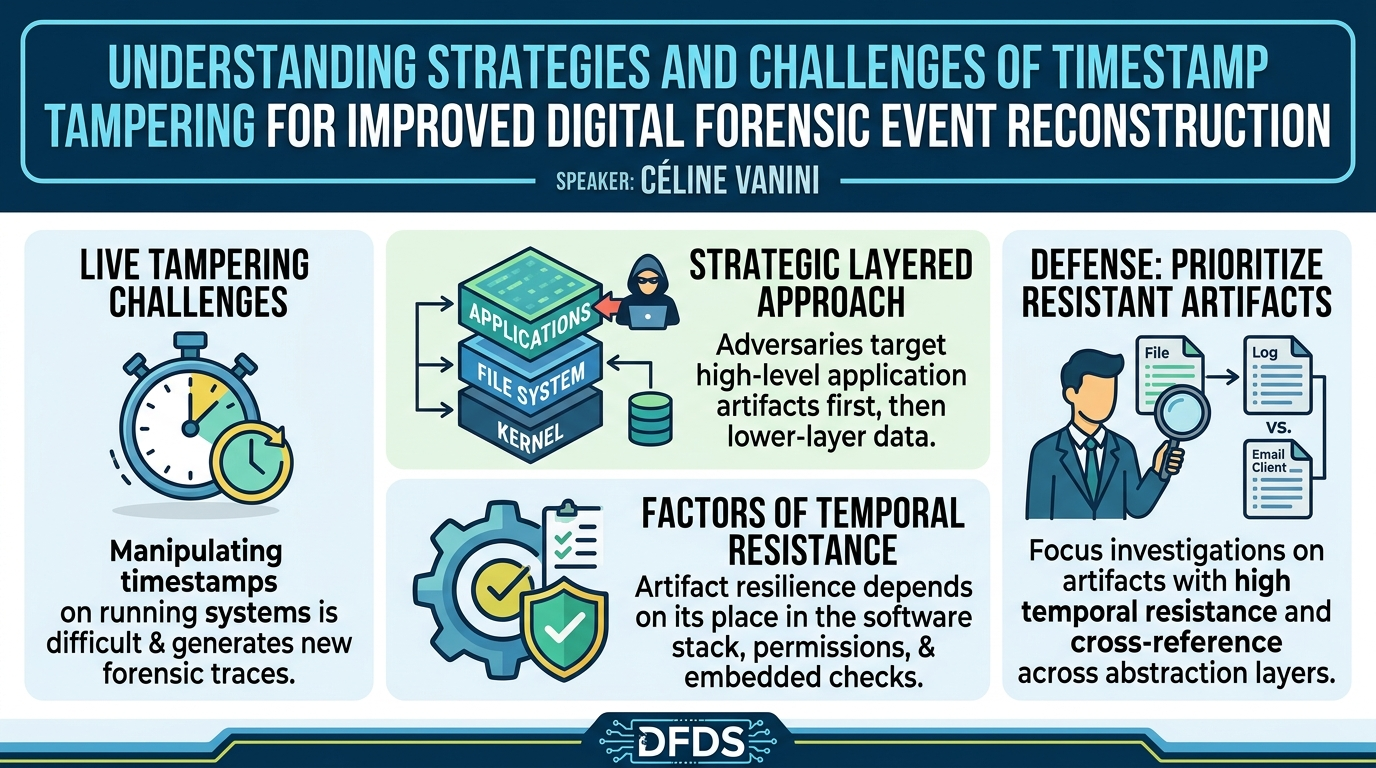
- Live Timestamp Tampering is Challenging: Manipulating timestamps on a running system is inherently difficult for adversaries, as the act itself generates additional forensic traces.
- Strategic Layered Approach: Adversaries typically employ a "rational tempering budget," first targeting application-level artifacts perceived as easier to modify, before attempting to alter lower-layer file system data.
- Factors of Temporal Resistance: Artifacts possess inherent features (e.g., placement in software stack, required permissions, embedded verification mechanisms) that dictate their resilience to tampering.
- Technical Hurdles Expose Manipulation: Specific technical difficulties, such as maintaining logical consistency within databases (e.g., entry IDs), often lead to detectable inconsistencies.
- Defenders Should Prioritize Resistant Artifacts: Forensic investigations should focus on artifacts with high temporal resistance and cross-reference timestamps across different abstraction layers to detect discrepancies.
- Corroboration is Key: The risk of external data copies (e.g., on servers) means forensic analysis must extend beyond local systems to effectively detect and interpret timestamp manipulation.
About the Speaker(s)
Céline Vanini is a doctoral researcher at the University of Lausanne, currently in her third year of a five-year PhD program. Her research focuses on understanding the factors and conditions that can lead to incorrect timing information in digital evidence, such as system clock errors and intentional timestamp tampering. Her work aims to provide practical solutions to mitigate the risks of misinterpretations in digital forensic event reconstruction. This specific presentation was conducted in collaboration with Young Rubber Deninsen and Feling from FAU, Chris from the University of Oxford, and Binger from the University of Osborg, highlighting a collaborative approach to addressing complex challenges in digital forensics.
Reviews
Dr. Zero (Offensive Security Researcher) — SOLID
Solid methodology, interesting problem framing, but the findings are largely intuitive rather than surprising. A user study with 10 grad students showing that attackers go for low-hanging fruit first and struggle with database consistency isn't going to reshape how anyone does forensics.
Heather Calloway (CISO) — SOLID
Useful practitioner research on how adversaries approach timestamp tampering in live systems. The 'factors of temporal resistance' framework gives forensic teams a principled way to prioritize artifact examination, though the small study size limits how far you can generalize.