Fireside Chat: From Cybersecurity Practitioner to Cybersecurity Voice
Caitlin Sarian (CEO & Cybersecurity Educator), Sofia C.V. (Host, Ask Me Anything Cyber)
Ekoparty Miami 2026 · Main Track
Overview
In an engaging fireside chat at Ekoparty Miami, cybersecurity educator and CEO Caitlin Sarian, known through her popular "Cyber Security Girl" platform, delved into her journey from a traditional cybersecurity practitioner to a prominent voice in public cybersecurity education. Hosted by Sofia C.V. of Ask Me Anything Cyber, the conversation illuminated the critical need for accessible, jargon-free cybersecurity information for the general public. Sarian's talk underscored a fundamental shift in cybersecurity strategy: recognizing the individual as the human firewall – the first and most crucial line of defense against ever-evolving digital threats.
Key moments
- 0:00 Journey into cyber and channel origin
- 2:19 Three pillars of Cyber Security Girl
- 3:55 Viral 'Have I been pwned?' video experience
- 7:55 Explaining cyber to executives vs. TikTokers
- 13:00 Formula for engaging cybersecurity content
- 17:30 Dream collaboration: Dancing with the Stars
- 20:50 AI's role: enhancing, not replacing human thought
- 22:50 Advice to future cyber professionals
Fireside Chat: From Cybersecurity Practitioner to Cybersecurity Voice
Speakers: Caitlin Sarian (CEO & Cybersecurity Educator); Sofia C.V. (Host, Ask Me Anything Cyber)
Conference: Ekoparty Miami
YouTube: https://www.youtube.com/watch?v=ougPAl0HDkM
Overview
In an engaging fireside chat at Ekoparty Miami, cybersecurity educator and CEO Caitlin Sarian, known through her popular "Cyber Security Girl" platform, delved into her journey from a traditional cybersecurity practitioner to a prominent voice in public cybersecurity education. Hosted by Sofia C.V. of Ask Me Anything Cyber, the conversation illuminated the critical need for accessible, jargon-free cybersecurity information for the general public. Sarian's talk underscored a fundamental shift in cybersecurity strategy: recognizing the individual as the human firewall – the first and most crucial line of defense against ever-evolving digital threats.
Sarian’s unique approach emphasizes demystifying complex technical concepts, making online safety relatable, and actively encouraging diversity within the cybersecurity field, particularly for women and those from non-traditional backgrounds. Her work addresses a significant gap identified by a NIST report from nearly five years prior, which projected 600,000 open cybersecurity jobs by 2025, highlighting a severe talent shortage. This talk serves as a powerful testament to the impact of proactive public education and the strategic importance of empowering individuals with practical knowledge to navigate the digital world safely.
This article explores the motivations behind Sarian's mission, her innovative content creation strategies, her perspectives on emerging technologies like AI, and the profound defensive implications of fostering a more cyber-aware populace. It highlights how her work transcends traditional cybersecurity roles, creating a cultural movement that prioritizes actionable advice over fear-mongering, and curiosity over rigid specialization.
Background
▶ Watch: Journey into cyber and channel origin (0:00)
Caitlin Sarian's entry into cybersecurity was unconventional, beginning not with a passion for hacking or coding, but with a background in aerospace engineering. She recounts being offered a cybersecurity role over a decade ago with limited prior knowledge, learning "everything on the job." This personal experience informed her understanding of the industry's accessibility challenges, especially for those without a traditional computer science or hacking background. Her career evolved from cyber consulting, assessing companies on various domains like network architecture and data protection, to specializing in data protection and privacy, notably working in the UK during the implementation of GDPR.
The impetus for creating her "Cyber Security Girl" channel stemmed from several observations. Firstly, a pervasive public misconception that cybersecurity professionals are solely "hackers in hoodies," often leading to requests like "Can you hack my phone?" Secondly, a stark realization that "no one knows their rights" or "how to protect themselves" online. This was exacerbated by the COVID-19 pandemic, which further highlighted the digital literacy gap. Thirdly, Sarian was deeply motivated to address the cybersecurity talent deficit, referencing a NIST report that projected a staggering 600,000 open cyber jobs by 2025. This report, now seen as a missed opportunity for proactive recruitment, solidified her resolve to broaden the appeal and understanding of cybersecurity careers. Her channel was thus founded on three core pillars: to get more women in cyber and STEM, to educate people on what a cyber career looks like, and to educate the public on how to be safe online, conceptualizing the individual as the human firewall.
Key Findings
▶ Watch: Viral 'Have I been pwned?' video experience (3:55)
Caitlin Sarian's journey and her "Cyber Security Girl" platform reveal several critical findings about effective cybersecurity education and communication:
- The "Human Firewall" is Paramount: Sarian's central thesis is that individuals are the first line of defense. By empowering them with practical, easy-to-understand advice, the overall security posture of society improves significantly. This shifts the focus from purely technological solutions to a more holistic, human-centric approach to cybersecurity.
- Jargon-Free Communication is Essential: The cybersecurity industry's propensity for complex terminology ("squishing," "wishing," "phishing") alienates the general public. Sarian's success demonstrates that simplifying language, relating concepts to everyday experiences (e.g., WhatsApp messages, social media accounts), and replacing intimidating terms with straightforward language (e.g., "scams" instead of specific phishing types) is crucial for engagement and comprehension.
- Actionable Advice Drives Engagement: People are more likely to listen and implement advice when it provides clear, immediate steps they can take. Sarian explicitly states she only shares information when there are "actual measures to protect themselves." This principle prevents fear-mongering and fosters a sense of empowerment rather than helplessness.
- Consistency and Repetition Reinforce Learning: While the news cycle constantly generates new threats, the fundamental defensive actions remain largely the same. Sarian acknowledges that she often repeats core advice – strong passwords, multi-factor authentication (MFA), auto-updates, data deletion, and credit freezes. This repetition is not redundant but essential for building lasting cyber hygiene habits.
- Authenticity and Relatability Build Trust: Sarian's commitment to only partnering with brands she genuinely uses (e.g., Verizon, McCauley) and her willingness to share personal approaches (like her cautious use of public Wi-Fi) build credibility. Her content is designed to make cybersecurity approachable, starting with questions like "How does it relate to everyone?" rather than technical deep dives.
- The Digital Divide in Cybersecurity Understanding: Explaining cybersecurity concepts is equally challenging for executives and TikTok users, albeit for different reasons. Executives require narratives tied to business risk, while the general public needs relatable personal impact. This highlights the need for tailored communication strategies across different audiences.
- Influencer Responsibility in the Digital Age: Sarian takes her role as an educator seriously, emphasizing triple-verification of information and refusing to disseminate unconfirmed or non-actionable news. This stance advocates for a higher standard of responsibility for all digital influencers, especially in critical fields like cybersecurity.
Technical Deep Dive
▶ Watch: Formula for engaging cybersecurity content (13:00)
While Caitlin Sarian's talk is not a deep dive into exploit techniques or network architectures, it offers a profound "technical deep dive" into the methodology of effective cybersecurity communication – a critical, often overlooked, aspect of overall security posture. Her approach is meticulously structured to translate complex technical realities into digestible, actionable insights for a broad audience.
Sarian's content strategy revolves around three core pillars, each requiring a different communication angle:
- Encouraging Women in Cyber and STEM: This involves demystifying the industry, showcasing diverse roles beyond coding, and emphasizing that curiosity is a key prerequisite for success, regardless of background. By presenting cybersecurity as a multi-faceted field that needs "every single type of person," she tackles the perception of a niche, inaccessible career path.
- Demystifying Cyber Careers: For aspiring professionals, she illustrates the breadth of roles within cybersecurity, from consulting and data protection to policy and education. Her own journey, learning on the job without a coding background, serves as a powerful example that the field is accessible through continuous learning and adaptation. She likens the professional's journey to a "crawl, walk, run" progression, where foundational knowledge is often forgotten by experts, yet it's precisely these basics that the public needs.
- Educating the Public on Online Safety (The Human Firewall): This is where Sarian's communication methodology shines brightest. Instead of using intimidating terms like phishing, smishing, or vishing, she rebrands them simply as "scams." When discussing encryption, she doesn't delve into cryptographic algorithms but explains it in terms of "Your messages that you're messaging someone on WhatsApp, it is protected because of XYZ." This makes the abstract concept of encryption tangible and relevant to daily digital interactions.
Her content creation process is a "technical" workflow in itself, designed for accuracy and impact:
- Information Vetting: Sarian adheres to a strict verification protocol before publishing any content. She follows authoritative sources like CISA (Cybersecurity and Infrastructure Security Agency) and requires news to be reported "three times" or confirmed by "other cyber professionals" before she addresses it. This ensures the information she shares is reliable and reduces the spread of misinformation.
- AI-Assisted News Curation: To manage the overwhelming volume of cybersecurity news, Sarian employs an AI helper. This AI sifts through "leading computer, cyber news, CISA, attack news outlets," and only flags news as "green to go" after "double or triple verifies a news source." This intelligent automation allows her to stay current while maintaining high standards of accuracy, effectively using AI to enhance her research capabilities.
- Actionability Filter: A crucial "technical" filter in her process is demanding actionability. She explicitly states, "unless someone can take actual measures to protect themselves from this, I'm not going to just come on here like, 'There's a fire.' And then like walk away." This prevents panic and ensures her audience receives practical advice they can immediately implement.
- Core Security Tenets: Her "30 seconds of advice" encapsulates the fundamental technical controls she advocates for individuals:
- Strong, Secure Passwords: A foundational element of identity and access management.
- Multi-Factor Authentication (MFA): Adding layers of security beyond just a password, significantly reducing account compromise risk.
- Turn on Auto Updates: Ensuring operating systems, applications, and devices receive crucial security patches against known vulnerabilities.
- Delete Data: Practicing data minimization, reducing the attack surface and potential impact of a breach.
- Freeze Your Credit: A critical step for identity theft protection, preventing new accounts from being opened in one's name.
Sarian's "technical deep dive" is therefore not into the mechanics of exploits, but into the psychology and pedagogy of cybersecurity, demonstrating how to effectively bridge the gap between complex technical knowledge and public understanding to build a stronger "human firewall." Her approach acknowledges that the most sophisticated technical defenses can be undermined by human error or ignorance, making effective communication a critical security control.
Demo / Proof of Concept
▶ Watch: Dream collaboration: Dancing with the Stars (17:30)
This fireside chat, being an interview format, did not feature a live technical demonstration or a traditional proof of concept of a vulnerability or tool. However, the entire discussion serves as an implicit proof of concept for Caitlin Sarian's successful methodology in cybersecurity education and public engagement.
Her "Cyber Security Girl" channel, with its viral video on "Have I Been Pwned?" and its consistent reach to millions, demonstrates the viability and profound impact of delivering cybersecurity content in an accessible, relatable, and jargon-free manner. The effectiveness of her approach is evident in her ability to simplify complex topics like encryption and phishing into understandable "scams" and practical advice, thereby empowering a broad audience to become their own "human firewalls." The talk itself, through Sarian's articulate explanations and clear communication, exemplifies the very principles she advocates for in her educational content.
Defensive Implications
▶ Watch: Advice to future cyber professionals (22:50)
The defensive implications of Caitlin Sarian's work are profound and primarily revolve around strengthening the human element in cybersecurity. While traditional defensive strategies focus on technological solutions like firewalls, intrusion detection systems, and endpoint protection, Sarian champions the individual as the ultimate line of defense. Her approach provides actionable insights for defenders, particularly in the realm of security awareness and training.
- Empowering the "Human Firewall": The most significant implication is the recognition and cultivation of the human firewall. By educating the public on basic cyber hygiene – strong passwords, multi-factor authentication (MFA), auto-updates, data deletion, and credit freezes – Sarian directly addresses the most common vectors of attack: social engineering and weak credentials. A cyber-aware populace is less susceptible to phishing attempts, account takeovers, and identity theft, thereby reducing the overall attack surface for both individuals and organizations.
- Shifting from Fear to Empowerment: Traditional security awareness often relies on fear tactics, which can lead to apathy or overwhelm. Sarian's strategy of providing actionable advice transforms fear into empowerment. Defenders should adopt this model, ensuring that security warnings are accompanied by clear, simple steps individuals can take, fostering a proactive rather than reactive security mindset.
- Bridging the Communication Gap: Sarian's success in translating complex cyber jargon into everyday language offers a blueprint for security teams communicating with non-technical staff or executive leadership. By avoiding terms like "squishing" or "vishing" in favor of "scams," and by relating security measures to personal impact (e.g., protecting WhatsApp messages), defenders can achieve greater buy-in and compliance with security policies.
- Continuous Education and Adaptation: The digital threat landscape is constantly evolving. Sarian's commitment to triple-verifying information and using an AI helper to curate up-to-date news highlights the need for continuous, accurate, and timely security education. Organizations should similarly invest in dynamic security awareness programs that reflect current threats and provide relevant, verified guidance.
- Promoting Proactive Habits: Sarian emphasizes the repetitive nature of core security advice because the solutions to many new threats remain foundational. Defenders should reinforce these basic, yet critical, cyber hygiene habits through consistent messaging, making them second nature for users. This includes regular reminders about password strength, the importance of MFA, and the benefits of keeping software updated.
- Addressing the Talent Gap through Diversity: By encouraging more women and individuals from non-traditional backgrounds into cybersecurity, Sarian implicitly strengthens the defensive posture of the entire industry. A diverse workforce brings varied perspectives, innovative problem-solving, and a broader understanding of user needs, leading to more robust and inclusive security solutions.
- Ethical Responsibility in Communication: Sarian's strict adherence to veracity and actionability in her content creation sets a high bar for all communicators in the security space. Defenders, especially those in public-facing roles, must uphold similar ethical standards, ensuring that information shared is accurate, verified, and provides genuine value without unnecessarily alarming the public.
In essence, Sarian's work demonstrates that effective cybersecurity defense extends beyond the network perimeter to the individual user. By nurturing a globally cyber-aware populace, the collective resilience against digital threats can be significantly enhanced, making public education a critical, often underestimated, defensive strategy.
Key Takeaways
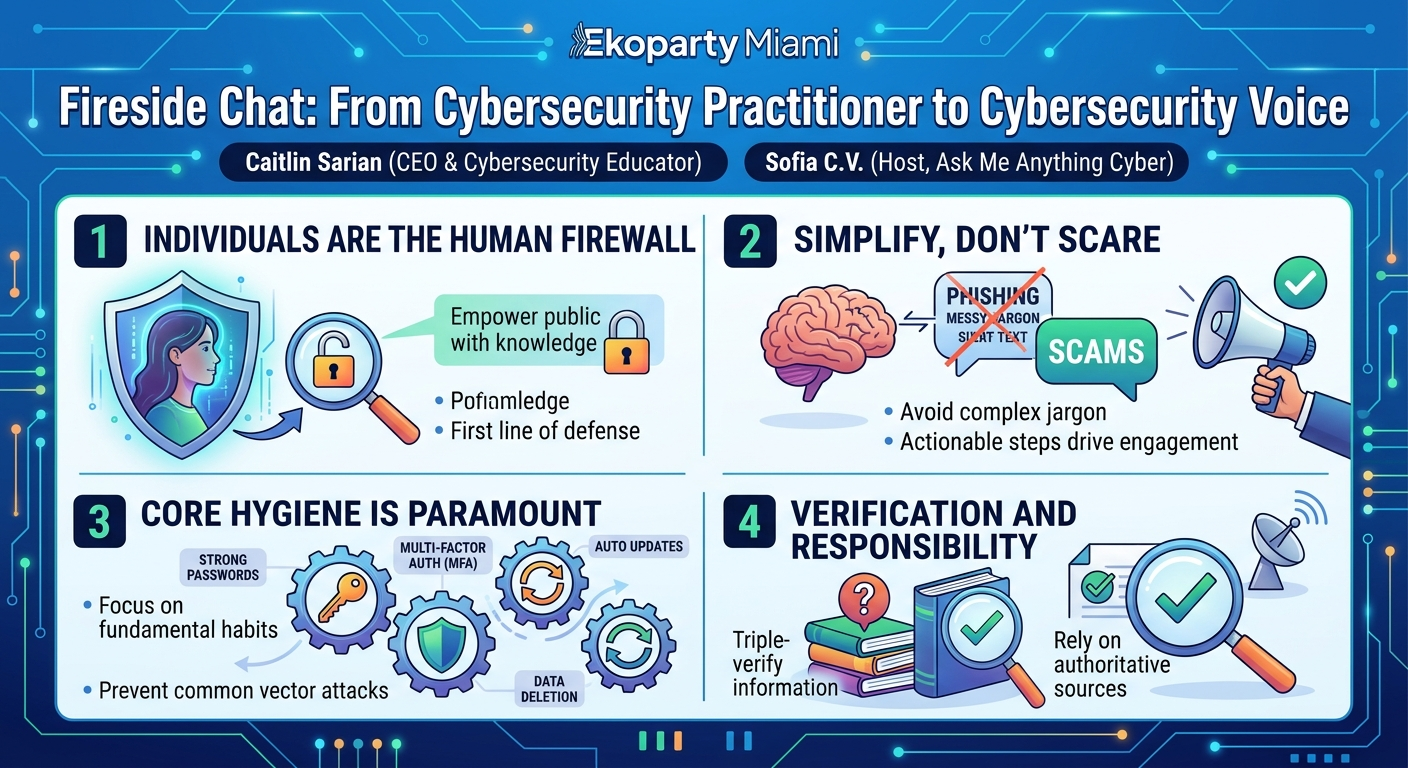
- Individuals are the "Human Firewall": Empowering the general public with accessible cybersecurity knowledge is the most crucial, and often overlooked, defensive strategy against digital threats.
- Simplify, Don't Scare: Effective cybersecurity communication avoids jargon, relates threats to personal experiences, and focuses on actionable steps rather than fear-mongering. "Scams" is more impactful than "phishing."
- Core Hygiene is Paramount: Fundamental practices like strong, unique passwords, multi-factor authentication (MFA), enabling auto-updates, practicing data minimization, and freezing credit are the most effective defenses against a wide range of cyber threats.
- Verification and Responsibility are Key: Cybersecurity educators and influencers bear a significant responsibility to triple-verify information, rely on authoritative sources like CISA, and only share advice that is actionable and truly beneficial to the audience.
- Embrace Curiosity and Diverse Paths: The cybersecurity field needs diverse talent from all backgrounds. Professionals should stay curious, avoid self-imposed boxes, and bring their full personalities to their roles, fostering innovation and broader appeal.
- AI as an Enhancement, Not a Replacement: While tools like AI helpers can assist in monotonous tasks like news curation and verification, human oversight and critical thinking must always remain in the loop to ensure ethical use and prevent the spread of misinformation.
About the Speaker(s)
Caitlin Sarian is a prominent cybersecurity educator and CEO, widely recognized for her "Cyber Security Girl" platform. With an academic background in aerospace engineering, Sarian transitioned into cybersecurity over a decade ago, learning extensively on the job. Her career journey has spanned cyber consulting, assessing companies on various security domains, and specializing in data protection and privacy, including working on GDPR implementation in the UK. Driven by a passion to demystify cybersecurity, increase diversity in STEM, and educate the public on online safety, she founded "Cyber Security Girl." Her platform, which started on TikTok and achieved viral success, focuses on translating complex technical concepts into accessible, actionable advice, effectively positioning the individual as the "human firewall." Sarian is known for her rigorous content verification process, her commitment to authentic partnerships, and her advocacy for a more inclusive and understandable cybersecurity landscape.
Sofia C.V. served as the host for this fireside chat, representing "Ask Me Anything Cyber." As an interviewer, she skillfully guided the conversation, prompting Caitlin Sarian to elaborate on her journey, motivations, and the practicalities of her educational mission. Her questions helped to explore the nuances of communicating complex cybersecurity topics to different audiences and the ethical responsibilities of digital influencers.
Reviews
Dr. Zero (Offensive Security Researcher) — WEAK
A fluffy career-journey interview that never graduates past 'use MFA and strong passwords.' Zero technical content, zero novel insight, zero reason this needed a conference slot instead of a podcast upload.
Heather Calloway (CISO) — WEAK
A career-journey interview dressed up as cybersecurity strategy. The 'human firewall' framing is fine for consumer awareness campaigns, but there's nothing here that changes how I'd run a security program, brief my board, or allocate budget. This is influencer origin story, not security leadership content.