IC5 – Integrated CERT Cyber Communications, Collaboration & Coordination Framework
Rakesh Kumar Singh (CERT-In), Yudhishthira Sapru (CERT-In)
FIRST Cyber Threat Intelligence Conference 2026 (#FIRSTCTI26)
Overview
National Computer Emergency Response Teams (CERTs) play a pivotal role in national cybersecurity, issuing a constant stream of advisories, alerts, and threat intelligence reports to a diverse audience ranging from government agencies and critical infrastructure operators to the general public. However, as highlighted by Yudhishthira Sapru and Rakesh Kumar Singh from CERT-In, the effectiveness of these communications is often hampered by a fundamental challenge: ensuring the right message reaches the right audience in an actionable format, and verifying its implementation. Their talk introduces IC5, an Integrated CERT Cyber Communications, Collaboration & Coordination Framework, a five-layered model designed to transform raw cyber event information into highly effective, targeted, and measurable communications.
Key moments
- 0:00 Introduction: The problem of ineffective cyber communication
- 4:00 Identifying common gaps in national CERT communications
- 6:00 Introducing the five-layered IC5 communication framework
- 8:30 Prism layer: tailoring messages for different audiences
- 13:30 Embedding efficacy cues and step-by-step instructions
- 16:00 Establishing feedback loops and performance indicators (Mirror layer)
- 18:50 Case study: CERT-In advisory improved by IC5 framework
- 24:40 Q&A: Framework's impact and future implementation plans
IC5 – Integrated CERT Cyber Communications, Collaboration & Coordination Framework
Speakers: Rakesh Kumar Singh (CERT-In); Yudhishthira Sapru (CERT-In)
Conference: FIRST CTI Conference
YouTube: https://www.youtube.com/watch?v=_CnKokom1ns
Overview
National Computer Emergency Response Teams (CERTs) play a pivotal role in national cybersecurity, issuing a constant stream of advisories, alerts, and threat intelligence reports to a diverse audience ranging from government agencies and critical infrastructure operators to the general public. However, as highlighted by Yudhishthira Sapru and Rakesh Kumar Singh from CERT-In, the effectiveness of these communications is often hampered by a fundamental challenge: ensuring the right message reaches the right audience in an actionable format, and verifying its implementation. Their talk introduces IC5, an Integrated CERT Cyber Communications, Collaboration & Coordination Framework, a five-layered model designed to transform raw cyber event information into highly effective, targeted, and measurable communications.
The IC5 framework addresses common shortcomings in existing CERT communication strategies, such as generic, one-size-fits-all advisories, a lack of audience segmentation, and the absence of robust feedback mechanisms. By integrating established management and communication theories, IC5 proposes a structured approach to classify cyber events, tailor message tone, frame information for specific stakeholders (e.g., C-suite, SOC teams, IT administrators), optimize dissemination channels, and establish quantifiable performance indicators. The ultimate goal is to enhance the adoption rate of CERT advisories, drive compliance, and ultimately bolster national cyber resilience.
The presentation not only details the theoretical underpinnings and practical layers of IC5 but also demonstrates its application through a generative AI model. This model was used to process existing CERT advisories, transforming them into multi-layered communications compliant with the IC5 framework. This proof of concept illustrates how the framework can significantly improve the clarity, actionability, and overall impact of critical cybersecurity intelligence, marking a significant step towards more effective national-level cyber communication.
Background
▶ Watch: Introduction: The problem of ineffective cyber communication (0:00)
The genesis of the IC5 framework stems from a critical observation: despite the volume and importance of communications issued by national CERTs, their impact often falls short. Yudhishthira Sapru opened the discussion with an anecdote illustrating a common communication failure – a notice posted but never seen by its intended audience. This analogy perfectly encapsulates the challenges faced by CERTs globally. A comprehensive study conducted by CERT-In across various CERTs in North America, Latin America, APAC, and South Asia revealed several pervasive gaps in current communication practices.
These gaps include:
- Single-Layer Messaging: Communications are often generic, presenting the same technical message to everyone, regardless of their role (e.g., technical staff, IT administrators, or senior leadership). This leads to information overload for some and insufficient detail for others.
- Lack of Specific Channels: Advisories are frequently broadcast via general distribution lists or web portals, failing to leverage channels tailored to specific audience needs or preferences (e.g., executive briefings for CISOs versus STIX feeds for SOC teams).
- Poor CTI Operationalization: Threat intelligence feeds (like STIX) are often disconnected from broader communication advisories, making it difficult for organizations to integrate and act upon them effectively. Some organizations also lack the maturity to digest raw STIX feeds.
- Absence of Adoption Mechanisms: CERTs typically publish advisories without driving compliance or ensuring their implementation. There's no clear mechanism to measure whether the recommended actions are taken.
- Lack of Feedback Loops: A critical missing element is the feedback mechanism. CERTs rarely know if their communications have been acted upon, or if the recommended mitigations have been successfully implemented by the target organizations. This prevents continuous improvement of communication strategies.
- Framing Clarity Issues: The way messages are framed often lacks strategic intent, failing to motivate specific actions or convey the business impact of inaction to leadership.
To address these systemic issues, CERT-In embarked on developing a structured framework. They drew inspiration from a diverse range of established management and communication theories, including the Situation Crisis Communication Theory, Diffusion of Innovation, Framing Theory, Information Classification Theory, Situational Awareness Theory, and Stakeholder Theory. By synthesizing insights from these theoretical models, the IC5 framework was designed to provide a robust, multi-layered approach to cyber communication, ensuring messages are not just delivered, but are understood, acted upon, and their impact measured.
Key Findings
▶ Watch: Introducing the five-layered IC5 communication framework (6:00)
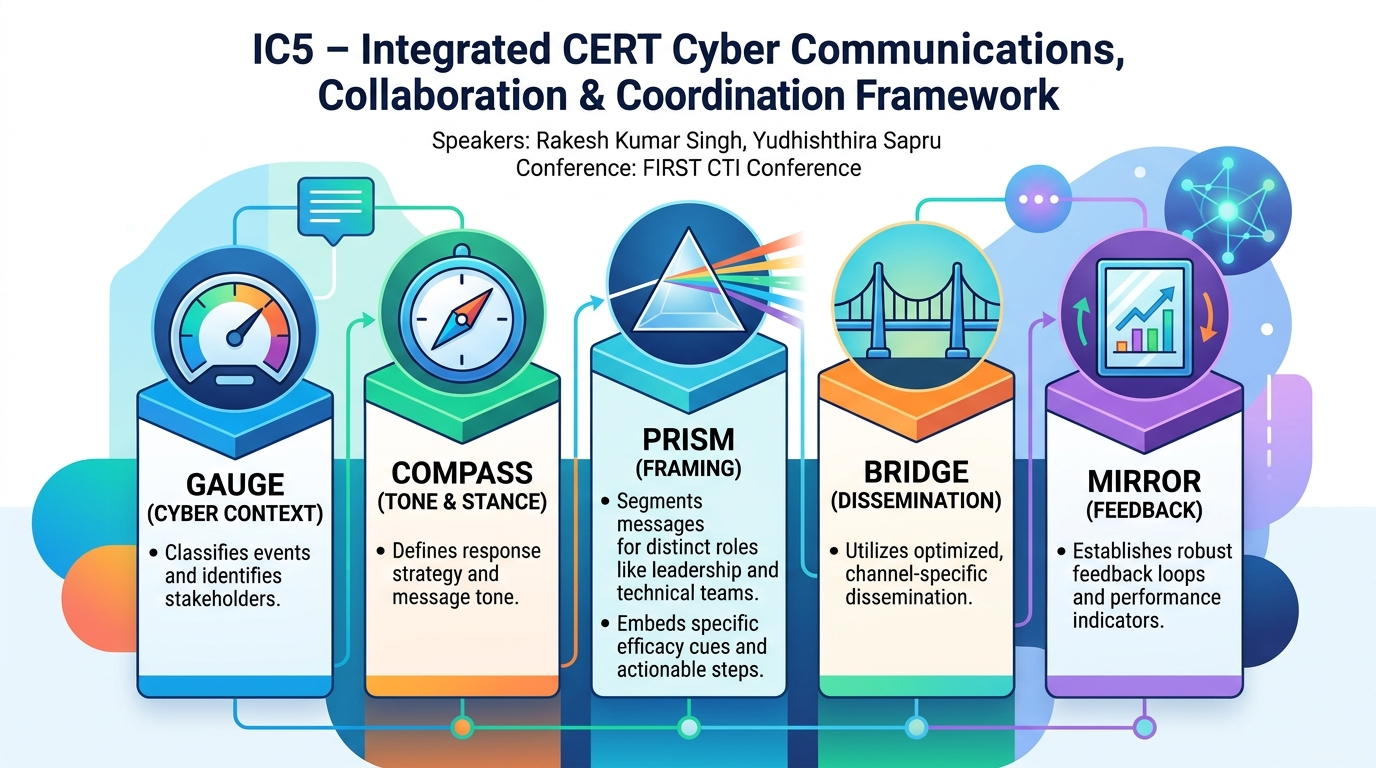
The central finding and contribution of this talk is the IC5 framework itself, a five-layered model for enhancing the effectiveness of national CERT communications. This framework is designed to systematically process raw cyber event information and transform it into targeted, actionable, and measurable advisories. The core idea is that each of the five layers adds specific value to the communication, refining it for different audiences and ensuring its intended impact.
The five layers of the IC5 framework are conceptualized using common jargons to make them intuitive:
- Gauge (Cyber Context): This initial layer acts like a gauge, helping the CERT to classify the event, understand the type of information involved, and identify the relevant stakeholders. It answers fundamental questions about "what kind of event," "what type of information," and "what type of audience."
- Compass (Advisory Tone & Stance): Once the context is established, the compass layer guides the direction and tone of the message. It helps define the appropriate response strategy (e.g., reactive, preventative) and determines the tone (e.g., instructional, urgent, remedial) based on the incident type and stakeholder situation.
- Prism (Framing & Motivational Design): Like a prism refracting light, this layer breaks down the single message into multiple frames tailored for different audiences. It focuses on how the message is constructed and presented, embedding specific threat emphasis and efficacy cues to motivate action from leadership, SOC teams, and IT administrators.
- Bridge (Dissemination & Adoption): The bridge layer connects the CERT to the end organizations, ensuring the refined message reaches its intended recipients through optimal channels. It proposes a hierarchical dissemination model and emphasizes localization and appropriate channels to maximize adoption.
- Mirror (Feedback & Performance): The final layer acts as a mirror, reflecting the reality of whether the communication has been effective. It establishes feedback loops and defines key performance indicators (KPIs) to measure the impact and adoption of advisories, enabling continuous improvement of the communication process.
The IC5 framework represents a significant shift from generic, broadcast-style communications to a strategic, audience-centric approach. By systematically applying these layers, CERTs can move beyond simply publishing information to actively driving compliance, accountability, and a measurable reduction in cyber risk across their respective nations.
Technical Deep Dive
▶ Watch: Embedding efficacy cues and step-by-step instructions (13:30)
The IC5 framework is a structured, five-stage process that leverages communication and management theories to optimize the delivery and impact of national CERT advisories. Each layer builds upon the previous one, adding granularity and strategic intent to the communication.
Layer 1: Gauge (Cyber Context)
The first layer, Gauge, is dedicated to establishing the fundamental context of a cyber event. It classifies the raw incident information along three critical dimensions:
- Event Type: This categorizes the nature of the cyber incident, which could be a ransomware incident, a zero-day vulnerability disclosure, a threat campaign, or other specific types. Multiple event types can be associated with a single incident.
- Information Category: This defines the output format and purpose of the communication. Examples include a vulnerability note, a CTI report, an incident notification, or an awareness campaign.
- Stakeholder Context: This identifies all relevant audiences who need to receive the communication. This could include international partners, ISACs (Information Sharing and Analysis Centers), sectoral CERTs, enterprise SOCs, CISOs, CTOs, CIOs, and the general public.
By systematically categorizing these dimensions, the Gauge layer ensures a foundational understanding of "what kind of event," "what type of information is needed," and "who needs to know."
Layer 2: Compass (Advisory Tone & Stance)
With the context set by the Gauge layer, the Compass layer dictates the strategic direction and emotional tone of the communication. It defines the CERT's response strategy and sets the overall tone of the advisory, which is crucial for motivating the desired action.
- Response Strategy: This can be reactive (e.g., for victim organizations of a ransomware attack, requiring immediate action) or preventative (e.g., for organizations vulnerable to a newly discovered threat).
- Tone: The tone is tailored to the response strategy and stakeholder context. For a victim organization, the tone might be instructional and urgent. For an organization that could have prevented an incident due to negligence, the tone might emphasize a remedial strategy and full accountability. The framework allows for multiple clusters of response strategies and tones, ensuring the message resonates appropriately with the recipient's situation.
Layer 3: Prism (Framing & Motivational Design)
The Prism layer is where the single message is refracted into multiple, audience-specific frames, akin to how a prism disperses white light. This addresses the common problem of generic advisories by tailoring content for distinct stakeholder groups.
- Different Frames and Sections: The advisory is segmented into frames for different audiences, such as leadership (C-suite), SOC teams, and IT administrators.
- Threat Emphasis: The emphasis of the threat is customized:
- For leadership, the focus shifts from technical details to cost value and business impact of inaction, aiming to "raise their eyebrows."
- For SOC teams and threat hunters, the emphasis is highly technical, including details like "actively exploited in the wild," "no user interaction required," and calls to "hunt now."
- Efficacy Cues: To maximize motivation and action, the Prism layer embeds efficacy cues directly into the message. These include step-by-step patch instructions, verification steps, embedded scripts for immediate execution, rollback procedures, and checklists. This practical guidance directly facilitates implementation and reduces friction for the end-user.
Layer 4: Bridge (Dissemination & Adoption)
The Bridge layer focuses on the effective delivery of the tailored message, connecting the CERT to the end organizations and removing bottlenecks to adoption. It moves beyond simple broadcasting to strategic dissemination.
- Hierarchical Model: The framework proposes a hub-and-spoke model for dissemination. Communications flow from the national CERT to sectoral CERTs or ISACs, and then to respective organizations (e.g., a power ISAC to power organizations). This ensures the message reaches the correct community and leverages a network multiplier effect.
- Specific Channels: Dissemination is channel-specific:
- STIX/TAXII feeds for SOC teams.
- Executive briefings for the C-suite.
- Traditional email channels for broader reach.
- Advisory portals and webinars for specific engagements.
- Adoption Level Increase: To further boost adoption, the framework suggests localization. This includes translating communications into regional languages (e.g., German for German organizations, various Indian regional languages within India), making the advice more accessible and relevant.
Layer 5: Mirror (Feedback & Performance)
The final Mirror layer is crucial for closing the loop, measuring the effectiveness of the communication, and driving continuous improvement. It establishes robust feedback mechanisms and defines performance indicators.
- Feedback Loops: These can be:
- Passive: Portal analytics, number of STIX pull counts, email click-through rates.
- Active: Acknowledgement requests, patch uptake surveys, webinar Q&A analysis.
- Automated: IOC hit rates, DLP community signals, MISP sightings (identifying false positives or confirmed detections).
- Institutional: After-action reports, partner debriefs with affected organizations.
- Performance Indicators (KPIs): The framework defines specific KPIs to measure communication effectiveness:
- Advisory adoption rate.
- Percentage of systems patched/remediated (e.g., a target of 85% in 48 hours).
- Response speed or mean time to patch (MTTP).
- SOC manager satisfaction surveys.
- Organizations acknowledging receipt and submitting compliance.
- Overall reduction in attacks within a particular organization or sector, serving as an ultimate outcome measure.
By integrating these five layers, the IC5 framework provides a comprehensive and dynamic approach for national CERTs to enhance their cyber communications, moving from mere information dissemination to proactive cyber risk management.
Demo / Proof of Concept
▶ Watch: Establishing feedback loops and performance indicators (Mirror layer) (16:00)
To demonstrate the practical application and efficacy of the IC5 framework, CERT-In leveraged a generative AI model. This model was fed existing CERT advisories and instructed to reformat them according to the five layers and specified parameters of the IC5 framework. The results showcased a significant transformation from traditional, generic advisories to highly structured, audience-segmented, and actionable documents.
Two distinct case studies were presented:
Case Study 1: CERT-In Vulnerability Note
The first example was a vulnerability note originally published by CERT-In in March, concerning multiple vulnerabilities in Apple iOS, iPadOS, and macOS. The AI-generated output, adhering to IC5 principles, presented a dramatically improved advisory structure:
- Summary of the Incident: The advisory began with a concise summary, detailing the affected vendor (Apple), CVSS impact, and exploit vectors. This provides immediate, high-level context.
- Leadership Briefing (C-level executives and Senior Managers): A dedicated section targeted at leadership. This section focused on "what has happened," "why this requires your attention," and "what leadership must authorize within 72 hours." Crucially, it included clear timelines, such as actions required "within 24 hours" and "48 hours," emphasizing the business urgency rather than technical minutiae.
- Technical Section (SOC Teams, SOC Analysts, Security Engineers, Threat Hunters): This segment provided highly technical details essential for operational teams. It included comprehensive vulnerability details, Indicators of Compromise (IOCs) that could be fed into analytical solutions, and detection guidelines for monitoring adversaries. This ensures that the technical teams have the precise information needed for immediate defensive actions.
- Operational Playbook (IT Admin, System Admins): For IT and system administrators, the advisory offered a clear, prioritized operational playbook. It outlined "priority one" actions and subsequent steps to be taken within specific timelines (e.g., "within 24 hours," "next 24 hours").
- Verification Checklist: To ensure successful implementation, a detailed verification checklist was included. This provided clear checks for verifying actions taken (e.g., for specific iOS versions), along with expected results, empowering administrators to confirm remediation.
- Contact, Reporting, and Update Schedule: A section for establishing a closed-loop mechanism, detailing how organizations should report actions taken and providing an update schedule (ee.g., "what they update in 24 hours").
- Evaluation Matrix: Finally, the advisory included an evaluation matrix with predefined Key Performance Indicators (KPIs), measurements, and targets. This allows CERT-In to assess the effectiveness of its communication and the remediation efforts.
Case Study 2: Joint FBI CISA Advisory
The second demonstration applied the IC5 framework to a joint advisory issued by the FBI and CISA. The AI model produced a similarly structured advisory, reinforcing the framework's versatility across different types of threat intelligence:
- It started with a summary of the attack.
- Followed by a leadership briefing for CISOs, senior managers, and other leaders.
- A dedicated section for technical teams (SOC analysts, CTI teams, threat hunters) included a malware overview and mapping to the MITRE ATT&CK framework, providing valuable context for defensive operations.
- An operational playbook for IT and security administrators.
- A verification checklist.
These demonstrations clearly illustrated how the IC5 framework, when applied, transforms raw or conventionally structured advisories into multi-faceted, role-specific, and actionable intelligence. The generative AI model served as an effective tool to quickly prototype and visualize these enhanced communications, highlighting the potential for automation in implementing the framework. While the speakers noted that the framework is newly devised and real-world deployment is commencing, these proofs of concept provide compelling evidence of IC5's potential to significantly improve national CERT communication effectiveness.
Defensive Implications
▶ Watch: Q&A: Framework's impact and future implementation plans (24:40)
The IC5 framework, if widely adopted and fully implemented, holds significant defensive implications for organizations, national CERTs, and the broader cybersecurity ecosystem. It represents a paradigm shift from reactive, generic information dissemination to proactive, targeted, and measurable cyber risk management.
For organizations receiving advisories, the benefits are substantial:
- Enhanced Clarity and Actionability: Advisories will no longer be cryptic or overwhelming. Instead, they will be segmented, providing CISOs with clear business impact statements, SOC teams with precise technical details and IOCs, and IT administrators with step-by-step instructions and verification checklists. This reduces ambiguity and accelerates decision-making and action.
- Faster Remediation and Response: By embedding efficacy cues like scripts, rollback procedures, and prioritized action lists, IC5-compliant advisories directly facilitate quicker and more accurate remediation. The emphasis on timelines (e.g., 24, 48, 72 hours) instills a sense of urgency and helps organizations prioritize their defensive efforts.
- Improved Resource Allocation: With clear guidance tailored to specific roles, organizations can more effectively allocate their cybersecurity resources. SOC teams can immediately focus on threat hunting with provided IOCs, while IT teams can efficiently apply patches and verify their success.
- Increased Accountability and Compliance: The inclusion of feedback loops and performance indicators means organizations will be expected to acknowledge receipt, report on patch uptake, and demonstrate compliance. This fosters a culture of accountability and helps organizations track their defensive posture against national threats.
- Better Strategic Decision-Making: For leadership, the focus on business impact and cost value of inaction provides the necessary context to make informed strategic decisions regarding cybersecurity investments and policy changes.
For national CERTs, IC5 offers:
- Measurable Impact: The framework introduces robust feedback mechanisms and KPIs, allowing CERTs to quantify the effectiveness of their communications for the first time. This data can inform continuous improvement cycles, making future advisories even more impactful.
- Optimized Dissemination: By promoting a hierarchical, channel-specific dissemination model, CERTs can ensure their critical intelligence reaches the right hands through the most effective means, minimizing information loss and maximizing reach.
- Enhanced Credibility: By providing highly relevant, actionable, and well-structured advisories, CERTs can build greater trust and credibility with their stakeholders, solidifying their role as authoritative sources of cyber threat intelligence.
- Standardization and Automation Potential: The structured nature of IC5 lends itself well to automation, as demonstrated by the generative AI model. This can significantly reduce the manual effort involved in crafting complex advisories, allowing CERT analysts to focus on intelligence gathering and analysis.
Overall, the IC5 framework has the potential to elevate national cybersecurity defense by transforming communication from a mere information exchange into a powerful tool for driving collective action, improving national cyber resilience, and fostering a more secure digital environment.
Key Takeaways
- The IC5 framework is a five-layered, structured approach developed by CERT-In to significantly enhance the effectiveness and actionability of national CERT communications.
- It addresses critical shortcomings in traditional CERT advisories, such as generic messaging, lack of audience segmentation, and the absence of feedback mechanisms.
- The framework segments communication into distinct layers—Gauge, Compass, Prism, Bridge, and Mirror—each adding value by classifying events, setting tone, tailoring messages for specific roles (leadership, SOC, IT), optimizing dissemination, and measuring impact.
- IC5 emphasizes providing efficacy cues like step-by-step instructions, verification checklists, and embedded scripts to directly motivate and facilitate immediate defensive actions by recipient organizations.
- The framework incorporates robust feedback loops and Key Performance Indicators (KPIs) (e.g., advisory adoption rate, mean time to patch) to measure communication effectiveness, drive compliance, and enable continuous improvement.
- A generative AI model was successfully used to demonstrate the framework's application, transforming existing advisories into multi-layered, audience-specific, and actionable documents, highlighting the potential for automation in its implementation.
About the Speaker(s)
Yudhishthira Sapru (Yudi) is associated with CERT-In (Indian Computer Emergency Response Team). He introduced the core problem of ineffective cyber communications and detailed the theoretical underpinnings and the five-layered structure of the IC5 framework.
Rakesh Kumar Singh is also associated with CERT-In. He presented the practical application of the IC5 framework, showcasing how a generative AI model was used to transform existing advisories into IC5-compliant documents, demonstrating the framework's tangible benefits through specific case studies.
Reviews
Dr. Zero (Offensive Security Researcher) — SOLID
A well-intentioned operational framework for CERT communication that correctly diagnoses real problems — generic advisories, missing feedback loops, audience blindness — but the solution is mostly a taxonomy dressed up as innovation. The GenAI demo is a nice touch but doesn't prove the hard part: whether anyone actually patches faster.
Heather Calloway (CISO) — SOLID
A thoughtful framework for improving how national CERTs communicate with their stakeholders — the right problem to solve. The layered model is sensible, but it's still theory. No deployment data, no evidence it actually changes patch rates or adoption. Worth knowing if you interface with national CERTs or run a sectoral ISAC; otherwise, file under 'interesting but unproven.'
→ Top-rated talks at FIRST Cyber Threat Intelligence Conference 2026 (#FIRSTCTI26)
All talks from FIRST Cyber Threat Intelligence Conference 2026 (#FIRSTCTI26)