Cyber Deception 2.0: Adaptive Honeynets and Canary Intelligence in Production
Peter Morin (Leader, OT Cyber Security Practice · PwC)
Overview
In a landscape increasingly challenged by sophisticated cyber threats and persistent SOC overload, Peter Morin, Leader of PwC Canada's OT Cyber Security Practice, presented a compelling vision for the future of deception technology. His talk, "Cyber Deception 2.0: Adaptive Honeynets and Canary Intelligence in Production," introduced Adaptive Grid, an innovative, open-source project designed to overcome the limitations of traditional honeypots and provide high-fidelity, actionable intelligence to security teams. Born out of a practical need for enhanced detection in restrictive Operational Technology (OT) environments, Adaptive Grid redefines how organizations can leverage deception to detect, analyze, and respond to advanced attackers.
Key moments
- 0:00 Introduction and OT Cyber Security Challenges
- 6:05 Adaptive Deception Model: Dynamic Honeypot Responses
- 8:47 AI for Behavioral Detection and Attack Case Correlation
- 17:20 AI-Generated Threat Summaries for SOC Analysts
- 22:00 Forensic Data Value and Mass Deployment Strategies
- 24:20 Project Roadmap and Open-Source Contribution Invitation
- 29:00 Clarifying Enterprise Version and OT Persona Configurations
Cyber Deception 2.0: Adaptive Honeynets and Canary Intelligence in Production
Speakers: Peter Morin, Leader, OT Cyber Security Practice, PwC
Conference: FIRSTCON
YouTube: https://www.youtube.com/watch?v=IGzmAPAKKV4
Overview
In a landscape increasingly challenged by sophisticated cyber threats and persistent SOC overload, Peter Morin, Leader of PwC Canada's OT Cyber Security Practice, presented a compelling vision for the future of deception technology. His talk, "Cyber Deception 2.0: Adaptive Honeynets and Canary Intelligence in Production," introduced Adaptive Grid, an innovative, open-source project designed to overcome the limitations of traditional honeypots and provide high-fidelity, actionable intelligence to security teams. Born out of a practical need for enhanced detection in restrictive Operational Technology (OT) environments, Adaptive Grid redefines how organizations can leverage deception to detect, analyze, and respond to advanced attackers.
Morin's work addresses critical issues facing modern security operations: the deluge of false positives that contribute to alert fatigue, the static nature of older deception tools that are easily fingerprinted by adversaries, and the urgent demand for undeniable evidence of malicious activity. By integrating dynamic adaptation, advanced behavioral analysis, and artificial intelligence, Adaptive Grid aims to transform raw security events into correlated, high-confidence attack storylines, significantly reducing the burden on human analysts and accelerating incident response.
This article delves into the technical intricacies and strategic implications of Adaptive Grid, exploring its architecture, operational mechanics, and the profound defensive advantages it offers. From its origins in the challenging OT space to its broader applicability in enterprise IT networks, Morin’s project represents a significant leap forward in cyber deception, promising a more intelligent and responsive approach to threat detection.
Background
▶ Watch: Introduction and OT Cyber Security Challenges (0:00)
The genesis of Adaptive Grid stems from the inherent limitations faced by security professionals operating in OT environments. Unlike traditional IT networks where Endpoint Detection and Response (EDR) solutions and extensive logging are commonplace, OT systems often prohibit the deployment of such agents due to stability, performance, and certification concerns. This leaves a significant gap in detection capabilities, forcing security teams to seek alternative, non-intrusive methods for identifying malicious activity.
Morin's initial research into existing honeypot solutions revealed a common set of drawbacks. Many were described as "old," characterized by static deception that offered predictable services and responses. This predictability made them vulnerable to easy fingerprinting by automated scanners like Nmap or more advanced reconnaissance tools. Furthermore, the telemetry gathered by these traditional honeypots was often limited, providing insufficient context for a SOC analyst to fully understand the nature and intent of an attack. Such static systems could quickly be identified as decoys by attackers, rendering them ineffective.
Beyond the OT specific challenges, the broader cybersecurity landscape grapples with SOC overload. Security Information and Event Management (SIEM) systems often generate tens of thousands, or even hundreds of thousands, of alerts daily. This sheer volume leads to alert fatigue and a high probability of missing critical events. While Intrusion Detection Systems (IDS) provide network-wide visibility, they too are prone to generating numerous false positives based on signature or anomaly detection, further contributing to the noise.
Morin recognized that a truly effective deception system needed to be fundamentally different. It had to be undeniable, generating alerts that were 99-100% certain indicators of malicious activity. It needed to be adaptive, changing its behavior to thwart attacker fingerprinting. And crucially, it had to provide rich, correlated intelligence that reduced the analytical burden on SOC teams, allowing them to focus on genuine threats rather than sifting through irrelevant data. This vision laid the groundwork for Adaptive Grid, a project designed to deliver high-confidence detection and deep insights into attacker methodologies.
Key Findings
▶ Watch: AI for Behavioral Detection and Attack Case Correlation (8:47)
The development of Adaptive Grid represents several key findings and contributions to the field of cyber deception:
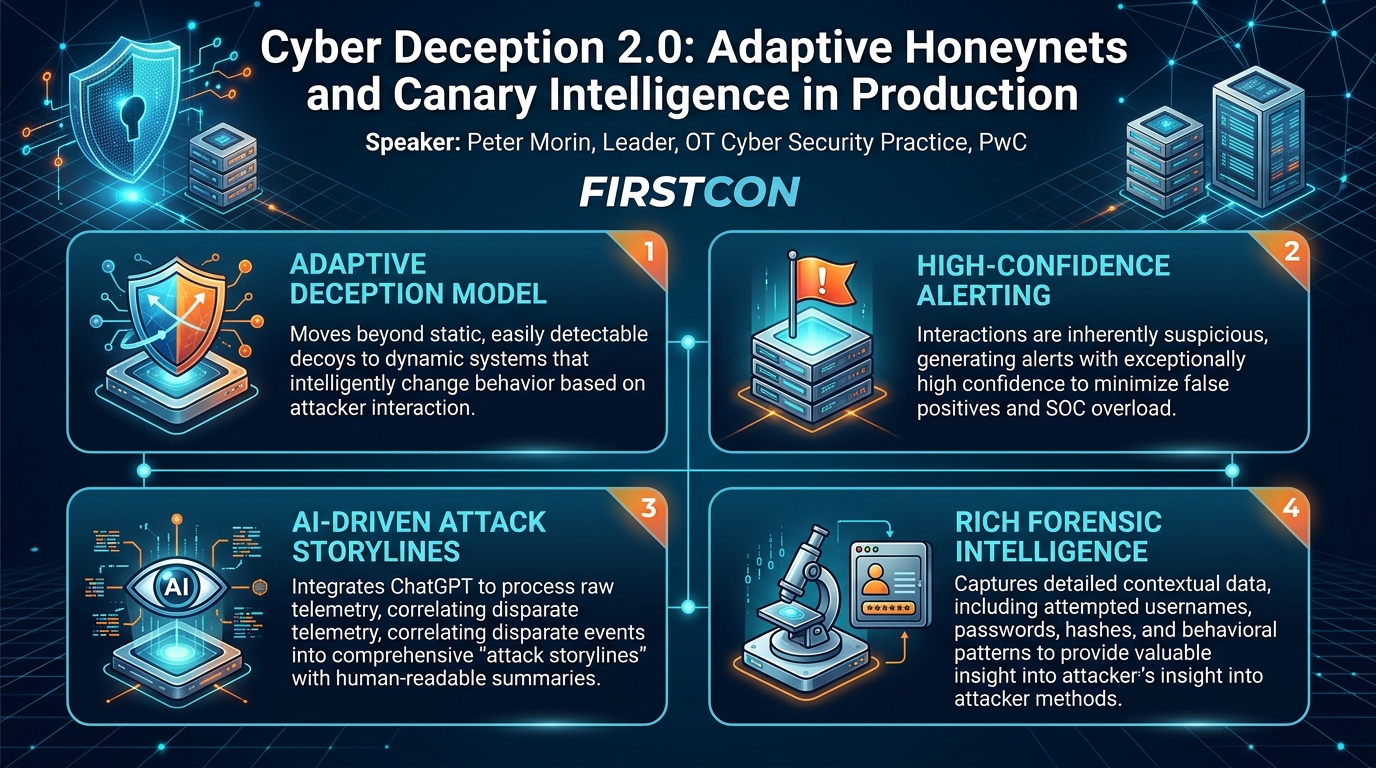
- Adaptive Deception Model: The core innovation is a dynamic, adaptive approach to deception. Unlike static honeypots, Adaptive Grid actively changes its responses and behaviors based on attacker interaction. This significantly increases the difficulty for adversaries to identify it as a decoy, ensuring prolonged engagement and richer data collection.
- High-Confidence Alert Generation: By design, any interaction with an Adaptive Grid honeypot is inherently suspicious. This principle allows the system to generate alerts with exceptionally high confidence, minimizing false positives and providing SOC analysts with clear, actionable intelligence that something is genuinely amiss in the environment.
- Enhanced and Correlated Telemetry: Adaptive Grid moves beyond simple event logging. It captures a vast array of contextual data, including attempted usernames, passwords (and their hashes), SSH versions, source IPs, port information, and behavioral patterns. Crucially, it correlates these disparate events into a cohesive "case file" or attack storyline, presenting the full sequence of attacker actions rather than isolated alerts.
- AI-Driven Intelligence and Analysis: A significant contribution is the integration of AI (specifically ChatGPT) for advanced analysis and summarization. The AI processes the raw telemetry, evaluating event sequences, frequency, order, and service transitions to distinguish coordinated attacks from background noise. It then generates human-readable summaries for SOC analysts, complete with identified attack techniques and recommended next steps, drastically reducing the time and effort required for initial triage.
- Dynamic Risk Scoring: The system incorporates a sophisticated risk scoring mechanism. It differentiates between low-concern activities (e.g., a single web request) and high-value indicators (e.g., multiple SSH brute-force attempts, aggressive scanning bursts, or lateral movement style behavior), assigning dynamic severity levels to alerts. This helps prioritize responses and understand the attacker's intent.
- Open-Source and Community-Driven: Despite its advanced capabilities, Adaptive Grid is being released as a fully open-source project. This fosters community contribution, allowing for broader testing, continuous improvement, and the development of new modules and functionalities, making sophisticated deception technology accessible to a wider audience.
These findings collectively address the critical shortcomings of previous deception technologies, providing a robust, intelligent, and analyst-friendly solution for advanced threat detection and intelligence gathering.
Technical Deep Dive
▶ Watch: AI-Generated Threat Summaries for SOC Analysts (17:20)
Adaptive Grid is architected to be a lightweight, yet highly sophisticated, deception platform. Built predominantly in Python, the current version 1.0 operates as a single process, with future plans for expansion into multi-process capabilities. Its modular design is central to its adaptability, allowing for the dynamic enabling or disabling of services based on the desired decoy persona.
At its core, Adaptive Grid leverages several key Python modules to achieve its high fidelity:
- AIO HTTP is used for realistic HTTP and API replication, allowing the honeypot to mimic web servers and complex API endpoints with dynamic responses.
- AsyncIO underpins other decoys, most notably the full SSH honeypot implementation. This enables the honeypot to handle multiple concurrent connections and respond in a way that appears legitimate to an attacker.
A standout technical feature is the masquerading script. When deployed, particularly on an Ubuntu server, this script goes beyond simple service emulation. It deeply modifies the underlying operating system to mimic other platforms or devices. For instance, to make an Ubuntu server appear as a Windows server or an OT PLC, the script alters critical TCP stack parameters, including window size, reset packet behavior, and ICMP response. These low-level network characteristics are often used by advanced attackers and reconnaissance tools like Nmap for operating system fingerprinting. By dynamically adjusting these, Adaptive Grid significantly enhances its believability.
The modularity extends to the services offered. An Adaptive Grid instance can be configured to present only relevant services. For example, a Linux honeypot would not expose Microsoft SQL Server, nor would a Windows server replica offer SSH or RDP if not typical for that persona. This prevents attackers from quickly identifying the decoy by probing an illogical combination of open ports.
The "adaptive" aspect is driven by several components:
- Behavioral Detection: The system doesn't merely log individual events. It continuously evaluates patterns of activity over time. This includes identifying repeated login attempts, burst scanning (e.g., an attacker scanning all 65,000 ports), weird API enumeration using tools like Nicu or Gear Buster, and multi-service probing. A legitimate user would typically interact with one or two services, not probe every available port.
- AI-driven Correlation and Case Management: This is where Adaptive Grid truly differentiates itself. Raw telemetry, collected in a timeline.json file, is fed into an AI (specifically ChatGPT) as structured prompts. The AI analyzes these event sequences within a rolling time window, looking at frequency, order, and transitions between services. Instead of generating disparate alerts (e.g., "failed SSH login," "web enumeration," "SMB probe," "API request burst"), the AI correlates them into a single, comprehensive "case." This case represents a unified attack storyline, categorizing activity into phases like reconnaissance, access attempts, and lateral exploitation. This correlation vastly reduces the workload on SOC analysts, who no longer need to manually piece together seemingly unrelated events.
- Dynamic Risk Scoring: The AI also plays a role in risk scoring. It differentiates between benign "background noise" (e.g., a single web request) and "high-value" activities indicative of a serious threat (e.g., 25 failed logins in two minutes, persistent brute force behavior, or aggressive scanning). Scores are assigned based on repetition, burst behavior, and multi-service interaction, allowing the system to assign a confidence level (e.g., "critical risk") to the observed activity.
The telemetry collected is extensive:
- For SSH authentication monitoring, it extracts usernames, passwords (and their hashes), the SSH version, and the source IP and port.
- It captures the first few bytes of a session, allowing for initial fingerprinting (e.g., detecting an Nmap module) even if the attacker aborts the connection early.
- All this information, including scoring and identified attack techniques, is fed into a threat interpretation engine (the AI component). This engine outputs a human-readable summary for the SIM, detailing the assessed risk, observed behavior, and a clear recommendation for the SOC analyst. This summary eliminates the need for analysts to parse raw JSON data, providing immediate understanding and guidance.
Furthermore, the system is highly configurable via a JSON config file. This allows administrators to customize fingerprinting details, such as the exact version of a service (e.g., "VSFTTP 3.03" or a known vulnerable FTP server), ensuring the decoy appears as a specific, plausible target. This level of detail in both emulation and analysis positions Adaptive Grid as a powerful tool for next-generation cyber deception.
Demo / Proof of Concept
▶ Watch: Project Roadmap and Open-Source Contribution Invitation (24:20)
While the talk did not feature a live, interactive demonstration, Peter Morin effectively illustrated Adaptive Grid's capabilities through several practical scenarios, serving as a comprehensive proof of concept. These scenarios highlighted how the system intelligently interacts with attackers and provides rich, actionable intelligence.
- Nmap Scan Detection:
The first scenario depicted an Nmap scan targeting the honeypot. The demonstration showed the honeypot's dynamic response, mimicking various services and ports. Crucially, the system's JSON config file allows for customizable service banners and versions. This means an administrator can configure the honeypot to appear as, for example, a specific, potentially vulnerable version of VSFTTP 3.03, increasing its allure to attackers. The output to the SOC would be an analyzed alert detailing the Nmap activity, the source IP, and the services probed, all correlated into a single case.
- Credential Attack (Hydra):
A more advanced scenario involved a credential attack using the popular brute-forcing tool Hydra against an SSH honeypot. Morin explained a critical adaptive feature: the honeypot introduces subtle delays in failed authentication responses. Traditional honeypots might fail instantly or rapidly, causing tools like Hydra to abort or slow down in a way that could tip off a savvy attacker. By mimicking realistic authentication latency, Adaptive Grid ensures that Hydra (or similar tools like Medusa) can continue its attempts for an extended period. This maximizes the chances of capturing a wide array of attempted usernames and passwords, providing invaluable intelligence about attacker methodologies and potentially compromised credentials. The configuration for these delays and the SSH server's characteristics are all managed via the JSON config file.
- Web Directory Scan:
The third scenario showcased the honeypot's ability to replicate a web server and respond to web directory scans. Tools like Gear Buster or similar enumerators would discover a range of "fake pages" and directories, such as /admin. Adaptive Grid incorporates burst analysis logic in the background, allowing it to gracefully handle many requests in a short amount of time without revealing its nature as a honeypot. This provides detailed telemetry on common web enumeration techniques and targeted directory structures, which can be crucial for understanding attacker reconnaissance.
Across all scenarios, Morin emphasized the rich telemetry generated. For an SSH probe, this includes the timestamp, server banner, detected attack techniques, detection context, attempted credentials (usernames and passwords), and their hashes. This raw data is always available in the timeline.json file, ensuring that even without AI analysis, security teams have access to granular forensic details. The AI then processes this raw data to produce the concise, actionable summaries and recommendations that are forwarded to the SIM and other notification channels.
Defensive Implications
▶ Watch: Clarifying Enterprise Version and OT Persona Configurations (29:00)
The strategic deployment and robust capabilities of Adaptive Grid offer significant defensive implications for organizations across various sectors. By providing high-fidelity, actionable intelligence, it empowers defenders to proactively respond to threats and enhance their overall security posture.
- Early Detection of Lateral Movement: One of the most critical applications of Adaptive Grid is its ability to detect lateral movement. By deploying honeypots in strategic areas of the network, particularly within highly segmented or sensitive zones like PCI DSS networks, NERC SIP enclaves, or critical OT networks, defenders can identify when an attacker has breached initial defenses and is attempting to move deeper. A hit on a honeypot in such an enclave immediately signals that an adversary has successfully traversed from the general enterprise network into a more secured domain.
- Rich Forensic Data Collection: The detailed telemetry collected by Adaptive Grid is invaluable for forensic analysis. It answers critical questions:
- Where did the attacker traverse? The location of the triggered honeypot provides geographical context within the network.
- How did they navigate to that segment? Analysis of the attack storyline reveals techniques used for lateral movement.
- What was the end target? The services probed and credentials attempted can indicate the attacker's objectives.
- What credentials or SSH certificates did they steal or attempt to use? Capturing usernames, passwords, and their hashes provides crucial intelligence for identifying compromised accounts and preventing further misuse.
- Enhanced SOC Efficiency and Reduced Alert Fatigue: By correlating disparate events into a single, high-confidence attack storyline and providing AI-generated summaries with recommendations, Adaptive Grid drastically reduces SOC overload. Analysts are presented with clear, legible intelligence, eliminating the need to manually correlate numerous low-level alerts. This frees up valuable analyst time to focus on genuine threats and critical incident response.
- Integration with Existing Security Infrastructure: Adaptive Grid is designed for seamless integration with an organization's existing security ecosystem. It currently supports syslog, webhook Slack notifications, and raw JSON export. It has been tested for integration with major SIEM platforms such including Splunk, Sentinel, QRadar, and Elastic. This allows organizations to incorporate the honeypot's intelligence into their central logging and analysis systems.
- Advanced Correlation and Threat Hunting: The raw data, particularly captured credentials, can be correlated with other data sources. For example, captured passwords can be matched against Active Directory or other identity systems to identify if the same credentials are being used elsewhere in the network, indicating a broader compromise. The source IP of an attack can also be used for threat hunting, checking if the IP has interacted with any legitimate systems beyond the honeypots.
- Mass Deployment for Honey Nets: The lightweight nature of Adaptive Grid (requiring minimal memory and disk space) and its support for Ansible and Puppet scripts enable mass deployment as a honeynet. Hundreds of instances can be deployed rapidly in VM environments, Docker environments, or even on low-cost hardware like Raspberry Pis. This creates a vast deception surface, increasing the probability of detecting attackers early in their reconnaissance or lateral movement phases.
- Future Defensive Capabilities: Morin outlined several future updates that will further bolster defensive capabilities:
- PowerShell and WMI Interaction: Capturing interactions via PowerShell and WMI will provide critical insights into post-exploitation activities on Windows systems.
- Windows Server Replication: A dedicated Windows version (running on Ubuntu but mimicking Windows) will expand the deception surface.
- Web Management Interface: A central management server will allow for holistic monitoring and data retrieval from all deployed honeypots.
- Expanded HTTP Directory Structure: Persona-based HTTP directories will allow honeypots to mimic specific web applications, further enhancing realism.
- PCAP Data Collection: The ability to gather pcap information will provide deep network-level insights into attacker traffic.
- Teams Integration: Expanding notifications to Teams will cater to diverse organizational communication preferences.
By embracing Adaptive Grid, organizations can move beyond passive detection to an active deception strategy, gaining invaluable intelligence directly from attacker interactions and significantly improving their ability to defend against evolving cyber threats.
Key Takeaways
- Evolution of Deception: Adaptive Grid redefines honeynets by moving beyond static, easily detectable decoys to dynamic, adaptive systems that intelligently respond to attacker behavior, significantly prolonging engagement and increasing believability.
- High-Fidelity Intelligence: The integration of AI (specifically ChatGPT) for analysis and correlation transforms raw security events into high-confidence, contextualized attack storylines, drastically reducing false positives and SOC overload.
- Rich Forensic Data: The system collects comprehensive telemetry, including attempted credentials, behavioral patterns, and network-level details, providing invaluable forensic data for understanding attacker intent, methodologies, and potential compromises.
- Strategic Deployment for Early Detection: Deploying lightweight Adaptive Grid instances as a honeynet in critical network segments (e.g., PCI DSS, NERC SIP, OT networks) enables early detection of lateral movement and provides undeniable evidence of network breaches.
- Open-Source Empowerment: As a fully open-source project, Adaptive Grid encourages community contribution, making advanced deception technology accessible and continuously evolving through collaborative development.
- Analyst-Centric Design: By providing AI-generated summaries, identified attack techniques, and clear recommendations, Adaptive Grid empowers SOC analysts to efficiently triage threats, focus on critical incidents, and accelerate incident response.
About the Speaker(s)
Peter Morin is the Leader of the OT Cyber Security Practice at PwC Canada. In this role, he works extensively with critical infrastructure organizations, including power companies and utilities, to enhance their operational technology security posture. His deep experience in this specialized field directly informed the development of Adaptive Grid, an open-source project born from the practical challenges of securing OT environments. Morin is a passionate advocate for community contribution in cybersecurity, having previously presented at conferences like BSides. He emphasizes that Adaptive Grid is a personal project, developed out of his own initiative and desire to contribute innovative solutions to the security community, rather than a PwC product.
Reviews
Dr. Zero (Offensive Security Researcher) — SOLID
A competent walkthrough of a practitioner-built honeypot tool with some nice touches—TCP stack masquerading, AI-driven correlation—but nothing that moves the field. It's a well-executed open-source project demo, not novel research.
Heather Calloway (CISO) — SOLID
Competent open-source deception tooling with AI-driven alert correlation — addresses real SOC pain points around alert fatigue and honeypot fingerprinting. Worth evaluating if you're running deception programs, but the AI integration is early-stage and the production-readiness claims need testing.
→ Top-rated talks at FIRSTCON26 — 38th Annual FIRST Conference