Battle-Tested Incident Recovery: Lessons from the Front Lines
Jack Hughes (Senior Director of Digital Forensics and Incident Response · Unit 42 by Palo Alto Networks)
Overview
In his compelling FIRSTCON presentation, "Battle-Tested Incident Recovery: Lessons from the Front Lines," Jack Hughes, Senior Director of Digital Forensics and Incident Response for Unit 42 by Palo Alto Networks in Europe, shared invaluable insights derived from his extensive experience in guiding organizations through their most severe cyber crises. Hughes underscored a critical, often overlooked reality in cybersecurity: incidents are not a matter of if, but when, and robust recovery capabilities are paramount. His talk aimed to illuminate the evolving threat landscape, particularly in ransomware, and to provide a practical, "battle-tested" methodology for effective incident recovery.
Key moments
- 1:08 86% of incidents have business impact
- 2:26 AI accelerates and generates cyber attacks
- 4:50 Ransomware's shift to quintuple extortion tactics
- 7:45 Why recovery is often overlooked in IR
- 20:20 Battle-tested 'sheep dipping' recovery methodology
- 25:50 Key takeaways: never waste a good crisis
- 28:20 Best practices for scanning backups for malware
- 32:20 Threat actors' speed: 72 minutes to exfiltrate data
Battle-Tested Incident Recovery: Lessons from the Front Lines
Speakers: Jack Hughes, Senior Director of Digital Forensics and Incident Response, Unit 42 by Palo Alto Networks
Conference: FIRSTCON
YouTube: https://www.youtube.com/watch?v=uIoQxFWscUE
Overview
In his compelling FIRSTCON presentation, "Battle-Tested Incident Recovery: Lessons from the Front Lines," Jack Hughes, Senior Director of Digital Forensics and Incident Response for Unit 42 by Palo Alto Networks in Europe, shared invaluable insights derived from his extensive experience in guiding organizations through their most severe cyber crises. Hughes underscored a critical, often overlooked reality in cybersecurity: incidents are not a matter of if, but when, and robust recovery capabilities are paramount. His talk aimed to illuminate the evolving threat landscape, particularly in ransomware, and to provide a practical, "battle-tested" methodology for effective incident recovery.
Hughes's presentation is particularly pertinent in an era where cyberattacks are not only increasing in frequency but also in their business impact. Unit 42's data reveals that an alarming 86% of the 750 incidents they responded to last year resulted in significant operational disruption, escalating beyond the scope of a typical Security Operations Center (SOC) to become full-blown organizational crises involving legal, executive, and public relations teams. The talk highlights the growing sophistication of adversaries, now leveraging Artificial Intelligence (AI) to accelerate and generate attacks, and the dynamic evolution of ransomware tactics towards multi-faceted extortion models.
The core message of Hughes's session revolves around the critical gap in current incident response strategies: while detection, containment, and eradication are often well-practiced, the recovery phase frequently remains underdeveloped and untested. He introduced Unit 42's proven incident recovery methodology, anchored by the "sheep dipping" concept, designed to systematically restore compromised systems to a trusted, secure state. This approach emphasizes strategic planning, cross-functional collaboration, and viewing a crisis not merely as a setback, but as a catalyst for profound security improvement.
Background
▶ Watch: 86% of incidents have business impact (1:08)
The premise of Hughes's talk is built upon the undeniable truth that cyber incidents are an inevitable part of the modern digital landscape. Unit 42's experience, responding to 750 incidents last year alone, underscores this reality, with network intrusions and ransomware recovery constituting a significant portion of their workload. A critical finding from their data is that 86% of these incidents had a profound business impact, transcending purely technical issues to demand a full organizational crisis response, engaging legal counsel for data breach notifications, executive leadership, and crisis communication teams. This shift from a "cyber event" to a "business event" necessitates a broader, more integrated approach to incident management.
The threat landscape itself is undergoing rapid transformation, driven in part by the emergence of Artificial Intelligence (AI). Hughes provided concrete examples of AI's role in accelerating and generating attacks. On the generation side, attackers are directly copying and pasting malicious scripts generated by Large Language Models (LLMs) into command prompts, often including the LLMs' helpful — but incriminating — code comments. More ominously, Frontier AI is demonstrating an unprecedented ability to quickly identify vulnerabilities and chain them together to construct entire attack flows, foreshadowing a rapid increase in the volume and complexity of threats that the cybersecurity community must confront.
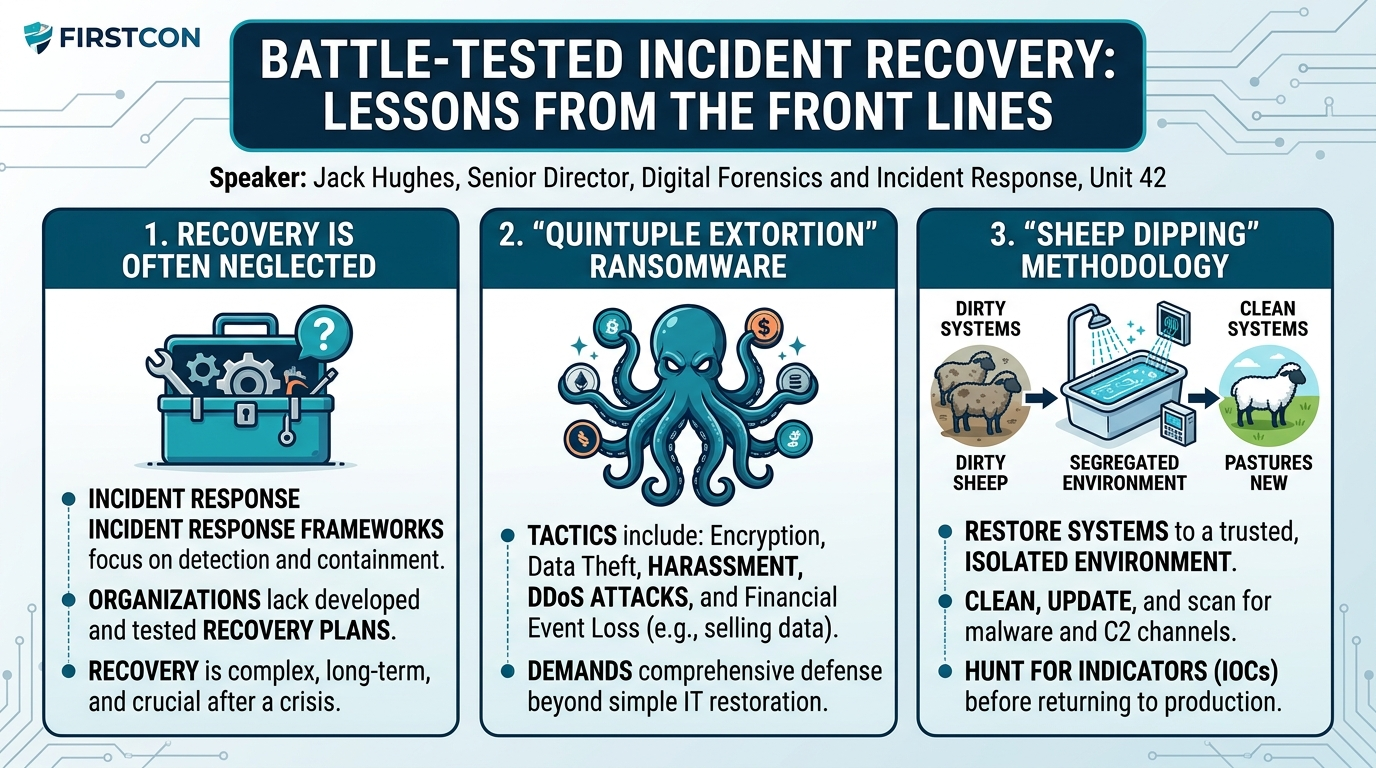
Ransomware, a persistent and evolving threat, formed a particular focus of the discussion. Hughes detailed a significant shift in ransomware modus operandi. Initially, encryption was the primary tactic for extortion. However, from January to March of the previous year, Unit 42 observed a notable decrease in encryption-focused attacks, with threat actors primarily resorting to data exfiltration. This trend proved unsustainable for the attackers, as simply stealing data often failed to compel organizations to pay. Consequently, from March onwards, there was a rapid resurgence of encryption, coupled with a more aggressive, multi-pronged extortion strategy that Hughes termed "quintuple extortion." This expanded model includes:
- Encryption of systems: The traditional method of locking operational data.
- Data theft: Exfiltrating sensitive or confidential information, threatening its public release or sale.
- Harassment: Direct, persistent pressure on executives and IT administrators, ranging from repeated phone calls to sending flowers to home addresses, demonstrating intimate knowledge of personal details.
- Denial of Service (DDoS) attacks: Launched against the victim's public-facing systems after recovery, aimed at disrupting business operations and customer access.
- Financial event loss: Utilizing stolen information to sell on dark web forums or to trigger regulatory fines by reporting breaches on the victim's behalf.
Despite the wealth of incident response frameworks from esteemed organizations like NIST and SANS, Hughes highlighted a critical deficiency: while these frameworks excel at preparing, identifying, containing, and eradicating threats, the recovery phase is consistently underdeveloped and under-practiced. This gap often leaves organizations unprepared for the complex, long-term process of restoring operations after a major breach, underscoring the urgent need for a battle-tested recovery methodology.
Key Findings
▶ Watch: Ransomware's shift to quintuple extortion tactics (4:50)
Hughes's presentation unveiled several critical findings regarding the state of cyber incident recovery, gleaned from Unit 42's extensive experience on the front lines:
- Recovery is the Neglected Phase: Despite robust frameworks for detection and response from entities like NIST and SANS, the actual recovery process is frequently overlooked and rarely tested. Organizations often assume they will never reach this stage, or that recovery will be straightforward, which is rarely the case in a significant crisis.
- Backups are Not Always a Panacea: While essential, backups alone do not guarantee a smooth recovery. Hughes cited incidents where backup systems, including those with cyber vaulting technology and data diodes, were compromised because simple oversight, like a remote desktop connection cable left plugged into a Citrix NetScaler environment, allowed attackers to delete them. Furthermore, restoring from compromised backups can reintroduce Command and Control (C2) communication channels, leading to repeat infections, as demonstrated by a client who was re-hit after restoring malicious backups.
- AI Accelerates Attack Timelines: The use of AI by threat actors is dramatically shortening the window for defensive response. Hughes provided alarming statistics:
- 72 minutes: The quickest observed time for a threat actor to gain initial access, identify sensitive data stores, and exfiltrate data from an environment.
- 62 minutes: The time observed for a threat actor to exploit a Palo Alto zero-day vulnerability after mitigation had been applied by the victim.
- 15 minutes: The time it takes for actors to begin scanning for exploitable systems once a Common Vulnerabilities and Exposures (CVE) is publicly disclosed, even before the widespread adoption of Frontier AI. These speeds fundamentally challenge traditional patch management and response paradigms.
- Ransomware Evolution and "Quintuple Extortion": Threat actors have moved beyond simple encryption. The shift to data exfiltration proved less effective for extortion, leading to a return to encryption combined with a multi-faceted approach. Quintuple extortion now encompasses encryption, data theft, direct harassment of personnel, Denial of Service (DDoS) attacks post-recovery, and leveraging stolen data for financial event loss (e.g., selling data or reporting breaches to regulators).
- The "Minimum Viable Business" Concept: In a crisis, full restoration is not immediate. Organizations must identify their minimum viable business functions – the absolute essentials needed to operate (e.g., payroll for employees) – and prioritize a staged recovery approach. This requires a shift from technical restoration to strategic business continuity.
- A Crisis is an Opportunity for Improvement: Hughes strongly advocated for the principle of "never waste a good crisis." Significant incidents provide a unique opportunity to secure executive buy-in for fundamental security improvements, such as decommissioning Windows XP systems or other legacy technology, and implementing a holistic cybersecurity program that might have been difficult to justify under normal circumstances.
- Persistent Gaps in Basic Security: Despite years of advocacy, fundamental security controls remain lacking. Hughes specifically called out the continued prevalence of over-privileged access for cloud administrators and, notably, the widespread absence of Multi-Factor Authentication (MFA) on external-facing accounts, which remains a significant initial access vector for attackers.
Technical Deep Dive
▶ Watch: Battle-tested 'sheep dipping' recovery methodology (20:20)
Jack Hughes elaborated on Unit 42's incident response methodology, with a particular emphasis on the often-neglected restore phase, and introduced a novel, "battle-tested" approach to recovery: "Sheep Dipping."
Unit 42's overarching incident response methodology begins with understanding the incident through four key pillars: network, identity, cloud application, and endpoint. This comprehensive investigation aims to pinpoint how the threat occurred, enabling secure containment and eradication of persistence mechanisms. The critical transition then occurs into the restore phase.
Hughes illustrated the complexity of modern attacks with a case study involving AI acceleration. An organization was compromised in April but didn't experience ransomware detonation until August, highlighting a prolonged dwell time. Despite multiple notifications from vendors about a vulnerability on their perimeter systems and threat intelligence warnings about active threat actor presence, action was delayed. When they finally patched the vulnerability, they failed to perform an investigation to ascertain if it had already been exploited. The threat actor had already established a foothold, moving laterally to access backups of domain controllers. They then exfiltrated the sensitive ntds.dit file—containing hashed credentials—from these backups using a seemingly innocuous tool like WinRAR. A critical factor enabling this was the absence of Endpoint Detection and Response (EDR) on legacy systems within that part of the estate. Compounding the issue, the organization stored root usernames and passwords for critical infrastructure like firewalls and backup technologies in unsecure spreadsheets, providing the attackers with "keys to the kingdom." The AI acceleration manifested in the post-exfiltration phase: the threat actor stole 2 TB of data and, within two days, generated a highly personalized, AI-crafted extortion note that accurately listed specific sensitive records, safety case numbers, internal investigations, and secret code names, demonstrating sophisticated data analysis and communication capabilities.
The restore phase itself begins with a critical assessment of backup availability and integrity. Hughes stressed the importance of identifying all backup types:
- Tapes: Considered the "holy grail" for recovery due to their inherent air-gapped nature, despite being a "legacy technology" that takes "forever to restore from."
- Backup servers, cloud backup environments, hybrid solutions, and snapshots: These are common but carry the risk of compromise if the threat actor gains access to both production and backup systems.
A key warning is that backups are not always safe. Hughes recounted an incident where an organization's cyber vaulting technology and data diodes were bypassed because a remote desktop connection cable was left plugged into their Citrix NetScaler environment, allowing the threat actor to delete backups. Another alarming example involved a client who, after a ransomware attack, restored their systems only to be re-hit two weeks later. The reason: they had unknowingly restored the C2 communication channel that the threat actor had installed, enabling a second, more destructive deployment of ransomware, followed by the deletion of all backups. This underscores the necessity of knowing the precise timeline of threat actor access to avoid restoring malicious artifacts. Even without backups, Hughes noted that forensic avenues can sometimes recover encrypted data, though this is often a slow and complex process.
When facing a full-scale encryption event, the situation transitions from an "incident" to a "crisis." Hughes defined a crisis as an event where the duration and full impact are unknown, affecting the entire organizational ecosystem. In this scenario, the priority shifts to defining the "minimum viable business" – identifying the absolute core functions required for survival (e.g., paying employees). Recovery must be a staged approach, considering foundational infrastructure elements like:
- Cleaned infrastructure: Ensuring the underlying hardware and network are free of compromise.
- Identity providers: Restoring Active Directory (AD) or other identity management systems.
- Virtualization environments: Rebuilding or securing hypervisors and virtual machine infrastructure.
This crisis recovery necessitates elevating the response beyond technical teams to a crisis management team, involving business leadership, the board, C-suite executives, and cross-functional departments like IT, HR (for potential insider investigations, but with a strict "no-blame" culture), finance (for purchasing new systems), external support (incident response firms, legal), and existing Managed Service Providers (MSPs). The emphasis is on collective recovery, not blame.
The cornerstone of Unit 42's recovery methodology is "Sheep Dipping." This agricultural analogy describes running "dirty" systems (sheep) through a "bath of chemicals" (a segregated, trusted environment) to clean and protect them before returning them to "pastures new" (the clean, operational environment). The methodology involves distinct stages:
- Create Segregated Environment: A new, isolated environment is established, trusted from the ground up. This involves creating network segmentation using firewalls or VLANs, standing up new hypervisors, and ensuring no internet access to prevent reinfection. Strict security controls are placed around this environment.
- Restore/Move Systems into the Sheep Dip: Compromised systems (or their backups) are moved into this isolated "sheep dip" environment. Here, a comprehensive cleaning and hardening process takes place:
- Install Security Tooling: EDR or XDR solutions are deployed to gain visibility.
- System Updates: Operating systems and applications are fully patched and updated.
- Configuration Review: Applications are reconfigured for security best practices.
- Malware Scanning: Backups and restored systems are thoroughly scanned for malware and C2 channels before being cleared.
- Hunt for Indicators of Compromise (IOCs): All Indicators of Compromise (IOCs) identified during the initial technical investigation are used to actively hunt for any remaining malicious activity within the "sheep dipped" systems. This ensures no persistence mechanisms or dormant threats are carried forward.
- Move to Pastures New: Only after rigorous cleaning, verification, and assurance that systems are free of compromise, are they transitioned back into the operational, "clean" environment. This meticulous process ensures the integrity and availability of restored systems, preventing a recurrence of the attack.
Demo / Proof of Concept
▶ Watch: Key takeaways: never waste a good crisis (25:50)
The presentation did not include a live demonstration or a proof of concept. Instead, Jack Hughes leveraged a detailed case study to illustrate the real-world application of AI in accelerating attacks and the critical need for a robust recovery methodology. The "Sheep Dipping" process was presented as a conceptual framework, explained through an agricultural analogy and clear procedural steps, rather than a hands-on technical demonstration.
Defensive Implications
▶ Watch: Threat actors' speed: 72 minutes to exfiltrate data (32:20)
The insights shared by Jack Hughes carry profound defensive implications for organizations striving to build resilience against sophisticated cyber threats. The primary takeaway is a call to action to elevate incident recovery from an afterthought to a core component of a mature cybersecurity program.
- Prioritize and Test Incident Recovery Plans: The most critical implication is to actively develop, update, and rigorously test incident response plans, with a strong focus on the recovery phase. Organizations must simulate "extinction-level events" to ensure they can genuinely recover from backups and restore critical operations, rather than simply assuming their plans will work. This includes considering recovery in a completely air-gapped scenario.
- Fortify Backup Strategy and Integrity:
- Immutable Storage: Implement immutable storage solutions to prevent threat actors from deleting or encrypting backups.
- Multiple Locations: Store backups in multiple, geographically dispersed, and logically isolated locations.
- Air-Gapped Solutions: Re-evaluate and secure backup infrastructure, ensuring true air-gaps for critical backups (e.g., tapes) and eliminating exploitable connections (like the remote desktop cable example for Citrix NetScaler).
- Backup Scanning: Integrate mechanisms to scan backups for malware, C2 channels, and other malicious artifacts before restoration. This prevents reintroducing threats into a "clean" environment.
- Accelerate Vulnerability and Patch Management: Given the alarming speed of modern attacks (e.g., 72 minutes from access to exfiltration, 15 minutes for CVE scanning), organizations must drastically improve their vulnerability management and patching cycles.
- Rapid Mitigation: Prioritize patching perimeter-facing systems and critical vulnerabilities immediately upon disclosure.
- Mitigation Strategies: Where immediate patching isn't possible, implement rapid mitigating controls at the network level or through containerization to isolate vulnerable systems.
- AI Threat Awareness: Prepare for an accelerated threat landscape where Frontier AI will rapidly identify and chain vulnerabilities, demanding unprecedented agility in defense.
- Enhance Detection and Visibility: Holistic visibility across the network, identity, cloud application, and endpoint pillars is non-negotiable.
- EDR/XDR Deployment: Deploy Endpoint Detection and Response (EDR) or Extended Detection and Response (XDR) solutions across the entire estate, including legacy systems, to detect anomalous activity and prevent lateral movement. The case study highlighted the danger of lacking EDR on older technology.
- Identity Protection: Address over-privileged access in cloud environments and, critically, enforce Multi-Factor Authentication (MFA) on all external-facing accounts to counter one of the most persistent initial access vectors.
- Embrace Crisis Management Principles:
- Cross-Functional Crisis Teams: Establish and train diverse crisis management teams involving IT, legal, HR, finance, communications, and executive leadership.
- "Minimum Viable Business" Planning: Pre-define and document the essential business functions required for survival during a crisis, enabling a staged and prioritized recovery.
- "No-Blame" Culture: During a crisis, foster an environment of collaboration and focus solely on recovery, avoiding blame towards internal teams or Managed Service Providers (MSPs). Post-incident reviews can address accountability, but the crisis itself demands unity.
- Realistic Communication: Prepare to communicate realistic recovery timelines to leadership, managing expectations that full recovery can take months, if not years, for complete transformation.
- Leverage Crisis for Strategic Security Improvement: A major incident, while devastating, presents a unique opportunity to drive significant, long-term security enhancements. Organizations should seize the moment to:
- Decommission Legacy Systems: Use the crisis to justify the removal of outdated, vulnerable technology (e.g., Windows XP systems).
- Modernize Infrastructure: Invest in modern, secure infrastructure and security tooling.
- Build a Healthy Cybersecurity Program: Implement a comprehensive program that integrates lessons learned and addresses systemic weaknesses exposed by the incident.
Key Takeaways
- Recovery is Critical and Underprepared: Organizations must shift focus from solely detection and containment to actively developing, practicing, and investing in robust incident recovery plans, as 86% of incidents have significant business impact.
- Ransomware has Evolved to "Quintuple Extortion": Threat actors now employ multi-faceted extortion tactics beyond simple encryption, including data theft, harassment, DDoS attacks, and financial event loss, requiring a comprehensive defense strategy.
- AI Accelerates Attacks Dramatically: Artificial Intelligence is shortening attack timelines, enabling rapid vulnerability identification and exploitation, and generating sophisticated extortion messages, demanding faster defensive responses and continuous vigilance.
- Backups are Essential but Not Foolproof: While critical, backups must be secured through immutable storage, multiple isolated locations, and rigorous scanning for malware and C2 channels to prevent re-infection or deletion.
- The "Sheep Dipping" Methodology Offers Secure Recovery: Unit 42's process of restoring systems in a segregated, trusted environment, installing security tooling, hunting for IOCs, and thoroughly cleaning before returning to production, provides a battle-tested path to secure recovery.
- A Crisis is an Opportunity for Transformation: Major incidents, though challenging, provide a unique catalyst to retire legacy technology, implement foundational security controls like MFA, and build a more mature, resilient cybersecurity program.
About the Speaker(s)
Jack Hughes is a Senior Director of Digital Forensics and Incident Response for Unit 42, the global threat intelligence and incident response division of Palo Alto Networks, operating out of Europe. In his role, Hughes specializes in assisting organizations with recovery from the most severe cyber crises, drawing on a career almost entirely dedicated to cybersecurity consulting, digital forensics, and incident response. With four years at Unit 42 and a lifetime of experience in the field, he brings a wealth of practical, "front-lines" knowledge to his presentations. Currently, Hughes is pursuing a PhD focused on broader cyber crisis management, aiming to develop a comprehensive framework that can be utilized by the entire cybersecurity community.
Reviews
Dr. Zero (Offensive Security Researcher) — SOLID
Competent practitioner talk from someone who's clearly done the work, but nothing here moves the field. The 'sheep dipping' concept is just network segmentation and staged recovery rebranded with a folksy name. Useful for orgs that haven't thought hard about recovery; unremarkable for anyone who has.
Heather Calloway (CISO) — SOLID
Solid practitioner talk on incident recovery fundamentals. Hughes delivers useful operational discipline around backup integrity and staged recovery, but the core methodology is well-established. Worth the time for teams that haven't stress-tested their recovery playbooks recently; less novel for mature programs.
→ Top-rated talks at FIRSTCON26 — 38th Annual FIRST Conference