Mind Over Malware: Reducing Decision Fatigue in Incident Response Teams
John Hollenberger (Fortinet)
Overview
In the high-stakes world of cybersecurity incident response (IR), technical prowess is often lauded as the paramount skill. However, John Hollenberger's FIRSTCON talk, "Mind Over Malware: Reducing Decision Fatigue in Incident Response Teams," posits a radical shift in perspective: the human brain, not technical capability, is the ultimate bottleneck. Drawing on psychological insights primarily from his wife, Jennifer, a social worker, Hollenberger meticulously dissects how stress, cognitive load, and the resulting decision fatigue cripple IR teams, leading to critical errors, prolonged incidents, and widespread burnout.
Key moments
- 0:00 Introduction: Brain as the bottleneck in incident response
- 2:00 Explaining the "Four Fs" of stress response in IR
- 8:00 Six ways decision fatigue impacts incident response
- 14:00 Solution 1: Role segmentation and planning for support
- 17:00 Solution 2: Stress-simulating tabletop exercises (Chaos Stack, Gamified)
- 22:15 Solution 3: Psychological techniques to reduce stress and cognitive load
- 24:50 Key takeaways and opening for audience questions
Mind Over Malware: Reducing Decision Fatigue in Incident Response Teams
Speakers: John Hollenberger, Proactive Incident Response Lead, Fortinet
Conference: FIRSTCON
YouTube: https://www.youtube.com/watch?v=X7Fc_LsRHpQ
Overview
In the high-stakes world of cybersecurity incident response (IR), technical prowess is often lauded as the paramount skill. However, John Hollenberger's FIRSTCON talk, "Mind Over Malware: Reducing Decision Fatigue in Incident Response Teams," posits a radical shift in perspective: the human brain, not technical capability, is the ultimate bottleneck. Drawing on psychological insights primarily from his wife, Jennifer, a social worker, Hollenberger meticulously dissects how stress, cognitive load, and the resulting decision fatigue cripple IR teams, leading to critical errors, prolonged incidents, and widespread burnout.
The presentation argues that while organizations often focus on acquiring the latest tools and training technical skills, they frequently overlook the physiological and psychological pressures that undermine even the most skilled responders. Hollenberger illustrates how these pressures manifest in observable behaviors and decision-making flaws during an incident. More importantly, he outlines a comprehensive strategy to combat decision fatigue, integrating structured processes, innovative tabletop exercises, and practical psychological techniques to empower IR teams to perform optimally under duress.
This talk is crucial for any organization involved in incident response, offering a compelling case for a holistic approach that prioritizes the cognitive well-being and operational resilience of its human responders. By understanding the intricate interplay between stress and decision-making, security leaders can implement proactive measures to transform reactive chaos into structured, efficient, and ultimately more successful incident resolution.
Background
▶ Watch: Introduction: Brain as the bottleneck in incident response (0:00)
The environment of incident response is inherently chaotic and high-pressure. Responders are often thrust into situations demanding rapid, critical decisions with incomplete information, under intense scrutiny, and with significant organizational consequences hanging in the balance. This sustained pressure triggers a fundamental physiological response in the human brain. Hollenberger explains this process scientifically: the amygdala, acting as the brain's "EDR tool" or threat detector, signals danger. This activates the hypothalamus, which then orchestrates the release of stress hormones like adrenaline and cortisol.
This hormonal surge prepares the body for the "four Fs" responses: fight, flight, freeze, and fawn. In an IR context, these manifest as specific detrimental behaviors. The "fight" response might lead to agitation, infighting, or pushing back against authority. "Flight" can involve conflict avoidance, distraction (e.g., excessive scrolling), or withdrawal. "Freeze" is particularly debilitating, characterized by an inability to make decisions, brain fog, and unresponsiveness. The "fawn" response involves people-pleasing, saying "yes" when they should say "no," and avoiding necessary confrontations. These responses, while natural, are counterproductive in an incident.
Critically, this stress response dramatically increases cognitive load. The mind and body are constantly scanning for threats, processing strong emotions, and simultaneously attempting rapid problem-solving. This consumes the brain's working memory, leaving less mental space for complex thinking, information organization, and focus on details. High cognitive load inevitably leads to decision fatigue, a state where every decision demands disproportionately more mental energy. Hollenberger likens this to an "overloaded database" with insufficient memory and processing space.
The consequences of decision fatigue are profound in IR. Responders become mentally tired faster, avoid decisions, and rely on shortcuts or default choices that may be suboptimal or even dangerous. Their ability to prioritize weakens, making everything feel urgent and leading to task-hopping. This state also makes individuals highly vulnerable to burnout, characterized by emotional detachment and a loss of confidence in their decisions, further slowing down response times.
Hollenberger highlights six specific ways decision fatigue sabotages IR:
- First Plausible Explanation: Responders, seeking an easy way out, latch onto the first seemingly viable explanation, potentially leading them down rabbit holes or making ineffective decisions.
- Premature Containment: Driven by a desire for a "quick win," teams might declare an incident contained before it truly is, possibly restoring backups that still contain the threat actor, leading to re-infection months later.
- Dismissing Alerts: In a Security Operations Center (SOC) role, alert fatigue can cause responders to become numb, missing critical alerts that could be the "kickoff to the incident."
- Tunnel Vision: Stress can cause responders to hyper-focus on irrelevant details, pursuing red herrings while missing the broader picture.
- Strained Communication: Stress impairs effective communication, leading to ill-advised emails, withholding crucial information, or general miscommunication, all of which slow down response.
- "Squirrel" Attitude (Task-Hopping): Responders may try to stay busy by jumping from task to task, creating an illusion of productivity without focused effort on critical priorities.
Ultimately, decision fatigue doesn't cause random errors; it causes errors to accumulate, wearing down the team and making them increasingly prone to mistakes. The goal, therefore, is not to eliminate stress—which is impossible in IR—but to fundamentally change how teams respond to and manage it.
Key Findings
▶ Watch: Six ways decision fatigue impacts incident response (8:00)
The central revelation of Hollenberger's talk is that the human element, specifically cognitive capacity and stress management, is the critical, often unaddressed, bottleneck in incident response. Technical skills and advanced tools are necessary, but insufficient if the human operators are overwhelmed by decision fatigue. The talk identifies that stress and cognitive load are not merely side effects of IR but direct causes of errors, prolonged incident timelines, and professional burnout.
Hollenberger's key contributions lie in presenting a multi-faceted approach to proactively address this human bottleneck:
- Structured Preparation is Paramount: Defining roles, establishing clear escalation procedures, and developing comprehensive playbooks or runbooks are not just administrative tasks; they are essential decision support tools that dramatically reduce cognitive load during an actual incident.
- Stress Simulation is Effective Training: Innovative tabletop exercises, such as the Chaos Stack Tabletop and Gamified Tabletop Exercises, are powerful methods to simulate the real-world pressure of an incident. These exercises train responders to make decisions under constraint, identify individual and team weaknesses, and reinforce roles and communication channels before a real crisis hits.
- Psychological Techniques are Integral: Incorporating individual psychological strategies, like mindful breaks, stress inoculation techniques (e.g., progressive muscle relaxation, 4-7-8 breathing), and the STOP skill, empowers responders to self-regulate their stress responses and maintain clear thinking.
- Holistic Approach to IR Resilience: The talk advocates for a shift from purely technical readiness to a comprehensive strategy that integrates organizational structure, procedural clarity, simulated stress training, and individual psychological resilience. This holistic approach leads to stronger, faster, and more sustainable incident response teams, ultimately reducing the accumulation of errors and improving overall incident outcomes.
Technical Deep Dive
▶ Watch: Solution 1: Role segmentation and planning for support (14:00)
While not focused on traditional code or protocol analysis, the "technical deep dive" of this talk lies in its detailed exploration of methodologies designed to optimize human performance in incident response, treating the human brain as a complex system requiring specific architectural and operational considerations.
The first critical methodology is Role Segmentation. Hollenberger emphasizes that clearly defined roles are non-negotiable, even for small teams. This involves:
- Defining Responsibilities: Establishing who does what across technical, communication, and leadership functions.
- Splitting Technical Tasks: Distributing the technical workload among team members to prevent individual overload.
- Backup and Redundancy: Ensuring primary and secondary responders for each critical task to maintain continuity.
- External Support Planning: Proactively identifying and engaging external partners (e.g., forensics firms, legal counsel) for smaller teams or specialized incidents, making these decisions before an incident, not during.
- Escalation Procedures: Clearly documenting who gets involved and when, based on incident severity (low, high, critical). This removes ambiguity and the decision-making burden of "who to call" during an active crisis.
By pre-defining these structures within the incident response plan, organizations significantly reduce the on-the-fly decision-making that compounds stress.
Next, Decision Support Tools are vital. These primarily manifest as playbooks or runbooks tailored for various incident types. These aren't rigid scripts but comprehensive guides that dictate:
- Step-by-Step Actions: Outlining the sequence of technical and procedural steps.
- Communication Protocols: Specifying who communicates with internal teams, external stakeholders, media, and law enforcement, and under what authority.
- Decision Authority: Clearly assigning who has the authority to make critical calls (e.g., engaging law enforcement).
These tools provide a structured framework, allowing responders to execute tasks efficiently without having to invent processes under pressure, thereby reducing cognitive load.
A significant portion of the deep dive focuses on Structured Exercises designed to simulate stress and build resilience:
- Chaos Stack Tabletop Exercises: Unlike traditional linear tabletops where injects (new information or challenges) are introduced sequentially over time, Chaos Stack front-loads the stress. Injects are "stacked" every 5-10 minutes, irrespective of whether previous injects have been resolved. An example scenario might involve:
- Layer 1: Service degradation.
- Layer 2 (5 mins later): Internal disruption.
- Layer 3 (15 mins later): Security concern.
- Layer 4 (20 mins later): External pressure (e.g., media inquiry).
This methodology forces teams to make rapid decisions under a constant deluge of information, mirroring the reality of a complex incident, and interrupting ongoing conversations to simulate real-world chaos.
- Gamified Tabletop Exercises: These are short (around 30 minutes), competitive exercises designed for regular practice, perhaps over a lunch break or a Friday afternoon. Teams are assigned specific roles: Detection Lead, Containment Lead, Communication Lead, and Incident Commander. The objective is to maximize the speed of containment and decision quality.
- Mechanics: Teams earn points or "tokens," and decisions cost tokens. Hidden information can be revealed by the facilitator if teams ask the right questions or spend tokens.
- Scoring: Points are awarded for fast containment and good communication, while points are deducted for duplicate work or incorrect decisions.
- Inject Examples:
- Detection: Multiple login failures, with a twist like "50% of alerts are false positives," forcing critical analysis.
- Operational Impact: Critical systems go offline, containment worsens.
- Executive Pressure: The CEO demands an immediate response.
- Benefits: This competitive format forces decisions under constraint, simulates cognitive overload, reinforces roles, and makes IR training engaging and memorable. The facilitator must have a clear understanding of desired outcomes to grade effectively.
Finally, Hollenberger integrates Psychological Techniques as practical tools for individual responders:
- Breaks: Stepping away, even for 10 minutes, can significantly calm the mind and reduce stress.
- Stress Inoculation Techniques:
- Progressive Muscle Relaxation: Tensing and then releasing muscle groups from toes to neck, promoting physical relaxation.
- 4-7-8 Breathing: Inhaling for 4 seconds, holding for 7 seconds, exhaling for 8 seconds. The longer exhale activates the parasympathetic nervous system, promoting calm.
- Cold Water Splash: Splashing cold water on the face can trigger the "dive reflex," slowing heart rate and inducing a calming effect.
- Music: Listening to calming music (even Christmas music in June, as Hollenberger quips) can be an effective cognitive aid.
- The STOP Skill: A mindfulness technique:
- Stop: Halt what you are doing.
- Take a step back: Physically and mentally disengage.
- Observe: Introspectively assess your feelings and current state.
- Proceed mindfully: Make decisions with intention, uninfluenced by immediate emotions.
These techniques aim to directly lower the stress response and reduce cognitive load at the individual level, complementing the organizational and team-based strategies.
Demo / Proof of Concept
▶ Watch: Solution 3: Psychological techniques to reduce stress and cognitive load (22:15)
While "Mind Over Malware" did not feature a traditional software or hardware demonstration, the talk effectively presented its core concepts through illustrative examples and detailed explanations of the Chaos Stack Tabletop and Gamified Tabletop Exercises. These advanced tabletop methodologies serve as conceptual "proofs of concept" for the talk's central thesis: that stress can be simulated and managed, and decision-making under duress can be trained and improved.
Hollenberger provided concrete examples of injects and scoring mechanisms for both exercise types, clearly outlining how they mimic the chaotic, high-pressure environment of a real incident. By demonstrating the structure and benefits of these exercises, the presentation effectively "showed" how organizations can proactively address decision fatigue. The detailed walkthrough of the exercise mechanics, including the rapid-fire injects of Chaos Stack and the competitive, role-based structure of the Gamified Tabletop, served as a compelling argument for their efficacy in building resilient IR teams.
Defensive Implications
▶ Watch: Key takeaways and opening for audience questions (24:50)
The insights from "Mind Over Malware" offer critical defensive implications for organizations aiming to build more resilient and effective incident response capabilities:
- Prioritize Human Resilience: Security leaders must recognize that technical skills alone are insufficient. Investment in psychological support, stress management training, and cognitive load reduction strategies for IR teams is as crucial as investment in security tools.
- Formalize Role Segmentation and Planning: Proactively define clear roles, responsibilities, and escalation paths within the IR plan. This includes identifying primary and secondary responders, planning for external support, and pre-negotiating vendor contracts to avoid critical decision-making during an active incident.
- Develop Robust Decision Support Tools: Create and regularly update comprehensive playbooks and runbooks for various incident types. These should not only detail technical steps but also communication protocols, decision authorities, and legal/media engagement strategies, serving as a cognitive aid during high-stress situations.
- Implement Advanced Tabletop Exercises: Move beyond linear tabletops to incorporate Chaos Stack and Gamified Tabletop Exercises. These simulations are invaluable for:
- Stress Inoculation: Training teams to perform under realistic pressure.
- Role Reinforcement: Solidifying understanding of individual and team responsibilities.
- Identifying Gaps: Exposing weaknesses in processes, communication, and decision-making before a real incident.
- Building Cohesion: Fostering teamwork and trust in a competitive, yet safe, environment.
- Foster a Culture of Well-being: Encourage and normalize taking breaks, especially during prolonged incidents. Leaders should model this behavior and actively combat the "always-on" mentality that leads to burnout.
- Educate on Psychological Techniques: Provide IR teams with practical stress management tools, such as progressive muscle relaxation, 4-7-8 breathing, and the STOP skill. Empower individuals to self-regulate their emotional and cognitive states.
- Beware of Decision Fatigue Pitfalls: Train teams to recognize the signs of decision fatigue (e.g., seeking quick wins, dismissing alerts, tunnel vision) in themselves and their colleagues. Implement peer review or mandatory pause points for critical decisions during extended incidents to counteract these tendencies.
- Avoid Premature Containment: Emphasize thoroughness over speed when declaring an incident contained and during recovery efforts. Rushing to restore systems without complete eradication due to fatigue can lead to costly re-infections, as threat actors may persist in backups.
By adopting these defensive strategies, organizations can transform their incident response from a reactive, stress-driven process into a proactive, resilient, and human-centric operation capable of making clear, effective decisions even in the face of chaos.
Key Takeaways
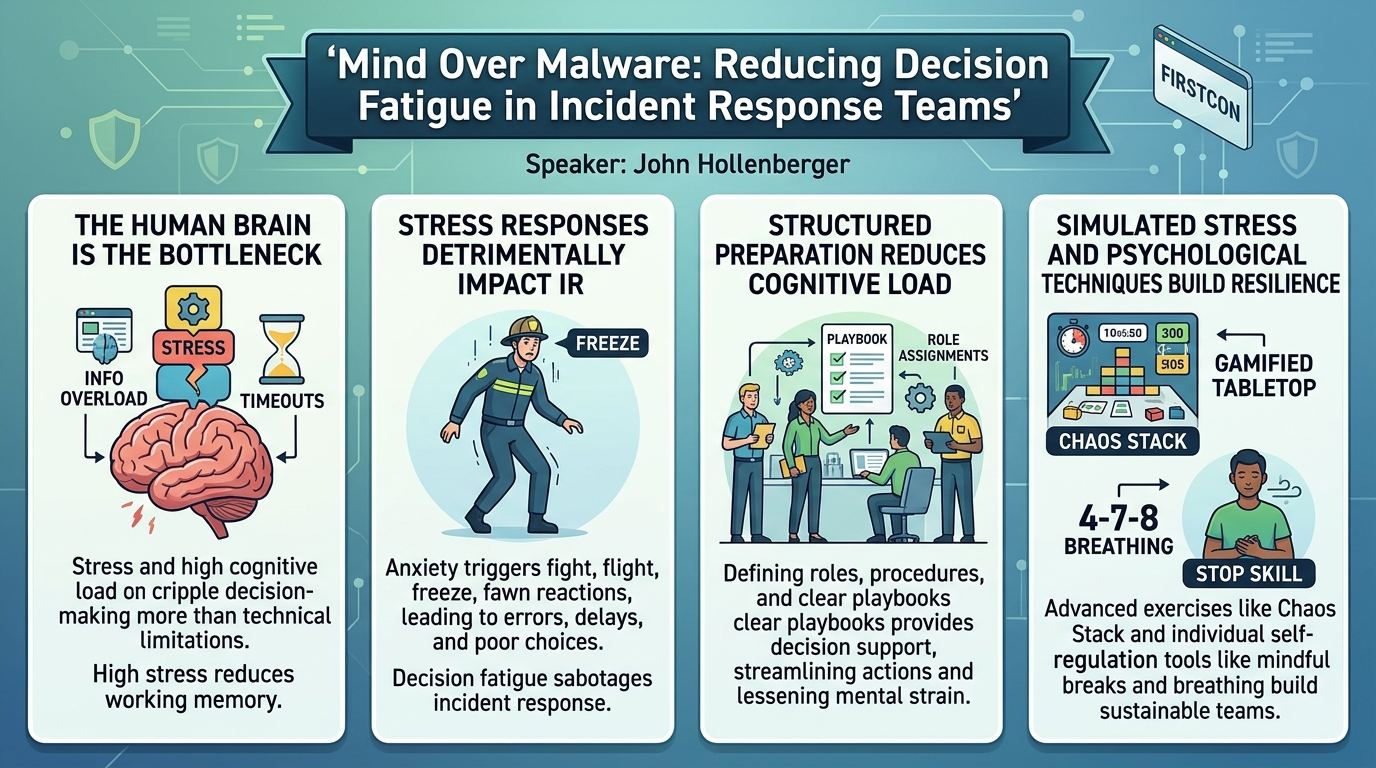
- The Human Brain is the Bottleneck: In incident response, stress and cognitive load, leading to decision fatigue, are often more critical limitations than technical skill or tools.
- Stress Manifests in Predictable Ways: Understanding the "four Fs" (fight, flight, freeze, fawn) and their impact on IR team behavior is crucial for effective leadership and self-awareness.
- Structured Preparation Reduces Cognitive Load: Clearly defined roles, responsibilities, escalation procedures, and comprehensive playbooks are essential decision support tools that minimize on-the-fly decision-making.
- Simulated Stress Builds Resilience: Innovative tabletop exercises like Chaos Stack and Gamified Tabletops are vital for training teams to make sound decisions under realistic pressure and for identifying operational gaps.
- Psychological Techniques Empower Individuals: Incorporating personal stress management strategies (e.g., mindful breaks, breathing techniques, the STOP skill) directly enhances individual cognitive capacity and emotional regulation during incidents.
- Proactive Investment in Human Factors is Critical: Organizations must prioritize a holistic approach that integrates procedural rigor, advanced training, and psychological well-being to build truly effective and sustainable incident response capabilities.
About the Speaker(s)
John Hollenberger is a Proactive Incident Response Lead at Fortinet. His work primarily revolves around developing and refining incident response plans, playbooks, and conducting tabletop exercises. He brings extensive experience in preparing organizations for and guiding them through cybersecurity incidents. Hollenberger explicitly credits his wife, Jennifer, a social worker with a background in psychology, as the "brainchild" behind the presentation's core psychological insights regarding stress and decision fatigue in high-pressure environments.
Reviews
Dr. Zero (Offensive Security Researcher) — SOLID
Competent awareness talk on decision fatigue in IR that packages well-known psychology (amygdala hijack, cognitive load theory) with some genuinely useful tabletop exercise formats. The Chaos Stack and gamified TTX mechanics are the only original contribution worth noting. This is a solid conference session but not research.
Heather Calloway (CISO) — SOLID
Useful framing of decision fatigue as an operational risk in IR, with practical tabletop formats worth stealing. The psychology is entry-level but the application to IR team design is sound. Worth your IR lead's time; not a board conversation.
→ Top-rated talks at FIRSTCON26 — 38th Annual FIRST Conference