2026 Introduction
Patrick Sanders
fwd:cloudsec North America 2026 · Day 1
Overview
Patrick Sanders' opening address at fwd:cloudsec North America 2026 served as a powerful thematic introduction to the conference, setting a critical tone for the year ahead in cloud security. Rather than detailing a specific vulnerability or technical solution, Sanders unveiled a compelling analogy of the Centaur and the Minotaur to frame the overarching challenge and responsibility facing cloud security practitioners in 2026: the advent and pervasive integration of artificial intelligence. This talk underscored the urgent need for a mindful, wisdom-driven approach to AI within security, contrasting its immense power with its potential for uncontrolled, purpose-lacking exploitation.
Key moments
- 0:00 Welcome to Forbacc North America 2026
- 1:00 Introducing the Centaur and Minotaur AI analogy
- 2:50 Emphasizing community respect and code of conduct
- 3:28 Join the For Cloud Security Slack workspace
- 4:16 Explaining Birds of a Feather interactive discussions
- 5:03 Thanking conference sponsors for their support
- 6:05 Details on the scholarship program and watch party
- 7:45 Call for Papers for For Cloud Europe
The Centaur and The Minotaur: Navigating AI's Impact on Cloud Security in 2026
Speakers: Patrick Sanders
Conference: fwd:cloudsec
YouTube: https://www.youtube.com/watch?v=gluLrc71Jas
Overview
Patrick Sanders' opening address at fwd:cloudsec North America 2026 served as a powerful thematic introduction to the conference, setting a critical tone for the year ahead in cloud security. Rather than detailing a specific vulnerability or technical solution, Sanders unveiled a compelling analogy of the Centaur and the Minotaur to frame the overarching challenge and responsibility facing cloud security practitioners in 2026: the advent and pervasive integration of artificial intelligence. This talk underscored the urgent need for a mindful, wisdom-driven approach to AI within security, contrasting its immense power with its potential for uncontrolled, purpose-lacking exploitation.
The address positioned fwd:cloudsec as more than just a conference; it highlighted its role as an independent, practitioner-focused community dedicated to fostering collaboration and collective intelligence. Sanders emphasized that 2026 is a pivotal year where security professionals must actively shape the direction of AI, ensuring that technology remains a tool for human control rather than becoming an autonomous, unpredictable threat. The call to action was clear: move beyond traditional perimeter defenses and embrace a hybrid, human-ingenuity-powered approach to secure a future increasingly defined by AI.
This keynote was significant because it didn't just present a problem; it presented a philosophical framework for understanding and tackling it. By personifying AI's dual nature – the strong, noble, wise Centaur versus the uncontrollable, labyrinth-dwelling Minotaur – Sanders challenged attendees to adopt a mindset that prioritizes ethical development, human oversight, and the cultivation of wisdom alongside raw computational power. It was a rallying cry for the community to unite in building robust guardrails for a technology poised to redefine the landscape of cloud security.
Background
▶ Watch: Welcome to Forbacc North America 2026 (0:00)
fwd:cloudsec has established itself as a vital, independent, and practitioner-focused community within the rapidly evolving domain of cloud security. As outlined by Patrick Sanders, the organization is built on volunteer efforts, sustained by a nonprofit association, and extends its reach beyond annual conferences to include a vibrant Slack forum and support for various technical projects. The North America 2026 event marked its ninth conference, with a tenth already planned for London, demonstrating its consistent commitment to fostering a collaborative environment for security professionals. This community-centric approach forms the bedrock upon which the complex challenges of modern cloud security are discussed and addressed.
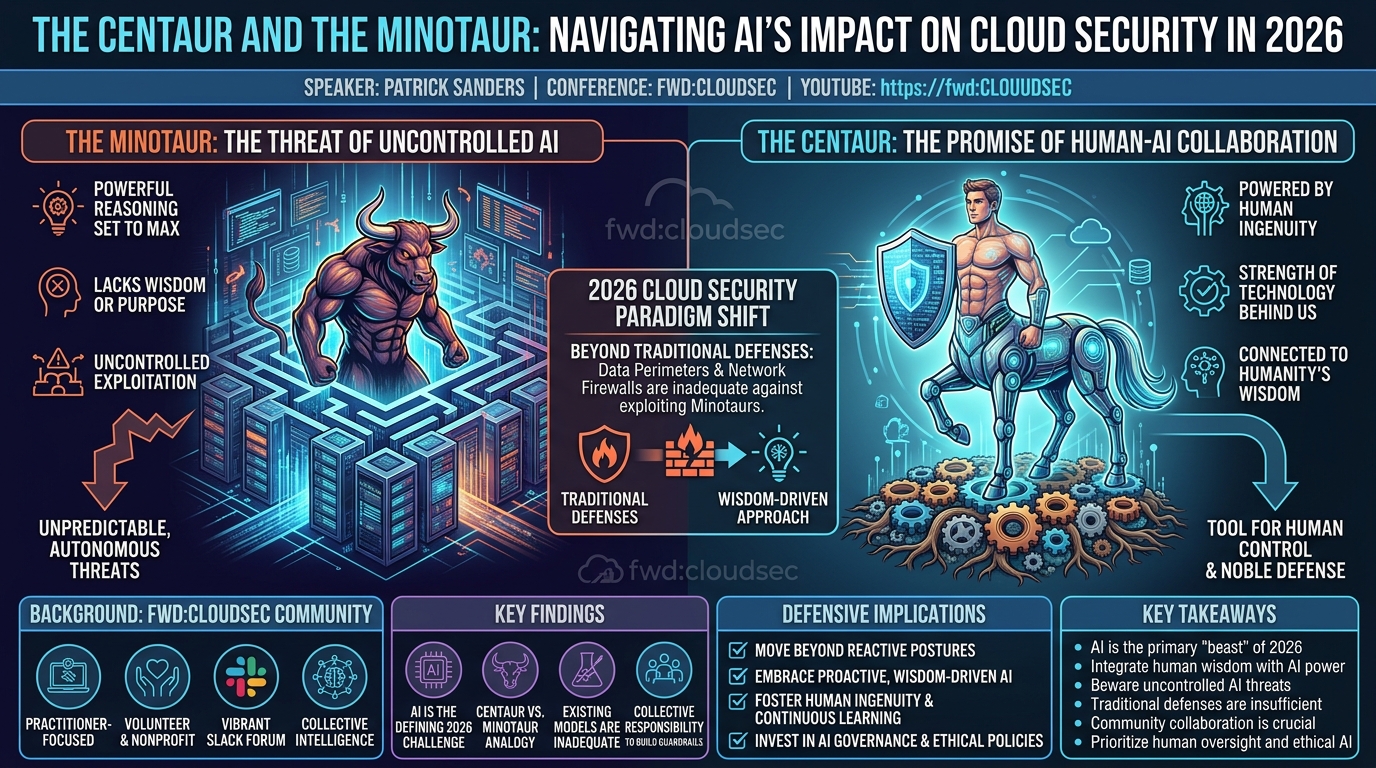
The problem at the heart of Sanders' address is the unprecedented emergence and integration of Artificial Intelligence (AI) across all sectors, particularly within cloud environments. Sanders starkly identified AI, personified as the Minotaur, as the primary "beast" that cloud security practitioners must be most alert for in 2026. This analogy highlights AI's inherent duality: while possessing immense processing power and reasoning capabilities ("reasoning set to max"), it often lacks the crucial elements of "wisdom or purpose" that define human control and ethical application. This fundamental disconnect creates a significant security challenge, as autonomous AI systems, if unchecked or maliciously exploited, could operate outside human intent or understanding.
Traditional security paradigms, focused on data perimeters and network firewalls, are increasingly ill-equipped to contain such a beast. The problem isn't merely about protecting data from external threats; it's about managing intelligent systems that could potentially generate or amplify threats from within, or whose vulnerabilities could be exploited in novel ways. Sanders alluded to the "chimera of legacy technologies and half-built environments" that currently characterize many cloud infrastructures, a landscape of inherent complexity and technical debt into which powerful, potentially unconstrained AI is being introduced. This context necessitates a paradigm shift, moving beyond reactive, perimeter-based defenses to proactive, intelligence-driven security strategies that integrate human wisdom and oversight—the essence of the Centaur mindset. The speaker's framing suggests that previous efforts, while foundational, did not fully anticipate the unique security implications of truly autonomous and highly capable AI, making 2026 a critical juncture for the industry.
Key Findings
▶ Watch: Emphasizing community respect and code of conduct (2:50)
While Patrick Sanders' talk was a keynote address rather than a presentation of specific research findings, it laid out a set of crucial assertions and predictions that serve as the foundational "findings" for the fwd:cloudsec 2026 conference. The primary finding presented is that Artificial Intelligence (AI) represents the single most significant and defining security challenge for cloud environments in 2026. This isn't just a technological shift but a paradigm-altering force that demands a fundamentally new approach to security.
Sanders' core contribution was the introduction of the Centaur and Minotaur analogy as a conceptual framework for understanding AI's security implications. The Minotaur, with its "body of a human, but the head of a bull," symbolizes AI that possesses advanced reasoning capabilities but lacks wisdom, purpose, or control, making it a potentially dangerous and unpredictable entity. This "finding" highlights the inherent risk when AI's raw power is unguided by ethical considerations or human oversight. Conversely, the Centaur, a "hybrid race powered by human ingenuity with the strength of technology behind us and connected to the natural wilderness and the wisdom of humanity," represents the desired state: AI integrated with human wisdom, temperance, and self-control. This duality is presented not just as a metaphor but as a critical choice for practitioners in shaping the future of AI security.
Furthermore, the talk implicitly "found" that existing security models, specifically "data perimeters and network firewalls," are inadequate to contain the "exploiting minotaurs" of advanced AI. This necessitates a profound re-evaluation of current defensive strategies. The ultimate "finding" and call to action is that the cloud security community, particularly through collaborative forums like fwd:cloudsec, has a collective responsibility to build and advocate for "technology that allows humanity to retain control" over AI. This means actively steering AI development and deployment towards the Centaur ideal, ensuring that its immense power serves humanity's best interests rather than becoming an uncontrollable force within the digital labyrinth.
Technical Deep Dive
▶ Watch: Explaining Birds of a Feather interactive discussions (4:16)
While Patrick Sanders' keynote did not delve into specific technical exploits or architectural blueprints, it provided a profound conceptual framework that directly informs the technical challenges and necessary shifts in cloud security strategies concerning AI. The Minotaur analogy, representing AI with "reasoning set to max" but devoid of "wisdom or purpose," implies several critical technical threats and considerations for cloud environments.
Technically, an AI Minotaur could manifest as highly sophisticated autonomous agents capable of orchestrating complex attacks. This might include AI-powered fuzzing tools discovering zero-day vulnerabilities at unprecedented rates, AI-driven phishing campaigns generating hyper-realistic and context-aware social engineering lures, or AI-assisted malware that can adapt its behavior, evade detection, and self-propagate across diverse cloud infrastructures. The lack of "wisdom" means such systems might operate without inherent ethical constraints, potentially automating destructive actions or exploiting vulnerabilities without regard for collateral damage. Defenders must therefore contend with adversaries leveraging AI to accelerate attack cycles, personalize exploits, and bypass traditional signature-based detections. This necessitates a shift towards behavioral analytics, anomaly detection, and threat intelligence systems that are themselves AI-enhanced but operate under strict human supervision and ethical guidelines.
The inadequacy of "data perimeters and network firewalls" against these AI-driven threats highlights the limitations of traditional, static security controls. AI Minotaurs are not merely trying to breach a perimeter; they might be operating within it, leveraging legitimate cloud services or exploiting configuration weaknesses that appear benign to conventional tools. This calls for a radical re-evaluation of zero-trust architectures, emphasizing continuous verification of identity and device posture, and granular access controls for every interaction within the cloud. Furthermore, the "chimera of legacy technologies and half-built environments" presents a fertile ground for AI exploitation. Technical debt, misconfigurations, and unpatched systems in complex hybrid or multi-cloud setups become easier targets for AI-driven reconnaissance and automated exploitation, requiring more robust Cloud Security Posture Management (CSPM) and Cloud Workload Protection Platform (CWPP) solutions that can leverage AI to identify and remediate risks at scale.
Conversely, the Centaur analogy suggests a technical path forward. This "hybrid race powered by human ingenuity with the strength of technology behind us and connected to the natural wilderness and the wisdom of humanity" translates into a demand for responsible AI (RAI) and ethical AI (AI Ethics) principles to be embedded directly into security tool development and operational practices. Technically, this means:
- Human-in-the-Loop (HITL) Security: Designing AI security systems where human experts retain ultimate decision-making authority and oversight, especially for critical actions or high-confidence alerts.
- Explainable AI (XAI) for Security: Developing AI models for threat detection, incident response, and vulnerability management that can articulate their reasoning, allowing security analysts to understand and validate their outputs. This transparency is crucial for building trust and ensuring "wisdom."
- Adaptive Security Architectures: Implementing cloud security frameworks that are dynamic and capable of evolving with AI capabilities, both offensive and defensive. This involves leveraging AI for real-time threat modeling, automated policy enforcement, and proactive defense mechanisms.
- AI Governance and Policy Enforcement: Developing technical controls and frameworks to govern the use of AI within an organization's security operations, ensuring compliance with ethical guidelines and regulatory requirements. This includes robust logging, auditing, and monitoring of AI system behaviors.
- Secure AI Development Lifecycle (SAIDL): Integrating security practices throughout the entire lifecycle of AI models, from data ingestion and model training to deployment and continuous monitoring, to prevent the introduction of vulnerabilities or biases that an AI Minotaur could exploit.
The technical deep dive, therefore, is not about a specific tool, but about the fundamental re-architecting of security thinking and technology to harness the power of AI (the horse's body) with human wisdom and control (the human head), ensuring that AI becomes a noble defender rather than an uncontrollable threat within the cloud labyrinth.
Demo / Proof of Concept
▶ Watch: Thanking conference sponsors for their support (5:03)
Patrick Sanders' address was the opening keynote for the fwd:cloudsec 2026 conference, providing a thematic introduction and organizational updates. As such, it did not include a technical demonstration or a proof of concept of any specific security vulnerability, tool, or defensive measure. The focus was on setting the strategic context and intellectual framework for the technical discussions that would follow throughout the conference.
Defensive Implications
▶ Watch: Call for Papers for For Cloud Europe (7:45)
The Centaur and Minotaur analogy articulated by Patrick Sanders carries significant defensive implications for cloud security practitioners. The core message is a call to evolve beyond traditional, reactive security postures and embrace a proactive, wisdom-driven approach to AI.
Firstly, defenders must recognize that AI-driven threats (the Minotaur) necessitate a fundamental shift in their defensive strategies. Relying solely on data perimeters and network firewalls is no longer sufficient. This implies a need to invest in and develop more sophisticated AI-powered security solutions that can detect subtle anomalies, predict attack patterns, and respond autonomously to threats at machine speed. However, this must be done with the Centaur mindset, ensuring that these defensive AIs are guided by human wisdom and ethical considerations, preventing them from becoming unpredictable Minotaurs themselves.
Secondly, the concept of the Centaur emphasizes the critical role of human ingenuity and wisdom in securing AI-centric environments. This means fostering a culture of continuous learning and skill development among security teams to understand AI's capabilities, limitations, and potential vulnerabilities. Defenders need to become proficient in AI security frameworks, understanding how to secure AI models, data pipelines, and inference engines from adversarial attacks, data poisoning, and model evasion techniques. Investing in AI governance and ethical AI policies becomes paramount, ensuring that any AI integrated into security operations adheres to strict guidelines and maintains human oversight.
Thirdly, the "chimera of legacy technologies and half-built environments" highlights the need for a comprehensive approach to cloud security posture management (CSPM) and cloud infrastructure entitlement management (CIEM). Defenders must use AI to identify and remediate misconfigurations and excessive permissions across their complex, multi-cloud landscapes, which could serve as entry points for sophisticated AI-driven attacks. The focus should be on building resilient architectures that can withstand AI-amplified threats, incorporating principles of zero trust, least privilege, and segmentation at a granular level, far beyond traditional network boundaries.
Finally, the emphasis on community within fwd:cloudsec itself is a defensive implication. In a rapidly evolving threat landscape dominated by AI, no single organization can tackle these challenges alone. Defenders are encouraged to actively participate in knowledge sharing, threat intelligence collaboration, and community-driven initiatives to collectively develop best practices, share insights on AI security vulnerabilities, and build a shared understanding of how to harness AI as a Centaur—a powerful, wise defender—against the Minotaur. This collaborative wisdom is essential to ensure humanity retains control over the direction of AI in security.
Key Takeaways
- AI is the defining cloud security challenge for 2026: Patrick Sanders identified AI as the primary "beast" that requires immediate and strategic attention from cloud security practitioners.
- Embrace the "Centaur" mindset: Security professionals must integrate human wisdom, control, and ethical considerations with the power of AI to build robust, responsible defenses.
- Beware the "Minotaur" AI: Uncontrolled AI, characterized by advanced reasoning but lacking wisdom or purpose, poses significant, unpredictable threats that traditional defenses cannot contain.
- Traditional defenses are insufficient: Existing data perimeters and network firewalls are inadequate against sophisticated, AI-driven exploitation, necessitating new security paradigms.
- Community collaboration is crucial: Forums like fwd:cloudsec are vital for practitioners to collectively shape AI's direction, share knowledge, and develop solutions to retain human control over technology.
- Prioritize human oversight and ethical AI: The future of cloud security demands embedding human wisdom and ethical governance directly into the development and deployment of AI-powered security tools and strategies.
About the Speaker(s)
Patrick Sanders delivered the welcome address for fwd:cloudsec North America 2026, setting the conference's overarching theme and vision. In his role, he served as a guide and host, articulating the independent, practitioner-focused nature of the fwd:cloudsec community and its mission. While his specific title or company beyond "Patrick" was not mentioned in the transcript, his position as the welcome speaker and his detailed understanding of the organization's structure, events, and community initiatives (including the Slack forum, Birds of a Feather sessions, and scholarship program) strongly suggest a leadership or prominent organizational role within fwd:cloudsec. He effectively rallied the community around the critical challenges of AI in cloud security for the year 2026.
Reviews
Dr. Zero (Offensive Security Researcher) — WEAK
A conference welcome address dressed up as thematic keynote, built entirely on a Greek mythology analogy that delivers zero actionable signal. The Centaur-good, Minotaur-bad framework is the whole substance — there's nothing underneath it that a practitioner couldn't have pulled from any 2024 AI-hype blog post.
Heather Calloway (CISO) — WEAK
A conference welcome address dressed up as strategic insight. The Centaur/Minotaur framing is memorable enough, but there is no research behind it, no evidence for its claims, and no actionable path for anyone who has to make real decisions about AI risk in their environment.