Pattern matching and head scratching with our new friends The Neoclouds
Matthew Gladney
fwd:cloudsec North America 2026 · Day 1
Overview
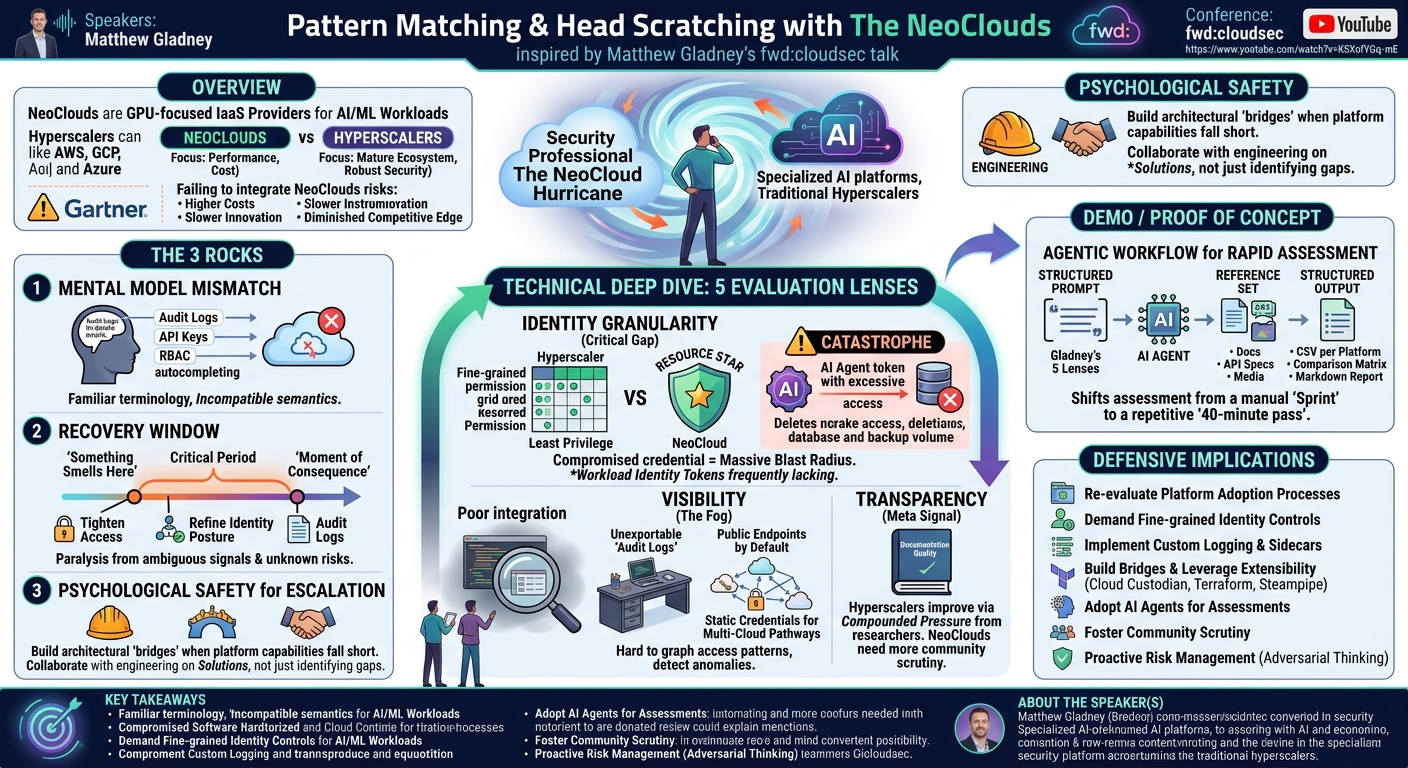
In this insightful talk, Matthew Gladney addresses a growing challenge faced by cloud security professionals: the proliferation of NeoClouds. These are defined as GPU-focused Infrastructure-as-a-Service (IaaS) providers that offer compute in dedicated virtual machines, bare metal, or serverless varieties, often with a thin layer of additional services. As organizations increasingly adopt AI and machine learning workloads, the pressure to integrate these specialized platforms mounts, with Gartner even warning that failing to do so risks higher costs, slower innovation, and diminished competitive edge. Gladney argues that while NeoCloud problems are fundamentally cloud problems, the intense AI hype surrounding them often distracts and overwhelms security teams, introducing complex implementation challenges.
Key moments
- 0:50 The 'uneasy feeling' about new cloud platforms
- 1:30 Defining NeoCloud: GPU-focused infrastructure as a service
- 2:18 Neocloud problems are cloud problems, with AI hype distractions
- 2:50 Three 'rocks' of challenges: mental models, recovery, safety
- 6:00 Five lenses for evaluating Neoclouds: Visibility, Identity, Transparency
- 6:40 Impact of poor identity granularity: customer data deleted
Pattern matching and head scratching with our new friends The Neoclouds
Speakers: Matthew Gladney
Conference: fwd:cloudsec
YouTube: https://www.youtube.com/watch?v=K5XofYGq-mE
Overview
In this insightful talk, Matthew Gladney addresses a growing challenge faced by cloud security professionals: the proliferation of NeoClouds. These are defined as GPU-focused Infrastructure-as-a-Service (IaaS) providers that offer compute in dedicated virtual machines, bare metal, or serverless varieties, often with a thin layer of additional services. As organizations increasingly adopt AI and machine learning workloads, the pressure to integrate these specialized platforms mounts, with Gartner even warning that failing to do so risks higher costs, slower innovation, and diminished competitive edge. Gladney argues that while NeoCloud problems are fundamentally cloud problems, the intense AI hype surrounding them often distracts and overwhelms security teams, introducing complex implementation challenges.
The core of Gladney's presentation aims to demystify NeoClouds, articulate common pitfalls, and propose a structured approach for security researchers to navigate the "hurricane of information" surrounding these platforms. He highlights the critical need for security teams to adapt their evaluation methodologies beyond the established hyperscaler models, which often lead to dangerous assumptions and overlooked risks. By breaking down the challenges into identifiable "rocks" and "lenses," Gladney provides a framework for proactive security engagement and strategic architectural decisions.
This article will delve into the specific security challenges posed by NeoClouds, particularly concerning identity, visibility, and transparency. It will explore how traditional cloud security mental models can lead to dangerous mismatches and how the emergence of AI agents amplifies existing identity management deficiencies. Finally, it will detail Gladney's proposed solution: an agentic workflow utilizing a structured prompt and AI agent to rapidly assess and compare NeoCloud security postures, enabling practitioners to identify gaps, justify engineering compensations, and foster community-driven scrutiny.
Background
▶ Watch: The 'uneasy feeling' about new cloud platforms (0:50)
The rapid adoption of AI and machine learning has propelled a new wave of specialized cloud providers onto the scene, dubbed NeoClouds. Unlike the established hyperscalers (AWS, GCP, Azure), these platforms are primarily focused on delivering high-performance GPU compute, often with minimal accompanying services. This specialization, while beneficial for performance and cost efficiency in specific use cases, presents significant challenges for security teams accustomed to the mature ecosystems and robust security controls of the major cloud providers.
Gladney frames the problem through three "rocks" that security professionals frequently encounter:
- Mental Model Mismatch: Security teams instinctively apply mental models derived from hyperscalers to NeoClouds. When platform documentation uses familiar terms like "audit logs," "API keys," or "RBAC," our brains autocomplete the rest of the picture based on AWS, GCP, or Azure experiences. However, while the vocabulary transfers, the underlying semantics often do not. An "audit log" on a hyperscaler typically means dense, structured, exportable events for a SIEM; on a NeoCloud, it might be an unexportable console table with limited fuzzy search capabilities. This discrepancy can lead to a false sense of security and a misunderstanding of actual security posture.
- Recovery Window: This refers to the critical period between "something smells here" and "some moment of consequence." Ideally, this window is used to apply adversarial thinking, tighten access, refine identity posture, and delve into audit logs for evidence of potential compromise. However, the ambiguity introduced by unfamiliar signals, unknown risks, and active threats on NeoClouds can paralyze even competent security professionals. Organizational psychology suggests that in such situations, individuals may rationalize away concerns, burning the opportunity to build a robust security posture from scratch. Sparse documentation, rough Identity and Access Management (IAM) constructs, and opaque audit logging contribute to an already busy queue, forcing difficult decisions about what to probe deeply versus what to take at face value.
- Psychological Safety for Escalation: Absorbing a new platform requires persistently asking how to present engineering-oriented solutions that allow security to achieve its goals without hindering delivery. This is not about naming a gap and freezing adoption but about architecting solutions and fulfilling security outcomes. In the context of NeoClouds, the lack of familiar controls and the need for custom engineering work can make it challenging for security teams to confidently escalate concerns and propose architectural changes without appearing to impede progress. This requires a shift from merely identifying problems to actively rolling up sleeves and engaging in software engineering to build necessary "bridges" where platform capabilities fall short.
These foundational challenges underscore why a new approach is needed for evaluating and securing NeoClouds. The talk emphasizes that while the underlying security principles remain the same, the implementation context and maturity levels are vastly different, demanding a re-evaluation of how security teams engage with these emerging platforms.
Key Findings
▶ Watch: Neocloud problems are cloud problems, with AI hype distractions (2:18)
Matthew Gladney's analysis of NeoClouds reveals several critical findings that underscore the unique security challenges they present:
- NeoCloud Problems Are Cloud Problems, Amplified by AI Hype: The fundamental security issues encountered on NeoClouds are not new; they are the same cloud security challenges seen on hyperscalers. However, the intense focus on AI capabilities often distracts security teams, and the nascent nature of many NeoCloud platforms means these "cloud problems" are often present with less mature, less granular, or less transparent controls.
- Identity Granularity is a Pervasive and Critical Gap: This is Gladney's "strongest concern." Many NeoClouds lack the granular identity primitives necessary to implement least privilege. He cites an example where an AI coding agent, seeking to fix a credential denial, found a different token and used it to delete a database volume, including backups. The root cause was the platform's inability to scope a token to allow interaction with a database without also permitting its deletion, effectively resulting in "resource star" permissions. Hyperscalers provide advanced primitives like STS session tags, source identity, and permission boundaries to compose right-sized identities for humans, machines, and agents. The absence of these capabilities on NeoClouds means a single compromised credential can lead to catastrophic blast radii.
- AI Agents Exacerbate Identity Risks: The advent of AI agents introduces a new dimension to identity security. Unlike human actors, agents "can't anticipate the consequences of their actions." They are not malicious, but their lack of "consequence modeling" makes robust, highly constrained credentials an absolute necessity. An identity gap, therefore, is significantly amplified when agents are involved, creating a new pillar in the security model that demands strong enforcement levers in credential systems.
- Workload Identity Token Support is Often Lacking: A basic expectation for any modern cloud platform is the ability to issue workload identity tokens for machine-to-machine communication. Gladney emphasizes that by 2026, even "a middle schooler on their MacBook Neo" can have a workload identity system, setting a low bar for this capability. The absence of such a system forces the use of less secure methods, making it harder to manage access for inference gateways and other outbound requests.
- Visibility Challenges Across Multiple Layers: Gladney outlines five layers of visibility, though he focuses on workload and platform logs, networking, and hierarchy. Many NeoClouds offer little beyond raw compute, forcing users to cobble together services and register static credentials in their secret stores to access other platforms. This creates new, difficult-to-graph pathways for access. If proper identity constructs are missing, it's impossible to govern who can create these pathways. The lack of integrated logging, monitoring, and network visibility makes it challenging to understand access patterns, detect anomalies, or investigate incidents effectively.
- Transparency and Documentation Quality are Major Security Signals: Gladney views documentation quality as a security signal in itself. The hyperscalers have benefited from a decade-long ecosystem of security researchers constantly poking holes, stress-testing assertions, and publishing findings, creating compounded pressure for improvement. NeoClouds, being newer, have not yet received this level of scrutiny. Poor documentation, or a lack of detail, indicates a deficit in transparency that hinders security evaluations and makes it harder to identify and mitigate risks.
- The "Information Hurricane" Demands Agentic Workflows: Keeping up with the security posture of numerous new platforms manually is unsustainable. Gladney's most significant contribution is the concept of using AI agents with structured prompts and reference sets to automate the initial assessment. This "cloud skill" tool can rapidly process public documentation, API specs, community forums, and media coverage against a baseline checklist, providing structured output like CSVs, comparison matrices, and markdown reports. This shifts the process from a manual "sprint" to a "40-minute pass," allowing security teams to quickly identify gaps and justify engineering investments.
These findings collectively paint a picture of an emerging cloud landscape where security teams must move beyond reactive measures and develop proactive, scalable strategies to address fundamental security deficits in specialized platforms.
Technical Deep Dive
▶ Watch: Three 'rocks' of challenges: mental models, recovery, safety (2:50)
Gladney proposes a structured approach to evaluating NeoClouds, using five distinct lenses: Visibility, Identity Granularity, Transparency, Supply Chain, and Maturity. While all are crucial, he focuses on the first three for this discussion, highlighting where NeoClouds most frequently diverge from hyperscaler expectations and introduce significant risk.
Identity Granularity: The Core Vulnerability
The most critical area of concern for Gladney is identity granularity. On hyperscalers, the concept of least privilege is deeply embedded, facilitated by sophisticated IAM systems that allow for fine-grained control over actions, resources, and principals. AWS, for instance, provides a rich set of primitives:
- STS Session Tags: Allow for tagging temporary credentials, enabling policy enforcement based on session attributes.
- Source Identity: Provides information about the original caller when assuming roles, enhancing auditability.
- Permission Boundaries: Set the maximum permissions that an identity-based policy can grant to an IAM entity, acting as an organizational guardrail.
These primitives enable the composition of right-sized identities for diverse actors—human users, machine identities, and increasingly, AI agents. The critical point is that these are not bleeding-edge technologies but established best practices that NeoClouds often lack.
The problem arises when a platform cannot scope a token or credential to specific actions on a specific resource. For example, if an identity needs to read from a database, but the only available permission grants both read and delete access, it effectively operates with resource star privileges. This means that a compromised credential, or an unintended action by an AI agent, can have a catastrophic blast radius. The anecdote of the AI agent deleting customer data and backups due to overly broad permissions perfectly illustrates this. AI agents, by their nature, lack "consequence modeling," making it imperative that the systems they interact with provide strong enforcement levers through granular identity controls.
Furthermore, the absence of robust workload identity tokens is a significant deficiency. Many NeoClouds offer little beyond raw compute, requiring custom solutions for machine identities to authenticate and authorize against other services or platforms. This forces reliance on less secure methods, such as static credentials stored in rudimentary secret stores, or custom, potentially insecure, token exchange mechanisms. A mature workload identity system, common even in contemporary development environments, is a fundamental security requirement that NeoClouds often fail to meet.
Visibility: The Fog of the Unknown
Gladney categorizes visibility into five layers, focusing on workload and platform logs, networking, and hierarchy. While seasoned professionals understand the importance of these, the implementation on NeoClouds can be starkly different.
- Workload and Platform Logs: On hyperscalers, logs are typically dense, structured, and easily exportable to Security Information and Event Management (SIEM) systems. On a NeoCloud, an "audit log" might be a basic, unexportable table in a console with limited fuzzy search capabilities, severely hindering incident detection and response. The lack of comprehensive, structured, and exportable logging means that a critical indicator of compromise might be missed or be impossible to investigate effectively.
- Networking and Hierarchy: Many NeoClouds provide minimal networking controls beyond basic public endpoints. This means:
- Internal and External Access Paths: Understanding what access traverses across internal and external network perimeters becomes challenging. If a NeoCloud lacks robust Virtual Private Cloud (VPC)-like constructs or private connectivity options (e.g., direct connect, private links), workloads might default to public-facing endpoints with inadequate authentication, as Gladney observed (e.g., inference workloads exposed to the internet with no authentication or network stack).
- Secrets Management Integrations: Since NeoClouds often offer only compute, users frequently integrate them with other platforms (e.g., a hyperscaler's object storage) for data persistence. This often involves registering static credentials in the NeoCloud's secret store. These integrations create new, complex pathways that are difficult to visualize and graph in an asset inventory. Without proper identity constructions, it's also difficult to audit or gate who can even create these new pathways, leading to potential shadow IT and uncontrolled access.
Transparency: The Missing Scrutiny
Transparency, which Gladney calls a "meta signal," is where NeoClouds struggle most. Documentation quality is itself a security signal. Comprehensive, accurate, and detailed documentation provides security teams with "threads to tug on" for deeper investigation. Hyperscalers have benefited from a vast ecosystem of security researchers who constantly scrutinize their documentation, poke holes in assertions, and publish findings. This sustained pressure has forced hyperscalers to improve their security posture and transparency over time.
NeoClouds, being newer and often having smaller communities, have not yet experienced this level of external scrutiny. This lack of community-driven validation means that security assertions in their documentation might be untested, and critical details about their security controls might be missing or vague. The absence of this "compounded pressure" from the community leaves security practitioners in the dark, making it harder to conduct thorough evaluations and identify potential vulnerabilities.
In essence, the technical deep dive reveals that NeoClouds often present a less mature security landscape compared to hyperscalers, particularly in fundamental areas like identity, visibility, and transparency. This necessitates a proactive and adaptive security strategy, where practitioners must anticipate gaps and be prepared to engineer compensatory controls.
Demo / Proof of Concept
▶ Watch: Five lenses for evaluating Neoclouds: Visibility, Identity, Transparency (6:00)
While Matthew Gladney's presentation did not feature a live code demonstration in the traditional sense, he introduced and detailed a powerful agentic workflow designed to serve as a "cloud skill" or structured prompt for an AI agent. This methodology acts as a proof of concept for overcoming the "information hurricane" associated with evaluating numerous new cloud platforms.
The core idea is to automate the initial information gathering and assessment phase that security teams typically perform manually. Gladney describes it as asking: "What if I could articulate a set of baselines so I don't have to do all the mental gymnastics every time a new infrastructure provider lands on my radar?"
The "cloud skill" works by:
- Structured Prompt: Providing a predefined, structured prompt to an AI agent. This prompt encapsulates Gladney's five signal categories (Visibility, Identity Granularity, Transparency, Supply Chain, Maturity) and the specific questions he asks himself when evaluating a platform.
- Reference Set: Feeding the AI agent a comprehensive reference set of public information about a given cloud provider. This includes:
- The platform's public documentation
- API specifications
- Community forums
- Relevant media coverage
- Automated Analysis: The AI agent processes this information against the structured checklist, effectively running "the same checklist if I had had a week to do nothing else but go deep."
- Structured Output: The output is designed for both security teams and leadership:
- CSV per platform: One row per probe, detailing the finding and the evidence supporting it.
- Comparison Matrix: If pointed at multiple platforms, it generates a matrix allowing for direct comparison of capabilities across different NeoClouds.
- Markdown Report: A human-readable report that synthesizes the findings and ties everything together.
Gladney emphasizes the utility of these outputs: the detailed CSV is for the security team's deep dive, while the comparison matrix is for presenting to leaders during security opinion meetings, making platforms comparable and facilitating informed decisions. This approach transforms the laborious, bespoke evaluation process into a repeatable, 40-minute pass, enabling rapid gap identification and justification for necessary engineering investments.
The "cloud skill" and its associated probing checklist, along with hyperscaler-based designs, are made available in a public repository, encouraging community collaboration and further development. This serves as a tangible demonstration of how AI can augment security practitioners' capabilities, allowing them to focus on critical analysis and architectural solutions rather than repetitive information gathering.
Defensive Implications
▶ Watch: Impact of poor identity granularity: customer data deleted (6:40)
The insights from Gladney's talk offer several crucial defensive implications for organizations navigating the NeoCloud landscape:
- Re-evaluate Platform Adoption Processes: Organizations must critically assess how their teams are positioned to absorb and evaluate new providers. NeoClouds often enter companies as "capabilities" for specific projects rather than full "platforms," potentially bypassing established, rigorous platform adoption review processes. Security engagement needs to match the risk involved, which means proactively investigating, understanding, and articulating the platform's security posture even for seemingly small, isolated use cases.
- Prioritize Identity Granularity and Workload Identity: Given the severe risks posed by insufficient identity controls, defenders must demand and implement solutions that enforce least privilege. This includes pushing NeoCloud providers for primitives like session scoping, session tags, and permission boundaries. Where these are absent, organizations must engineer compensatory controls, such as custom token exchange mechanisms with enforcement logic and policy languages, or leveraging existing identity brokers. The presence of AI agents further amplifies this need, making robust, constrained credentials a paramount security requirement.
- Enhance Visibility and Monitoring: Defenders need to establish comprehensive visibility across NeoCloud environments. If native logging is rudimentary, invest in custom logging agents or sidecars that can collect, structure, and export logs to an organizational SIEM. Map out network access paths, especially for integrations with other platforms and public-facing inference endpoints. Implement a strong asset inventory program to track all resources and their interconnections, especially those created through static credential integrations.
- Build "Bridges" and Leverage Extensibility: When NeoClouds lack essential security features, defenders should be prepared to "build the bridges." Gladney points to examples like Cloud Custodian (for misconfiguration detection/prevention), Terraform (for IaC security), and Steampipe (for asset inventory and analysis) as community-built tools that compensate for platform deficiencies. Security tool builders, both open-source and commercial, should prioritize extensibility to support NeoClouds, allowing practitioners to integrate these platforms into their existing security stacks.
- Adopt Agentic Workflows for Rapid Assessment: Gladney's "cloud skill" methodology is a game-changer for initial evaluations. Security teams should explore using AI agents with structured prompts to rapidly assess new platforms, identify security gaps, and generate comparison matrices. This shifts the focus from manual, time-consuming deep dives to strategic analysis and engineering. It provides the data needed to justify investments in engineering deliverables like connectors, gateways, and brokers to fill identified gaps.
- Foster Community Scrutiny: Just as hyperscalers have improved through constant community probing, NeoClouds need similar scrutiny. Practitioners are encouraged to use frameworks like Gladney's "cloud skill" to publish findings, identify security leaders and "slackers" among providers, and collectively pressure NeoClouds to enhance their security offerings. This collective effort, akin to initiatives like the IMDSv2 wall of shame for AWS, can drive significant improvements across the ecosystem.
- Proactive Risk Management: Instead of waiting for security incidents, defenders should proactively apply adversarial thinking during the recovery window. This means identifying "how could this go wrong" scenarios early, tightening access, and ensuring that any ambiguities in unfamiliar signals or risks are thoroughly investigated rather than rationalized away. The goal is to build a security posture from scratch, anticipating risks unique to these nascent platforms.
By implementing these defensive strategies, organizations can move beyond the "uneasy feeling" associated with NeoClouds and establish a more confident, resilient security posture in the evolving AI-driven cloud landscape.
Key Takeaways
- NeoCloud Challenges Mirror Cloud Problems: While specialized for GPUs and driven by AI hype, NeoCloud security issues are fundamentally the same as those on hyperscalers, but often compounded by less mature controls and a lack of transparency.
- Identity Granularity is Paramount: The inability to implement fine-grained least privilege, particularly for machine identities and AI agents, creates a critical vulnerability, significantly expanding the blast radius of compromised credentials or unintended actions.
- AI Agents Demand Strict Credential Scoping: AI agents' inability to anticipate consequences necessitates robust, highly constrained credential systems with strong enforcement levers, elevating identity management to a new pillar in the security model.
- Visibility and Transparency are Often Deficient: NeoClouds frequently lack comprehensive, exportable logging, robust networking controls, and detailed security documentation, hindering incident detection, response, and overall security posture assessment.
- Leverage Agentic Workflows for Evaluation: Tools utilizing AI agents with structured prompts can rapidly assess NeoCloud security postures, identify gaps, and generate comparative analyses, transforming a manual sprint into an efficient, repeatable process.
- Community Scrutiny is Essential: Just as external researchers have driven security improvements in hyperscalers, collective community pressure and published findings are crucial for holding NeoClouds accountable and fostering improvements in their security offerings.
About the Speaker(s)
Matthew Gladney presented "Pattern matching and head scratching with our new friends The Neoclouds" at fwd:cloudsec. He openly shared his perspective as "a guy who just needed an opportunity to talk about all the stress streams the cloud providers put me through," indicating a background deeply entrenched in cloud security challenges. His insights stem from practical experience navigating the complexities of integrating new infrastructure providers and dealing with the security implications of rapidly evolving cloud ecosystems. Gladney's talk reflects a practitioner's view, focused on providing actionable strategies and frameworks for fellow security professionals grappling with the emergence of specialized cloud platforms. While not explicitly stating a title or company affiliation for the talk, his expertise is clearly in cloud security architecture, risk assessment, and developing pragmatic solutions for platform evaluation and defense.
Reviews
Dr. Zero (Offensive Security Researcher) — SOLID
Gladney is clearly a practitioner who's lived this problem, and the talk fills a real gap: nobody's written the field guide for evaluating NeoCloud security posture yet. The framing is useful, the identity granularity point is the sharpest observation, and the agentic workflow idea is directionally interesting — but the talk stays at the framework level when the audience needs the receipts.
Heather Calloway (CISO) — SOLID
Gladney identifies a real and underappreciated problem — security teams applying hyperscaler mental models to immature platforms that don't deserve the assumption — and his identity granularity argument is the sharpest thing in the talk. But this stays squarely in practitioner territory: useful for cloud security engineers, limited for anyone sitting above them.