Quantum Computing: Where We Are and Where We’re Headed | NVIDIA GTC 2025 Fireside Chat
Jensen Huang (Founder and CEO · NVIDIA)
NVIDIA GTC 2025 · Fireside Chat
Overview
This NVIDIA GTC 2025 fireside chat, hosted by NVIDIA founder and CEO Jensen Huang, brought together an unprecedented assembly of leaders from the quantum computing industry. Titled "Quantum Computing: Where We Are and Where We’re Headed," the session aimed to provide a comprehensive, state-of-the-art overview of this rapidly evolving field, directly addressing a prior controversial comment by Huang regarding the timeline for quantum computer usefulness. The event underscored NVIDIA's deep commitment to the quantum ecosystem, not as a builder of quantum computers, but as a crucial enabler through its accelerated computing platforms, libraries, and tools like CUDAQ and cuQuantum.
Key moments
- 0:00 Welcome to Quantum Day at GTC
- 2:00 Jensen's comment on quantum usefulness and industry reaction
- 5:00 Nvidia's role: Enabling quantum computing with accelerated stacks
- 8:15 Announcement: Nvidia Quantum Research Lab in Boston
- 8:45 Inaugural partners for the new Boston Quantum Lab
- 10:00 Introduction of quantum industry CEO panelists
Quantum Computing: Where We Are and Where We’re Headed | NVIDIA GTC 2025 Fireside Chat
Speakers: Jensen Huang (Founder and CEO, NVIDIA), Mikuel (CEO, QuEra), Subodh Kulkarni (CEO, Rigetti Computing), Rajeev Hazra (CEO, Quantinuum), Loïc Henriet (CEO, Pasqal), Peter Chapman (Chairman, IonQ), Alan Baratz (CEO, D-Wave), Ben Bloom (Co-founder, Atom Computing), Matthew Canella (CEO, Inflection), John Levy (CEO, SEEQ), Loïc Henriet (CEO, Alice & Bob), Rob Schoelkopf (Co-founder and Chief Scientist, Quantum Circuits), Pete Shadbolt (Chief Scientific Officer, PsiQuantum), Simony Saini (GM Quantum Computing, AWS), Krysta Svore (Distinguished Engineer and GM Quantum, Microsoft)
Conference: NVIDIA GTC
YouTube: https://www.youtube.com/watch?v=9XB-LsfpvCU
Overview
This NVIDIA GTC 2025 fireside chat, hosted by NVIDIA founder and CEO Jensen Huang, brought together an unprecedented assembly of leaders from the quantum computing industry. Titled "Quantum Computing: Where We Are and Where We’re Headed," the session aimed to provide a comprehensive, state-of-the-art overview of this rapidly evolving field, directly addressing a prior controversial comment by Huang regarding the timeline for quantum computer usefulness. The event underscored NVIDIA's deep commitment to the quantum ecosystem, not as a builder of quantum computers, but as a crucial enabler through its accelerated computing platforms, libraries, and tools like CUDAQ and cuQuantum.
The discussion featured CEOs and scientific leaders from a diverse array of quantum computing companies—including QuEra, Rigetti Computing, Quantinuum, Pasqal, IonQ, D-Wave, Atom Computing, Inflection, SEEQ, Alice & Bob, Quantum Circuits, and PsiQuantum, alongside cloud giants AWS and Microsoft. This unique gathering facilitated an open dialogue on the varied technological approaches, the definition of "usefulness" for quantum machines, the challenges of scalability and error correction, and the burgeoning synergy between quantum and classical computing, particularly with AI. The talk highlighted the accelerating pace of innovation and the collective vision for quantum computing as a transformative scientific instrument and an accelerator for complex problems, rather than a replacement for conventional computers.
A significant announcement made during the fireside chat was NVIDIA's establishment of a new quantum research lab in Boston, in partnership with institutions like Harvard and MIT, and initial industry collaborators including Quantinuum, Quantum Machines, and Q. This initiative solidifies NVIDIA's role in fostering an open, collaborative ecosystem, mirroring its strategy in other complex domains like autonomous vehicles and robotics, where it provides the foundational computing stack without building the end product itself. The overarching message was one of cautious optimism, emphasizing the long-term potential and the critical need for collaboration, focused application development, and robust engineering to translate scientific breakthroughs into practical, impactful solutions.
Background
▶ Watch: Welcome to Quantum Day at GTC (0:00)
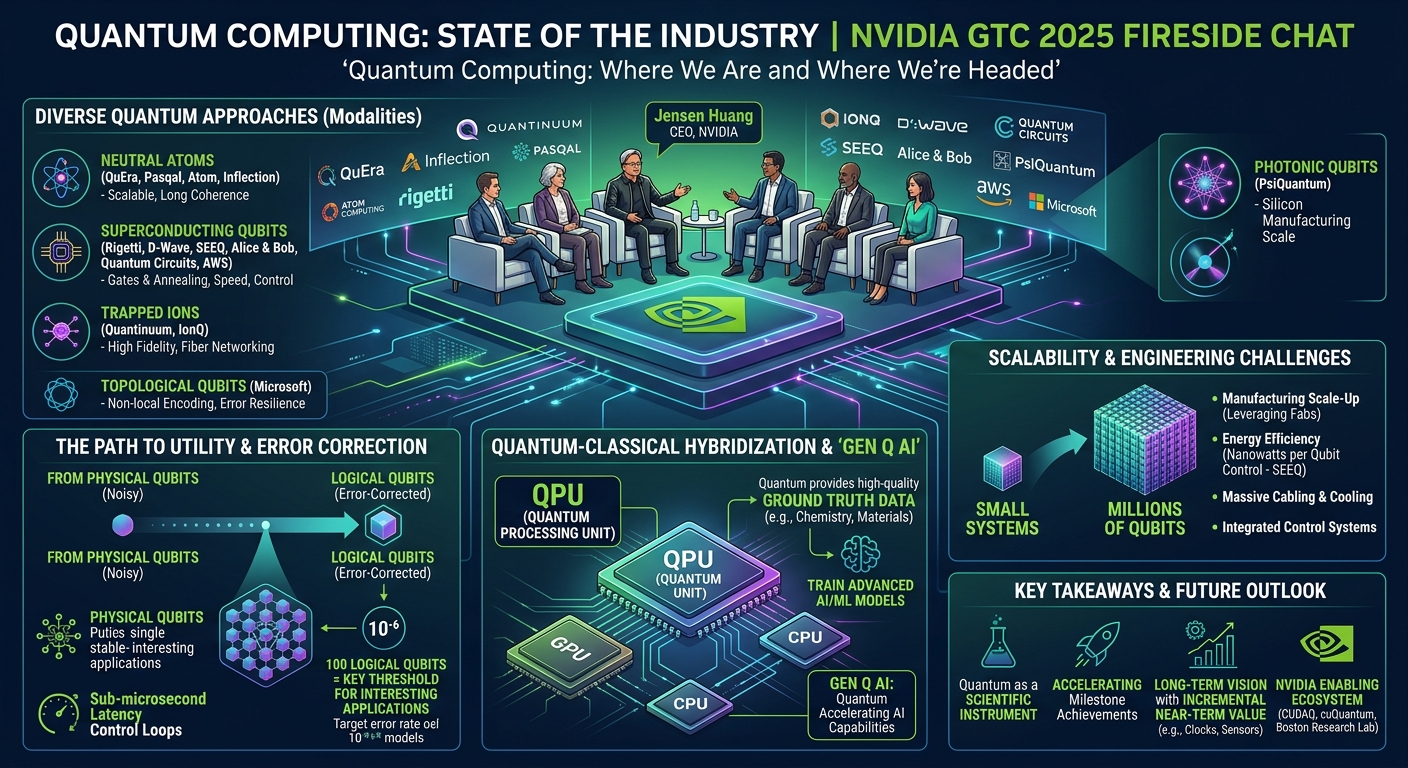
The landscape of quantum computing is characterized by a remarkable diversity of approaches, a testament to the nascent stage of the technology and the profound scientific challenges it seeks to address. Unlike the relatively unified path of classical computing, which converged on CMOS technology, quantum computing currently sees multiple modalities vying for dominance, each with distinct advantages and hurdles. These include trapped ions, neutral atoms, superconducting qubits, topological qubits, quantum annealing, and photonics. This inherent diversity, while stimulating rapid experimentation, also presents a challenge for industry convergence and standardization.
The fundamental problem quantum computing aims to solve lies in tackling computational tasks that are intractable for even the most powerful classical supercomputers. These problems often involve simulating quantum mechanical phenomena—such as molecular interactions in chemistry, material properties, or complex biological processes—which scale exponentially with classical methods. The promise of quantum computing is to leverage quantum mechanical effects like superposition and entanglement to perform these computations efficiently. However, realizing this promise is exceptionally complex. Quantum systems are inherently fragile, susceptible to noise and decoherence, which leads to errors. This necessitates sophisticated error correction mechanisms, a major engineering and scientific frontier.
Prior work has largely focused on demonstrating proof-of-concept quantum algorithms and building small-scale quantum processors. The industry has grappled with defining "quantum advantage" or "usefulness," often leading to skepticism when early claims are met with advanced classical algorithms or misinterpreted expectations. Jensen Huang's opening remarks directly referenced this, acknowledging how his previous comments on the long timeline for quantum utility caused market fluctuations. The industry is now moving towards a more nuanced understanding: quantum computers are not general-purpose replacements for classical machines but specialized accelerators, or "instruments," designed to solve specific, highly complex problems that are beyond classical reach, often in collaboration with traditional computing infrastructure. This reframing is crucial for setting realistic expectations and guiding focused development in the ML/systems space.
Key Findings
▶ Watch: Nvidia's role: Enabling quantum computing with accelerated stacks (5:00)
The fireside chat unveiled several key findings and advancements across various quantum computing modalities, highlighting the rapid, albeit challenging, progress in the field:
- Accelerated Milestone Achievement: A consensus emerged that the rate of milestone achievements in quantum computing is accelerating. Krysta Svore of Microsoft noted a significant jump from zero useful logical qubits a year prior to 28 logical qubits demonstrated with Atom Computing, with a roadmap to 50 logical qubits this calendar year and 100 logical qubits on a 10,000 physical qubit machine in the next generation. This indicates a non-Moore's Law scaling, with factors of 2-3x or more in short periods.
- Diverse Modalities and Their Strengths:
- Neutral Atoms (QuEra, Pasqal, Atom Computing, Inflection): Praised for scalability (thousands of qubits demonstrated by Atom Computing and Pasqal), high fidelity, and long coherence times. QuEra emphasized laser control and "god-given cubits." Inflection highlighted room-temperature operation, field deployment, and potential for monetization in clocks and sensors.
- Superconducting Qubits (Rigetti, D-Wave, SEEQ, Alice & Bob, Quantum Circuits, AWS): Rigetti showcased 84-qubit systems with improved 2-qubit gate fidelities (99-99.5%). D-Wave, using quantum annealing, demonstrated solving magnetic material properties that would take "nearly a million years" classically and developed quantum proof of work for blockchain. SEEQ focused on energy efficiency (3 nanowatts/qubit vs. 2-5 watts) and all-digital control for heterogeneous compute. Alice & Bob introduced the cat qubit with built-in error correction, slashing required qubits by "up to 200-fold." Quantum Circuits championed a "correct first then scale" approach with dual rail qubits for hardware-level error detection. AWS announced its Ocelot superconducting chip, emphasizing scalable error correction.
- Trapped Ions (Quantinuum, IonQ): Highlighted for the industry's highest fidelities (9s and beyond). Quantinuum detailed a roadmap for 50 logical qubits this year, 100 in 18 months, and millions by 2031-32. IonQ noted the ability to operate at room temperature, networkability via fiber optics, and leading average 2-qubit gate fidelities.
- Topological Qubits (Microsoft): Microsoft announced a breakthrough with its Myana 1 chip, promising non-local encoding of information for enhanced protection and simplified digital control.
- Photonic Qubits (PsiQuantum): PsiQuantum emphasized building large-scale, universal fault-tolerant million-qubit machines using single photons on silicon photonics, leveraging the semiconductor manufacturing ecosystem.
- Early Application Successes:
- D-Wave: Achieved a "useful computation" for magnetic materials and demonstrated the first distributed quantum application for blockchain proof-of-work.
- IonQ: Announced a 12% performance increase in Ansys LS-Dyna for blood pump modeling and a 20x improvement in a chemistry application with NVIDIA, AWS, and AstraZeneca on a 36-qubit system.
- The Rise of Logical Qubits and Error Correction: There was a strong consensus that logical qubits (error-corrected qubits) are the "key to the kingdom." The ratio of physical to logical qubits is improving (from 10,000:1 to 100:1 or better). The industry is converging on 100 logical qubits as a threshold for "interesting things," with a target fidelity of 1 in a million operations (10^-6) for 100 logical qubits, and 1 in a billion for 1,000 logical qubits. Error correction is no longer just theoretical but a "practical discipline."
- Quantum-Classical Hybridization and AI Synergy: A recurring theme was the complementary role of quantum computers with classical CPUs and GPUs. Quantum computers are seen as specialized accelerators or "scalpels" that generate highly accurate, otherwise inaccessible data, which can then be used to train classical AI/ML models. This concept, dubbed "Gen Q AI" by Rajeev Hazra, envisions quantum computers providing "ground truth" data for fields like chemistry, material science, and biology, amplifying the capabilities of AI to solve complex problems.
These findings collectively paint a picture of an industry moving past initial skepticism, focusing on concrete engineering challenges, and strategically integrating with the broader classical computing ecosystem to deliver tangible value.
Technical Deep Dive
▶ Watch: Announcement: Nvidia Quantum Research Lab in Boston (8:15)
The technical discussions provided a rich tapestry of quantum computing architectures, control mechanisms, and scalability strategies.
Qubit Modalities and Control:
- Neutral Atoms: QuEra and Pasqal detailed their use of single atoms (often rubidium or strontium) as qubits, controlled and assembled by arrays of laser beams, utilizing techniques like holography. The key advantage is that atoms are "god-given cubits"—identical, extremely well-isolated, with long coherence times. Lasers allow for precise positioning and movement of atoms, enabling dynamic connectivity within the processor. Atom Computing further emphasized this, showcasing systems with over 1,000 qubits and very high fidelity. Inflection highlighted room-temperature operation, trapping qubits in ultra-high vacuum cells, making the technology highly flexible and potentially field-deployable.
- Superconducting Qubits: Rigetti, D-Wave, SEEQ, Alice & Bob, Quantum Circuits, and AWS all utilize superconducting circuits, leveraging silicon chip fabrication.
- Rigetti's gate-based approach uses transmon qubits, emphasizing scalability and fast gate speeds (tens of nanoseconds) due to electron-based operations. They highlighted recent improvements in 2-qubit gate fidelity to 99-99.5%, achieved through better noise mitigation. Their open, modular stack allows integration of external solutions like NVIDIA CUDAQ or Quantum Machines control systems.
- D-Wave's unique annealing technology uses flux qubits designed for optimization problems. It's simpler to scale and less sensitive to noise compared to gate-based models.
- SEEQ focuses on digitally controlled and multiplexed superconducting qubits, integrating core functionality onto a single chip. Their innovation lies in extreme energy efficiency, reducing control power from 2-5 watts per qubit to 3 nanowatts per qubit. This all-digital approach minimizes crosstalk and facilitates seamless integration with GPUs and CPUs.
- Alice & Bob's cat qubit is a novel superconducting qubit design with a first layer of error correction directly built within the qubit. This hardware-efficient approach significantly reduces the number of physical qubits required for a logical qubit, providing a potential "decade head start."
- Quantum Circuits developed the dual rail qubit in superconducting circuits, incorporating error detection at the hardware level. This aims to combine the speed and scalability of superconducting devices with the high fidelity typically seen in trapped ion/neutral atom systems, following a "correct first then scale" philosophy.
- AWS's Ocelot chip demonstrates error correction in a scalable superconducting architecture, leveraging AWS's experience in custom silicon.
- Trapped Ions: Quantinuum and IonQ employ trapped ions, using individual atoms (e.g., Ytterbium ions) confined by electromagnetic fields and manipulated with lasers. IonQ noted operations at 0.02 nanometers. This modality is renowned for the "industry's highest fidelities" (9s and beyond) and long coherence times. IonQ also emphasized the potential for distributed quantum computing by networking ion traps together using existing fiber optic infrastructure. Quantinuum uses a QCCD (Quantum Charge-Coupled Device) architecture to extend scalability.
- Topological Qubits: Microsoft's Myana 1 chip is based on topological qubits, specifically Majorana zero modes. This approach encodes quantum information non-locally, spreading it across a device to inherently protect it from local noise, promising superior error resilience. It also simplifies control requirements, enabling digital control instead of complex analog systems.
- Photonic Qubits: PsiQuantum uses single photons (particles of light) on a chip, repurposing silicon photonics technology originally developed for data centers. This offers profound advantages in overcoming scaling challenges related to manufacturability, cooling power, connectivity, and control electronics.
Error Correction and Logical Qubits:
A pervasive theme was the paramount importance of quantum error correction (QEC). Speakers consistently highlighted that physical qubits are inherently noisy (failing once every thousand operations), and QEC is essential to achieve the reliability needed for useful computation (quadrillions of operations). The goal is to create logical qubits that are significantly more robust than their underlying physical counterparts. The consensus is that 100 logical qubits, with a target error rate of 10^-6 (one fault per million operations), represents a critical threshold for outperforming classical computers in certain scientific domains. For 1,000 logical qubits, the target error rate increases to 10^-9.
Hybrid Quantum-Classical Architectures:
NVIDIA's role was articulated through its CUDAQ programming model for hybrid classical-accelerated quantum computing, and cuQuantum libraries for simulating quantum circuits. The future vision involves QPU, GPU, and CPU working in concert. Classical systems are vital for:
- Control Systems: Driving quantum hardware, performing real-time error detection and correction. John Levy of SEEQ emphasized the need for sub-microsecond latency (500-800 nanoseconds) for error correction loops, a challenging requirement combining high throughput and low latency.
- Co-simulation and Design: Using GPUs to design quantum chips and simulate their behavior.
- Data Processing and AI Integration: Quantum computers generate highly accurate "ground truth" data for quantum mechanical problems (e.g., molecular energy states). This data, though small in volume, is invaluable for training classical AI/ML models (e.g., LLMs), enabling them to reason about complex quantum phenomena without direct quantum simulation. This "Gen Q AI" paradigm positions quantum computers as specialized data generators for AI, rather than standalone solution providers.
Scalability and Manufacturing:
The discussion underscored that scaling quantum computers is not just about increasing qubit count but about robust engineering and manufacturing. Peter Chapman (IonQ) mentioned that adding a qubit doubles computational power (2^N increase). Ben Bloom (Atom Computing) stressed the need for "factors of 10" scaling every few years, far exceeding Moore's Law. Pete Shadbolt (PsiQuantum) highlighted the necessity of leveraging the trillion-dollar semiconductor industry's manufacturing capabilities (fabs, OSATs, contract manufacturers) to achieve the 100,000x scale-up required for genuinely useful machines, comparing it to the rapid deployment of NVIDIA's 100,000 GPU cluster (XAI Colossus). Challenges include managing massive cabling (e.g., Google's Willow chip requiring five cables per qubit), efficient cooling, and integrating all control functionality onto a chip.
Experimental Setup & Results
▶ Watch: Inaugural partners for the new Boston Quantum Lab (8:45)
The conference talk, being a fireside chat, focused more on broad industry trends and company-specific roadmaps rather than detailed experimental setups. However, several concrete results and performance metrics were shared:
- D-Wave's Quantum Annealing: Alan Baratz reported a paper published in Science where D-Wave's annealing quantum computer performed a "useful computation" to determine properties of magnetic materials. This computation was estimated to take "nearly a million years to compute classically" on a massively parallel supercomputer like Frontier at Oak Ridge National Lab. Additionally, D-Wave demonstrated quantum proof of work in a blockchain context, running on four of their quantum computers as the "first distributed quantum application," aiming for lower energy consumption in hashing and validation functions.
- IonQ's Trapped Ion Systems: Peter Chapman announced a partnership with Ansys LS-Dyna, where IonQ's quantum computers achieved a 12% increase in performance in modeling a blood pump. Another collaboration with NVIDIA, AWS, and AstraZeneca resulted in a 20x improvement in a chemistry application using a 36-qubit system. IonQ expects to have a 64-qubit system by the end of the year, which would offer a 2^28 (roughly 260 million times) increase in computational power over their current 36-qubit system for certain applications.
- Rigetti Computing's Superconducting Qubits: Subodh Kulkarni mentioned their flagship 84-qubit system, available on AWS and Azure, boasting 79-nanosecond gate speeds. Rigetti reported achieving 99-99.5% 2-qubit gate fidelity, comparable to other leading modalities.
- Quantinuum's Trapped Ion Roadmaps: Rajeev Hazra outlined a clear path to advanced logical qubits: 50 logical qubits this year, 100 logical qubits in approximately 18 months, and a long-term vision for millions of qubits in the 2031-32 timeframe.
- Atom Computing's Neutral Atom Systems: Ben Bloom stated that Atom Computing was "one of the first companies to breach a thousand qubits" with very high fidelity and all-to-all connectivity.
- Microsoft's Logical Qubit Progress: Krysta Svore detailed Microsoft's rapid advancement in logical qubits, moving from zero useful logical qubits a year ago to demonstrating 4 logical qubits with Quantinuum, then 12, and most recently 28 logical qubits with Atom Computing. The goal is to reach 50 logical qubits this calendar year (with Atom Computing) and 100 logical qubits in the next generation on a 10,000 physical qubit machine. This progress highlights the increasing efficiency in translating physical qubits into stable logical ones.
- Pasqal's Neutral Atom Deployments: Loïc Henriet mentioned the deployment of four machines worldwide over the past 18 months, including one in France (GENCI) and another in Germany (Jülich Supercomputing Centre), indicating real-world system delivery.
- SEEQ's Energy Efficiency: John Levy highlighted their achievement of 3 nanowatts of power per qubit for control, a significant reduction compared to the 2-5 watts typically used in other superconducting systems, addressing a critical scaling challenge.
- PsiQuantum's Manufacturing Focus: Pete Shadbolt discussed breaking ground on "very large scale data center-like quantum computers" (half-million square foot sites) in Australia and Chicago, emphasizing their commitment to industrial-scale manufacturing using silicon photonics.
While specific raw data or detailed experimental protocols were not the focus, these statements provide concrete indicators of the industry's progression in qubit counts, fidelity, system deployments, and the first demonstrations of quantum utility for specific problems.
Practical Implications
▶ Watch: Introduction of quantum industry CEO panelists (10:00)
The discussions at GTC 2025 offered profound practical implications for practitioners, infrastructure teams, model builders, and deployers in the AI/ML and broader computing sectors.
Quantum as an Accelerator, Not a Replacement: The most significant practical takeaway is the redefinition of a quantum computer. It is not a faster version of a classical computer, but a QPU (Quantum Processing Unit) that complements CPUs and GPUs. Jensen Huang stressed that quantum machines should be seen as "accelerators" or "scientific instruments"—"a scalpel, not a hammer"—designed to solve highly specialized problems that classical computers cannot efficiently address. This reframing is crucial for managing expectations and guiding strategic investments. Infrastructure teams should plan for hybrid quantum-classical architectures, where quantum devices are tightly integrated into existing high-performance computing (HPC) and cloud environments.
Generating Ground Truth Data for AI (Gen Q AI): A revolutionary implication is the use of quantum computers to generate high-quality, otherwise inaccessible training data for classical AI models. Krysta Svore and Simony Saini articulated this vision: quantum computers can simulate complex quantum mechanical phenomena (e.g., molecular ground states, protein folding) to produce "ground truth" data for domains like chemistry, material science, and biology. This data, even in small amounts, can significantly enhance the accuracy and predictive power of classical AI models. Model builders can leverage this "Gen Q AI" paradigm to train more sophisticated LLMs and other AI agents, enabling breakthroughs in drug discovery, new material design, and deeper scientific understanding. This means quantum computing will increasingly become a foundational input layer for advanced AI.
Focus on "Hairy Problems" and Niche Applications: Practitioners should identify problems that are truly intractable for classical methods. The D-Wave example of magnetic material properties and IonQ's chemistry application highlight that early utility will come from specific, difficult scientific challenges rather than general-purpose tasks. This necessitates a shift from broadly searching for "quantum advantage" to meticulously identifying "quantum unique problems" where even modest quantum capabilities can yield disproportionate benefits.
The Primacy of Error Correction and Logical Qubits: For deployers, the transition from physical to logical qubits is paramount. The industry's focus on achieving 50-100 logical qubits with high fidelity (e.g., 10^-6 error rate) signals a move towards more stable and reliable quantum computation. Infrastructure teams must consider the complex classical control systems required for real-time error correction, which demand extremely low latency (500-800 nanoseconds) and high throughput between QPUs and GPUs/CPUs. This tight integration poses significant engineering challenges in hardware design and software stacks.
Diverse Hardware and Open Ecosystems: The continued diversity of quantum modalities (neutral atoms, trapped ions, superconducting, topological, photonic) implies that no single "winner" has emerged. Practitioners may need to evaluate different QPU types based on the specific problem domain. Companies like Rigetti advocate for an open, modular approach to allow easy integration of best-of-breed components (e.g., control systems, error correction libraries). This encourages collaboration and accelerates development, offering flexibility for deployers.
Long-Term Vision with Near-Term Value: While the vision for millions of fault-tolerant qubits is decades away, the industry is focused on delivering incremental value now. Inflection's strategy of monetizing early quantum advantages in related fields like atomic clocks and quantum sensors provides a practical roadmap for generating revenue and refining technology. This "knob, not a switch" approach to quantum usefulness means continuous, gradual improvements will unlock new capabilities over time.
NVIDIA's Enabling Role: NVIDIA's commitment to providing accelerated computing tools like CUDAQ and cuQuantum, along with its new Boston quantum research lab, offers a critical infrastructure layer. This means developers can access quantum simulation and hybrid programming environments, enabling them to explore quantum algorithms and integrate quantum capabilities into their workflows without needing to build quantum hardware themselves.
In essence, quantum computing is maturing into a specialized, powerful tool within a larger computational ecosystem. Its practical impact will be realized through careful problem selection, deep integration with AI and HPC, and a sustained focus on overcoming formidable engineering challenges in error correction and scalability.
Key Takeaways
- Quantum is an Accelerator, Not a Replacement: Quantum computers (QPUs) are best understood as specialized scientific instruments and accelerators that complement classical CPUs and GPUs, rather than replacing them. They are designed to solve "hairy problems" intractable for classical machines.
- Hybrid Quantum-Classical AI (Gen Q AI): A primary near-term value proposition for quantum computing is generating highly accurate "ground truth" data for complex quantum mechanical systems (chemistry, materials, biology). This data can then be used to train and augment classical AI models, creating "Gen Q AI" that can reason about and tackle problems previously beyond reach.
- The Primacy of Logical Qubits and Error Correction: The industry is rapidly advancing towards building stable logical qubits (error-corrected qubits). Reaching 50-100 logical qubits with high fidelity (e.g., 10^-6 error rate) is seen as a critical phase shift for demonstrating useful quantum advantage, requiring sophisticated classical control systems with sub-microsecond latency.
- Diversity of Modalities with Accelerating Progress: Multiple quantum computing approaches (neutral atoms, trapped ions, superconducting, topological, photonic) are actively being developed, each with unique strengths in scalability, fidelity, and control. The rate of milestone achievements, particularly in logical qubit development, is accelerating beyond traditional computing scaling laws.
- NVIDIA's Enabling Ecosystem: NVIDIA is actively fostering the quantum ecosystem through its CUDAQ programming model, cuQuantum libraries, DGX Quantum for error correction, and the new Boston quantum research lab, providing critical tools and infrastructure for hybrid quantum-classical development.
- Long-Term Vision, Incremental Value: While universal fault-tolerant quantum computers are a multi-decade endeavor, the industry is focused on delivering incremental value through early applications, scientific discovery, and commercialization strategies that leverage existing quantum advantages in related fields like atomic clocks and sensors.
About the Speaker(s)
The fireside chat featured a distinguished lineup of leaders and pioneers in the quantum computing and accelerated computing fields:
- Jensen Huang: Founder, President, and CEO of NVIDIA. A visionary leader in accelerated computing, he hosted the panel and guided the discussion, emphasizing NVIDIA's role in enabling the quantum ecosystem through its computing platforms.
- Mikuel: CEO of QuEra, a company specializing in neutral atom quantum computers.
- Subodh Kulkarni: CEO of Rigetti Computing, a developer of superconducting gate-based quantum computers.
- Rajeev Hazra: CEO of Quantinuum, a leader in trapped ion quantum computing using the QCCD architecture.
- Loïc Henriet: CEO of Pasqal, which builds quantum processors leveraging neutral atom technology.
- Peter Chapman: Chairman of IonQ, a company focused on trapped ion quantum computing.
- Alan Baratz: CEO of D-Wave, a pioneer in quantum annealing technology.
- Ben Bloom: Co-founder of Atom Computing, a company developing neutral atom quantum computers.
- Matthew Canella: CEO of Inflection, also focused on neutral atom quantum computing.
- John Levy: CEO of SEEQ (Scalable Energy Efficient Quantum Computing), specializing in digitally controlled and energy-efficient superconducting quantum computers.
- Loïc Henriet: CEO of Alice & Bob, a company designing superconducting cat qubits for hardware-efficient error correction.
- Rob Schoelkopf: Co-founder and Chief Scientist of Quantum Circuits, a Yale University spin-out focused on superconducting circuits with built-in error detection.
- Pete Shadbolt: Chief Scientific Officer of PsiQuantum, which aims to build large-scale universal fault-tolerant quantum computers using single photons on a chip.
- Simony Saini: General Manager of Quantum Computing at AWS, overseeing AWS's quantum initiatives, including superconducting qubit development.
- Krysta Svore: Distinguished Engineer and General Manager of Quantum at Microsoft, leading Microsoft's efforts in quantum computing, particularly with topological qubits and logical qubit development.
These speakers collectively represent the forefront of quantum hardware development, software innovation, and strategic integration with cloud and AI ecosystems, offering a comprehensive view of the industry's challenges and future directions.
Reviews
Simon Wisk (Open Source Developer & AI Tooling Expert) — WEAK
A star-studded quantum computing panel with Jensen Huang and 14 company CEOs that reads more like a coordinated PR event than an engineering talk. The article is competently summarized, and there are some genuinely interesting technical nuggets buried in there — cat qubits, dual rail qubits, the Gen Q AI framing — but nothing you couldn't get from reading each company's press releases side by side. No one digs into anything long enough for it to be useful, and the format structurally prevents the kind of depth that would make this worth your time.
Jensen Hitch (AI Compute Platform CEO) — SOLID
A broad industry survey session that does something genuinely useful: it reframes quantum computers as specialized accelerators integrated into a hybrid classical stack rather than general-purpose replacements. The 'Gen Q AI' framing — quantum as a ground-truth data generator for training classical AI — is the most interesting systems-level idea in the room. But this is a fireside chat with 14 CEOs, so depth necessarily trades against breadth. Physical constraint reasoning is thin, the performance claims are scattered and context-free, and the session never seriously grapples with what it actually takes to close the loop between a QPU and a GPU at production latency. Solid orientation…