NVIDIA GTC Live Washington, D.C. Keynote Pregame
Brad Gerstner (Founder and CEO · Altimeter Capital), Patrick Moorhead (Founder · Moor Insights & Strategy), Kristina Partsinevelos (Anchor · CNBC)
NVIDIA GTC 2025 · Keynote
Overview
The NVIDIA GTC Live Washington, D.C. Keynote Pregame was a comprehensive, multi-hour event setting the stage for Jensen Huang's keynote address in the nation's capital. Hosted by Brad Gersonner of Altimeter Capital and Patrick Morehead of More Insights and Strategy, the program featured over 20 industry titans, investors, and innovators across several panels. The central theme revolved around the state of AI, its transformative role in business, science, and national security, and the critical infrastructure being built by NVIDIA and its partners to power this revolution. The event underscored the strategic importance of AI, moving beyond purely technological discussions to encompass economic, geopolitical, and societal implications.
Key moments
- 0:00 Welcome to NVIDIA GTC Live Washington D.C.
- 2:22 NVIDIA's unique role in building the AI ecosystem
- 3:41 Overview of pre-keynote panel discussions and topics
- 5:12 Live report from the GTC conference floor
- 7:19 The evolution and impact of NVIDIA's CUDA platform
NVIDIA GTC Live Washington, D.C. Keynote Pregame
Speakers: Brad Gersonner, Founder & CEO, Altimeter Capital; Patrick Morehead, Founder, CEO, & Chief Analyst, More Insights and Strategy; and various industry leaders including Jensen Huang (NVIDIA)
Conference: NVIDIA GTC
YouTube: https://www.youtube.com/watch?v=VHLYXuqja4c
Overview
The NVIDIA GTC Live Washington, D.C. Keynote Pregame was a comprehensive, multi-hour event setting the stage for Jensen Huang's keynote address in the nation's capital. Hosted by Brad Gersonner of Altimeter Capital and Patrick Morehead of More Insights and Strategy, the program featured over 20 industry titans, investors, and innovators across several panels. The central theme revolved around the state of AI, its transformative role in business, science, and national security, and the critical infrastructure being built by NVIDIA and its partners to power this revolution. The event underscored the strategic importance of AI, moving beyond purely technological discussions to encompass economic, geopolitical, and societal implications.
This pregame show served as a crucial platform to contextualize the rapid advancements in AI and accelerated computing. Speakers delved into everything from the democratization of high-performance computing through CUDA to the emergence of agentic AI and the profound challenges and opportunities in building the necessary AI factories—modern data centers—to meet an unprecedented demand for compute. The discussions highlighted NVIDIA's central role not just as a chip manufacturer, but as the architect of an entire AI ecosystem, providing the foundational software and hardware stack that empowers innovation across diverse sectors, including healthcare, manufacturing, and even quantum computing.
The choice of Washington D.C. as the venue for this GTC event was deliberate, emphasizing the growing intersection of technology, policy, and national strategy. Discussions frequently touched upon the need for public-private partnerships, regulatory frameworks, and national priorities to accelerate AI development in the United States. The overarching message was one of immense opportunity and the urgent need for coordinated efforts to secure America's leadership in the global AI race, addressing bottlenecks like power generation and infrastructure buildout, while also considering the societal impact of widespread AI adoption.
Background
▶ Watch: Welcome to NVIDIA GTC Live Washington D.C. (0:00)
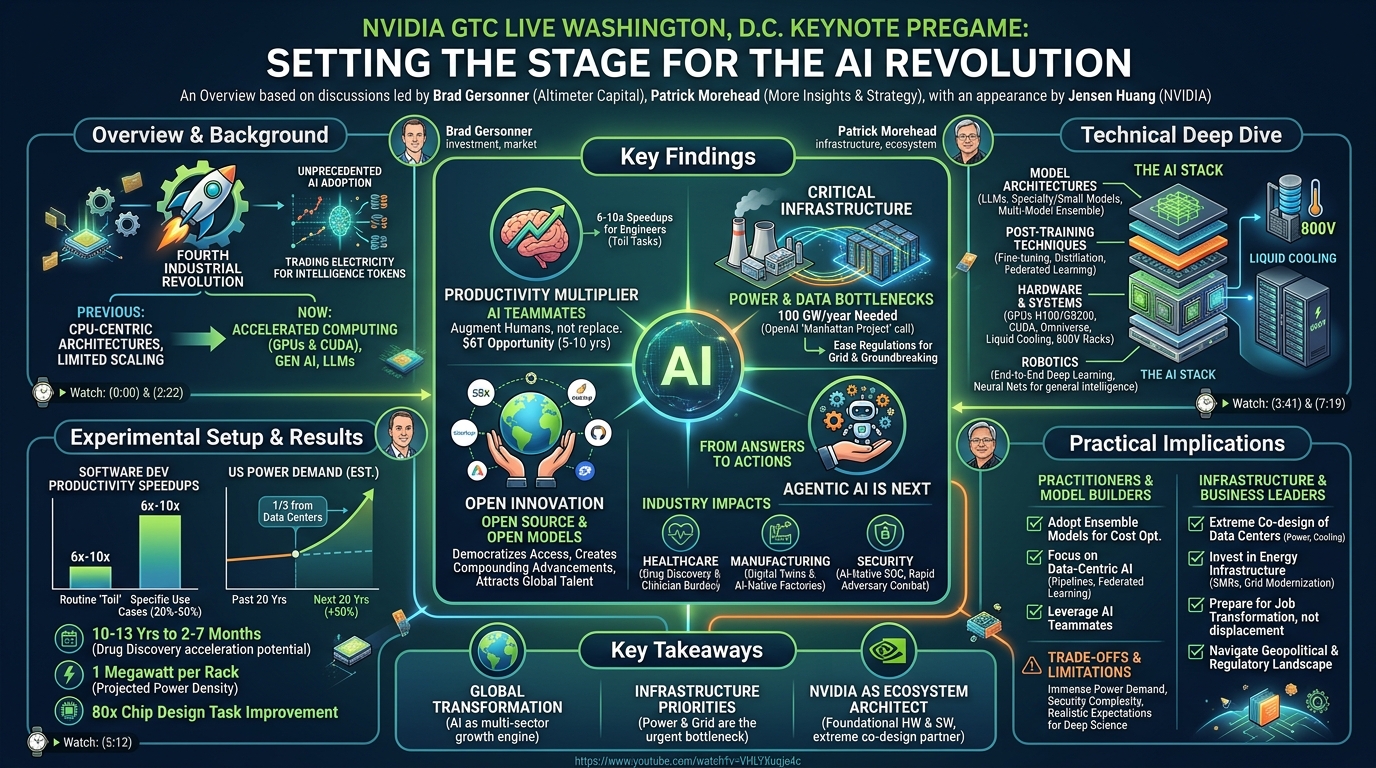
The current era of artificial intelligence is characterized by an unprecedented acceleration in innovation and adoption, driving what many consider the fourth industrial revolution. This transformation is deeply rooted in significant advancements in computing power, particularly accelerated computing, pioneered by NVIDIA. For over a decade, NVIDIA has invested heavily in its platform, with CUDA evolving from a GPU programming toolkit into the backbone of the global AI community. This ecosystem, comprising millions of engineers, researchers, and creators, leverages parallel computing to drive breakthroughs in fields ranging from genomics and robotics to generative AI.
The problem AI addresses in the ML/systems space is multifaceted. Firstly, traditional CPU-centric architectures struggle to handle the massive computational demands of modern deep learning models, particularly Large Language Models (LLMs). This necessitated the development of specialized hardware like GPUs and an accompanying software stack like CUDA to enable efficient parallel processing. Secondly, the sheer scale of data required to train and deploy these sophisticated AI models demands an entirely new approach to infrastructure. Data centers are no longer just repositories; they are "AI factories" that transform electricity into "tokens" of intelligence. This shift creates immense pressure on existing power grids, cooling systems, and supply chains, highlighting a critical bottleneck in the continued scaling of AI.
Prior work in the ML/systems space laid the groundwork for this moment, but the current trajectory of AI, especially with the rise of foundation models and agentic AI, demands a rethinking of traditional IT infrastructure. The discussions at GTC Live underscore that AI is not merely an application but a fundamental force reshaping every aspect of industry, security, and science. This necessitates a holistic, ecosystem-wide approach, where hardware, software, data, and even policy converge to enable the next wave of innovation, positioning NVIDIA's integrated platform as a central enabler.
Key Findings
▶ Watch: NVIDIA's unique role in building the AI ecosystem (2:22)
The GTC Live Washington, D.C. pregame keynote brought forth several key findings and insights from a diverse panel of industry leaders:
- AI as a Productivity Multiplier, Not Just a Job Replacer: While concerns about job displacement persist, the consensus among panelists like Martin Casado (Andreessen Horowitz) and Naveen Chara (Mayfield) was that AI primarily augments human capabilities. Chara predicted a "$6 trillion opportunity" in AI teammates that accelerate productivity, amplify creativity, and enable a billion people to become creators through tools like VIP coding, moving humans from mundane tasks to higher-value work. Scott Woo (Cognition) noted 6 to 10x speedups for engineers on "toil" tasks like migrations and replatforming.
- The Primacy of Infrastructure: Power and Data: A recurring and critical finding was that the single biggest bottleneck to AI scaling is power generation and data center infrastructure. Martin Casado stated that easing regulations on breaking ground for new data centers and adding power is the most impactful non-technical action to increase AI throughput. OpenAI's call for a "Manhattan-like project" for power generation, targeting 100 gigawatts per year, was cited as evidence of this urgent need. Data was also highlighted as a primitive, with models being "data frozen in time," requiring robust data machinery.
- The Power of Openness in AI: Sarah Guo (Conviction) emphasized that open source and open models drive innovation by democratizing access, allowing more entrepreneurs to build applications, and creating compounding advancements. While geopolitical considerations exist, the overall sentiment was that strategically open approaches, attracting global talent and capital, are vital for national leadership in AI.
- Agentic AI: The Next Frontier: The transition from "answers" to "actions" was identified as the next 10x moment for AI. Aravan Srinivas (Perplexity) predicted that agents capable of complex, multi-step tasks like booking travel or managing emails will be commonplace within months, operating asynchronously in the background. Scott Woo (Cognition) detailed how coding agents like Devon can perform hundreds or thousands of queries for a single human ask, demonstrating their compute-hungry but highly productive nature.
- AI's Transformative Impact Across Industries:
- Healthcare: Eli Lilly's Dio (Chief Information and Digital Officer) discussed using 45+ internal LLMs and federated learning to accelerate drug discovery, aiming to cut the 13-year average timeline in half over the next decade. Shiv Gaglani (aBridge) highlighted AI's role in unburdening clinicians from clerical work, improving patient care and documentation.
- Manufacturing & Robotics: Peter Kouta (Siemens AG) described AI-native factories built first as digital twins for optimization before physical construction, enabling unprecedented speed and productivity. Brett Adcock (Figure AI) showcased humanoid robots capable of human-like work, operating commercially and aiming for general-purpose physical intelligence through end-to-end neural nets.
- Security: George Kurtz (CrowdStrike) emphasized data as key to security, with AI enabling an AI-native SOC (Security Operations Center) to combat adversaries who now exploit vulnerabilities in minutes.
- NVIDIA's Ecosystem Leadership: Speakers consistently praised NVIDIA's unique role in curating and pushing forward the entire AI ecosystem, from GPUs and CUDA to Omniverse and advanced data center designs. Its partnerships across power generation (GE Vernova, Schneider Electric), data center operators (Crusoe, CoreWeave), and software developers (Cadence) were highlighted as critical for collective progress.
- The "Token" as the New Economic Primitive: Jensen Huang's impromptu appearance reinforced that AI fundamentally transforms electricity into "tokens"—numbers representing everything from words and images to motions and chemical structures. This profitable token generation is seen as the virtuous cycle driving investment and scale, akin to the first profitable wafer in semiconductor manufacturing.
Technical Deep Dive
▶ Watch: Overview of pre-keynote panel discussions and topics (3:41)
The GTC Live event illuminated several critical technical advancements and architectural shifts underpinning the AI revolution, heavily influenced by NVIDIA's ecosystem.
Model Architectures and Training/Inference Techniques:
The discussion frequently touched upon Large Language Models (LLMs) as foundational, but also emphasized the growing importance of specialized and smaller models for specific tasks and edge deployment. Eli Lilly, for instance, utilizes over 45 internal models, highlighting a multi-model approach. Companies like Cognition and aBridge employ ensemble model approaches, hitting multiple models (e.g., 19-20 times for aBridge for a single patient encounter) to generate outputs efficiently. This strategy is crucial for driving down the cost of inference and leveraging the "frontier of models" by using the most expensive, smartest models only when absolutely necessary, and faster, cheaper models for routine tasks.
Post-training, fine-tuning, and distillation were identified as key techniques for adapting open-source models or commercial LLMs to bespoke enterprise data, enabling highly specialized agents that are both effective and cost-efficient. For instance, Siemens retrains general language models for specific machine programming tasks in manufacturing. Federated learning was highlighted by Eli Lilly as a critical protocol for collaborative model training across biotech firms, allowing models to learn from millions of proprietary molecules (including those that don't work, which are crucial for training) without exposing sensitive source data.
Systems Design and Hardware/Software Stack:
The concept of the data center as an "AI factory" was central. This factory transforms electricity into tokens, demanding extreme co-design across the entire stack. Key innovations discussed include:
- 800-volt (800V) rack designs: NVIDIA is pushing this, moving from traditional 48V, to achieve massive efficiency gains in power delivery within data centers. This requires a complete rethink of the power train and thermal chain, moving from component-at-a-time builds to integrally designed, modular systems.
- Liquid cooling: A "colossal change" in data center design, transitioning from air-cooled to hybrid or fully liquid-cooled systems to manage the escalating heat densities of high-performance GPUs (e.g., GB200s).
- Memory optimization: Crusoe is focused on software aspects of operating AI factories, particularly optimizing how data moves from object storage directly into HBM (High Bandwidth Memory) to maximize GPU utilization and "intelligence per unit of investment."
- NVIDIA's comprehensive ecosystem: Beyond GPUs (H100s, H200s, upcoming GB200s), NVIDIA's software stack like CUDA, Omniverse (for digital twins and simulation), Neotron, and tools like Lepton (distribution for getting compute into hands) and Dynamo (accelerating inference) are critical for driving this integrated approach.
Algorithms and Robotics:
In robotics, Figure AI's Brett Adcock emphasized that solving general-purpose humanoid robotics requires end-to-end deep learning and neural networks, rather than traditional coding. With 40 different joints, the number of possible states for a robot's body position is astronomical, making neural nets the only tractable solution. These robots utilize onboard GPUs for AI processing to run policies and perform inference without external network connections, enabling autonomous operation in the physical world.
Power Generation and Grid Infrastructure:
The sheer scale of AI factories—with individual racks potentially consuming 1 megawatt (the power of a thousand homes)—demands significant innovation in power generation and grid management. GE Vernova is quadrupling its gas turbine capacity by 2028 and exploring all power sources (gas, nuclear, solar, wind, hydrogen), including Small Modular Reactors (SMRs). Schneider Electric highlighted the role of AI in making energy infrastructure more efficient, leveraging electrification, automation, and digitalization to design, build, and maintain AI factories, including digital twins for power and cooling simulation. Innovations in power electronics and battery energy storage systems are crucial for managing massive load oscillations from AI training workloads and stabilizing the grid.
Cadence discussed AI for design, applying AI to accelerate chip and electronic system design, which involves a complex mix of CS, math, and physics. This aims for "10x productivity improvement" to handle chips that will be 10 times bigger and systems 30-40 times more complex by 2030. The integration of CPU and GPU in platforms like Grace Hopper and Grace Blackwell provides a powerful foundation for scientific and AI workloads.
Experimental Setup & Results
▶ Watch: Live report from the GTC conference floor (5:12)
While the GTC Live pregame featured high-level strategic discussions rather than detailed academic presentations, several concrete examples and quantitative results were shared, highlighting the tangible impact of AI and accelerated computing:
- Software Development Productivity: Scott Woo of Cognition reported significant productivity gains for software engineers using AI coding agents. For routine "engineering toil" tasks like migrations and replatforming, companies are seeing 6 to 10x speedups. For more specific, gritty use cases, speedups are in the range of 20% to 50%.
- AI Teammates Market Opportunity: Naveen Chara projected a $6 trillion opportunity for AI teammates within 5-10 years, representing 20% of the global knowledge worker spend, driven by enhanced productivity and new capabilities.
- Drug Discovery Timelines: Eli Lilly's Chief Information and Digital Officer noted that traditional drug discovery takes an average of 10-13 years and $2.6-$4 billion per drug, with 9 out of 10 drugs failing clinical trials. AI, however, is beginning to accelerate this. Mark Tessier Lavine (Zyra Therapeutics) mentioned a company that went from project initiation to clinical trials in two years, significantly faster than the typical five years. George Church (Leela Sciences) cited a record case of seven months from birth diagnosis to cure using gene therapy for baby KJ. The ambition is to cut the 13-year timeline and attrition rates in half within the next decade.
- Data Center Growth and Power Demand: The US power demand, flat for 20 years, is expected to grow 50% in the next 20 years, with one-third of that coming from data centers. NVIDIA CEO Jensen Huang predicts data center buildout will reach $1 trillion. CoreWeave is planning to build 2 gigawatts of capacity in West Texas alone. GE Vernova is quadrupling its gas turbine capacity by 2028 compared to 2020.
- Data Center Power Density: Chase Lockach Miller (Crusoe) highlighted the dramatic increase in power density, noting that a single rack in a data center, historically 2-4 kilowatts 20 years ago, now reaches 130-140 kilowatts with GB200s, and projected to reach 1 megawatt with future architectures like Vera Rubin and Fineman.
- Robotics Development: Figure AI, a three-and-a-half-year-old company with 400 employees and a $3.9 billion valuation, has robots running commercially for 10-hour shifts for almost six months, demonstrating dropping fault rates and rising performance.
- Chip Design Acceleration: Cadence announced a joint product with NVIDIA that provides up to 80x improvement in certain chip design tasks and 20x lower power consumption using NVIDIA's accelerated platform.
- Market Valuation: NVIDIA's stock climb of 1400% in the last year and a market cap approaching $5 trillion (at the time of the talk) were cited as indicators of the market's response to AI's impact.
These figures, while not always presented with traditional scientific rigor, provide concrete evidence of the scale, speed, and economic impact of the AI transformation discussed throughout the event.
Practical Implications
▶ Watch: The evolution and impact of NVIDIA's CUDA platform (7:19)
The discussions at GTC Live Washington, D.C. have profound practical implications for a wide array of stakeholders in the AI ecosystem:
- For Practitioners and Model Builders:
- Increased Productivity: Software engineers and knowledge workers can expect significant productivity boosts (e.g., 6-10x for coding toil) by integrating AI tools and AI teammates. The emphasis shifts from mundane tasks to higher-level creative and strategic work.
- Specialization and Ensemble Models: Model builders should explore fine-tuning, post-training, and distillation techniques on open-source or commercial LLMs to create highly specialized, cost-effective agents for specific enterprise use cases. The ensemble model approach is critical for optimizing inference costs by dynamically selecting the right model for the job.
- Data-Centric AI: The quality and curation of data remain paramount. Practitioners need robust data pipelines that can feed models effectively, even leveraging "unhelpful" data (like failed drug molecules) for comprehensive training. Federated learning offers a blueprint for collaborative, privacy-preserving data utilization.
- Hardware Agnosticism (for software): As emphasized by Perplexity, software companies should aim for hardware-agnostic solutions where possible, ensuring broad accessibility and adaptability across diverse device ecosystems.
- For Infrastructure Teams and Deployers:
- Massive Buildout and Power Challenges: Infrastructure teams face the monumental task of building gigawatt-scale AI factories. This requires aggressive investment in power generation (including new nuclear, gas, renewables), grid modernization, and innovative cooling solutions (liquid cooling, 800V rack designs).
- Public-Private Partnerships: Overcoming regulatory hurdles for data center construction and power infrastructure will necessitate strong collaboration with government entities, streamlining permitting processes and recognizing AI infrastructure as a national priority.
- Extreme Co-Design: A shift from component-level thinking to holistic system design is essential. This includes optimizing the entire power train, thermal chain, and networking stack to maximize efficiency and GPU utilization (e.g., moving data efficiently to HBM).
- Operational Intelligence: AI will be leveraged to manage the AI factories themselves, with digital twins for simulation, optimization, and predictive maintenance of power and cooling systems.
- For Business Leaders and Investors:
- Long-Term Investment Horizon: AI, particularly in deep science like drug discovery, operates on multi-year to multi-decade timelines. Businesses and investors must adopt a long-term perspective, understanding that significant returns may not be immediate but are transformative.
- Strategic Openness: Embracing open models and open-source contributions can foster innovation and market growth, but requires careful consideration of national security implications and supply chain control.
- Geopolitical Considerations: The "AI race" has national security implications, making government partnerships and policy engagement crucial for securing competitive advantages and addressing international trade dynamics (e.g., US-China chip trade).
- New Economic Primitives: The concept of "profitable token generation" as the new economic driver suggests that businesses should focus on how AI can convert raw inputs (electricity, data) into valuable, actionable intelligence.
- Human-Robot Collaboration: While job displacement is a concern, the emphasis is on job transformation. Businesses should prepare for a future workforce augmented by AI agents and humanoid robots, focusing on upskilling and new job creation.
Tradeoffs and Limitations:
The path forward is not without challenges. The immense power requirements of AI pose significant environmental and logistical hurdles. Regulatory frameworks are still evolving, and striking the right balance between innovation and oversight is crucial. The "doomerism" surrounding AI's impact on jobs, while countered by optimism for productivity, still necessitates thoughtful societal adaptation. Furthermore, the long cycle times for scientific breakthroughs, even with AI acceleration, mean that expectations must be managed realistically. Security also becomes exponentially more complex as AI democratizes both defense and offense, requiring continuous innovation in AI-native SOCs and data-driven security.
Key Takeaways
- AI is fundamentally transforming the global economy, acting as a massive productivity multiplier across all industries, from software development and healthcare to manufacturing and scientific discovery.
- Infrastructure, particularly power and data centers, is the primary bottleneck for scaling AI. Addressing this requires unprecedented investment, public-private partnerships, and innovations in energy generation, grid modernization, and cooling technologies.
- Agentic AI, capable of taking actions and generating new ideas asynchronously, represents the next major leap, moving beyond simple question-answering to performing complex, multi-step tasks for both consumers and enterprises.
- NVIDIA plays a unique and central role as the architect of a comprehensive AI ecosystem, providing the foundational hardware (GPUs like GB200s) and software (CUDA, Omniverse) that enables extreme co-design and accelerates innovation across diverse partners.
- Open models and strategic openness are critical for democratizing AI, fostering rapid innovation, and maintaining national leadership, while requiring careful consideration of geopolitical and security implications.
- The "token" is emerging as a new economic primitive, with AI transforming electricity into valuable intelligence, driving a virtuous cycle of investment and profitable growth across the entire AI value chain.
About the Speaker(s)
Brad Gersonner is the Founder and CEO of Altimeter Capital. With a deep background in technology and investing, Gersonner has been a long-time believer in NVIDIA's accelerated computing platform. He co-hosted the GTC Live pregame event, guiding discussions on AI's economic impact, investment trends, and the strategic importance of AI for national competitiveness. His insights often focused on the intersection of technology, market dynamics, and policy.
Patrick Morehead is the Founder, CEO, and Chief Analyst at More Insights and Strategy. With three decades of experience in tech, tracking silicon, infrastructure, compute, and software, Morehead provided expert analysis on NVIDIA's central role in creating the entire AI ecosystem. As a co-host, he emphasized NVIDIA's leadership position, not just in chips, but in complete AI systems and software stacks, and the need to understand the context, commitment, wins, and challenges of the AI era.
Jensen Huang is the co-founder, President, and CEO of NVIDIA. Though not a scheduled panelist for the pregame, Huang made an impromptu appearance, underscoring his vision for AI and its future. He emphasized the concept of profitable token generation as the core economic driver of AI, equating AI factories to transforming electricity into tokens. Huang also highlighted NVIDIA's role in building out the AI ecosystem and the importance of working with partners across the stack. His presence reinforced NVIDIA's leadership and commitment to advancing AI as a national treasure.
The event also featured over 20 other notable speakers, including:
- Thomas Leafant (co-founder, CO2 Management), Sarah Guo (founder, Conviction), Martin Casado (general partner, Andreessen Horowitz), and Naveen Chara (managing partner, Mayfield) discussed AI innovation and investment.
- Dio (Chief Information and Digital Officer, Eli Lilly) and Shiv Gaglani (founder & CEO, aBridge) provided insights into AI in healthcare.
- Aravan Srinivas (co-founder & CEO, Perplexity), Scott Woo (founder & CEO, Cognition), and George Kurtz (founder & CEO, CrowdStrike) spoke about agentic AI and its applications.
- Mike Contractor (co-founder, chairman, CoreWeave), Gio Albertazi (CEO, Verdive), Olivier Bloom (CEO, Schneider Electric), Krishna Jonagato (CTO, GE Vernova), and Chase Lockach Miller (co-founder & CEO, Crusoe) detailed the AI infrastructure buildout.
- George Church (chief scientist, Leela Sciences), Matt Kinzella (CEO, Inflection), Mark Tessier Lavine (co-founder, chairman, Zyra Therapeutics), and Anirude Devon (president & CEO, Cadence) explored AI in science and quantum computing.
- Peter Kouta (CTO & CSO, Siemens AG), Young Liu (chairman & CEO, Foxconn), Brett Adcock (founder & CEO, Figure AI), and Aki Jane (president & CTO, Palantir US Government) discussed AI, robotics, and manufacturing.
Each speaker brought unique perspectives from their respective fields, contributing to a comprehensive overview of the AI landscape.
Reviews
Simon Wisk (Open Source Developer & AI Tooling Expert) — PASS
A pregame hype show for an NVIDIA keynote, dressed up with bullet points and bolded buzzwords to look like a technical article. There is no engineering content here — just a collection of VC talking points, market cap figures, and product announcements from a roster of people with obvious financial interests in NVIDIA's continued ascendancy. Nothing in this article would help an engineer build anything differently tomorrow.
Jensen Hitch (AI Compute Platform CEO) — WEAK
This is a pregame hype show, not a technical talk. It assembles credible voices from across the AI ecosystem and surfaces real structural themes — power as the binding constraint, the AI factory framing, inference cost dynamics — but it never goes deep enough on any of them to change how an engineer thinks or builds. The format is inherently diffuse: 20+ speakers, each delivering four-minute takes on topics that deserve hours of rigorous treatment. What you get is a collection of declarative headlines with no load-bearing technical content underneath. The 'findings' are real, but they're already widely known. The 'technical deep dive' is a glossary recitation, not an engineering analysis…