Nakatomi Space: Lateral Movement As L1 Post-Exploitation In OT
Jos Wetzels (Security Researcher · Forescout)
HITBSecConf2023 - Amsterdam · Day 1 · Track 1
Overview
In the realm of Operational Technology (OT) security, traditional lateral movement discussions often revolve around traversing higher-level network segments within the Purdue model, such as the enterprise-to-control layer DMZs. However, Jos Wetzels, a Security Researcher at Forescout, presented a groundbreaking talk at HITB Amsterdam, "Nakatomi Space: Lateral Movement As L1 Post-Exploitation In OT," that challenges this conventional wisdom. Wetzels unveiled a novel approach to lateral movement, focusing on the deepest echelons of OT networks – Level 1 control devices like PLCs, RTUs, and IEDs – demonstrating how attackers can leverage these often-overlooked systems to achieve unprecedented levels of granular control and bypass what are typically considered hardened perimeters.
Key moments
- 0:00 Introduction to OT lateral movement and Purdue model
- 2:15 The 'Nakatomi Space' concept for OT networks
- 5:50 Lateral movement into Safety Instrumented Systems (SIS)
- 14:00 Technical tactics for deep level one lateral movement
- 21:50 Exploiting WAGO coupler and M340 PLC authentication
- 31:00 Hot patching PLC memory for stealthy code execution
- 45:50 Full attack chain demonstrated in a video
- 50:50 Practical mitigations, detections, and forensics advice
Nakatomi Space: Lateral Movement As L1 Post-Exploitation In OT
Speakers: Jos Wetzels, Security Researcher, Forescout
Conference: HITB Amsterdam
YouTube: https://www.youtube.com/watch?v=0b87g3tY6bY
Overview
In the realm of Operational Technology (OT) security, traditional lateral movement discussions often revolve around traversing higher-level network segments within the Purdue model, such as the enterprise-to-control layer DMZs. However, Jos Wetzels, a Security Researcher at Forescout, presented a groundbreaking talk at HITB Amsterdam, "Nakatomi Space: Lateral Movement As L1 Post-Exploitation In OT," that challenges this conventional wisdom. Wetzels unveiled a novel approach to lateral movement, focusing on the deepest echelons of OT networks – Level 1 control devices like PLCs, RTUs, and IEDs – demonstrating how attackers can leverage these often-overlooked systems to achieve unprecedented levels of granular control and bypass what are typically considered hardened perimeters.
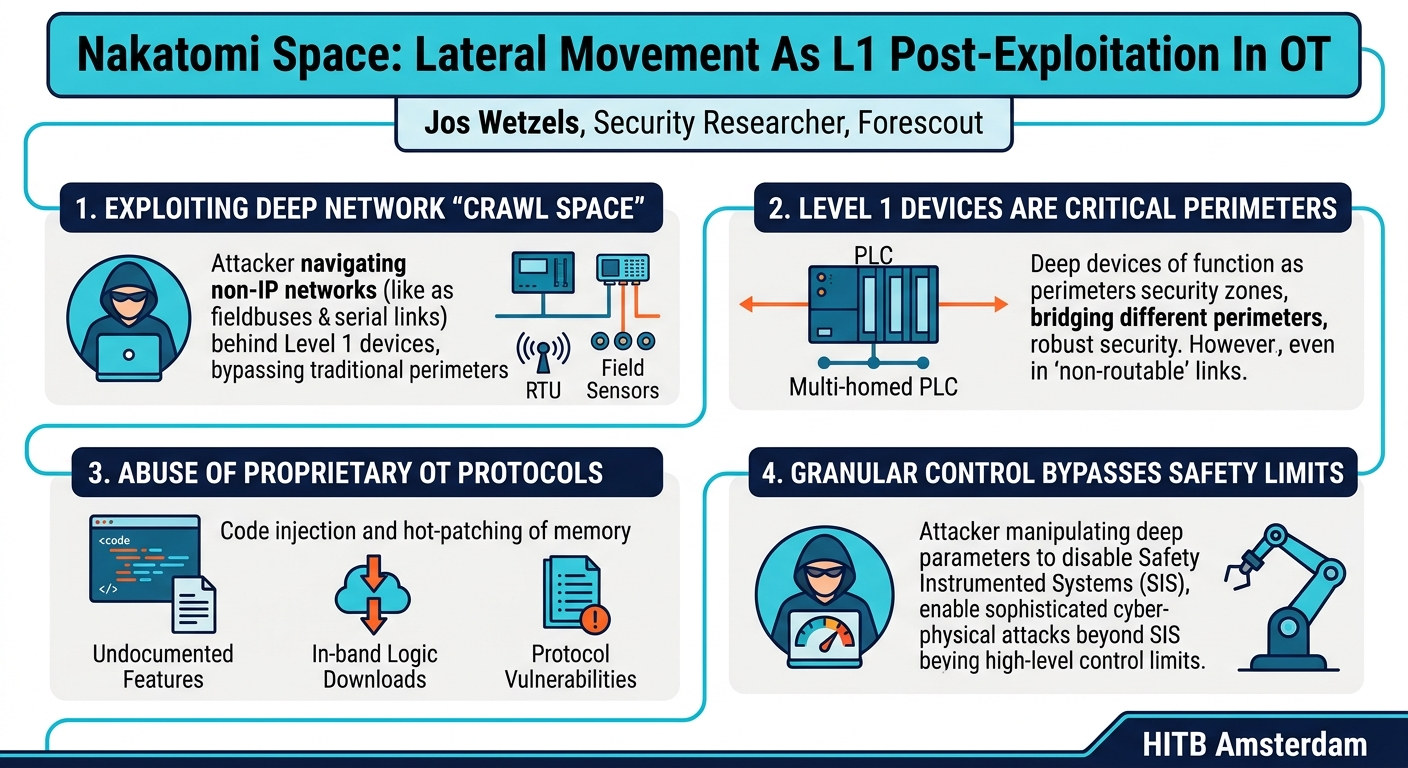
The talk introduces the "Nakatomi Space" concept, drawing inspiration from the movie Die Hard, where Bruce Willis navigates a building through its unseen architectural elements like vents and shafts. In OT, this translates to exploiting the "network crawl space" – the myriad of non-IP, point-to-point, or deeply nested fieldbus networks that exist behind Level 1 devices, often with zero visibility or security acknowledgment. Wetzels meticulously details a multi-stage attack chain, featuring multiple zero-day vulnerabilities and novel exploitation techniques, to illustrate how an attacker can move from an initial foothold on a gateway device, through an object PLC, and ultimately into a safety instrumented system (SIS) PLC, gaining complete, stealthy control over critical industrial processes.
This research is profoundly significant because it exposes a critical blind spot in current OT security strategies. By demonstrating the feasibility of deep lateral movement, Wetzels highlights that even deeply embedded Level 1 devices, if multi-homed or positioned between different security zones, act as crucial perimeter devices requiring a robust security profile. The findings compel defenders to reconsider their risk assessments, extend their visibility and monitoring capabilities into the lowest levels of the Purdue model, and acknowledge that the impact of a device compromise is not limited to its immediate connectivity but can cascade through multiple orders of nested systems, enabling sophisticated cyber-physical attacks previously thought impossible.
Background
▶ Watch: Introduction to OT lateral movement and Purdue model (0:00)
The widely adopted Purdue Enterprise Reference Architecture model serves as a fundamental framework for segmenting OT networks. At its apex (Levels 4 and 5), lie the enterprise networks and the internet DMZ. Below this, Level 3.5 typically hosts the control center layer with SCADA HMIs, historians, and domain controllers, followed by a Level 2.5 DMZ leading to remote supervisory levels at specific sites. The focus of Wetzels' research, however, is on Level 1, the deepest tier where Programmable Logic Controllers (PLCs), Remote Terminal Units (RTUs), and Intelligent Electronic Devices (IEDs) reside, directly interfacing with physical processes.
Historically, lateral movement in OT security has predominantly concentrated on breaching the classical perimeters at Level 3.5 and 2.5, where the IT/OT divide is typically enforced. There has also been some focus on "upstream hacking," where an attacker with deep access attempts to move upwards into SCADA systems. What has been largely overlooked, however, is the possibility of "hacking down" into these deepest levels of control systems. This oversight stems from a common misconception that once an attacker gains access to an OT network, the inherent insecurity of many OT devices renders further deep exploitation unnecessary. Wetzels argues that this perspective misses crucial attack vectors and capabilities.
The core concept of "Nakatomi Space" eloquently captures this blind spot. It refers to leveraging architectural elements with latent potential for unintended traversal, much like Bruce Willis navigating the Nakatomi Plaza through ventilation shafts. In OT, this "network crawl space" includes diverse, often non-IP networks such as fieldbus networks (e.g., Profibus, CANopen), radio frequency links, and point-to-point connections to third-party systems. These deeply nested networks often suffer from a complete lack of visibility, unacknowledged perimeters, and an inability to detect malicious activity, making them ideal for stealthy lateral movement.
Wetzels outlines compelling reasons for an attacker to pursue such deep lateral movement:
- Crossing Hardened or Unacknowledged Perimeters: Even deep within OT, multi-homed devices can act as perimeter devices. A prime example is the interface between a Basic Process Control System (BPCS) and a Safety Instrumented System (SIS). While often logically separate, modern architectures increasingly integrate these systems. In an "interface architecture," a direct point-to-point connection (Ethernet or serial) between a BPCS controller and an SIS controller allows an attacker with code execution on the BPCS to jump directly into the SIS, even if the latter is otherwise fully segmented. This enables manipulation of SIS bypasses, critical safety functions that, if disabled, can allow an attacker to execute cyber-physical attacks without the safety system kicking in. Another example involves packaged units – black-box control systems from third-party vendors (e.g., HVAC, turbines). These often have an API interface to the asset owner's system but may also feature remote maintenance links (e.g., cellular modems), creating unacknowledged external access points deep within the network.
- Achieving Granular Control: Standard SCADA interfaces typically offer high-level control. However, many deeply nested devices (e.g., variable speed drives) have settings not directly mapped to the master PLC. To bypass internal safety limits within a control device (e.g., pushing a pump beyond its "sanity check" pressure limits), an attacker might need to make firmware modifications, requiring direct, deep access. This level of granular control is crucial for complex, impactful cyber-physical attacks.
The concept of deep lateral movement finds parallels in automotive exploitation, where attackers often gain initial access via an infotainment unit and then must hop through multiple Electronic Control Units (ECUs) and gateways to reach critical buses like the CAN bus, demonstrating the need for multi-stage compromises to achieve specific objectives.
Despite these realities, vendors and standards frequently offer limited advice for non-routable links (e.g., a direct Ethernet cable with static IPs, or a serial link), often considering them inherently secure due to their physical isolation. Backplane security and multi-zone devices at Level 1 have received almost no attention, leaving significant security gaps.
Key Findings
▶ Watch: Lateral movement into Safety Instrumented Systems (SIS) (5:50)
The central finding of this research is the undeniable existence and exploitability of "network crawl space" within Level 1 OT environments. Jos Wetzels demonstrates that deeply nested networks, often comprising non-IP protocols, serial links, and proprietary interfaces, are not only accessible but also offer critical pathways for lateral movement that are routinely overlooked by traditional OT security models.
Key technical findings and contributions include:
- Novel Lateral Movement TTPs for L1 OT: Wetzels outlines specific tactics, techniques, and procedures (TTPs) for deep lateral movement:
- Routing and Encapsulation: Leveraging inherent capabilities of OT protocols like SIP, AS7 com, EtherCAT, and Modbus My to route or encapsulate other protocols across multiple layers, reaching deeply nested devices.
- Abusing In-Band Code Downloads: Exploiting the ability to download program logic or firmware updates through the same channel as regular communication, often without requiring a dedicated device update mode.
- Direct Memory Manipulation: Utilizing proprietary interfaces to write directly to device memory, frequently lacking crucial bounds checks or Access Control Lists (ACLs).
- Protocol Stack Vulnerabilities: Acknowledging that proprietary or embedded protocol parsers, often written in C, are susceptible to common software vulnerabilities.
- Multi-Stage, Multi-Vendor Attack Chain: The research presents a concrete, multi-hop attack chain demonstrating lateral movement across three distinct vendors and device types: a WAGO coupler, a Schneider Electric PLC, and an Allen-Bradley safety PLC. This highlights the cross-vendor interoperability of these attack techniques.
- Discovery of New Vulnerabilities and Exploitation Techniques:
- WAGO 750-852 Coupler: Exploitation of a previously unknown Nucleus 13 vulnerability (CVE-2022-47595) in the Nucleus net TCP/IP stack's FTP server, leading to remote code execution (RCE) via a stack buffer overflow and a write-four primitive.
- Schneider Electric M340 PLC (UMAS Protocol): Discovery of two novel authentication bypasses for the proprietary UMAS protocol (Modbus Function Code 0x5A), enabling an attacker to forge authenticated requests or replay reservation attempts.
- Schneider Electric M340 PLC (Code Execution): Identification and exploitation of an obscure, undocumented protocol feature – the CSA request (service code 0x50) – allowing for "hot patching" of executable code in memory without triggering a PLC restart or altering project checksums, thereby achieving stealthy RCE.
- Allen-Bradley 1756-EN2D Ethernet Module: Exploitation of an Urgent 11 vulnerability (CVE-2020-14490) in the Wind River IPnet TCP/IP stack, leading to RCE on the safety PLC's Ethernet module, despite the presence of an execute-never bit, which required a carefully crafted ROP chain.
- Implications for Risk Assessment: The findings underscore that conventional risk assessments for cyber-physical systems often underestimate the potential impact of compromise by assuming certain physical limitations (e.g., safety limits, creep speed) cannot be bypassed. Deep access to Level 1 devices fundamentally changes what is possible, demanding a re-evaluation of these assumptions.
Technical Deep Dive
▶ Watch: Exploiting WAGO coupler and M340 PLC authentication (21:50)
The talk meticulously unpacks a complex, multi-stage attack chain designed to demonstrate deep lateral movement in an OT environment. The scenario focuses on a movable bascule bridge management system, chosen for its critical cyber-physical interactions. The attacker’s goals are to cause significant damage, such as closing the bridge at full speed (bypassing deceleration) or driving the lock bar prematurely, or triggering an emergency stop at maximum velocity to induce structural stress. These objectives necessitate highly granular control over Level 1 devices, far beyond what a typical SCADA system interface would allow.
The demo architecture comprises several common OT components:
- A central SCADA system (top-level).
- A WAGO 750-852 Ethernet coupler/gateway, acting as an interface to the bridge's local control system.
- A Schneider Electric M340 PLC, serving as the primary "object PLC" managing the bridge's mechanical operations.
- An Allen-Bradley GuardLogix Safety PLC, connected to the M340 via a restricted, point-to-point Ethernet link, responsible for safety functions.
The attacker's journey through this architecture involves several critical hops:
Step 1: Initial Foothold on the WAGO 750-852 Coupler
The first objective is to gain remote code execution (RCE) on the WAGO 750-852 coupler, a Modbus-based device. This device acts as a limited gateway, restricting direct access to the nested networks behind it. Wetzels targeted its firmware, which uses the Nucleus real-time operating system (RTOS) on an ARM architecture. By leveraging binary differential analysis tools (BinDiff, Diaphora) with older Nucleus OS firmwares, he recovered symbols, revealing the use of the Nucleus net TCP/IP stack.
This stack was previously found to contain several Nucleus 13 vulnerabilities, including CVE-2022-47595, a stack buffer overflow in the FTP server's user command. The vulnerability arises because the FTPD checks the string length but copies data until a carriage return, not respecting a crafted null byte terminator. By injecting a username with a fake null byte, an attacker can overflow a 32-byte user buffer, overwriting subsequent FTP events linked list pointers. This provides a write-four primitive, allowing the attacker to write an arbitrary 4-byte value to an arbitrary memory address.
The exploit uses this primitive to write shellcode to a fully read-write-executable (RWX) BSS area. Then, it hijacks the span process packet function pointer, which normally processes certain network packets, redirecting its execution to the injected shellcode. Subsequent network packets trigger the shellcode. Since the exploit runs in ARM supervisor mode with no task separation, no privilege escalation is required. To overcome payload size restrictions, a staged approach is used: a small loader receives the main implant in chunks, stitches them together, and then triggers the larger payload. This implant creates a Nucleus RTOS task and hooks the Modbus handler to proxy specific Modbus traffic (function code 0x5A) to the M340 PLC behind it.
Step 2: Lateral Movement and RCE on the Schneider Electric M340 PLC
With the WAGO coupler compromised and acting as a proxy, the attacker can now communicate with the Schneider Electric M340 PLC using the proprietary UMAS protocol (Modbus Function Code 0x5A). This engineering protocol, used for Schneider Modicon PLCs, allows for powerful operations like starting/stopping the PLC, downloading/uploading logic, and reading/writing memory blocks.
Historically, UMAS was unauthenticated, but Schneider introduced an application password. Previous research identified a client-side authentication bypass, where the PLC would hand over the secret needed for authentication upon request. While Schneider patched this, Wetzels discovered two new bypasses:
- Reservation Replay Attack: The authentication mechanism uses a global nonce. By sniffing a legitimate session's nonce exchange and authentication hash, an attacker can replay this hash to gain a reservation ID. This method, however, locks out the legitimate session, reducing stealth.
- Forged Authenticated Requests: The signature for authenticated requests consists of the nonce and a publicly known hardware ID. Crucially, there's no secret in the signature itself. By sniffing the nonce and reservation ID from a legitimate session, an attacker can forge subsequent authenticated UMAS requests without locking out the original user.
To achieve RCE on the M340 PLC, Wetzels sought a method for hot patching – executing code directly in memory without causing a PLC restart or process upsets, which would trigger alarms and compromise stealth. The M340 firmware uses the LDX format, containing a VxWorks BMX binary (VxWorks 6.4 on ARMv4, lacking hardware NX support). Wetzels exploited a previously unexplored and undocumented feature: the CSA request (service code 0x50). This request allows direct manipulation of "virtual pages" in the PLC's memory, enabling read, write, and execute operations on blocks of code and data.
While direct writing to executable code blocks is restricted, the CSA request's copy operation bypasses this permission check. The attacker writes arbitrary shellcode to a data block and then uses the CSA copy command to move this data block into an executable code block, which is then executed as part of the PLC's normal runtime logic. This method is highly stealthy: it doesn't trigger restarts, doesn't change project checksums, and the modifications are not visible in the engineering software's source code.
The injected code initially executes within the context of the PLC's runtime logic (SAS user code exec), which is subject to a scan cycle timer (watchdog). To escape this, the implant hijacks a triggerable function pointer (e.g., one handling specific network traffic packets) and points it to the payload. Sending the correct packet then executes the payload in a different, unscheduled context. The implant then spawns a dedicated VxWorks RTOS task for scheduled execution and performs anti-forensics by cleaning up the manipulated memory blocks. With this "god mode" access, the attacker can interact with internal firmware components like the backplane device driver, CANopen device driver, and raw socket libraries.
This access allows for further exploitation of devices connected via CANopen, a fieldbus protocol. Through Service Data Objects (SDOs), an attacker can execute OS commands, download programs, or use debugger functionality on connected devices (e.g., motor drives, encoders). Often, any authentication on these SDOs is a static 32-bit password, trivial to discover.
Step 3: Lateral Movement and RCE on the Allen-Bradley GuardLogix Safety PLC
The final hop is to the Allen-Bradley GuardLogix Safety PLC, connected to the M340 via a dedicated 1756-EN2D Ethernet module. This is a non-routable, point-to-point link, strictly allowing only Modbus TCP traffic, making it a highly protected interface. To cross this, Wetzels targeted a protocol stack vulnerability.
The 1756-EN2D module's firmware (VxWorks 6.9.3.3 on ARM, Cortex A9, Allen-Bradley Ice 2 chip) contains the Wind River IPnet TCP/IP stack, known to be affected by Urgent 11 vulnerabilities. Specifically, CVE-2020-14490 involves a stack buffer overflow. By sending malformed IP options (e.g., multiple source record route options) that trigger an ICMP error response, the vulnerable stack copies the options to the response without validation.
Exploiting this on VxWorks is possible even with raw socket access. A key challenge here is the presence of an execute-never (NX) bit, requiring a Return-Oriented Programming (ROP) chain to bypass. Wetzels constructed a ROP chain to achieve another write-four primitive, which is then used to write the larger shellcode in 4-byte chunks to an existing RWX load segment in memory. A stack fix-up ensures proper execution flow after the exploit. This vulnerability was previously exploited on different versions, but minor adjustments to the ROP chain and gadget addresses were needed. Once RCE is achieved, the implant runs in supervisor mode, again without needing privilege escalation.
From the compromised Ethernet module, the attacker gains unconstrained access to the safety system. This includes the backplane device driver (CIP-based), allowing communication with other modules on the safety PLC (CPU, I/O) and remote I/O devices. This deep access enables manipulation of SIS bypass settings, internal tags, and the triggering of safety bypasses, directly impacting the integrity of the safety system.
Throughout these steps, anti-forensics are crucial. While PLCs generally lack introspection capabilities, and engineering software may show "everything is fine," a diligent forensic practitioner might upload the project, extract blocks, and carve the raw ARM code for malicious patterns. However, a clever attacker cleans up manipulated blocks after relocating the implant, making detection much harder. Attacker mistakes (e.g., triggering a watchdog) might be logged in crash logs, offering some indications.
Demo / Proof of Concept
▶ Watch: Hot patching PLC memory for stealthy code execution (31:00)
The talk included a compelling video demonstration that visually walked through the entire multi-stage lateral movement chain, showcasing the practical feasibility and stealth of the attack.
The demo began by illustrating the initial compromise of the WAGO 750-852 Ethernet coupler gateway. The attacker exploited the Nucleus 13 vulnerability (CVE-2022-47595) to achieve remote code execution. Once the implant was successfully installed on the WAGO coupler, it began its task of forwarding and sniffing Schneider UMAS traffic. The video then showed an unsuspecting engineer performing routine operations, authenticating to the nested Schneider M340 PLC. The WAGO implant, leveraging its sniffing capabilities, captured the necessary nonces from this legitimate session.
With the nonces acquired, the attacker then used the UMAS authentication bypass to send forged, yet seemingly authenticated, UMAS traffic to the M340 PLC. This allowed the attacker to interact with the M340's privileged interface. The next phase of the demo depicted the exploitation of the M340 PLC itself, utilizing the undocumented CSA commands (service code 0x50) to hot-patch and gain code execution directly in the PLC's memory. A critical aspect highlighted in the demo was the stealth of this technique: the engineering workstation software continued to report that everything was normal, with no indication of any changes or disruptions to the PLC's logic. This confirmed the high degree of stealth achieved by avoiding PLC restarts and checksum modifications.
Finally, with the M340 PLC compromised and an implant resident, the attacker used this new foothold to launch an attack against the previously unreachable Allen-Bradley GuardLogix safety PLC's Ethernet module. The demo showed the attacker leveraging one of the Urgent 11 exploits (CVE-2020-14490) to gain code execution on the Ethernet module. The culmination of the demo visually confirmed the attacker's unconstrained access: the video showed the manipulation of the GuardLogix module's display and various controller LEDs, demonstrating direct control over device peripherals. Similarly, the M340 CPU module's LEDs were manipulated, showcasing the granular access to local and remote field devices connected to the CAN bus or backplane.
The demonstration effectively underscored how deep lateral movement at Level 1 grants attackers profound access to complex control systems, enabling operations that would be impossible through conventional, higher-level attack vectors.
Defensive Implications
▶ Watch: Practical mitigations, detections, and forensics advice (50:50)
The research by Jos Wetzels carries profound implications for OT defenders, necessitating a fundamental shift in how security is approached at the lowest levels of the Purdue model.
Vulnerability Disclosure and Remediation:
The vulnerabilities discussed were coordinated with Schneider Electric, with issues reported in April and July 2022, and advisories released in January and updated in March 2023.
- M340/M580 Remote Code Execution (CVE-2022-47595): Remediations are available for the M580 PLC (excluding its safety version) and the M1E PLC. However, for the M340 and some other PLCs, only mitigations are currently available, with no immediate patch planned, implying architectural challenges.
- UMAS Authentication Bypass: As of the talk, there is no patch for this vulnerability, only mitigations. A complete protocol overhaul might be required, though Wetzels suggested a more graceful fix using Secure Remote Password (SRP) protocol and HMAC authentication to harden the existing mechanism without full backward compatibility breakage.
Mitigations, Detections, and Forensics:
Wetzels provided actionable advice for each stage of the attack chain:
- WAGO 750 Implant Detection:
- Alerting: Monitor and alert on UMAS traffic directed at non-Modicon devices. UMAS should only be speaking to Schneider Modicon PLCs; its presence elsewhere, especially on a coupler not explicitly configured for UMAS routing, is highly suspicious.
- Anomaly Detection: Monitor Modbus TCP statistics on fieldbus couplers. Deviations from expected traffic patterns (e.g., sudden spikes or unusual function codes) could indicate compromise.
- UMAS Authentication Bypass Detection:
- Access Controls: Restrict UMAS flows to only legitimate engineering workstations using IP access controls and firewalls.
- Alerting: Monitor for UMAS authentication requests with service code 0x38 that occur without a preceding nonce exchange. This is a clear indicator of a forged or replayed authentication attempt.
- M340/M580 Code Execution Detection & Forensics:
- Alerting: Monitor and alert on UMAS CSA traffic (service code 0x50). This undocumented feature should ideally never be seen in normal operations.
- Watchdog Monitoring: Monitor for PLC watchdog errors, which can be done through dedicated Modbus values on these PLCs. While attackers aim for stealth, errors can occur.
- Forensics: If an attacker has not performed anti-forensics, upload the PLC project, extract the blocks, carve the APX format, and analyze the raw ARM shellcode for known malicious patterns (e.g., get PC code, egg hunters).
- GuardLogix Ethernet Module RCE Detection:
- Network Statistics Monitoring: Monitor IEP and assert statistics via the module's webpage. Specifically, look for an increase in "in header errors," which directly correlates with the malformed packets used in the Urgent 11 exploit.
- RTOS Task Overview: Utilize the module's task statistics overview, which lists all active RTOS tasks. While advanced implants might bypass this, it can detect less sophisticated ones.
General Conclusions and Strategic Advice for Defenders:
- Acknowledge Network Crawl Space: OT networks likely contain extensive, unmonitored "network crawl space" – deep, non-IP, or point-to-point connections. Defenders must gain visibility into these areas.
- Level 1 Devices as Perimeters: Any Level 1 device that sits between security segments, regardless of its depth in the network, must be treated as a perimeter device and afforded a corresponding security profile.
- Non-Routable Links Are Not Immune: Serial links, point-to-point couplers, and other non-routable connections are not magically immune to compromise. They require the same security scrutiny as Ethernet links.
- Multi-Order Connectivity Risk: The impact of a device compromise is not limited to its direct connections. Defenders must think in "multiple orders of connectivity" to understand how a single compromised device can be leveraged to reach deeply nested and seemingly isolated systems.
- Re-evaluate Risk Assessments: Existing risk assessments for cyber-physical systems often assume that certain physical limitations (e.g., safety limits, deceleration speeds) cannot be bypassed. This research demonstrates that deep access to Level 1 devices can indeed bypass these, necessitating a re-evaluation of potential attack scenarios and their impact.
Key Takeaways
- Deep Lateral Movement in OT is Real and Overlooked: Traditional OT security models often neglect the "network crawl space" at Level 1, leaving critical vulnerabilities in deeply nested, non-IP, and point-to-point networks.
- Level 1 Devices are Critical Perimeters: Any Level 1 device that bridges different network segments, regardless of how deep it is within the architecture, functions as a perimeter and requires a robust security profile.
- Proprietary Protocols Offer Unique Attack Vectors: Undocumented features and vulnerabilities in proprietary OT protocols (like Schneider's UMAS CSA requests) enable highly stealthy and impactful exploitation, including hot-patching RCE without system disruption.
- Segmentation is Insufficient Without Device-Level Security: Relying solely on network segmentation for non-routable or point-to-point links is inadequate; device-level vulnerabilities can allow an attacker to bypass these perceived boundaries.
- Granular Control Enables Novel Cyber-Physical Attacks: Achieving deep access to Level 1 devices grants attackers the ability to manipulate process parameters and safety functions with extreme granularity, enabling sophisticated cyber-physical attacks previously considered impossible or highly improbable.
- Rethink OT Risk Assessments: Security professionals must re-evaluate risk assessments for cyber-physical systems, acknowledging that deep access can bypass inherent safety limits and physical constraints, fundamentally altering the potential impact of an attack.
About the Speaker(s)
Jos Wetzels is a distinguished Security Researcher at Forescout, specializing in Operational Technology (OT), Internet of Things (IoT), and embedded systems security. His expertise in these critical areas stems from a career dedicated to understanding and securing the foundational technologies that underpin modern industrial and connected infrastructures. Jos joined Forescout in 2018 through the acquisition of Security Matters, a Dutch company with a strong focus on OT security, further cementing his role at the forefront of industrial control system research. Prior to his work at Forescout, Jos was a researcher at the University of Twente in the Netherlands, where his academic pursuits centered on critical infrastructure protection. He is a recognized voice in the embedded systems security community, having presented his research at numerous conferences, sharing insights into the complex vulnerabilities and defensive strategies for these intricate systems.
Reviews
Dr. Zero (Offensive Security Researcher) — MUST SEE
This is the real thing — multi-vendor, multi-hop exploitation chain into safety PLCs with fresh zero-days and undocumented protocol abuse, presented by someone who clearly did all the work themselves. If you touch OT security, this reframes how you think about Level 1 risk.
Heather Calloway (CISO) — STRONG ACCEPT
This is serious offensive research with direct implications for anyone running industrial control systems. Wetzels demonstrates that Level 1 devices—PLCs, safety controllers, fieldbus gateways—are not endpoints but pivot points, and most OT security programs aren't treating them that way. If you have critical infrastructure, your risk committee needs to understand this attack surface exists.