API Security In The Age Of Microservices
Ali Abdollahi (Security Engineer · Picnic Technologies)
HITBSecConf2023 - Amsterdam · Day 1 · CommSec Track
Overview
In an era increasingly defined by distributed systems, microservices and APIs form the backbone of modern applications, enabling agile development and scalable architectures. However, this architectural paradigm introduces a complex array of security challenges that traditional perimeter-based defenses often fail to address. Ali Abdollahi, a Security Engineer at Picnic Technologies, delivered a compelling talk at HITB Amsterdam, dissecting the unique vulnerabilities inherent in microservice-driven API environments and outlining robust strategies for their defense.
Key moments
- 0:00 Talk Introduction and Agenda Overview
- 1:10 Key Microservice Architecture Components Explained
- 3:40 Real-world API and Microservice Security Incidents
- 5:00 Overview of OWASP API Security Top 10
- 8:50 Common API Gateway and Service Mesh Vulnerabilities
- 20:00 Best Practices: Implementing Mutual TLS (mTLS)
- 27:50 Final Recommendations: Monitoring, Testing, and Hardening
API Security In The Age Of Microservices
Speakers: Ali Abdollahi, Security Engineer, Picnic Technologies
Conference: HITB Amsterdam
YouTube: https://www.youtube.com/watch?v=mUyC7n0Lf18
Overview
In an era increasingly defined by distributed systems, microservices and APIs form the backbone of modern applications, enabling agile development and scalable architectures. However, this architectural paradigm introduces a complex array of security challenges that traditional perimeter-based defenses often fail to address. Ali Abdollahi, a Security Engineer at Picnic Technologies, delivered a compelling talk at HITB Amsterdam, dissecting the unique vulnerabilities inherent in microservice-driven API environments and outlining robust strategies for their defense.
Abdollahi’s presentation, "API Security In The Age Of Microservices," serves as a critical guide for security professionals, developers, and architects navigating the intricate landscape of distributed system security. He not only highlights the pervasive risks, drawing from real-world incidents and the OWASP API Security Top 10, but also provides a comprehensive framework of best practices. The talk emphasizes the necessity of shifting security left, embedding it into the design and operational phases of microservices, rather than treating it as an afterthought.
The importance of this talk cannot be overstated. As organizations continue their rapid adoption of microservices, the attack surface expands dramatically, making API security a non-negotiable component of any robust cybersecurity strategy. Abdollahi's insights into securing API Gateways, Service Meshes, and inter-service communication offer actionable intelligence, empowering teams to build more resilient and secure applications in a world where APIs are the primary interface for data exchange and business logic.
Background
▶ Watch: Talk Introduction and Agenda Overview (0:00)
The shift from monolithic applications to microservice architectures has brought significant benefits in terms of scalability, flexibility, and development velocity. However, this modularity also introduces a new set of security complexities. Instead of a single, well-defined attack surface, organizations now face a sprawling network of interconnected services, each potentially exposing its own APIs and presenting unique vulnerabilities. The talk begins by outlining the fundamental components of a microservice architecture that are pertinent to security discussions:
- API Gateway: This acts as the centralized entry point for all external API calls, managing traffic, enforcing security policies, and providing monitoring and logging capabilities. It's the first line of defense and a critical control point.
- Service Mesh: An infrastructure layer that facilitates service-to-service communication, offering features like traffic management, observability, encryption, and authentication for internal service interactions. It segregates control and data planes, allowing for fine-grained policy enforcement.
- Container Orchestrator: Tools like Kubernetes (e.g., AWS EKS) manage the deployment, scaling, and automation of containers, providing fault tolerance and high availability. While essential for operations, misconfigurations here can expose underlying services.
The prevalence of API-related incidents underscores the urgency of addressing these security challenges. Abdollahi cites several high-profile breaches:
- Uber Database Breach (2016): An attacker compromised a private Uber GitHub repository, discovered exposed AWS API keys, and used them to access AWS S3 storage containing PII data. This highlights the danger of exposed credentials and cloud misconfigurations.
- T-Mobile Data Breach (2018): Exploitation of a customer support staff API led to unauthorized access to sensitive customer information.
- Other incidents mentioned include Type 4 (2018), Facebook data leak (2019), Panera Bread (2018), and Shopify (2020), demonstrating a consistent pattern of API-driven compromises.
These incidents, alongside the ever-present threats detailed in the OWASP API Security Top 10, form the backdrop for understanding why robust API security is paramount. The OWASP list, which Abdollahi emphasizes, covers common API vulnerabilities such as Broken Object Level Authorization (BOLA), Broken User Authentication, Excessive Data Exposure, Lack of Resources & Rate Limiting, Broken Function Level Authorization, Mass Assignment, and Improper Asset Management. The transition to microservices amplifies the potential impact of these vulnerabilities by increasing the sheer number of interaction points and the complexity of managing their security posture.
Key Findings
▶ Watch: Real-world API and Microservice Security Incidents (3:40)
Abdollahi’s core findings revolve around the amplified security challenges and unique vulnerabilities that arise specifically within microservice and API-centric architectures. He identifies several critical areas where traditional security approaches often fall short or where new attack vectors emerge:
- Expanded Attack Surface: The proliferation of multiple APIs and services in a microservice environment inherently creates a significantly larger attack surface compared to monolithic applications. This complexity makes it harder to manage, increasing the likelihood of vulnerabilities, misconfigurations, and threats. Each new service or endpoint represents a potential entry point for attackers, demanding comprehensive and continuous security oversight.
- Pervasive Misconfiguration: The distributed nature of microservices leads to a higher probability of misconfigurations, particularly in security-related settings. This includes poorly implemented approval workflows, weak authentication and authorization mechanisms across services, and insecure defaults. These misconfigurations can inadvertently expose sensitive endpoints, data, or allow unauthorized access.
- Insecure Service-to-Service Communication: A critical, yet often overlooked, vulnerability is the insecure communication between microservices themselves. If an attacker gains access to the network segment where services communicate, a lack of proper encryption or authentication between these internal services can lead to data leakage, sniffing attacks, or Man-in-the-Middle (MITM) scenarios, compromising the entire system from within.
- Unique API Gateway Vulnerabilities: The API Gateway, as the central entry point, becomes a high-value target. Specific misconfigurations here can have cascading effects:
- Weak Authentication and Authorization Policies: Poor implementation of Authentication, Authorization, and Accounting (AAA) mechanisms allows unauthorized access, credential stuffing attacks, or manipulation of access tokens.
- Lack of Rate Limiting: Without proper rate limiting and source IP filtering, APIs are susceptible to Brute Force attacks, Denial of Service (DoS), and reconnaissance attempts, allowing attackers to test exploits without impediment.
- Cross-Origin Resource Sharing (CORS) Mismanagement: Improper CORS policies can allow unauthorized domains to interact with APIs, leading to data exposure or malicious cross-site requests originating from compromised user browsers.
- Unique Service Mesh Vulnerabilities: While service meshes aim to enhance security, their misconfiguration can introduce new risks:
- Security Policy Misconfiguration: Incorrectly configured ingress rules or traffic routing policies can inadvertently expose internal APIs to the public network, bypassing intended security controls. Attackers can then perform reconnaissance, scan for open ports, and exfiltrate sensitive data (PII, financial data, credentials).
- Insecure Service-to-Service Authentication: A failure to implement strong mutual authentication (e.g., mTLS) between services means that once an attacker compromises one service, they can move laterally through the network, impersonating legitimate services.
- Weak Encryption Algorithms for Data in Transit: Using vulnerable or outdated encryption algorithms (e.g., RSA 512-bit, as an example provided by the speaker) for inter-service communication makes data susceptible to decryption if the network is compromised, even if encryption is present. Attackers can exploit weak keys to sniff protected data and gain unauthorized access.
These findings collectively highlight that the very benefits of microservices—decoupling and distribution—also introduce complex security challenges that require a holistic and layered defensive strategy, moving beyond traditional perimeter security to embrace robust internal controls.
Technical Deep Dive
▶ Watch: Overview of OWASP API Security Top 10 (5:00)
The technical core of Abdollahi's talk delves into specific vulnerabilities and the corresponding mechanisms to secure API Gateways and Service Meshes, emphasizing protocols and architectural patterns.
API Gateway Security
The API Gateway is the central nervous system for external API interactions. Its security is paramount:
- Weak AAA Mechanisms: A common vulnerability is the weak implementation of Authentication, Authorization, and Accounting (AAA). For instance, if an API Gateway has insufficient checks, an attacker can leverage credential stuffing attacks using compromised credentials. This can lead to unauthorized access or Brute Force attempts against user accounts. Furthermore, improper handling of access tokens exchanged between users and identity servers can allow attackers to manipulate or replay them, bypassing authentication.
- Lack of Rate Limiting and Source IP Filtering: Without robust rate limiting, an attacker can flood the API with requests, leading to Denial of Service (DoS) or enabling efficient Brute Force attacks against parameters or credentials. Lack of source IP filtering means attackers can originate attacks from various IPs without immediate blocking, making mitigation difficult. Implementing proper rate limiting can stop these attacks in their initial stages.
- CORS Mismanagement: Cross-Origin Resource Sharing (CORS) policies determine which external domains are allowed to interact with an API. A misconfigured CORS policy, such as allowing
*(any origin) or specific unauthorized domains, can enable malicious websites to make requests to the API on behalf of a legitimate user. This could lead to sensitive data exposure to the attacker's arbitrary endpoint.
Service Mesh Security
The Service Mesh provides a critical layer for internal service-to-service communication, and its security posture directly impacts the overall system integrity:
- Misconfiguration of Security Policies: Incorrectly configured security policies within the service mesh can expose internal APIs. Examples include insecure traffic routing or improper Ingress rules that inadvertently make a protected API accessible from the public network. An attacker performing reconnaissance might discover this exposed endpoint, interact with it, and exfiltrate sensitive data like PII or financial information.
- Insecure Service-to-Service Authentication: Without strong mutual authentication between services, a compromised service can easily impersonate another, leading to unauthorized access. The talk strongly advocates for Mutual TLS (mTLS) to address this.
- Weak Encryption Algorithms for Data in Transit: Even if encryption is present, using outdated or weak algorithms (e.g., the speaker mentions RSA 512-bit as a hypothetical example) can render the encryption ineffective. If an attacker compromises the network, they could exploit these weak algorithms, decrypt traffic, and gain unauthorized access to data in transit.
Secure Protocols and Frameworks
Abdollahi highlights several key protocols and frameworks for robust authentication and authorization:
- OAuth 2.0: An industry-standard authorization framework that allows third-party applications to obtain limited access to an HTTP service, either on behalf of a resource owner or by orchestrating an approval interaction. It primarily uses access tokens for API access and supports multiple grant types. The handshake involves a user requesting an authorization grant, which leads to the issuance of an access token, enabling access to protected resources.
- JSON Web Token (JWT): A compact, URL-safe means of representing claims to be transferred between two parties. JWTs are digitally signed (often with HMAC or RSA), ensuring their integrity and authenticity. They encode data as a JSON object and are widely used for authentication and information exchange.
- OpenID Connect (OIDC): Built on top of OAuth 2.0, OIDC is an identity layer that allows clients to verify the identity of the end-user based on the authentication performed by an authorization server, as well as to obtain basic profile information about the end-user. It uses ID tokens (based on JWT format) and combines an OpenID provider (identity component) with token endpoints.
- Mutual TLS (mTLS): A critical component for securing service-to-service communication. Unlike standard TLS, which authenticates only the server to the client, mTLS performs two-way authentication, where both the client and the server present and verify certificates. This ensures that only trusted services can communicate with each other, preventing tampering and eavesdropping. The speaker illustrates this with an Alice and Bob analogy, where both parties exchange and verify each other's certificates before establishing a secure channel. Tools like Istio and Linkerd (service meshes) can centralize mTLS implementation.
Encryption and Network Controls
Beyond protocols, the talk emphasizes strong encryption and network segmentation:
- Strong Encryption Algorithms: For data in transit, the recommendation is to use secure algorithms like AES 256, Curve25519, or ChaCha20-Poly1305. For specific scenarios, VPNs and IPsec can also be considered, though with careful consideration of potential overhead.
- Network Segmentation: Implementing robust network segmentation through security groups (e.g., AWS Security Groups), Kubernetes network policies (using namespaces to limit access between pods), Network VLANs (for Layer 2 isolation), and firewalls/NAT helps create distinct security zones and restricts traffic flow between different components of the microservice architecture, adhering to the principle of least privilege.
By detailing these technical elements, Abdollahi provides a robust framework for understanding and mitigating the complex security challenges inherent in modern microservice environments.
Demo / Proof of Concept
▶ Watch: Best Practices: Implementing Mutual TLS (mTLS) (20:00)
The provided transcript does not describe a specific live demonstration or proof-of-concept during the talk. The speaker focused on presenting theoretical concepts, real-world incidents, vulnerabilities, and best practices through slides and verbal explanation.
Defensive Implications
▶ Watch: Final Recommendations: Monitoring, Testing, and Hardening (27:50)
The talk outlines a comprehensive set of defensive strategies for securing microservice-based APIs, emphasizing a layered, proactive approach:
- Secure API Gateway Implementation:
- Strong Authentication and Authorization: Implement robust AAA mechanisms. Utilize secure protocols like OAuth 2.0, OpenID Connect (OIDC), and secure JWTs (e.g., using algorithms like RS256 or ES256).
- Rate Limiting and Throttling: Enforce strict rate limiting on the API Gateway to prevent Brute Force attacks, DoS attacks, and rapid exploitation attempts. Implement spike detection and flow throttling mechanisms.
- Input Validation: Perform rigorous input validation on all incoming requests to mitigate common web vulnerabilities like SQL Injection and Cross-Site Scripting (XSS).
- Secure TLS Configuration: Ensure the use of strong TLS 1.3 and consider Mutual TLS (mTLS) for critical external integrations.
- Path-Based Routing: Implement proper path-based routing to direct traffic securely to internal services.
- Centralized Monitoring: Aggregate API Gateway logs and integrate them with SIEM (Security Information and Event Management) systems for real-time monitoring and correlation of abnormal behavior.
- Robust Inter-Service Communication Security:
- Mutual TLS (mTLS): This is paramount for securing service-to-service communication. Implement mTLS to ensure two-way authentication based on certificates, preventing tampering and eavesdropping within the network. Consider leveraging service mesh capabilities (e.g., Istio, Linkerd) for centralized mTLS management and policy enforcement.
- Strong Encryption for Data in Transit: Use modern, secure encryption algorithms such as AES 256, ChaCha20-Poly1305, or Curve25519. While VPNs and IPsec can be used for specific scenarios, be mindful of potential overhead.
- Principle of Least Privilege and Role-Based Access Control (RBAC):
- Apply the principle of least privilege rigorously across all services and users. Implement Role-Based Access Control (RBAC) to restrict access to only what is necessary.
- Utilize Open Policy Agent (OPA) or similar policy-as-code solutions for granular, centralized authorization policies.
- Defense in Depth Strategy:
- Layer security controls throughout the architecture, including secure API Gateways, firewalls, and Intrusion Detection/Prevention Systems (IDS/IPS).
- Ensure data at rest encryption for all databases and storage, using proper encryption algorithms and Key Management Systems (KMS) like AWS KMS or Google Cloud KMS.
- Identity and Access Management (IAM):
- Implement robust IAM solutions, leveraging protocols like OAuth 2.0 and OpenID Connect for user authentication and authorization, and JWT for secure token exchange.
- Establish secure Key Management and Secret Management practices using dedicated solutions like AWS Secrets Manager or HashiCorp Vault.
- Continuous Security Monitoring and Anomaly Detection:
- Spike Detection: Monitor for sudden increases in API requests or calls, which could indicate DoS attacks or Brute Force attempts.
- Failed Login Attempts: Track and alert on repeated failed login attempts.
- Payload Analysis: Inspect API request payloads for malicious content, potentially using Web Application Firewalls (WAFs).
- Geolocation and IP Analysis: Monitor for unusual IP addresses or requests originating from unexpected geolocations, integrating with security mechanisms or incident response teams.
- Centralized Logging: Aggregate all security logs into a SIEM for correlation, analysis, and threat hunting.
- Proactive Security Testing and Hardening:
- Periodic Penetration Testing and Red Team Exercises: Regularly conduct these to identify exploitable vulnerabilities.
- Static (SAST), Dynamic (DAST), and Interactive (IAST) Application Security Testing: Integrate these into the CI/CD pipeline to catch vulnerabilities early.
- Security Audits: Perform regular security audits of configurations, code, and infrastructure.
- Hardening: Harden deployments, networks, and containers based on secure frameworks like OWASP API Security Top 10 and NIST 800-204.
By adopting these comprehensive defensive measures, organizations can significantly reduce their attack surface, mitigate common API vulnerabilities, and build more resilient microservice architectures.
Key Takeaways
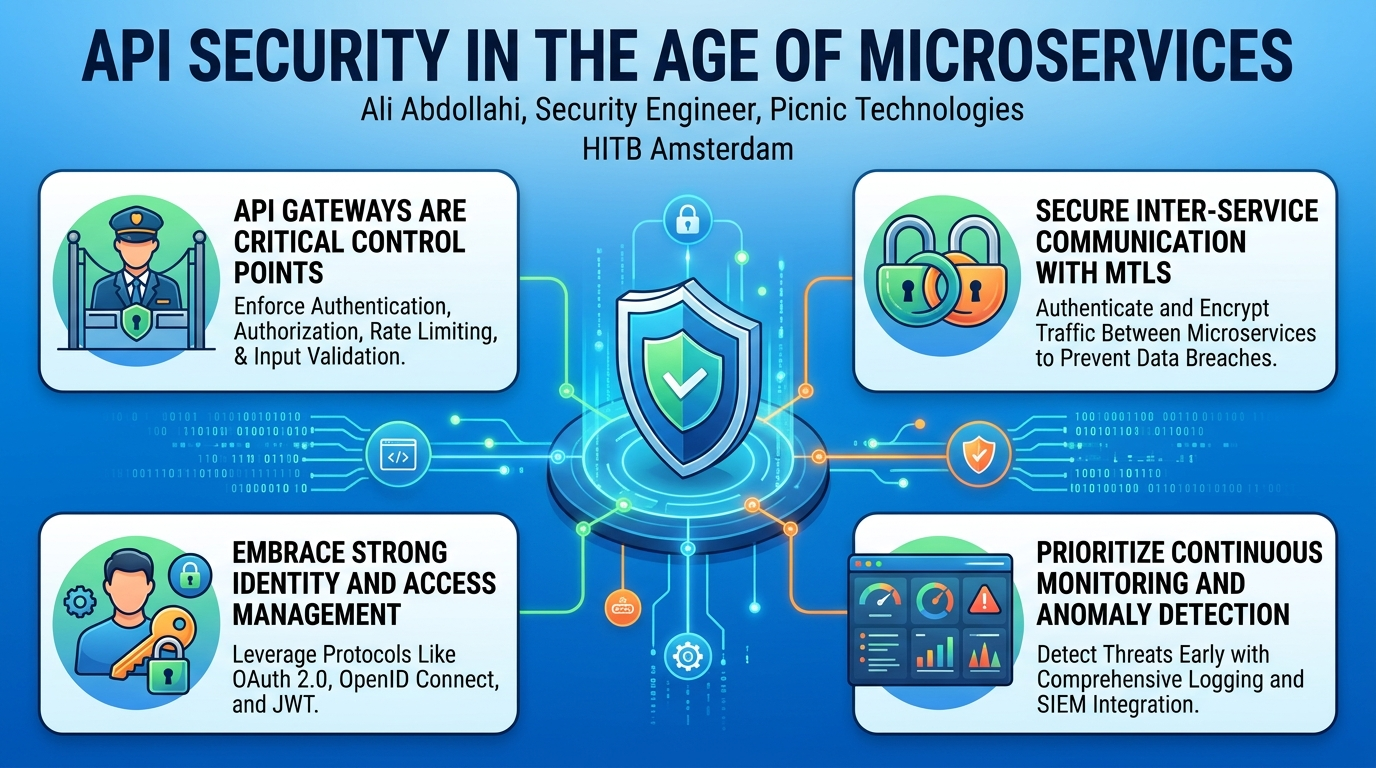
- API Gateways are Critical Control Points: As the centralized entry point, API Gateways must enforce strong authentication, authorization, rate limiting, and input validation to protect backend services.
- Secure Inter-Service Communication with mTLS: Mutual TLS (mTLS) is essential for authenticating and encrypting communication between microservices, preventing internal data breaches and unauthorized lateral movement.
- Embrace Strong Identity and Access Management: Leverage protocols like OAuth 2.0, OpenID Connect, and JWT for robust authentication and authorization across the entire microservice ecosystem.
- Prioritize Continuous Monitoring and Anomaly Detection: Implement comprehensive logging and monitoring, including spike detection, failed login attempts, and geolocation analysis, integrated with a SIEM for early threat detection.
- Adopt a Defense-in-Depth Strategy: Layer security controls from the network edge to individual services, incorporating least privilege, network segmentation, and data encryption at rest and in transit.
- Integrate Security into the SDLC: Conduct regular penetration testing, red team exercises, and automated security testing (SAST/DAST/IAST) throughout the development lifecycle, guided by frameworks like OWASP API Security Top 10 and NIST 800-204.
About the Speaker(s)
Ali Abdollahi is a Security Engineer at Picnic Technologies, based in Amsterdam. With over 11 years of experience in the security domain, he possesses a deep passion for cybersecurity and actively contributes to industrial conferences and events. His expertise lies in securing complex, modern architectures, particularly focusing on API and microservices security.
Reviews
Dr. Zero (Offensive Security Researcher) — WEAK
This is a survey talk that compiles OWASP Top 10, vendor documentation, and standard security hygiene into a single deck. There's no original research, no novel findings, no demonstrated exploitation, and nothing a competent security engineer couldn't pull together from an afternoon of reading Istio docs and the OWASP API Security project.
Heather Calloway (CISO) — SOLID
A competent overview of API and microservices security fundamentals — useful for teams early in their security maturity, but offers little new ground for organizations with established programs. Good primer, not a strategy-shifter.