DP-fy your DATA: How to (and why) synthesize Differentially Private Synthetic Data: Brief introduction to DP
Natalia Ponomareva, Sergei Vassilvitskii, Peter Kairouz, Alex Bie
International Conference on Machine Learning 2025 · Tutorial
Overview
This talk, delivered at ICML 2025 by a team of prominent researchers, addresses the critical and escalating challenge of data privacy in the age of large-scale machine learning, particularly with the proliferation of Large Language Models (LLMs). The speakers, Natalia Ponomareva, Sergei Vassilvitskii, Peter Kairouz, and Alex Bie, lay the groundwork for understanding why safeguarding sensitive information in vast datasets has become paramount, even as the demand for more data continues unabated. They skillfully connect the historical "unreasonable effectiveness of data" to modern scaling laws, highlighting the relentless pursuit of larger datasets for improved model performance. However, this pursuit is increasingly clashing with stringent privacy regulations and inherent risks associated with handling personal and regulated information.
Key moments
- 0:00 The "unreasonable effectiveness of data" and scaling laws.
- 2:00 Why data privacy is crucial: personal, regulated, LLM risks.
- 4:00 Promise of synthetic data for privacy, keeping pipelines intact.
- 5:30 Differentiating pure vs. differentially private synthetic data.
- 6:40 Understanding differentially private synthetic data for privacy.
- 8:00 Talk agenda: privacy, generation, evaluation, practicalities.
DP-fy your DATA: How to (and why) synthesize Differentially Private Synthetic Data: Brief introduction to DP
Speakers: Natalia Ponomareva, Sergei Vassilvitskii, Peter Kairouz, Alex Bie
Conference: ICML 2025
YouTube: https://slideslive.com/39043835
Overview
This talk, delivered at ICML 2025 by a team of prominent researchers, addresses the critical and escalating challenge of data privacy in the age of large-scale machine learning, particularly with the proliferation of Large Language Models (LLMs). The speakers, Natalia Ponomareva, Sergei Vassilvitskii, Peter Kairouz, and Alex Bie, lay the groundwork for understanding why safeguarding sensitive information in vast datasets has become paramount, even as the demand for more data continues unabated. They skillfully connect the historical "unreasonable effectiveness of data" to modern scaling laws, highlighting the relentless pursuit of larger datasets for improved model performance. However, this pursuit is increasingly clashing with stringent privacy regulations and inherent risks associated with handling personal and regulated information.
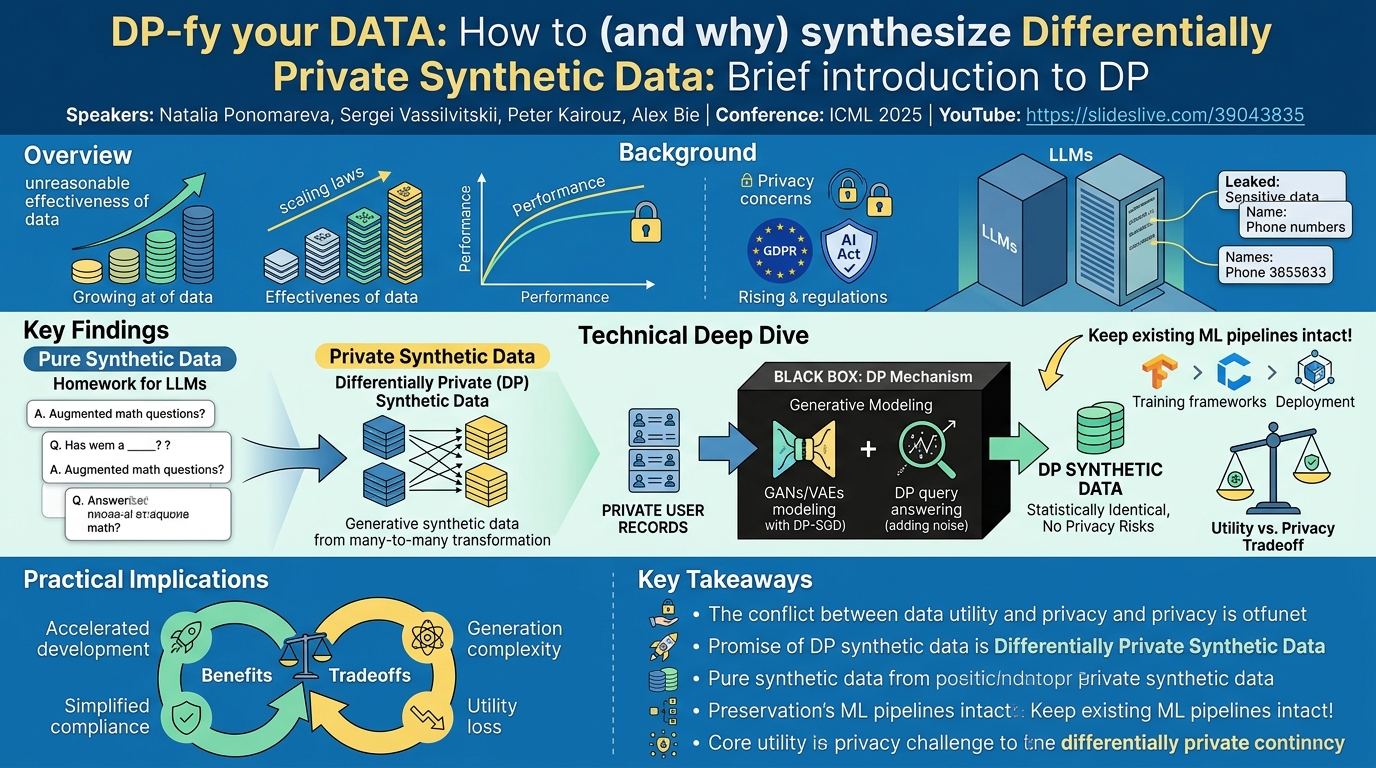
The core of this introductory segment revolves around proposing Differentially Private (DP) synthetic data as a transformative solution to this dilemma. The talk posits that by generating synthetic datasets that mimic the statistical properties and utility of real data but are entirely free of direct personal identifiers and privacy risks, organizations can continue to innovate with machine learning while adhering to ethical guidelines and legal mandates. This approach promises to allow existing ML pipelines—from training mechanisms to model architectures and deployment strategies—to remain largely unchanged, shifting the privacy burden primarily to the data generation phase. The speakers delineate the landscape of synthetic data, distinguishing between "pure synthetic data" used for augmenting model capabilities and "private synthetic data" specifically engineered for privacy preservation through a many-to-many transformation of sensitive user records. This initial presentation sets the stage for a deeper exploration into the technical intricacies of generating and evaluating such privacy-preserving synthetic data.
Background
▶ Watch: The "unreasonable effectiveness of data" and scaling laws. (0:00)
The journey of machine learning has been inextricably linked to data. The talk opens with a retrospective nod to a seminal 2009 paper on the "unreasonable effectiveness of data," a prescient observation made 15-16 years prior to this conference. This paper foreshadowed the data-driven revolution, asserting that for many tasks, sheer volume of text data would unlock unprecedented capabilities. Fast forward to today, and this premise has been overwhelmingly validated, with scaling laws now precisely quantifying the relationship between model quality, dataset size, and computational resources. These laws demonstrate a clear and predictable positive correlation: more data, coupled with sufficient compute, generally leads to better-performing models. Consequently, the machine learning community is perpetually "hungry for more data."
However, this insatiable appetite for data comes with significant caveats, primarily concerning data hygiene and privacy. A substantial portion of the data required for training modern ML models, especially LLMs, is personal data. This includes names, phone numbers, locations, and sensitive events, often appearing within vast, diverse corpora. Beyond personal information, much data is regulated. Regulations like the General Data Protection Regulation (GDPR) in Europe have set precedents for data protection, influencing a global shift towards stricter data governance. The impending AI Act further underscores the growing regulatory landscape, imposing obligations on how AI systems are developed and deployed, particularly regarding data use. Organizations must be acutely "cognizant about where the data is coming from, what we can use it for, when do we have to delete it, and so on and so forth."
The rise of Large Language Models (LLMs) exacerbates these privacy challenges. Their massive scale makes it statistically more probable for private information to be inadvertently included in training datasets. Furthermore, LLMs are characterized by their opacity; their internal workings are "much larger, they're much more opaque, they're much harder to reason about and to understand how they're using specific data bits and how they're processing them." This lack of interpretability makes it difficult to ascertain if or how private information is being learned or memorized. Crucially, the outputs of LLMs are not simple binary predictions but "rich enough to seem to contain private information," whether in the form of generated text, images, tables, audio, or video. Instances of models leaking sensitive data have become frequent news items, underscoring the urgent need for robust privacy-preserving mechanisms. It is within this complex backdrop of unprecedented data utility, stringent regulation, and heightened privacy risks that the promise of synthetic data emerges as a potential cornerstone for future ML development.
Key Findings
▶ Watch: Promise of synthetic data for privacy, keeping pipelines intact. (4:00)
While this segment of the talk serves as an introduction rather than a presentation of novel research findings or experimental results, it articulates several key conceptual findings and motivations that are critical for understanding the role of Differentially Private (DP) synthetic data. The primary "finding" is the critical need for a paradigm shift in data handling for ML, particularly for large-scale models, to reconcile the insatiable demand for data with escalating privacy concerns and regulatory pressures.
The talk effectively establishes that:
- The "unreasonable effectiveness of data" and modern scaling laws mandate continuous access to vast datasets for achieving state-of-the-art model performance. This fundamental truth of modern AI clashes directly with the increasing prevalence of personal and regulated data within these datasets.
- Existing data privacy challenges are significantly amplified by LLMs. Their sheer size, opacity, and ability to generate rich, complex outputs increase the likelihood and severity of privacy breaches, making traditional data governance insufficient.
- DP synthetic data offers a powerful and elegant solution to this dilemma. By generating data that "looks and feels just like your regular datasets but is entirely synthetic and new," it promises to circumvent the privacy restrictions inherent in real data. This is a crucial conceptual finding, positioning synthetic data not merely as an augmentation tool but as a fundamental privacy primitive.
- A significant practical advantage of DP synthetic data is its minimal disruption to existing ML pipelines. The core insight here is that if high-fidelity, privacy-preserving synthetic data can be generated, "the rest of your pipeline [can remain] the same." This includes training mechanisms, model architectures, optimizers, and deployment strategies. This finding highlights the efficiency gains and reduced engineering overhead compared to alternative privacy-preserving techniques that might require substantial modifications to the entire ML workflow.
- The distinction between "pure synthetic data" and "private synthetic data" is vital. Pure synthetic data, akin to "homework for LLMs," aims to expand training examples for specific tasks (e.g., generating more algebra questions). While valuable, its privacy guarantees are not explicit. In contrast, "private synthetic data" (specifically, DP synthetic data) is a "many-to-many kind of transformation" designed to produce synthetic records whose distributions are "identical" to the private source data, but without directly exposing sensitive information. This clear differentiation frames the problem space and the specific solution being advocated.
In essence, the talk's key contribution is to clearly frame the problem of data privacy in large-scale ML and to position DP synthetic data as a strategically advantageous and minimally disruptive solution that allows the ML community to continue leveraging the power of data while upholding privacy.
Technical Deep Dive
▶ Watch: Differentiating pure vs. differentially private synthetic data. (5:30)
The technical deep dive, as introduced in this segment of the talk, focuses on the foundational concepts and objectives behind Differentially Private (DP) synthetic data rather than delving into specific algorithmic implementations, which were slated for later parts of the full presentation. The core technical premise is to transform sensitive, real-world user records into a synthetic dataset that maintains the statistical properties and utility of the original, while rigorously guaranteeing privacy through the lens of Differential Privacy.
The speakers introduce the concept of synthetic data by first distinguishing two main types:
- Pure Synthetic Data (or "Homework for LLMs"): This category involves generating new data instances to augment training sets for specific tasks. For example, creating more fifth-grade algebra questions to improve an LLM's mathematical reasoning. The primary goal here is to enhance model accuracy, reduce costs, or mitigate errors. While useful, the privacy implications are secondary and often not formally guaranteed. Concerns like model collapse (where models trained on synthetic data might overfit to the generated patterns, leading to a degradation in generalization) are often discussed in this context.
- Differentially Private (DP) Synthetic Data: This is the focus of the talk. The process is conceptualized as a "many-to-many kind of transformation." An initial set of private user records serves as input to a "black box" mechanism. This black box, which would contain the DP-enabled synthetic data generation algorithms, then outputs a large number of synthetic records. The critical technical objective here is to ensure that "the distributions between the left-hand side and the right-hand side are the same." That is, the synthetic dataset must "look identical [and] feel identical" to the original private dataset in terms of its statistical characteristics, correlations, and underlying patterns, but without any direct or inferable link to individual records in the original data.
The underlying principle for achieving this privacy guarantee is Differential Privacy (DP). While the talk does not go into the mathematical definition of DP in this introductory segment, it implicitly highlights its goal: to ensure that the presence or absence of any single individual's data in the input dataset does not significantly alter the output of the synthetic data generation process. This property makes it incredibly difficult for an adversary to infer information about any specific individual from the synthetic dataset, thereby providing a strong, quantifiable privacy guarantee.
The "black box" mentioned by the speakers would, in a full technical exposition, encompass various DP mechanisms and synthetic data generation techniques. These could include:
- DP mechanisms for query answering: Techniques like the Laplace mechanism or Gaussian mechanism add carefully calibrated noise to aggregate statistics extracted from the private data. These noisy statistics then form the basis for synthesizing new data points.
- Generative models with DP guarantees: This might involve training generative adversarial networks (GANs) or variational autoencoders (VAEs) on private data, where the training process itself is made differentially private. This could be achieved by applying DP to the gradients during optimization (e.g., DP-SGD - Differentially Private Stochastic Gradient Descent) or by injecting noise at other stages of the learning process.
- Private synthetic data for different modalities: The talk explicitly mentions the intent to cover "text," "images," and "tables." This implies that the "black box" would need to incorporate diverse DP techniques tailored to the unique structures and sensitivities of each data type. For tabular data, this might involve synthesizing rows based on private marginals. For text, it could involve private language models. For images, private image generators.
The overarching technical challenge is to strike the delicate balance between privacy and utility. Adding too much noise for strong DP guarantees can degrade the fidelity and usefulness of the synthetic data, making it less effective for downstream ML tasks. Conversely, insufficient noise compromises privacy. The goal is to develop mechanisms that achieve high utility while maintaining stringent DP guarantees, enabling the synthetic data to serve as a drop-in replacement for real, sensitive data in various ML applications. The talk emphasizes that the ability to keep the "rest of your pipeline the same" hinges entirely on the technical success of this "black box" in generating high-fidelity, DP-guaranteed synthetic data.
Experimental Setup & Results
▶ Watch: Understanding differentially private synthetic data for privacy. (6:40)
This introductory segment of the ICML 2025 talk, "DP-fy your DATA: How to (and why) synthesize Differentially Private Synthetic Data: Brief introduction to DP," primarily focuses on establishing the motivation, problem statement, and conceptual framework for differentially private synthetic data. As such, the provided transcript does not contain any details regarding experimental setups, specific datasets used, baselines for comparison, hardware configurations, performance metrics, headline numbers, or ablation studies.
The speakers explicitly outlined the subsequent sections of their full talk, which were planned to delve into "how do we generate useful synthetic data," covering various modalities like text, images, and tables, followed by "evaluation of its utility." It is within these later, un-transcribed sections that one would expect to find the experimental details and results typically associated with a technical conference presentation. Therefore, based on the provided material, there are no experimental setups or results to report. The talk's initial objective was to build a strong theoretical and practical case for the necessity and potential of DP synthetic data before moving into the empirical validation of its effectiveness.
Practical Implications
▶ Watch: Talk agenda: privacy, generation, evaluation, practicalities. (8:00)
The practical implications of successfully implementing Differentially Private (DP) synthetic data are profound and far-reaching for various stakeholders in the AI/ML ecosystem. The core promise is to decouple the utility of data from its inherent privacy risks, enabling continued innovation in data-driven machine learning even in increasingly regulated environments.
For practitioners and model builders, DP synthetic data offers a powerful new avenue for model training and development. Instead of navigating complex legal frameworks, obtaining consent, or risking privacy breaches with real data, they can access statistically representative, yet privacy-preserving, synthetic datasets. This could significantly accelerate development cycles, especially for models requiring vast amounts of sensitive information, such as healthcare, finance, or personalized recommendation systems. The ability to use synthetic data means that model architects and data scientists can focus on model performance without being constantly constrained by data access limitations or privacy compliance overheads. It also facilitates data sharing within organizations or with external research partners, allowing for collaborative model building on sensitive topics without exposing raw private information.
For infrastructure teams and deployers, the primary benefit lies in the stability and simplicity of existing ML pipelines. As highlighted in the talk, if high-fidelity DP synthetic data can be generated, "the rest of your pipeline stays" the same. This means no wholesale re-architecting of training frameworks, no modification of model architectures, no changes to optimization algorithms, and no fundamental alterations to deployment strategies. This significantly reduces the engineering burden and potential for errors associated with implementing privacy-preserving techniques directly within the model training or inference stages (e.g., federated learning, secure multi-party computation, or on-device learning, which often require specialized infrastructure). Infrastructure teams can continue to leverage established MLOps practices, hardware stacks, and cloud resources, with the privacy guarantees being "baked in" at the data generation layer.
However, there are significant tradeoffs and limitations to consider:
- Complexity of Generation: The process of creating high-fidelity, DP-guaranteed synthetic data is inherently complex and technically challenging. The "black box" for generating such data needs to be robust, efficient, and capable of capturing intricate statistical relationships across diverse data types (text, images, tables) while rigorously enforcing differential privacy. This requires specialized expertise in both privacy-preserving ML and generative modeling.
- Utility vs. Privacy Tradeoff: Differential Privacy inherently involves adding noise to data or computations. The stronger the privacy guarantee (lower epsilon/delta values), the more noise is typically added, which can lead to a reduction in the utility and fidelity of the synthetic data. Finding the optimal balance where synthetic data remains useful for complex ML tasks without compromising privacy is a continuous research and engineering challenge.
- Data Drift and Real-World Nuances: Synthetic data, by definition, is a model of real data. It might struggle to capture subtle, emergent patterns or adapt to rapid data drift in real-world scenarios as effectively as continuously updated real data. This could lead to models trained on synthetic data performing suboptimally when deployed on live, evolving data streams.
- Cost and Computational Resources: Generating large-scale, high-quality DP synthetic data can be computationally intensive and costly, requiring significant resources for training sophisticated generative models and applying DP mechanisms.
- Regulatory Acceptance: While DP offers strong mathematical guarantees, its acceptance by regulatory bodies as a complete solution for compliance, particularly for sensitive applications, is still evolving. Organizations would need to ensure that their DP synthetic data generation practices meet specific legal and ethical requirements.
Despite these challenges, the practical implication is clear: DP synthetic data represents a strategic investment that could unlock new possibilities for AI development, allowing organizations to navigate the complex landscape of data privacy while continuing to harness the "unreasonable effectiveness of data." It shifts the privacy burden to a dedicated, upfront engineering effort, ultimately simplifying downstream ML operations.
Key Takeaways
- Data is paramount for modern ML, especially LLMs, but comes with significant privacy challenges. The "unreasonable effectiveness of data" combined with scaling laws drives an insatiable demand for larger datasets, yet much of this data is personal or regulated (e.g., GDPR, AI Act), and LLMs exacerbate privacy risks due to their scale, opacity, and rich outputs.
- Differentially Private (DP) synthetic data offers a promising solution to reconcile data utility with privacy needs. It proposes generating new, artificial datasets that statistically resemble real private data but are free from direct privacy risks, thereby allowing continued data-driven innovation.
- DP synthetic data is distinct from "pure synthetic data." While pure synthetic data aims to augment training sets (e.g., "homework for LLMs"), DP synthetic data specifically focuses on a "many-to-many transformation" of private records to produce an output dataset with strong, quantifiable privacy guarantees, aiming for identical statistical distributions.
- A major advantage of DP synthetic data is its ability to preserve existing ML pipelines. By shifting the privacy burden to the data generation phase, organizations can keep their training mechanisms, model architectures, optimizers, and deployment strategies largely unchanged, reducing engineering complexity and cost.
- The core technical challenge lies in generating high-fidelity synthetic data while maintaining strong Differential Privacy guarantees. This involves a delicate balance between adding sufficient noise to protect individual privacy and ensuring the synthetic data remains statistically useful for downstream machine learning tasks across various data modalities like text, images, and tables.
- Practical implications include accelerated development, simplified compliance, and enhanced data sharing. However, this comes with tradeoffs, including the inherent complexity of generating such data, the ongoing utility-privacy balance, and the need for regulatory acceptance of DP synthetic data as a robust privacy-preserving solution.
About the Speaker(s)
The talk, "DP-fy your DATA: How to (and why) synthesize Differentially Private Synthetic Data: Brief introduction to DP," was presented by Natalia Ponomareva, Sergei Vassilvitskii, Peter Kairouz, and Alex Bie. While specific biographical details were not provided within this introductory transcript, their participation in a prominent conference like ICML 2025 and their expertise in a highly specialized field such as Differential Privacy and synthetic data generation strongly suggest they are leading researchers and practitioners in machine learning and privacy. Given the nature of the topic and the detailed, analytical approach, it is highly probable that the speakers are affiliated with top-tier research institutions, universities, or major technology companies actively engaged in advancing the state-of-the-art in privacy-preserving AI. Their collective presence underscores the interdisciplinary nature of this critical area, merging expertise in core machine learning, data science, and privacy theory.
Reviews
Maya Iyer (Theoretical ML Researcher) — WEAK
This is a tutorial introduction to differentially private synthetic data, not a research contribution. The article describes a motivational framing session — scaling laws, GDPR, LLM opacity, the utility-privacy tradeoff — without presenting any theorems, experimental results, or novel technical ideas. The speakers are credible and the framing is competent, but reviewing this as a research contribution is a category error. What's here is a well-organized problem statement for an audience that may be unfamiliar with DP, not work that advances the field.
Chen Zhao (Applied ML Researcher & Empiricist) — WEAK
This is an introductory tutorial segment, not an empirical contribution. The article describes a well-motivated framing of DP synthetic data as a solution to ML privacy challenges, delivered by credible speakers at ICML 2025. But there are no experiments, no baselines, no results, no ablations, and no novel claims — the article itself explicitly acknowledges this. Evaluated as a research contribution, this scores poorly on every dimension I care about. As a tutorial introduction, it may serve a pedagogical function, but that is not what I am here to rate.
→ Top-rated talks at International Conference on Machine Learning 2025
All talks from International Conference on Machine Learning 2025