DP-fy your DATA: How to (and why) synthesize Differentially Private Synthetic Data: Techniques for creating DP synthetic TEXT data
Natalia Ponomareva, Sergei Vassilvitskii, Peter Kairouz, Alex Bie
International Conference on Machine Learning 2025 · Tutorial
Overview
This talk, delivered by Natalia Ponomareva and her esteemed colleagues at ICML 2025, provides a foundational and critical exploration into the realm of Differential Privacy (DP), specifically framing its necessity and application for generating synthetic text data. The presentation begins by meticulously dissecting the inherent failures of traditional data anonymization techniques, establishing a robust argument for why a more rigorous and mathematically sound approach to privacy is indispensable in modern machine learning. It then introduces Differential Privacy as the de facto standard for achieving strong privacy guarantees, explaining its core principles, mechanisms, and practical considerations for implementation.
Key moments
- 0:00 Introduction to privacy and operational definitions
- 2:00 Why removing user IDs is not privacy
- 4:00 Limitations of K-anonymity and homogeneity attacks
- 6:00 Defining Differential Privacy: output similarity
- 7:00 Example: Adding noise for plausible deniability
DP-fy your DATA: How to (and why) synthesize Differentially Private Synthetic Data: Techniques for creating DP synthetic TEXT data
Speakers: Natalia Ponomareva, Sergei Vassilvitskii, Peter Kairouz, Alex Bie
Conference: ICML 2025
YouTube: https://slideslive.com/39043836
Overview
This talk, delivered by Natalia Ponomareva and her esteemed colleagues at ICML 2025, provides a foundational and critical exploration into the realm of Differential Privacy (DP), specifically framing its necessity and application for generating synthetic text data. The presentation begins by meticulously dissecting the inherent failures of traditional data anonymization techniques, establishing a robust argument for why a more rigorous and mathematically sound approach to privacy is indispensable in modern machine learning. It then introduces Differential Privacy as the de facto standard for achieving strong privacy guarantees, explaining its core principles, mechanisms, and practical considerations for implementation.
The primary objective of this discussion is to equip attendees with a deep understanding of the "why" and "how" of synthesizing differentially private data, particularly in the context of sensitive text information. Ponomareva and her team highlight that as AI/ML models become increasingly data-hungry, the imperative to protect individual privacy while still extracting valuable insights from large datasets grows exponentially. This talk is crucial for anyone involved in data-driven AI/ML development, from researchers and data scientists to infrastructure engineers and policy makers, offering a clear roadmap for integrating state-of-the-art privacy protections into their workflows, thereby preventing the catastrophic data breaches and de-anonymization events that have plagued the industry for decades.
Background
▶ Watch: Introduction to privacy and operational definitions (0:00)
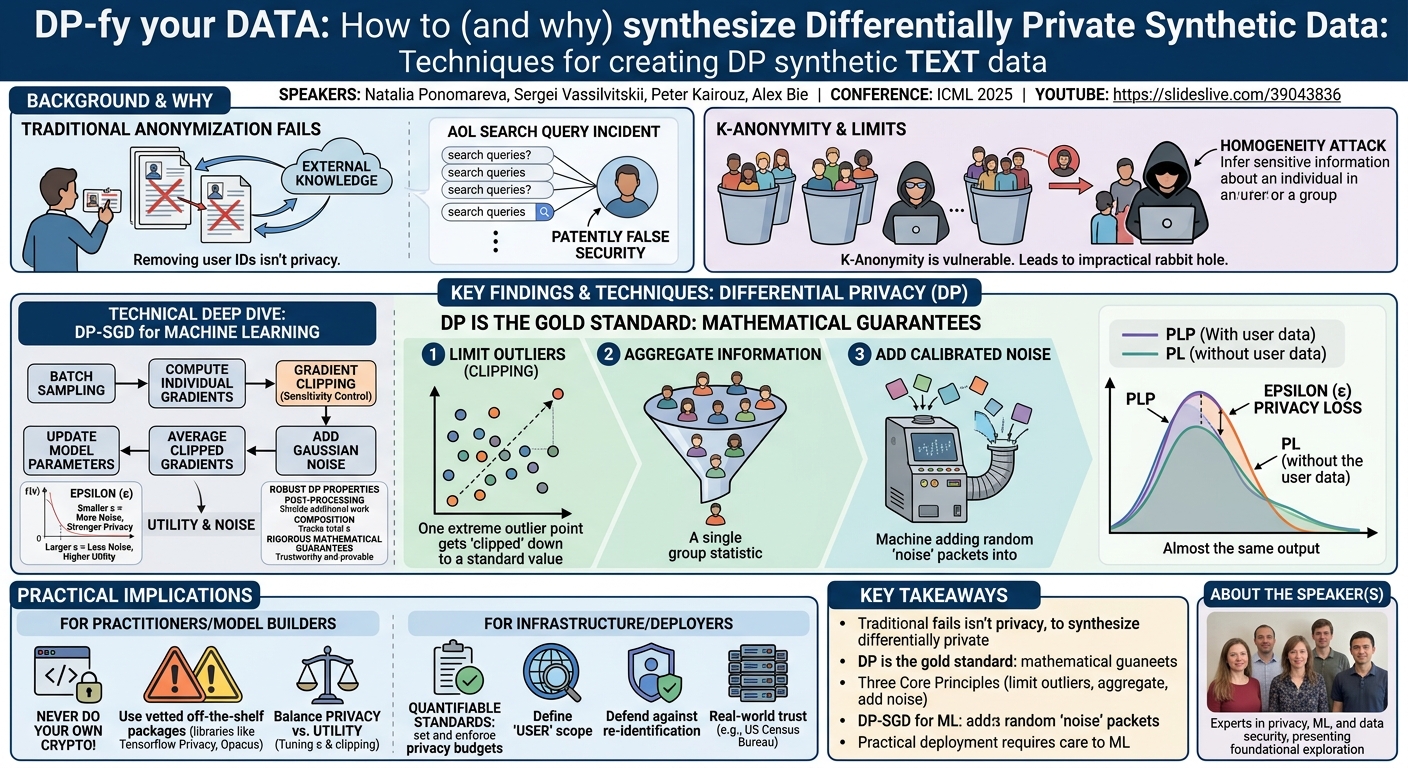
The problem of privacy in the ML and systems space is multifaceted and has historically been fraught with challenges, often leading to significant public trust erosion. The talk opens by illustrating the common pitfalls of naive data anonymization, asserting that the seemingly straightforward act of removing user IDs from a dataset is a "patently false" and dangerous approach to privacy. This assertion is powerfully underscored by the infamous AOL search query dataset release from two decades ago, where researchers were provided with anonymized search data. Despite the removal of direct identifiers and the use of random hashes, individuals were swiftly de-anonymized, leading to public identification and scrutiny, including a New York Times exposé. This incident serves as a stark reminder that even seemingly innocuous metadata, when combined with external information, can easily re-identify individuals.
Beyond explicit identifiers, the inherent richness of data itself often contains sufficient information for re-identification. Ponomareva cites US Census statistics, revealing that a combination of just three attributes—date of birth, five-digit zip code, and gender—can uniquely identify approximately 87% of the US population. This demonstrates that quasi-identifiers, which are not direct identifiers but can be linked to external records, pose a significant threat to privacy even in supposedly anonymized datasets.
The presentation then delves into more sophisticated, yet ultimately flawed, privacy techniques like k-anonymity. The principle of k-anonymity dictates that each individual's record should be indistinguishable from at least k-1 other records, effectively hiding individuals within a crowd of k people sharing the same attributes. While an improvement over simple ID removal, k-anonymity falls victim to several attacks. The most prominent is the homogeneity attack, where if all k individuals sharing the same quasi-identifiers also share the same sensitive attribute (e.g., all declared bankruptcy), then simply knowing someone is in that group leaks their sensitive information. Subsequent attempts to mitigate this, such as l-diversity (ensuring diversity of sensitive attributes) and t-closeness (ensuring sensitive attributes have a similar distribution), also prove susceptible to various attacks or lead to an impractical "rabbit hole" of defining and managing sensitive attributes, ultimately failing to provide robust, universal privacy guarantees. These historical failures highlight the critical need for a more rigorous, mathematically sound, and universally applicable definition of privacy, setting the stage for the introduction of Differential Privacy.
Key Findings
▶ Watch: Why removing user IDs is not privacy (2:00)
The central "finding" and contribution of this talk, rather than presenting a novel research result, is the comprehensive elucidation of Differential Privacy (DP) as the robust and mathematically verifiable solution to the persistent challenges of data anonymization, particularly for sensitive data like text. The talk systematically breaks down the theoretical underpinnings and practical application of DP, emphasizing a set of core principles that, when adhered to, provide strong privacy guarantees.
The key finding is that achieving true privacy requires a fundamental shift in how we process and release data. This shift is encapsulated in three non-negotiable actions:
- Limiting outliers: Individuals whose data points significantly deviate from the norm can inadvertently act as unique identifiers. DP mandates mechanisms to cap or clip these extreme values, ensuring no single data point disproportionately influences the output.
- Aggregating information: Instead of releasing individual records or statistics derived from single users, DP relies on computing aggregates across many users. This ensures that the output reflects group-level trends rather than individual contributions.
- Adding noise: Crucially, DP introduces a carefully calibrated amount of random noise to these aggregated computations. This noise serves as a probabilistic veil, making it impossible for an attacker, even with extensive auxiliary information, to definitively determine whether any single individual's data was included in the original dataset or to infer their specific attributes from the output.
The talk frames Differential Privacy as the only approach that offers rigorous mathematical guarantees of privacy, a stark contrast to the "feels private" methods that have repeatedly failed. It demonstrates that by applying these three principles, especially within iterative learning algorithms like gradient descent, one can achieve a state of "plausible deniability" for individuals, where their participation in a dataset cannot be conclusively inferred from the resulting model or data release. This framework is presented as the modern, de facto standard for privacy, evidenced by its adoption in high-stakes contexts such as the US Census Bureau. The "finding" is therefore a comprehensive framework and justification for the adoption of DP as the cornerstone of privacy-preserving machine learning.
Technical Deep Dive
▶ Watch: Limitations of K-anonymity and homogeneity attacks (4:00)
At its core, Differential Privacy (DP) is a formal, mathematical definition of privacy that guarantees that the output of a data analysis mechanism is "almost the same" whether or not any single individual's data is included in the input dataset. Ponomareva introduces this concept through an intuitive example: calculating the average age of people in a room. If the true average is computed and then a small amount of mean-zero Gaussian noise is added, an observer looking at the noisy output cannot definitively determine if a specific individual's age was included in the calculation. This is the essence of plausible deniability.
The formal definition of DP hinges on a parameter, epsilon (ε), which quantifies the privacy loss. A smaller ε signifies stronger privacy (more noise, lower utility), while a larger ε indicates weaker privacy (less noise, higher utility). The choice of ε dictates the width of the noise distribution. The amount of noise added is directly proportional to the sensitivity of the function being computed. Sensitivity measures the maximum possible change in the function's output when a single individual's data is added or removed from the dataset. If a function is highly sensitive to an individual (e.g., their salary is an extreme outlier), more noise is required to mask their contribution for a given ε. Conversely, if a function is less sensitive (e.g., their age is close to the average), less noise is needed. Academically, ideal ε values are often considered to be below 1, but in practical machine learning applications, values between 1 and 10 are common, often accompanied by additional checks to ensure meaningful privacy.
The talk then transitions to applying DP to machine learning models, specifically within the context of gradient descent, leading to Differentially Private Stochastic Gradient Descent (DP-SGD). The process involves several critical steps at each iteration of training:
- Batch Sampling: A subset of examples (a batch) is sampled from the dataset.
- Gradient Computation: For each example in the batch, its individual gradient is computed.
- Gradient Clipping: This is a crucial step for bounding sensitivity. Each individual's gradient vector is clipped (normalized or scaled) to a predefined maximum L2 norm. This ensures that no single data point, regardless of its extremity, can contribute an excessively large gradient that would disproportionately influence the model update and potentially reveal information.
- Gradient Aggregation: The clipped gradients are then averaged across the batch.
- Noise Addition: Finally, a carefully calculated amount of Gaussian noise is added to this aggregated, clipped gradient. The scale of this noise is determined by ε, the clipping bound, and the number of examples in the batch. This noisy average gradient is then used to update the model parameters.
This sequence ensures that the gradient used to update the model is private; it does not depend on any unique individual in a way that could lead to re-identification.
Differential Privacy offers three highly advantageous properties that solidify its position as the leading privacy framework:
- Post-processing: Any computation or analysis performed on a differentially private output remains differentially private. This means that once data or a model is made DP, subsequent transformations or analyses do not compromise its privacy guarantees, making it robust against further data manipulation.
- Composition: Multiple differentially private operations can be combined, and the overall privacy loss (total ε) can be rigorously tracked and bounded. This allows for the construction of complex DP systems from simpler DP building blocks, enabling modular design and analysis.
- Rigorous Mathematical Guarantees: Unlike heuristic anonymization methods, DP provides provable, mathematical guarantees. This means that the privacy properties are not based on intuition or empirical observation but are formally established, providing a strong foundation for trust and compliance.
The talk also underscores critical deployment considerations for DP. Defining what constitutes a "user" to be protected is paramount—is it an account, a physical person, an instance of interaction? This philosophical but practical decision directly impacts the scope of protection. Additionally, selecting appropriate clipping strategies and the correct privacy mechanisms (e.g., Laplace mechanism for scalar queries, Gaussian mechanism for vector-valued queries like gradients) is essential. The presentation strongly advises against "doing your own crypto" or implementing custom privacy algorithms, advocating instead for the use of well-vetted, off-the-shelf, open-source privacy libraries. Finally, the careful setting of DP parameters (ε, clipping thresholds, noise scale) is critical, as these choices directly determine the balance between privacy protection and the utility of the released data or trained model.
Experimental Setup & Results
▶ Watch: Defining Differential Privacy: output similarity (6:00)
The provided transcript focuses heavily on the foundational "why" and "how" of Differential Privacy, laying the theoretical and conceptual groundwork for its application. As such, this specific segment of the talk does not delve into any particular experimental setups, present specific datasets used, detail baselines for comparison, describe hardware configurations, or report headline numbers and ablation studies. The discussion serves as an introduction to the techniques required for creating differentially private synthetic text data, with the implication that subsequent parts of the tutorial (or related talks) would cover these empirical aspects. Therefore, no experimental results are presented in this portion of the conference talk.
Practical Implications
▶ Watch: Example: Adding noise for plausible deniability (7:00)
The widespread adoption of Differential Privacy (DP), as championed in this talk, carries profound practical implications for various stakeholders in the AI/ML ecosystem. For practitioners—data scientists, machine learning engineers, and researchers—DP offers a robust framework to develop and deploy models that are inherently privacy-preserving. The key takeaway here is to never "do your own crypto" or privacy implementation. Instead, practitioners are strongly advised to leverage off-the-shelf packages and libraries that have been rigorously developed, open-sourced, and vetted by experts. This minimizes the risk of introducing vulnerabilities through incorrect implementations of complex cryptographic and privacy-enhancing techniques.
For infrastructure teams and those responsible for data governance, DP provides a clear, auditable standard. The ability to define a specific epsilon (ε) value offers a quantifiable measure of privacy, allowing organizations to set and enforce privacy budgets across various data uses. This moves privacy from a vague, compliance-driven checklist to a mathematically guaranteed property. Implementing DP requires careful consideration of what constitutes a "user" or "individual" for protection, which can be complex in environments with shared devices, multiple accounts, or evolving identities. Infrastructure design must accommodate the mechanisms of gradient clipping and noise injection, potentially impacting existing data pipelines and computational resources.
Model builders benefit from DP by gaining the ability to train models on sensitive data without exposing individual records. This opens up opportunities to leverage datasets that might otherwise be inaccessible due to privacy concerns, such as medical records, financial transactions, or highly personal user interactions. However, they must also grapple with the inherent trade-off between privacy and utility. Stronger privacy (smaller ε) typically leads to a greater injection of noise, which can degrade model accuracy, especially for complex tasks or smaller datasets. Conversely, prioritizing utility (larger ε) weakens privacy guarantees. Model builders need to carefully tune parameters like clipping thresholds and noise scales, often requiring domain expertise and iterative experimentation to find an acceptable balance.
For deployers of ML systems, DP offers a powerful compliance tool. Its rigorous mathematical guarantees provide a strong defense against re-identification attacks, mitigating legal and reputational risks associated with data breaches. Real-world examples like the US Census Bureau adopting DP for releasing demographic data underscore its credibility and utility in high-stakes environments. Companies can confidently release aggregate statistics or even train models with the assurance that individual-level data remains protected, avoiding the catastrophic failures seen with earlier anonymization attempts, such as the AOL search query fiasco.
The limitations and tradeoffs are crucial to acknowledge. Implementing DP can introduce computational overhead due to gradient clipping and noise generation. Furthermore, the selection of appropriate ε values, clipping norms, and noise distribution parameters is not trivial and often requires expert judgment. The concept of a "privacy budget" (the cumulative ε over multiple queries or model training epochs) must be carefully managed to avoid inadvertently compromising privacy over time. Despite these challenges, DP represents a paradigm shift, enabling responsible data utilization in an increasingly privacy-conscious world.
Key Takeaways
- Traditional Anonymization Fails: Simple removal of user IDs, k-anonymity, and its variants (l-diversity, t-closeness) are insufficient to protect privacy and are susceptible to de-anonymization attacks, as demonstrated by the AOL search dataset and Census statistics.
- Differential Privacy (DP) is the Gold Standard: DP offers rigorous mathematical guarantees that the output of a computation will be "almost the same" regardless of any single individual's participation, providing strong, provable privacy.
- Three Core DP Principles: Achieving DP involves consistently applying three steps: limiting outliers (e.g., through gradient clipping), aggregating information across users, and adding calibrated noise to the aggregated results.
- DP-SGD for Machine Learning: Differential Privacy can be effectively integrated into machine learning training, particularly with gradient descent. This involves clipping individual gradients, averaging them, and then adding noise before updating model parameters.
- Robust Properties & Real-World Adoption: DP benefits from properties like post-processing (privacy preserved after subsequent operations), composition (privacy loss is trackable across multiple operations), and rigorous mathematical guarantees. It is adopted by critical institutions like the US Census Bureau.
- Practical Deployment Requires Care: Key considerations for implementing DP include clearly defining what constitutes a "user," effectively limiting outliers, using vetted off-the-shelf privacy libraries (avoiding custom implementations), and carefully setting privacy parameters like epsilon (ε) to balance privacy and data utility.
About the Speaker(s)
The talk was delivered by Natalia Ponomareva, alongside Sergei Vassilvitskii, Peter Kairouz, and Alex Bie. While specific biographical details are not provided in the transcript, their participation in a detailed technical tutorial on Differential Privacy at a premier machine learning conference like ICML 2025 indicates their expertise and significant contributions to the fields of machine learning, privacy, and data security. Their collective involvement suggests a strong background in both the theoretical underpinnings and practical applications of privacy-preserving technologies, likely within leading research institutions or technology companies. Natalia Ponomareva, as the primary speaker in this segment, demonstrated a deep understanding of the historical context, technical nuances, and practical implications of Differential Privacy.
Reviews
Maya Iyer (Theoretical ML Researcher) — WEAK
This is a tutorial introduction to Differential Privacy, not a research contribution. The talk correctly explains DP fundamentals — the formal definition, epsilon, DP-SGD, composition, post-processing — and situates them against the well-known failures of k-anonymity and naive de-identification. It is competently delivered and practically oriented. But there is no theorem, no new algorithm, no experimental result, and no conceptual advance over the existing literature. As a tutorial, it may serve attendees unfamiliar with the area. As a research talk at ICML 2025, it contributes nothing that wasn't already in Dwork & Roth (2014), the original DP-SGD paper by Abadi et al. (2016), or a dozen…
Chen Zhao (Applied ML Researcher & Empiricist) — WEAK
This is a tutorial talk on differential privacy fundamentals — DP-SGD, epsilon/delta, gradient clipping, composition — delivered at ICML 2025. As a pedagogical contribution, it covers the terrain competently and the framing around failures of k-anonymity is sensible. But evaluated as a research contribution, this is a survey of well-established material from Dwork et al. (2006) through the DP-SGD literature (Abadi et al. 2016), with no new experimental results, no novel benchmarks, no ablations, no baselines, and no mechanism that wasn't already in the textbooks. The article's own summary confirms: 'no experimental results are presented in this portion of the conference talk.' As a…
→ Top-rated talks at International Conference on Machine Learning 2025
All talks from International Conference on Machine Learning 2025