Beyond Matryoshka: Revisiting Sparse Coding for Adaptive Representation
Tiansheng Wen, Yifei Wang, Zequn Zeng, Zhong Peng, Yudi Su, Xinyang Liu, Bo Chen, Hongwei Liu, Stefanie Jegelka, Chenyu You (Assistant Professor · Stony Brook)
Overview
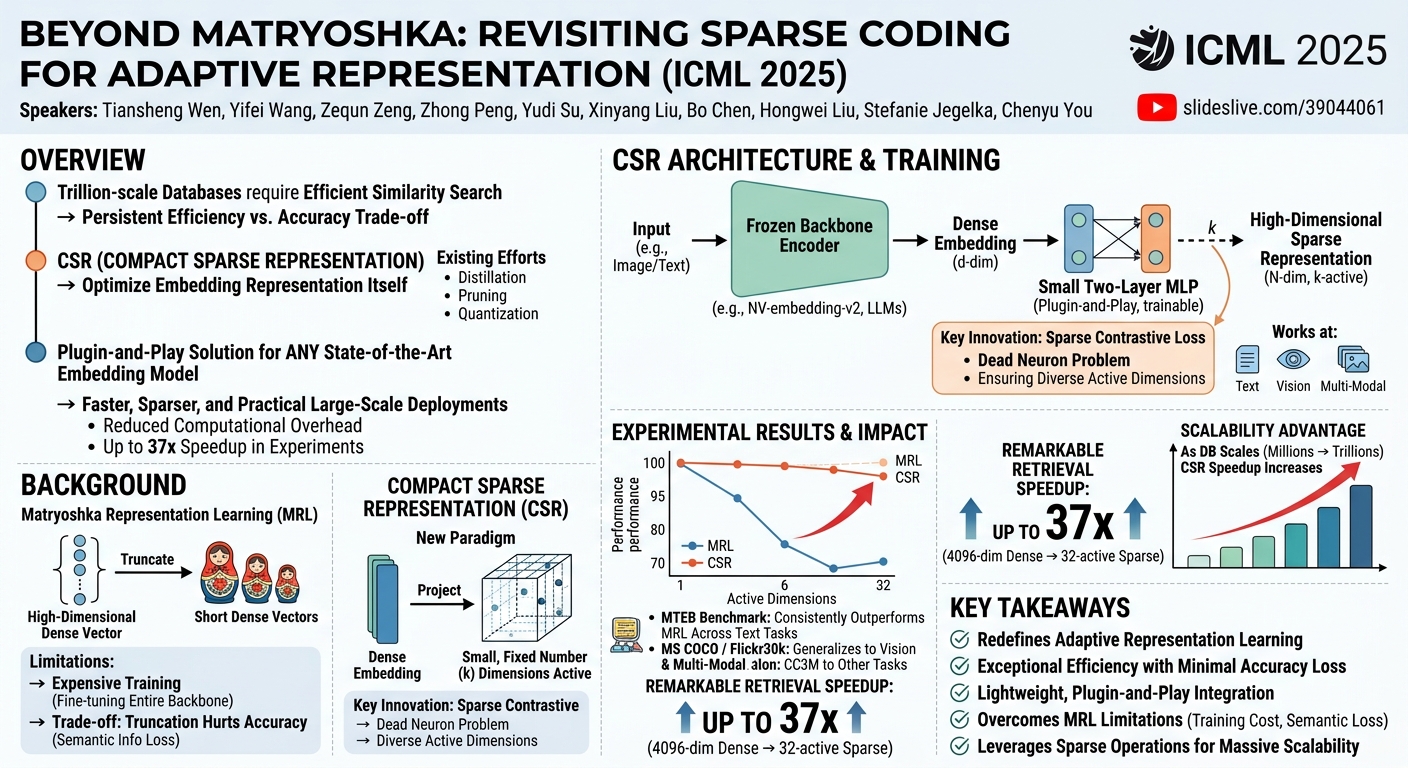
This article delves into the ICML 2025 talk, "Beyond Matryoshka: Revisiting Sparse Coding for Adaptive Representation," presented by Chenyu You, an Assistant Professor at Stony Brook, on behalf of his students and collaborators. The talk introduces CSR (Compact Sparse Representation), a novel approach to adaptive representation learning that re-examines the classical concept of sparse coding to address the challenges of modern large-scale retrieval systems. In an era dominated by trillion-scale databases powering real-time applications like web search, recommendation engines, and video retrieval, the demand for highly efficient yet accurate similarity search is paramount.
Key moments
- 0:00 Introduction to CSR and efficient retrieval motivation
- 4:00 Limitations of current adaptive methods (MRL)
- 4:28 CSR's core idea: high-dimensional sparse projection
- 5:48 CSR's lightweight plug-and-play architecture
- 6:40 CSR's efficiency and scalability benefits
- 7:16 Sparse contrastive loss addresses 'dead neuron' problem
Beyond Matryoshka: Revisiting Sparse Coding for Adaptive Representation
Speakers: Tiansheng Wen, Yifei Wang, Zequn Zeng, Zhong Peng, Yudi Su, Xinyang Liu, Bo Chen, Hongwei Liu, Stefanie Jegelka, Chenyu You
Conference: ICML 2025
YouTube: https://slideslive.com/39044061
Overview
This article delves into the ICML 2025 talk, "Beyond Matryoshka: Revisiting Sparse Coding for Adaptive Representation," presented by Chenyu You, an Assistant Professor at Stony Brook, on behalf of his students and collaborators. The talk introduces CSR (Compact Sparse Representation), a novel approach to adaptive representation learning that re-examines the classical concept of sparse coding to address the challenges of modern large-scale retrieval systems. In an era dominated by trillion-scale databases powering real-time applications like web search, recommendation engines, and video retrieval, the demand for highly efficient yet accurate similarity search is paramount.
The core motivation behind CSR is to significantly enhance retrieval efficiency without sacrificing performance accuracy, a persistent challenge in the ML/systems space. While existing efforts often focus on optimizing embedding generation (e.g., distillation, pruning) or accelerating vector search libraries (e.g., Faiss), CSR offers a fundamentally different perspective: optimizing the embedding representation itself. The work directly tackles the limitations of prevalent techniques like Matryoshka Representation Learning (MRL), which, despite its flexibility, suffers from high computational training costs and an inherent trade-off between embedding truncation and semantic information loss. CSR proposes an alternative paradigm, projecting dense embeddings into a higher-dimensional sparse space to unlock superior efficiency and semantic capacity.
The significance of CSR lies in its ability to provide a plug-and-play solution that makes any state-of-the-art embedding model faster, sparser, and more practical for large-scale deployments. By drastically reducing the computational overhead for similarity search and offering a substantial speedup—up to 37x in experiments—while maintaining or even improving accuracy, CSR presents a compelling advancement for practitioners and infrastructure teams. Its backbone-agnostic nature and proven efficacy across multiple modalities (text, vision, multi-modal) underscore its potential to redefine how embeddings are learned and deployed in real-world, high-throughput retrieval systems.
Background
▶ Watch: Introduction to CSR and efficient retrieval motivation (0:00)
The landscape of modern AI applications is increasingly defined by the need to efficiently retrieve relevant information from vast, often trillion-scale, databases. This is evident in critical real-time systems such as web search, product recommendations, and large-scale video content retrieval. A common bottleneck in these systems is the similarity search phase, where a query embedding is compared against millions or billions of item embeddings to find the closest matches. As the dimensionality of these embeddings increases, the computational cost of dot product similarity calculations escalates, directly impacting system latency and throughput.
Traditional approaches to tackle this problem broadly fall into two categories. The first focuses on optimizing the embedding generation process itself. Techniques like distillation reduce the size and complexity of embedding models, pruning removes redundant connections, and quantization lowers the precision of numerical representations, all aiming to speed up the initial computation of the embedding vector. The second category concentrates on accelerating the similarity search phase by optimizing vector search libraries, such as Faiss, to perform faster approximate nearest neighbor (ANN) searches. While effective, these methods often operate on a fixed embedding structure or introduce approximations that can degrade recall.
A prominent and widely adopted technique in adaptive representation learning is Matryoshka Representation Learning (MRL). Inspired by Russian nesting dolls, MRL learns embeddings at multiple lengths, where smaller embeddings are nested within larger ones. The model is trained such that each truncated length captures meaningful semantic information, allowing for a flexible trade-off between embedding size (and thus retrieval speed) and accuracy at inference time. MRL has found widespread adoption in industrial-level embedding models, including GTEs, due to its simplicity and effectiveness in enabling a dynamic balance between efficiency and performance.
However, MRL is not without its limitations. Firstly, it necessitates training or fine-tuning the entire backbone model, which can be prohibitively computationally expensive, especially for large language and vision models comprising millions or even billions of parameters. This high cost restricts its applicability for rapidly evolving or domain-specific models. Secondly, MRL faces an inherent fundamental trade-off: truncating an embedding inevitably leads to a loss of semantic information, which can significantly hurt retrieval accuracy, particularly when very short embeddings are required for extreme efficiency. This means that while MRL offers flexibility, it often comes at the cost of a direct compromise in semantic fidelity.
Recognizing these challenges, the CSR project proposes a fundamentally different path. Instead of compressing dense vectors into shorter dense vectors, as MRL does, CSR aims to project the original dense embedding into a higher-dimensional sparse space. In this sparse representation, only a small, fixed fraction of dimensions are actively utilized, while the vast majority remain zero. The core hypothesis is that this expansion into a larger, sparse space can provide greater capacity to preserve crucial semantic information compared to dense compression, thereby overcoming the accuracy-efficiency trade-off faced by MRL. This shift from "short dense" to "high-dimensional sparse" is the foundational idea behind CSR, promising a new avenue for efficient and accurate adaptive representation learning.
Key Findings
▶ Watch: CSR's core idea: high-dimensional sparse projection (4:28)
The research behind CSR unveils several pivotal findings that underscore its potential to revolutionize large-scale retrieval systems:
- Superior Accuracy-Efficiency Trade-off: CSR demonstrably outperforms MRL, especially when aggressive compression is required. While MRL's performance drops sharply as embedding length is truncated, CSR maintains strong retrieval accuracy even when activating only a very small number of dimensions (e.g., 2 or 4). This indicates that CSR can deliver high speed without sacrificing quality, enabling more aggressive compression than MRL or other truncation-based methods.
- Lightweight and Plug-and-Play Architecture: A significant contribution of CSR is its minimal computational overhead for integration. It operates by simply adding a lightweight two-layer MLP on top of a frozen pre-trained embedding backbone. This design means CSR can be seamlessly plugged into any state-of-the-art embedding model—such as GTEs, NV-embedding-v2, or other encoder types—without requiring retraining or fine-tuning the entire, potentially massive, backbone.
- Dramatically Reduced Training Cost: The training cost for CSR is substantially lower than that for MRL. By only training a small MLP on top of a frozen backbone using a simple contrastive reconstruction loss, CSR achieves its adaptive capabilities with a fraction of the computational resources, making it highly scalable and practical for real-world deployments where backbone fine-tuning is often infeasible.
- Effective Mitigation of the Dead Neuron Problem: Sparse coding traditionally faces the challenge of dead neurons, where a few dimensions are overused while many others remain inactive, effectively collapsing the sparse space. CSR introduces a specialized sparse contrastive loss that not only enhances the utility of sparse representations for downstream tasks but also actively pushes the model to activate a more diverse set of dimensions. Experiments showed this reduced dead neuron dimensions, even in extreme sparsity settings.
- Efficiency through Sparse Matrix Multiplications: The primary source of CSR's speedup is its leveraging of sparse matrix multiplications (e.g.,
torch.sparse.mm) for similarity search. Unlike dense dot products (torch.mm) which compute all interactions, sparse operations only process non-zero entries. Crucially, the research found that increasing the embedding dimension in the sparse space can actually improve retrieval speed due to the enhanced efficiency of sparse operations, alongside providing better semantic capacity.
- Exceptional Scalability with Database Size: CSR's performance advantages become more pronounced as the database scales. For retrieval systems growing from millions to billions or even trillions of entries, CSR's efficiency gains are more dramatic, making it particularly well-suited for the demands of truly large-scale real-world applications.
- Multi-Modality and Generalization Across Tasks: CSR's effectiveness is validated across multiple modalities and tasks. It generalizes well from text (e.g., MTEB benchmark with NV-embedding-v2 backbone) to vision (e.g., MS COCO, Flickr30k) and multi-modal settings. It consistently outperforms MRL and other SOTA methods, even in zero-shot transfer learning scenarios (e.g., trained on CC3M for vision tasks).
- Significant Retrieval Speedup: Concrete results demonstrate that CSR can compress a 4096-dimensional dense embedding into a sparse vector with only 32 active dimensions, achieving a remarkable 37x speedup in retrieval without a significant drop in performance. This quantifies the practical benefits for deploying highly efficient retrieval systems.
Technical Deep Dive
▶ Watch: CSR's lightweight plug-and-play architecture (5:48)
The technical innovation of CSR lies in its departure from traditional dense embedding compression and its sophisticated use of sparse representations for adaptive information retrieval. At its core, CSR transforms a dense embedding into a high-dimensional sparse vector, preserving semantic richness while drastically reducing computational requirements during similarity search.
The fundamental idea is to project an existing, frozen-trained dense embedding (e.g., from a backbone like NV-embedding-v2) into a much higher-dimensional sparse space. This contrasts directly with MRL, which aims to truncate dense embeddings to shorter lengths. Instead of compression, CSR effectively expands the representation into a space where most dimensions are zero, and only a fixed, small number of k dimensions are non-zero (active).
The architecture for this transformation is remarkably simple and lightweight: a two-layer MLP is added on top of the pre-trained, frozen backbone encoder. This MLP is the only part of the system that needs to be trained. Its role is to learn a mapping from the dense embedding space to the high-dimensional sparse space. During this mapping, the MLP is designed to activate only a small, predefined subset of dimensions, ensuring that each output vector maintains a fixed sparsity level k. This "plug-and-play" design is critical, as it allows CSR to be integrated with any state-of-the-art embedding model without the need for expensive retraining or fine-tuning of the entire, often massive, backbone.
The training objective for this lightweight MLP involves a simple contrastive reconstruction loss. This loss guides the MLP to generate sparse representations that are semantically meaningful and useful for downstream tasks. However, a significant challenge in sparse coding is the dead neuron problem, where a few dimensions become overused while others remain perpetually inactive, effectively collapsing the representational capacity of the sparse space. To counteract this, CSR introduces a specialized sparse contrastive loss. This loss serves a dual purpose: first, it makes the sparse representations more effective for downstream tasks like classification and retrieval; second, and crucially, it actively pushes the model to activate a more diverse set of dimensions. The experiments revealed that without this specialized loss, over 70% of dimensions could remain unused, highlighting its importance in fully leveraging the sparse space. By encouraging more balanced activation, the sparse contrastive loss ensures a richer and more robust semantic encoding.
The efficiency gains of CSR during the inference and retrieval phases stem primarily from its reliance on sparse matrix multiplications. In traditional dense similarity search, computing the dot product between a query embedding and each item embedding in a database involves dense matrix multiplication (e.g., torch.mm). This operation computes every possible interaction between dimensions, even if many are zero. In contrast, CSR leverages the sparsity of its embeddings by using sparse matrix multiplication primitives (e.g., torch.sparse.mm). These operations only store and compute the non-zero entries and their corresponding indices. If the indices of non-zero entries between two sparse vectors do not match, no dot product computation is performed for those specific dimensions, leading to a significant reduction in unnecessary calculations.
A counter-intuitive yet profound technical finding is that increasing the embedding dimension in the sparse space can actually improve retrieval speed. While higher dimensions typically imply more computation for dense vectors, for sparse vectors, a larger dimension often means that the relative sparsity can be maintained or even increased, leading to fewer active dimensions per unit of semantic information. This, combined with the optimized nature of sparse matrix operations, results in faster lookups and better semantic capacity. As the database scales, the advantages of sparse matrix multiplications become even more dramatic, leading to super-linear speedups compared to dense approaches. This makes CSR inherently well-suited for the extreme demands of trillion-scale retrieval systems.
In summary, CSR's technical prowess comes from a synergistic combination of:
- A lightweight, plug-and-play MLP for efficient sparse projection.
- A specialized sparse contrastive loss to ensure diverse and semantically rich sparse activations.
- The strategic utilization of sparse matrix multiplications for accelerated similarity search.
- A novel understanding of how higher-dimensional sparse spaces can lead to both improved semantic capacity and faster retrieval.
Experimental Setup & Results
▶ Watch: CSR's efficiency and scalability benefits (6:40)
The effectiveness of CSR was rigorously validated through extensive experiments conducted across multiple modalities, tasks, and benchmarks, showcasing its robustness and superior performance compared to existing methods like MRL.
Backbone Encoders: For text-based tasks, the NV-embedding-v2 model was utilized as the backbone encoder. For vision and multi-modal tasks, other state-of-the-art models were employed, though specific names beyond NV-embedding-v2 were not detailed in the transcript. The critical aspect is that the backbone was kept frozen, with only the lightweight CSR module being trained.
Datasets & Benchmarks:
- Text Modality: Evaluation was performed on several major datasets from the MTEB (Massive Text Embedding Benchmark), covering tasks such as text classification, clustering, and retrieval.
- Vision & Multi-modal Modality: Experiments included in-distribution and zero-shot setups on standard datasets like MS COCO and Flickr30k. For zero-shot evaluation, CSR was trained on the CC3M dataset and then directly evaluated without any task-specific fine-tuning.
Metrics: The primary metrics focused on quantifying the trade-off between retrieval accuracy (e.g., performance on classification, clustering, retrieval tasks) and efficiency (e.g., speedup factor, number of active dimensions). The number of trainable parameters was also a key metric for comparing training costs.
Headline Results & Key Findings:
- Superior Accuracy-Efficiency Curve: A central finding was CSR's ability to maintain high performance even with highly aggressive sparsity. When the number of active dimensions was significantly reduced, MRL's performance dropped sharply, indicating its inherent accuracy-efficiency trade-off. In stark contrast, CSR (marked by red dots in the presentation figures) preserved the richness of original embeddings while dramatically reducing computational cost. Even with only 2 or 4 active dimensions, CSR delivered strong, meaningful sparse semantic coding signals, a remarkable feat for such high compression.
- Significant Retrieval Speedup: In a direct comparison, CSR demonstrated impressive efficiency gains. It successfully compressed a 4096-dimensional dense embedding into a sparse vector with only 32 active dimensions, achieving an astounding 37x speedup in retrieval without a significant drop in performance. This concrete number highlights the practical utility of CSR for accelerating large-scale systems.
- Outperformance Across Text Tasks: Across all tasks in the MTEB benchmark, CSR consistently outperformed MRL, even when operating at similar retrieval accuracy and efficiency levels. This validated CSR's ability to provide better or equivalent quality with superior efficiency in language understanding tasks.
- Generalization to Vision and Multi-modal Tasks: CSR proved its generalization capabilities by performing strongly on vision and multi-modal benchmarks. In zero-shot experiments on MS COCO and Flickr30k, CSR achieved competitive results while using significantly fewer trainable parameters than MRL and outperforming other state-of-the-art methods. This indicates that sparse representations, when learned properly by CSR, can scale across modalities and retain semantic meaning essential for diverse downstream tasks.
- Low Training Cost: The experimental setup confirmed that CSR requires significantly fewer trainable parameters than MRL because it only trains a small, two-layer MLP on top of a frozen backbone. This translates directly into a much lower training cost, making CSR a more accessible and scalable solution for integrating adaptive representations into existing large models.
- Ablation Studies: Ablation studies provided insights into CSR's optimal configuration. A key finding was that pairing CSR with a strong encoder model yields high-fidelity sparse representations and more semantically meaningful outputs. For practical implementation, it was suggested that setting the hidden dimension to four times the sum of CSR's active dimensions typically yields the best results.
These results collectively demonstrate that CSR is not merely an incremental improvement but a paradigm shift in adaptive representation learning, offering a robust, efficient, and highly scalable solution for the demands of modern AI retrieval systems.
Practical Implications
▶ Watch: Sparse contrastive loss addresses 'dead neuron' problem (7:16)
The development of CSR carries profound practical implications for a wide array of stakeholders involved in the design, deployment, and operation of AI/ML systems, particularly those dealing with large-scale data retrieval.
For Practitioners and Model Builders:
- Plug-and-Play Efficiency: CSR's lightweight, two-layer MLP architecture, designed to operate on a frozen backbone, makes it an exceptionally easy-to-integrate solution. Model builders can take any existing state-of-the-art embedding model (e.g., GTEs, NV-embedding-v2, or custom encoders for text, vision, or multi-modal data) and simply "plug in" the CSR module. This eliminates the need for expensive and time-consuming retraining or fine-tuning of massive foundation models, significantly reducing development cycles and computational costs.
- Uncompromised Performance at Speed: The ability to achieve up to a 37x speedup in retrieval operations while maintaining or even improving accuracy is a game-changer. Practitioners no longer need to make severe trade-offs between system responsiveness and semantic fidelity. This enables the deployment of applications that are both fast and highly accurate, crucial for user experience in real-time systems like search engines and recommendation systems.
- Aggressive Compression: CSR allows for much more aggressive compression of embeddings than MRL or other truncation-based methods. This means that storage requirements for embedding databases can be drastically reduced, and network bandwidth usage during retrieval can be minimized, leading to lower operational costs.
For Infrastructure Teams and Deployers:
- Scalability for Trillion-Scale Systems: CSR's advantages become more pronounced as database sizes grow. For systems scaling from millions to billions or even trillions of items, the efficiency gains from sparse matrix multiplications are dramatic. This makes CSR an ideal candidate for future-proofing retrieval infrastructure against ever-increasing data volumes.
- Reduced Inference Latency and Throughput: The substantial speedup in similarity search directly translates to lower inference latency for individual queries and higher overall system throughput. This is critical for meeting stringent service level agreements (SLAs) in production environments.
- Optimized Resource Utilization: By reducing the computational load during retrieval, CSR can lead to more efficient utilization of hardware resources (e.g., GPUs or specialized AI accelerators). This can translate to lower cloud computing costs or the ability to serve more users with the same hardware footprint.
- Complementary to Existing Optimizations: CSR is orthogonal to other common acceleration techniques such as distillation, pruning, and quantization. These methods primarily target the embedding generation stage, while CSR optimizes the downstream retrieval efficiency. This means CSR can be combined with existing optimizations for even greater overall gains, creating a powerful multi-layered efficiency strategy.
Tradeoffs and Limitations:
While CSR offers significant advantages, a few practical considerations exist. The talk briefly mentions that the authors are working on "CSR-v2" to address "some limitations in our existing methods," though specific details of these limitations are not elaborated. Potential areas for consideration might include:
- Sparse Data Handling: While sparse matrix operations are highly efficient, they require specific software and potentially hardware optimizations. Ensuring that the chosen deployment environment (e.g., specific GPU architectures, deep learning frameworks like PyTorch or TensorFlow, or custom inference engines) fully supports and optimizes sparse operations is crucial. In some highly specialized or legacy systems, integrating sparse operations might require more effort.
- Optimal
kSelection: The fixed number of active dimensions (k) needs to be chosen carefully to balance accuracy and efficiency for a given task and dataset. While the paper provides guidance (e.g., setting hidden dimension to 4x sum of CSR), finding the absolute optimalkmight still involve some empirical tuning. - Overhead of Sparse Representation: While efficient, storing sparse indices and values adds a structural overhead compared to dense vectors, which could be a consideration in extremely memory-constrained scenarios, although this is usually offset by the benefit of fewer active values.
Despite these minor considerations, CSR represents a robust and practical solution for making large-scale retrieval systems more efficient, cost-effective, and performant, offering a clear path forward for deploying advanced AI models in real-world applications.
Key Takeaways
- Paradigm Shift in Adaptive Representation: CSR introduces a novel approach to adaptive representation learning by projecting dense embeddings into a higher-dimensional sparse space, fundamentally differing from Matryoshka Representation Learning (MRL)'s dense truncation strategy.
- Exceptional Efficiency with Preserved Accuracy: CSR achieves remarkable retrieval speedups (up to 37x) in large-scale systems while maintaining or even improving accuracy, enabling more aggressive compression than prior methods without semantic loss.
- Lightweight, Plug-and-Play Integration: The method utilizes a tiny, two-layer MLP on top of any frozen state-of-the-art embedding backbone, drastically reducing training costs and making it a seamless, backbone-agnostic solution for existing models across modalities.
- Innovative Sparse Loss for Robustness: CSR addresses the critical "dead neuron" problem in sparse coding through a specialized sparse contrastive loss, ensuring diverse dimension activation and enhancing the semantic richness and utility of the learned sparse representations.
- Leveraging Sparse Matrix Operations for Scalability: Efficiency is driven by sparse matrix multiplications, which offer increasing speed advantages as database sizes grow. Counter-intuitively, higher-dimensional sparse embeddings can lead to faster retrieval due to more efficient sparse computations.
- Broad Applicability Across Modalities: Validated across text (MTEB), vision (MS COCO, Flickr30k), and multi-modal tasks, CSR demonstrates strong generalization capabilities, making it a versatile tool for various AI applications.
About the Speaker(s)
The presentation was delivered by Chenyu You, an Assistant Professor at Stony Brook University. He presented the work on behalf of his students and collaborators, including Tiansheng Wen and Yifei Wang, who are key contributors to the CSR project. Other collaborators listed on the paper include Zequn Zeng, Zhong Peng, Yudi Su, Xinyang Liu, Bo Chen, Hongwei Liu, and Stefanie Jegelka. The talk highlighted the collaborative nature of the research, with Chenyu You expressing his pleasure in sharing the team's advancements in adaptive representation learning for modern large-scale retrieval systems.
Reviews
Maya Iyer (Theoretical ML Researcher) — SOLID
CSR is a competent, practically motivated contribution that revisits sparse coding as an alternative to Matryoshka Representation Learning for large-scale retrieval. The core idea — project frozen dense embeddings into a high-dimensional sparse space via a lightweight MLP, then exploit sparse matrix operations for fast similarity search — is coherent and the empirical results are plausible. However, the work reads primarily as an engineering contribution with theoretical claims that are either underdeveloped or absent. The 'sparse contrastive loss' and 'dead neuron' mitigation are presented descriptively rather than analytically, the 37x speedup figure lacks a rigorous asymptotic…
Chen Zhao (Applied ML Researcher & Empiricist) — SOLID
CSR is a competent and practically motivated contribution to adaptive representation learning for large-scale retrieval. The core idea — freeze a strong backbone, train a lightweight MLP to project into a high-dimensional sparse space, and exploit sparse matrix multiply at retrieval time — is clean and the plug-and-play framing is genuinely useful for practitioners. The 37x speedup headline is attention-grabbing and the multi-modal evaluation is broader than most comparable papers. However, based on the evidence presented in this write-up, the experimental rigor is uneven: the ablations are shallow, baselines beyond MRL appear underdeveloped, and the mechanistic account of why sparse…
→ Top-rated talks at International Conference on Machine Learning 2025
All talks from International Conference on Machine Learning 2025