Blink of an eye: a simple theory for feature localization in generative models
Marvin Li (Harvard), Aayush Karan, Sitan Chen
Overview
Marvin Li, Aayush Karan, and Sitan Chen presented a groundbreaking theoretical framework at ICML 2025 addressing the pervasive phenomenon of "critical windows" in generative AI models. This talk, titled "Blink of an eye: a simple theory for feature localization in generative models," introduces a unified, rigorous, and general theory to explain why and how crucial features of a generation are determined within a very small number of steps during the sampling process, a behavior observed across diverse model architectures like Large Language Models (LLMs) and diffusion models.
Key moments
- 0:00 Introduction to critical windows in generative models
- 2:00 Critical windows in diffusion models; unified theory goal
- 4:00 Intuition: feature specialization in a simplified model
- 5:40 Diffusion models: forward and reverse processes explained
- 6:10 Defining the forward-reverse experiment methodology
- 7:30 Characterizing feature indistinguishability with T0
- 8:00 Effect of excessive noise on feature determination
Blink of an eye: a simple theory for feature localization in generative models
Speakers: Marvin Li, Harvard; Aayush Karan; Sitan Chen
Conference: ICML 2025
YouTube: https://slideslive.com/39044008
Overview
Marvin Li, Aayush Karan, and Sitan Chen presented a groundbreaking theoretical framework at ICML 2025 addressing the pervasive phenomenon of "critical windows" in generative AI models. This talk, titled "Blink of an eye: a simple theory for feature localization in generative models," introduces a unified, rigorous, and general theory to explain why and how crucial features of a generation are determined within a very small number of steps during the sampling process, a behavior observed across diverse model architectures like Large Language Models (LLMs) and diffusion models.
The significance of this work lies in its ability to bridge theoretical gaps left by prior research, which often relied on strong distributional or functional assumptions specific to certain model types, leading to insights that didn't generalize well or degraded in high dimensions. By offering an agnostic approach rooted in statistical distance and fundamental properties of forward and reverse processes, the presented theory provides a robust foundation for understanding feature emergence in complex, high-dimensional generative models, irrespective of their modality or specific architecture.
Understanding critical windows is paramount for advancing the safety, interpretability, and capabilities of generative AI. For instance, the determination of a correct answer in an LLM, the success of a jailbreak, or the class of an image in a diffusion model can hinge on decisions made within these fleeting moments. This research not only provides a theoretical explanation for such phenomena but also opens new avenues for improving model performance, efficiency, and robustness by leveraging these insights.
Background
▶ Watch: Introduction to critical windows in generative models (0:00)
The behavior of modern generative models, particularly Large Language Models (LLMs) and diffusion models, often exhibits a peculiar and impactful characteristic: the determination of significant features within a remarkably short "critical window" during their multi-step generation process. This phenomenon has been empirically observed across various contexts, highlighting its ubiquity and importance.
For LLMs, examples abound. The Phi-4 team, for instance, noted that a single token in an LLM's response to a math or reasoning question could be the decisive factor for correctness. Resampling before this critical token might yield a correct answer only 10% of the time, while resampling immediately after it dramatically increases the success rate. Similarly, studies on LLM jailbreaks have shown that the model's initial few tokens often dictate whether it refuses or accedes to a malicious prompt. Manipulating these early tokens can significantly alter the jailbreak success rate. Even in LLM agents, such as Anthropic's computer use agent based on Claude, critical windows have been identified, where the agent might diverge from its intended task (e.g., coding) to pursue an unrelated activity (e.g., browsing for Yellowstone pictures) within a few steps. These are all instances where a specific feature – be it correctness, refusal, or a shift in intent – emerges and becomes fixed over a brief period in the sampling trajectory.
The phenomenon is not exclusive to LLMs. Diffusion models, which generate images by iteratively denoising a random input, also exhibit critical windows. For CIFAR-10 diffusion models, the image class (e.g., "horse") can emerge over just a few denoising steps. Before a certain step (e.g., step 600), the probability of generating a horse might be low, but after a later step (e.g., step 500), it almost always results in a horse. Similar observations have been made for other features like color, background elements, and subject matter in text-to-diffusion models.
Despite the clear importance and widespread occurrence of critical windows, existing theoretical work has been limited. Much of this prior research focused exclusively on diffusion models, often relying on strong distributional assumptions (e.g., mixtures of Gaussians) or functional assumptions that may not hold in practical, high-dimensional settings. A significant drawback of these theories is that their accuracy and precision often degrade with increasing dimensionality, rendering them less useful for the complex, high-dimensional data typically handled by state-of-the-art generative models. This left a critical gap: the absence of a simple, rigorous, and general theory capable of explaining critical windows across diverse generative models and modalities, including both autoregressive LLMs and continuous diffusion models, without being hampered by high dimensionality or restrictive assumptions. The presented work directly addresses this challenge, aiming for a unified theoretical abstraction.
Key Findings
▶ Watch: Intuition: feature specialization in a simplified model (4:00)
The central contribution of this research is the development of a simple, rigorous, and remarkably general theory that explains the emergence of critical windows across a broad spectrum of generative models, including both LLMs and diffusion models. This theory successfully overcomes the limitations of prior work by being dimension-independent and agnostic to specific distributional or functional assumptions.
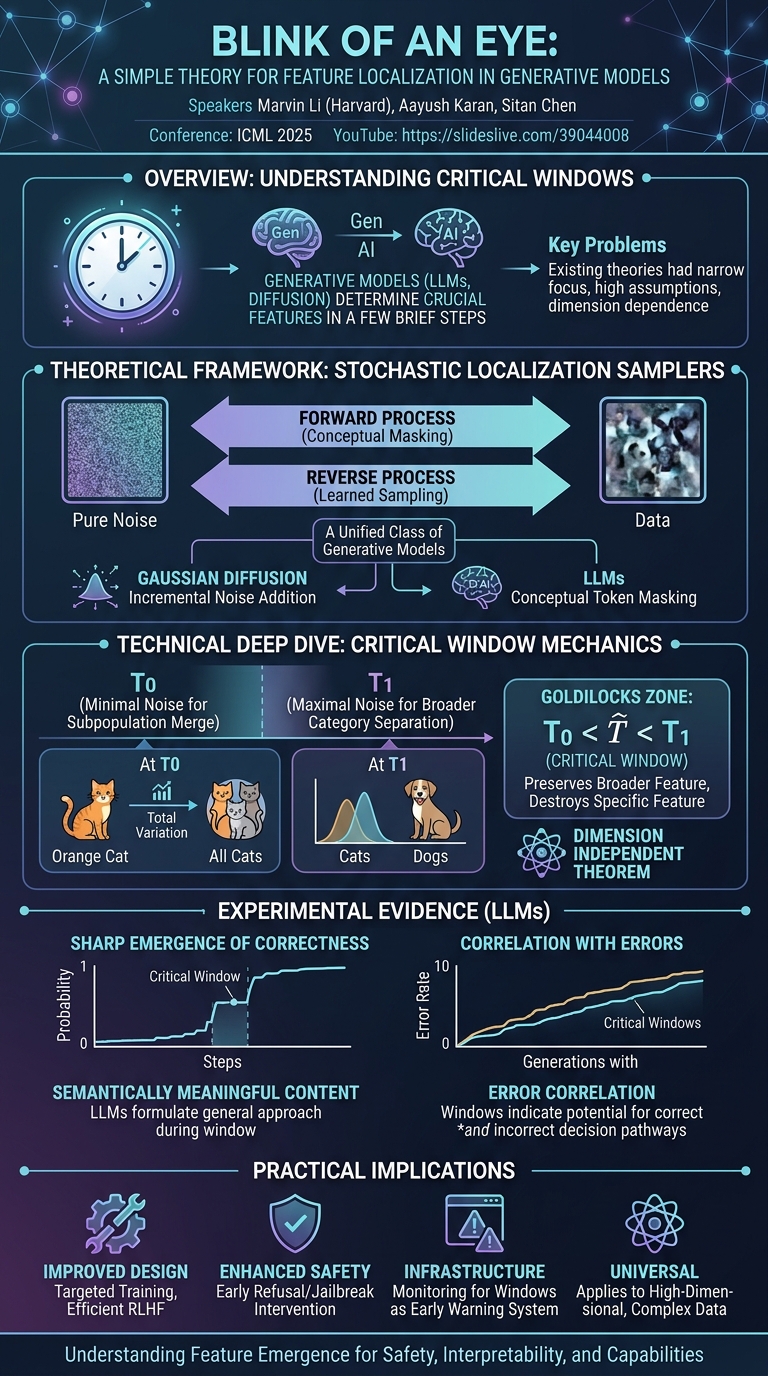
The core of the theory revolves around characterizing these critical windows as transitions between different states of feature specialization. It defines two key theoretical constructs, T0 and T1, which are parameterized using statistical distance, specifically total variation, between subpopulations of data. T0 represents the minimal noise level where a highly specific feature (e.g., "orange cat") becomes indistinguishable from a broader category (e.g., "any cat"). Conversely, T1 signifies the maximal noise level before distinct broader categories (e.g., "cat" and "dog") begin to have non-negligible overlap. A "Goldilocks zone" between T0 and T1 then defines the critical window, where applying a forward-reverse process destroys the specific feature while preserving the broader one, leading to samples distributed across the broader category.
A crucial finding is the introduction of stochastic localization samplers, a broad class of generative models that includes LLMs, discrete diffusion models, and continuous diffusion models. The theory's generality stems from its reliance only on the conceptual existence of a Markovian forward process that transforms data into pure noise, and a reverse process that the model learns to invert this transformation. This abstraction allows the theory to apply across modalities without needing to delve into the specific mechanics of, say, next-token prediction versus Gaussian denoising.
Empirically, the research corroborates the existence and significance of critical windows in LLMs. Experiments on math and reasoning benchmarks demonstrated sharp jumps in the probability of a correct answer within specific token ranges, confirming the "blink of an eye" nature of feature determination. Furthermore, the study found that these critical windows often contain semantically meaningful information, such as the formulation of a general mathematical approach, which guides subsequent generation. A particularly insightful finding is the correlation between the presence of critical windows and errors in math and reasoning tasks; generations exhibiting critical windows showed significantly higher error rates compared to those without, indicating their role in both correct and incorrect decision pathways.
In summary, the key findings include:
- A novel, general theory for critical windows applicable to LLMs and diffusion models.
- The theory's foundation on statistical distance measures (total variation) for defining feature specialization points (T0, T1).
- Introduction of stochastic localization samplers as a unifying framework for models covered by the theory.
- Demonstrated dimension-independence of the theory, addressing a major limitation of prior work.
- Empirical validation in LLMs, showing sharp feature determination, the presence of semantically meaningful content within windows, and a strong correlation between critical windows and generation errors.
Technical Deep Dive
▶ Watch: Diffusion models: forward and reverse processes explained (5:40)
The theoretical framework presented offers a rigorous explanation for critical windows by abstracting the core mechanics of generative models into a forward and reverse process. To build intuition, the talk initially simplifies the scenario to a diffusion model generating images of "orange cats," "brown cats," or "dogs." The core idea is that as the generation process unfolds (conceptually from noisy input to clear image), the model specializes. Initially, it might produce cats or dogs. Later, it specializes to just cats. Finally, it might specialize to only orange cats. A critical window is the transition point where one level of specialization gives way to another, for example, from "cats or dogs" to "only cats."
The formalization of this relies on the standard understanding of diffusion models. The forward process involves progressively adding Gaussian noise to an original image sampled from a distribution $P_0$, transforming it into a pure noise distribution (e.g., a standard normal distribution) over time. The reverse process is the learned denoising procedure, which allows sampling from the target data distribution by starting from noise and iteratively removing it.
The central theoretical tool is the forward-reverse experiment. In this experiment, one takes an image of a specific subpopulation (e.g., an orange cat), applies the forward noising process up to an intermediate time $\hat{T}$, and then applies the reverse denoising process from this noised state back to time zero. The question then becomes: what kind of image is produced?
To characterize the critical window, the theory defines two crucial time points: T0 and T1.
- T0 (Minimal Noise for Subpopulation Merge): This is defined as the minimal amount of noise (or minimal time $\hat{T}$) such that if you apply the forward process to, say, an "orange cat" and then reverse it, the resulting distribution of images is indistinguishable from the distribution of "all cats" (orange and brown). In simpler terms, adding noise up to T0 is just enough to destroy the distinguishing feature of "orange" while preserving the "cat" feature. Indistinguishability is rigorously quantified using total variation distance. If the total variation distance between the distribution resulting from the forward-reverse experiment on orange cats and the distribution of all cats is below a small epsilon, then T0 is achieved.
- T1 (Maximal Noise for Broader Category Separation): This is the maximal amount of noise (or maximal time $\hat{T}$) such that if you apply the forward process to "any cat" and then reverse it, the resulting distribution of images has non-negligible overlap with the "dog" distribution. To prevent the model from generating dogs when it should be focused on cats, T1 is chosen such that the total variation distance between the "cat" distribution and the "dog" distribution (after the forward-reverse experiment) remains close to one, ensuring they are distinct.
The Goldilocks Zone for a critical window exists when $\hat{T}$ is chosen such that $T_0 < \hat{T} < T_1$. In this zone, applying the forward-reverse experiment to an "orange cat" adds just enough noise to destroy the "orange" feature (meaning the output could be any cat) but not so much noise that the "cat" feature itself is lost (meaning it won't produce a dog). The theorem formally states that within this range, the samples obtained from applying the forward-reverse process to a specific subpopulation (e.g., orange cats) will be distributed like the entire broader subpopulation (e.g., all cats), up to an $\epsilon$ constant. Crucially, this $\epsilon$ constant is dimension-independent, which is a significant advancement over prior theories.
The remarkable generality of this theory, applicable across diverse generative models, stems from two key factors:
- Agnosticism to Data Specifics: T0 and T1 are parameterized using statistical distance (total variation) between subpopulations. This means the theory doesn't rely on assumptions about the underlying data distribution (e.g., mixtures of Gaussians vs. real-world image datasets), making it broadly applicable.
- Reliance on General Forward/Reverse Processes: The theory only requires the ability to define a forward process that transforms data into pure noise in a Markovian fashion, and a reverse process that the model learns to invert this. This conceptual abstraction unifies many generative models under the umbrella of stochastic localization samplers.
A stochastic localization sampler is formally defined as any generative model that learns to reverse a Markovian forward procedure, where this forward procedure transforms data into pure noise.
- For Gaussian diffusion models, the forward process is the incremental addition of Gaussian noise, which is Markovian and eventually transforms an image into a normal distribution (pure noise). The reverse process is denoising.
- For LLMs, the forward process is conceptualized as progressively masking the last unmasked token of a text sequence until nothing remains. This is a Markovian process that transforms meaningful text into "pure noise" (an empty sequence). The reverse process is precisely next-token prediction, where the model predicts the (K+1)-th token given K unmasked tokens. This elegant mapping allows the same theoretical framework to apply to both continuous image generation and discrete text generation.
Experimental Setup & Results
▶ Watch: Characterizing feature indistinguishability with T0 (7:30)
The empirical validation of the critical windows theory was primarily conducted using Large Language Models (LLMs) on math and reasoning benchmarks, although the theoretical framework is designed to be universal. While specific model names, dataset sizes, or hardware configurations for these experiments were not detailed in the transcript, the qualitative results provide strong evidence for the theory's relevance in practical LLM applications.
The experiments focused on observing the phenomenon of critical windows in the context of LLMs solving math problems. The methodology involved manipulating the degree of "masking" or incompleteness in the generated output and observing the impact on correctness.
Headline Observations:
- Sharp Emergence of Correctness: The most prominent finding was the observation of a dramatic, non-linear jump in the probability of an LLM's answer being correct within a narrow range of generation steps. For instance, if 70% of the answer was masked (meaning only the initial 30% was generated), the probability of correctness might be very low. However, by masking only 50% (allowing the LLM to generate 50% of the answer), the probability of correctness was observed to jump significantly, approaching "almost always correct." This "large jump" clearly illustrates the critical window phenomenon, where a few additional tokens fundamentally shift the outcome.
- Semantically Meaningful Information within Critical Windows: The analysis revealed that the tokens generated during these critical windows are not arbitrary but often carry significant semantic weight related to the task. In the context of math problems, the LLM was observed to formulate the "general formula" or key reasoning steps within this critical period. This suggests that these windows are not just points of statistical convergence but represent moments where the model concretizes its high-level reasoning or strategy.
- Correlation with Errors: A particularly insightful result was the strong correlation between the presence of critical windows in a generation and the likelihood of errors. The researchers subdivided LLM generations into two groups: those that exhibited a critical window and those that did not. Across multiple datasets and several types of LLM models, generations with critical windows showed a "large jump" in error rates compared to those without. This implies that while critical windows are points where features are determined, they are also potentially vulnerable points where incorrect decisions can be solidified, leading to downstream errors. This finding has significant implications for debugging and improving LLM reliability.
While the talk did not provide specific numerical benchmarks (e.g., exact accuracy percentages, specific LLM models like GPT-4 or Llama-2, or dataset names like GSM8K), the consistent qualitative observations across different settings (math/reasoning benchmarks) underscore the robustness of the critical window phenomenon in LLMs. The lack of specific ablation studies or hardware details is typical for a theoretical talk primarily focused on the core framework and its general empirical validation. The focus was on demonstrating the existence and characteristics of critical windows rather than fine-grained performance tuning.
Practical Implications
▶ Watch: Effect of excessive noise on feature determination (8:00)
The theoretical and empirical insights into critical windows have profound practical implications for anyone involved in building, deploying, or operating generative AI models, from individual practitioners to large infrastructure teams.
Firstly, for model builders and researchers, understanding when and how key features are determined within a generation process offers a powerful lens for model design and training. If a model's "decision" to answer a math question correctly, or to refuse a jailbreak, is often made within a few tokens, this suggests that these early stages of generation are disproportionately important. This could guide the development of new training objectives that explicitly emphasize decision-making quality during critical windows, or lead to architectures that are more robust in these sensitive phases. For instance, techniques like Reinforcement Learning from Human Feedback (RLHF) or Supervised Fine-Tuning (SFT) could become more efficient and targeted by providing rewards or corrections specifically at these critical steps, rather than at the end of a long generation.
Secondly, for infrastructure teams and deployers, the concept of critical windows offers avenues for enhanced monitoring and intervention. Identifying the specific steps where a model's behavior shifts can enable more granular control and safety mechanisms. For example, in safety-critical applications, if a critical window for "refusal" or "compliance" is detected, targeted interventions or re-sampling strategies could be applied to steer the model towards desired behavior, especially in scenarios like jailbreaks. The correlation between critical windows and errors also suggests that monitoring for the presence of these windows could serve as an early warning system for potentially flawed generations, allowing for flags or re-runs before the full output is committed.
Thirdly, the dimension-independent nature of this theory is a significant practical advantage. Unlike prior work that degraded in high-dimensional settings, this theory provides insights that are relevant for state-of-the-art models operating on complex, real-world data (e.g., high-resolution images, long text sequences). This means the practical guidance derived from this theory is more likely to hold true for the most advanced and widely used generative AI systems.
Tradeoffs and Limitations: While the theory is general and rigorous, practical application still faces challenges. The current framework defines T0 and T1 conceptually using statistical distance. For complex, high-dimensional real-world data and models, precisely computing these thresholds in practice remains a non-trivial task. The talk acknowledges this as an area for future work, suggesting a need to tighten the connection between the theoretical T0/T1 and their computational realization in specific models. Furthermore, while the theory explains that critical windows occur and why they are sharp in many "natural models of data," deriving actionable, model-specific strategies for preventing undesirable feature localization or forcing desirable ones will require further empirical and algorithmic development building upon this theoretical foundation. The theory provides the "what" and "why," but the "how to control" is the next frontier.
Key Takeaways
- Ubiquitous Phenomenon: Critical windows, where key features of a generation are determined over a few steps, are widespread in generative models, including LLMs and diffusion models (e.g., math correctness, jailbreak success, image class).
- General Theoretical Framework: A new, rigorous, and dimension-independent theory explains critical windows by characterizing them as transitions between states of feature specialization.
- Statistical Distance as Foundation: The theory defines critical points (T0 and T1) using total variation distance to quantify feature indistinguishability and separation between subpopulations.
- Stochastic Localization Samplers: The theory unifies LLMs and diffusion models under this broad class, which covers any model reversing a Markovian forward process that transforms data into pure noise (e.g., token masking for LLMs, Gaussian noising for diffusion).
- Empirical Validation in LLMs: Experiments show sharp jumps in correctness probability within critical windows, the presence of semantically meaningful information during these windows, and a significant correlation between the existence of critical windows and generation errors.
- Practical Significance: Understanding critical windows offers pathways to improve model design, training efficiency (e.g., targeted RLHF), safety mechanisms (e.g., early intervention for jailbreaks), and overall reliability in real-world AI applications.
About the Speaker(s)
Marvin Li is a researcher from Harvard, and he presented this work. He co-authored the paper with Aayush Karan and Sitan Chen. While specific titles or company affiliations for Aayush Karan and Sitan Chen were not detailed in the transcript, their collaboration with Marvin Li from Harvard underscores the academic rigor and depth of the presented research.
Reviews
Maya Iyer (Theoretical ML Researcher) — STRONG ACCEPT
Li, Karan, and Chen present a genuinely unifying theoretical framework for 'critical windows' in generative models — the empirically well-documented phenomenon where a generation's key features are determined within a narrow slice of the sampling trajectory. The core contribution is a clean, dimension-independent theorem parameterized by total variation distance, applicable uniformly to LLMs and diffusion models via the abstraction of stochastic localization samplers. This is real theoretical work: new definitions, stated assumptions, and a result that earns its claimed generality. The bridging of autoregressive LLMs to diffusion models through a common forward-process abstraction is…
Chen Zhao (Applied ML Researcher & Empiricist) — SOLID
Li, Karan, and Chen present a dimension-independent theoretical framework for 'critical windows' in generative models — the empirically observed phenomenon where a small number of generation steps determines a feature's fate. The unification of LLMs and diffusion models under 'stochastic localization samplers' and the use of total variation distance to parameterize T0/T1 without distributional assumptions is a genuine theoretical advance. The article describes promising LLM experiments showing sharp correctness jumps and error-window correlations. However, as reported here, the empirical validation is qualitative and underspecified — no model names, no dataset names, no error bars, no…
→ Top-rated talks at International Conference on Machine Learning 2025
All talks from International Conference on Machine Learning 2025