CollabLLM: From Passive Responders to Active Collaborators
Shirley Wu, Michel Galley, Baolin Peng, Hao Cheng, Gavin Li, Yao Dou, Weixin Cai, James Zou, Jure Leskovec, Jianfeng Gao
Overview
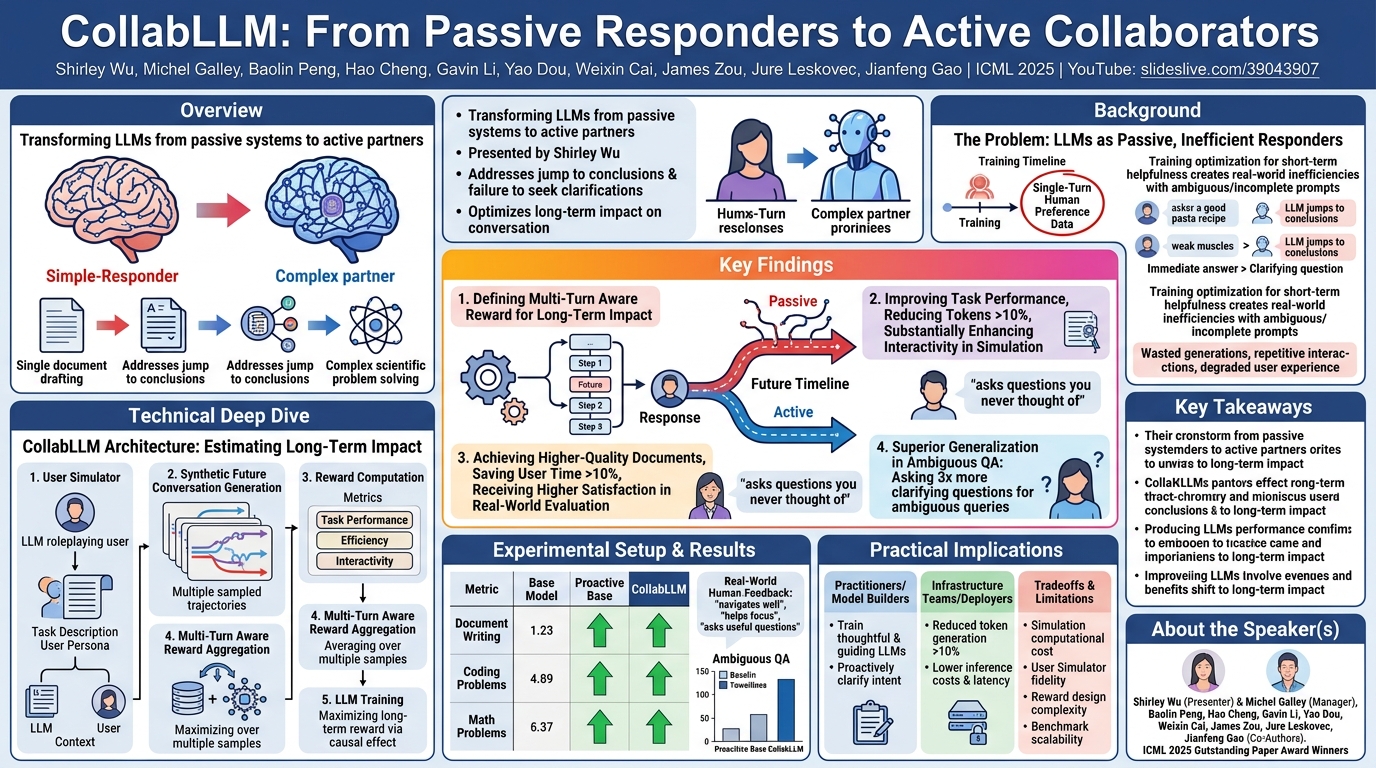
In an era where Large Language Models (LLMs) are increasingly integrated into daily workflows, from drafting documents to solving complex scientific problems, the quality of human-LLM collaboration has become paramount. This talk introduces CollabLLM, a groundbreaking framework designed to transform LLMs from passive, reactive systems into active, collaborative partners. Presented by Shirley Wu at ICML 2025, CollabLLM addresses a critical limitation of current LLMs: their tendency to jump to premature conclusions and fail to proactively seek clarifying information, leading to inefficient and often frustrating interactions.
Key moments
- 0:00 Problem: LLMs as passive, inefficient responders
- 2:00 Why LLMs are passive: single-turn preference tuning
- 3:00 CollabLLM's key insight: reward long-term impact
- 4:00 Methodology: LLMs simulate users for future trajectories
- 6:00 Core elements of CollabLLM architecture
- 7:00 Proposing new multi-turn evaluation benchmarks
- 8:00 Results: improved task performance in simulations
- 9:00 Real-world evaluation and positive user feedback
CollabLLM: From Passive Responders to Active Collaborators
Speakers: Shirley Wu, Michel Galley, Baolin Peng, Hao Cheng, Gavin Li, Yao Dou, Weixin Cai, James Zou, Jure Leskovec, Jianfeng Gao
Conference: ICML 2025
YouTube: https://slideslive.com/39043907
Overview
In an era where Large Language Models (LLMs) are increasingly integrated into daily workflows, from drafting documents to solving complex scientific problems, the quality of human-LLM collaboration has become paramount. This talk introduces CollabLLM, a groundbreaking framework designed to transform LLMs from passive, reactive systems into active, collaborative partners. Presented by Shirley Wu at ICML 2025, CollabLLM addresses a critical limitation of current LLMs: their tendency to jump to premature conclusions and fail to proactively seek clarifying information, leading to inefficient and often frustrating interactions.
The core innovation of CollabLLM lies in its novel reward mechanism, which moves beyond short-term, single-turn helpfulness to optimize for the long-term impact of an LLM's responses on an entire conversation. By leveraging LLM-based user simulation to forecast future conversational trajectories, CollabLLM trains models to understand when and how to ask questions, clarify user intent, and guide the interaction effectively. This paradigm shift promises to unlock a new level of efficiency, user satisfaction, and true partnership in human-AI collaboration, making LLMs not just intelligent responders but thoughtful facilitators.
This work is particularly significant because it tackles a fundamental problem in the alignment of LLMs with human goals in multi-turn settings. By redefining the optimization objective, CollabLLM paves the way for more robust, adaptable, and genuinely helpful AI assistants that can navigate ambiguity and proactively contribute to problem-solving, rather than merely executing commands. The implications extend across various domains, from personal productivity to advanced research, where collaborative intelligence can significantly accelerate progress.
Background
▶ Watch: Problem: LLMs as passive, inefficient responders (0:00)
The pervasive issue of LLMs acting as passive responders stems directly from their training methodologies. Modern LLMs are predominantly fine-tuned based on single-turn human preference data. In such a setup, a model's response is rewarded if it provides an immediate, comprehensive answer to a user's prompt. For instance, if a user asks for an article about optimism, a model that generates a full article is typically preferred over one that asks a clarifying question like "What specific aspects of optimism are you interested in?"
This optimization for immediate gratification, while seemingly beneficial in the short term, creates significant inefficiencies in real-world, multi-turn interactions. Users often provide ambiguous or incomplete prompts, either because they don't know exactly what they need or because they assume the LLM possesses more context than it does. Examples abound: a user asking for a "good pasta recipe" might be vegetarian, rendering a chicken-based recipe useless; a patient describing "weak muscles" might receive a list of six medical conditions without any attempt by the LLM to narrow down symptoms or ask follow-up questions. In these scenarios, the LLM's passive behavior leads to wasted generations, repetitive interactions, and a degraded user experience.
The problem, therefore, is not a lack of factual knowledge or generative capability in LLMs, but a deficit in collaborative intelligence. They lack the natural inclination to help users clarify their needs, explore options, or anticipate potential misunderstandings. This "jump-to-conclusion" syndrome, rooted in single-turn reward structures, highlights a critical gap in how we currently train and evaluate conversational AI, necessitating a re-evaluation of the objective function to foster more proactive and effective partnerships.
Key Findings
▶ Watch: CollabLLM's key insight: reward long-term impact (3:00)
CollabLLM introduces a robust framework that fundamentally shifts LLM behavior from passive responding to active collaboration, yielding several key findings:
Firstly, the central discovery is that by defining a multi-turn aware reward mechanism that estimates the long-term impact of an LLM's response on a conversation, models can be trained to exhibit significantly more proactive and helpful behaviors. This stands in stark contrast to traditional single-turn optimization, which encourages immediate, but often ill-suited, responses.
Secondly, CollabLLM demonstrates substantial improvements across critical metrics in multi-turn human-LLM collaboration. In simulated environments, it not only improves task performance but also reduces the number of tokens generated by over 10% and substantially enhances interactivity. These efficiency gains translate directly into lower operational costs and a more streamlined user experience.
Thirdly, the efficacy of CollabLLM extends beyond simulated settings to real-world human evaluations. With 200 participants completing a writing task, CollabLLM generated higher-quality documents, saved user time by over 10%, and consistently received higher user satisfaction ratings for interaction experience. Human feedback highlighted CollabLLM's ability to "navigate well," "help focusing," and "ask questions you never thought of," validating its collaborative nature.
Finally, CollabLLM exhibits superior generalization capabilities in discerning when to ask questions. On an ambiguous QA task, CollabLLM asked three times more clarifying questions for ambiguous queries compared to baseline models (including GPT-4 and Llama), while only slightly increasing questions for unambiguous queries. This indicates a sophisticated understanding of conversational context and user intent, allowing it to proactively seek necessary information without being overly verbose or redundant.
Technical Deep Dive
▶ Watch: Core elements of CollabLLM architecture (6:00)
The technical foundation of CollabLLM rests on a simple yet profound insight: to foster active collaboration, LLMs must be rewarded not just for their immediate output, but for the long-term positive impact their responses have on the entire conversational trajectory. Achieving this requires a mechanism to estimate this long-term impact, which inherently means peering into the future of a conversation.
The core challenge is estimating a response's long-term impact. The talk uses an evocative analogy: "imagine like we are living in the multiverse that we can see such different possibilities." Since we cannot literally see future conversations, CollabLLM proposes a pragmatic solution: LLM-based user simulation.
Here's how the simulation and multi-turn aware reward calculation process works:
- User Simulator Design: An auxiliary LLM is prompted to roleplay a user. This user simulator is provided with several key inputs:
- A task description: Defines the overall goal the user is trying to achieve (e.g., "write an article," "solve a coding problem").
- A user persona: Specifies characteristics or constraints of the user (e.g., "a vegetarian," "a patient with weak muscles," "a developer needing help with Python").
- The current conversation context: The ongoing dialogue between the main LLM and the simulated user.
- Synthetic Future Conversation Generation: When the main LLM (the one being trained) generates a response, this response is fed to the user simulator. The simulator then generates a realistic user reply, and the interaction continues. This iterative process generates synthetic future conversations that branch out from the main LLM's initial response. The goal is to generate multiple such trajectories, simulating different possible continuations of the dialogue.
- Reward Computation for Trajectories: For each generated synthetic conversation, a reward is computed. This reward is designed to reflect the quality of the interaction and the outcome of the task. Examples of metrics used include:
- Task Performance: This is task-dependent. For instance, in a coding task, it might be the pass rate of the final generated code against unit tests. In a writing task, it could be a qualitative assessment of document quality.
- Efficiency: Measured by the total number of tokens generated by the LLM during the entire synthetic conversation. The aim is to minimize this, indicating a more direct and less redundant interaction.
- Interactivity: A metric designed to measure how engaging or collaborative the conversation was. While the specific calculation isn't fully detailed in the transcript, it generally reflects the quality of turns and mutual understanding.
- Multi-turn Aware Reward Aggregation: Since a single response can lead to multiple possible future trajectories, CollabLLM generates multiple samples of synthetic future conversations for each model response. The individual rewards computed for each trajectory are then averaged across these samples. This average becomes the multi-turn aware reward for that specific model response. This averaging helps to estimate the robust, expected long-term impact, akin to calculating an expected value over possible futures.
- Causal Effect and Model Training: The averaged multi-turn aware reward effectively provides an estimate of the causal effect of a given LLM response on the overall success and quality of the future conversation. This reward signal is then used to train the LLM. While the specific reinforcement learning algorithm isn't explicitly detailed, the objective is to maximize this multi-turn aware reward, thereby encouraging the LLM to generate responses that lead to more successful, efficient, and interactive long-term collaborations. This framework implicitly guides the LLM to learn when to ask clarifying questions, how to guide the user, and what information is crucial for task completion.
The development of CollabLLM also necessitated new evaluation paradigms. Recognizing that most existing benchmarks are single-turn and assume unambiguous inputs, the researchers proposed three new multi-turn benchmarks. These benchmarks allow the LLM to interact with a user simulator to complete complex tasks such as writing a document, solving coding problems, and solving mathematical problems. These environments enable the measurement of both task performance and user experience dimensions (efficiency and interactivity) in a truly multi-turn context.
Experimental Setup & Results
▶ Watch: Proposing new multi-turn evaluation benchmarks (7:00)
To validate the CollabLLM framework, the researchers conducted extensive experiments across both simulated and real-world environments, utilizing specific benchmarks and comparing against relevant baselines.
Experimental Benchmarks:
The talk introduces three new multi-turn benchmarks designed to evaluate collaborative LLM behavior:
- Document Writing Task: An LLM assists a user in writing a document, requiring clarification and iterative refinement.
- Coding Problem Solving: An LLM collaborates with a user to solve a coding challenge, involving understanding requirements, suggesting code, and debugging.
- Mathematics Problem Solving: An LLM works with a user on complex mathematical problems, necessitating step-by-step reasoning and clarification.
Baselines:
Two primary baselines were used for comparison:
- Base Model: A standard, non-CollabLLM-trained LLM (e.g., Llama and GPT-4 were mentioned in the context of generalization experiments, implying similar base models were used for fine-tuning). This represents the typical passive behavior.
- Proactive Base Model: A base LLM explicitly prompted with instructions to be proactive (e.g., "Hey, you should ask questions and reduce the user efforts"). This baseline tests whether simple prompt engineering alone can achieve the desired collaborative behavior.
Metrics:
Performance was evaluated along two main dimensions:
- Task Performance: Task-specific metrics, such as the pass rate for code generated in the coding benchmark, or qualitative assessments for document quality.
- User Experience:
- Efficiency: Measured by the total number of tokens generated by the LLM during the conversation (lower is better).
- Interactivity: An engagement score, reflecting how engaging the conversation was (higher is better).
Results on Simulated Environments:
Across all three proposed multi-turn datasets, CollabLLM consistently demonstrated superior performance:
- Improved Task Performance: CollabLLMs achieved higher success rates in completing the given tasks.
- Enhanced Efficiency: CollabLLMs reduced the number of tokens generated by the LLM by over 10% compared to baselines. This indicates more focused and less redundant conversations.
- Substantial Interactivity Improvement: CollabLLMs significantly improved the interactivity scores, suggesting a more engaging and collaborative user experience.
Results on Real-World Environments:
To validate the findings with actual human users, a real-world evaluation was conducted:
- Participants: 200 human participants were recruited to complete a writing task with the assistance of different LLM variants.
- Metrics: After completing the task, participants rated the document quality and their interaction experience. The backend also recorded the time spent to complete the task.
- Findings:
- CollabLLM yielded higher-quality documents.
- Users completed tasks over 10% faster with CollabLLM.
- CollabLLM consistently received higher interaction experience ratings.
- Qualitative User Feedback: Representative feedback highlighted CollabLLM's strengths:
- Base model: "seems to be over-agreeable."
- Proactive base model: "seems to be very redundant and doesn't know how to adapt through the conversation."
- CollabLLM: "navigate real well on what to say and what information is needed," "help focusing on one part of story at a time," and "asks questions and make you think of things that you never thought of."
- Interaction Experience Over Time: Analysis of user ratings every three turns showed that the base model's interaction performance degraded from the sixth to the ninth turn. In contrast, CollabLLMs maintained and even improved user experience ratings throughout longer conversations.
Generalization to Ambiguous QA Tasks:
To test if the learned collaborative behavior generalizes, CollabLLM was applied to an ambiguous QA task with two types of queries:
- Ambiguous Queries: Expected the model to ask clarifying questions.
- Unambiguous Queries: Expected the model to provide a direct answer.
- Action-Level Accuracy: Measured how well the model knew when to ask questions.
- Findings:
- Baseline models (Llama and GPT-4) exhibited poor discernment; they "barely ask questions when there's [ambiguity]" and sometimes "almost always ask questions for non-ambiguous ones," indicating a lack of understanding of when a direct answer is appropriate.
- CollabLLMs asked three times more questions when queries were ambiguous, demonstrating a strong ability to identify information gaps.
- For unambiguous queries, CollabLLM only asked questions slightly more often than the base model, indicating it avoids unnecessary clarification when the input is clear. This shows a sophisticated balance between proactivity and directness.
These comprehensive results underscore the effectiveness of CollabLLM's multi-turn aware reward mechanism in fostering truly collaborative and efficient LLM behavior across diverse tasks and evaluation settings.
Practical Implications
▶ Watch: Real-world evaluation and positive user feedback (9:00)
The CollabLLM framework carries significant practical implications for various stakeholders in the AI/ML ecosystem, fundamentally altering how we conceive and deploy conversational AI.
For Practitioners and Model Builders:
CollabLLM provides a clear and actionable methodology to move beyond the limitations of single-turn optimization. It empowers model builders to train LLMs that are not just intelligent but also thoughtful and guiding. This means future LLMs can be designed to:
- Proactively clarify user intent: Reducing the burden on users to formulate perfect prompts.
- Navigate ambiguity: Making LLMs more robust in real-world, underspecified scenarios.
- Guide problem-solving: Acting as a genuine partner in complex tasks like coding, scientific discovery, or creative writing, rather than just a command executor.
- Improve user satisfaction: By fostering more natural and efficient interactions, leading to higher engagement and trust.
For Infrastructure Teams and Deployers:
The demonstrated reduction in token generation (over 10%) by CollabLLMs has direct economic benefits. Fewer tokens mean:
- Lower inference costs: A significant factor for large-scale LLM deployments, especially in cost-sensitive applications.
- Improved latency: Shorter, more focused conversations can lead to faster task completion times, enhancing real-time application performance.
- Reduced computational load: Less data processed per interaction can alleviate pressure on GPU/TPU resources.
The framework also suggests a shift towards evaluating LLMs based on multi-turn metrics, pushing infrastructure teams to develop tools and pipelines that support and monitor these longer-term interaction qualities.
Tradeoffs and Limitations:
While highly promising, CollabLLM introduces certain tradeoffs and areas for future development:
- Computational Cost of Simulation: Generating multiple synthetic future conversations for reward calculation during training can be computationally intensive. The overhead of running an auxiliary LLM (the user simulator) iteratively needs to be considered, especially for very long conversations or a large number of samples. This might increase training time and resource requirements compared to purely single-turn reward mechanisms.
- Fidelity of User Simulator: The quality and realism of the simulated user are paramount. As acknowledged by the speaker, there can be "noise" or "artifacts" when LLMs roleplay users. A less realistic simulator could lead to training an LLM that is optimized for interacting with an artificial agent rather than a human, potentially creating a sim2real gap. Ongoing research aims to make these simulators more human-like, which is crucial for the framework's long-term success.
- Complexity of Reward Design: While the concept of a multi-turn aware reward is clear, defining and implementing robust metrics for task performance, efficiency, and interactivity across diverse domains can be challenging. The effectiveness of CollabLLM heavily relies on well-designed, domain-appropriate reward functions.
- Scalability of Benchmarks: While new multi-turn benchmarks are proposed, creating a truly comprehensive and diverse suite of multi-turn interaction datasets that cover the vast array of human-LLM use cases remains a significant undertaking.
In essence, CollabLLM represents a crucial step towards building truly collaborative AI systems. It moves LLMs beyond being mere tools to becoming active partners, capable of understanding, guiding, and enhancing human problem-solving efforts. The shift in objective from short-term output to long-term impact is a foundational change that will likely influence the development of future generations of conversational AI.
Key Takeaways
- Current LLMs are often passive and inefficient in multi-turn interactions due to training on single-turn human preference data, which rewards immediate answers over clarifying questions.
- CollabLLM introduces a novel framework that empowers LLMs to become active collaborators by optimizing for the long-term impact of their responses on the entire conversation.
- The core of CollabLLM is a multi-turn aware reward mechanism that uses LLM-based user simulation to generate and evaluate synthetic future conversations.
- CollabLLMs significantly improve task performance, reduce token usage by over 10%, and substantially enhance user interactivity in multi-turn scenarios.
- Validated by real-world human evaluations, CollabLLM leads to higher quality outputs, saves user time (over 10%), and receives superior interaction experience ratings compared to passive or naively prompted models.
- The framework demonstrates strong generalization, enabling LLMs to intelligently discern when to ask clarifying questions (asking 3x more for ambiguous queries) versus providing direct answers.
- CollabLLM represents a critical advancement towards building more efficient, engaging, and genuinely collaborative AI systems that can proactively assist users in navigating complex tasks and ambiguous situations.
About the Speaker(s)
The talk was presented by Shirley Wu, a key researcher involved in the development of CollabLLM. She is part of a collaborative team that includes Michel Galley, who she identifies as her manager, and Baolin Peng, Hao Cheng, Gavin Li, Yao Dou, Weixin Cai, James Zou, Jure Leskovec, and Jianfeng Gao, all credited as co-authors and collaborators on this significant work. While specific titles and institutional affiliations beyond "manager" and "co-advisors" are not detailed in the transcript, the comprehensive nature of the research and the presentation at ICML 2025 suggest that the team comprises leading researchers in the fields of Large Language Models, human-AI interaction, and reinforcement learning, likely hailing from prominent academic institutions or industry research labs. Their collective expertise has culminated in this outstanding paper award-winning contribution to the field of AI/ML.
Reviews
Maya Iyer (Theoretical ML Researcher) — SOLID
CollabLLM proposes a multi-turn reward mechanism for training LLMs to ask clarifying questions by rolling out synthetic future conversations via an LLM-based user simulator and averaging the resulting task/efficiency/interactivity scores as a training signal. The empirical results are reasonably convincing — a 200-person human study is a genuine effort — and the problem framing is honest about a real failure mode in RLHF-trained systems. But the theoretical underpinning is thin, the 'causal effect' framing is asserted rather than formalized, and the central technical idea is a fairly direct application of model-based rollout estimation, a technique well-established in both RL and dialogue…
Chen Zhao (Applied ML Researcher & Empiricist) — SOLID
CollabLLM proposes using LLM-simulated future trajectories to compute a multi-turn aware reward for training more proactive conversational agents. The core idea is clean and the human evaluation with 200 participants is more rigorous than most papers in this space. That said, the article describes the work at a level of abstraction that leaves critical experimental details unresolved — the RL algorithm, the base model identity, the number of seeds, the exact reward formulation, and crucially, the sim-to-real fidelity of the user simulator. The benchmarks are new but authored by the same team, raising benchmark-method co-design concerns. The 10% token reduction and 3x clarification-question…
→ Top-rated talks at International Conference on Machine Learning 2025
All talks from International Conference on Machine Learning 2025