ConceptAttention: Diffusion Transformers Learn Highly Interpretable Features
Alec Helbling (PhD student · Georgia Tech), Tuna Han Salih Meral, Benjamin Hoover, Pinar Yanardag, Polo Chau
Overview
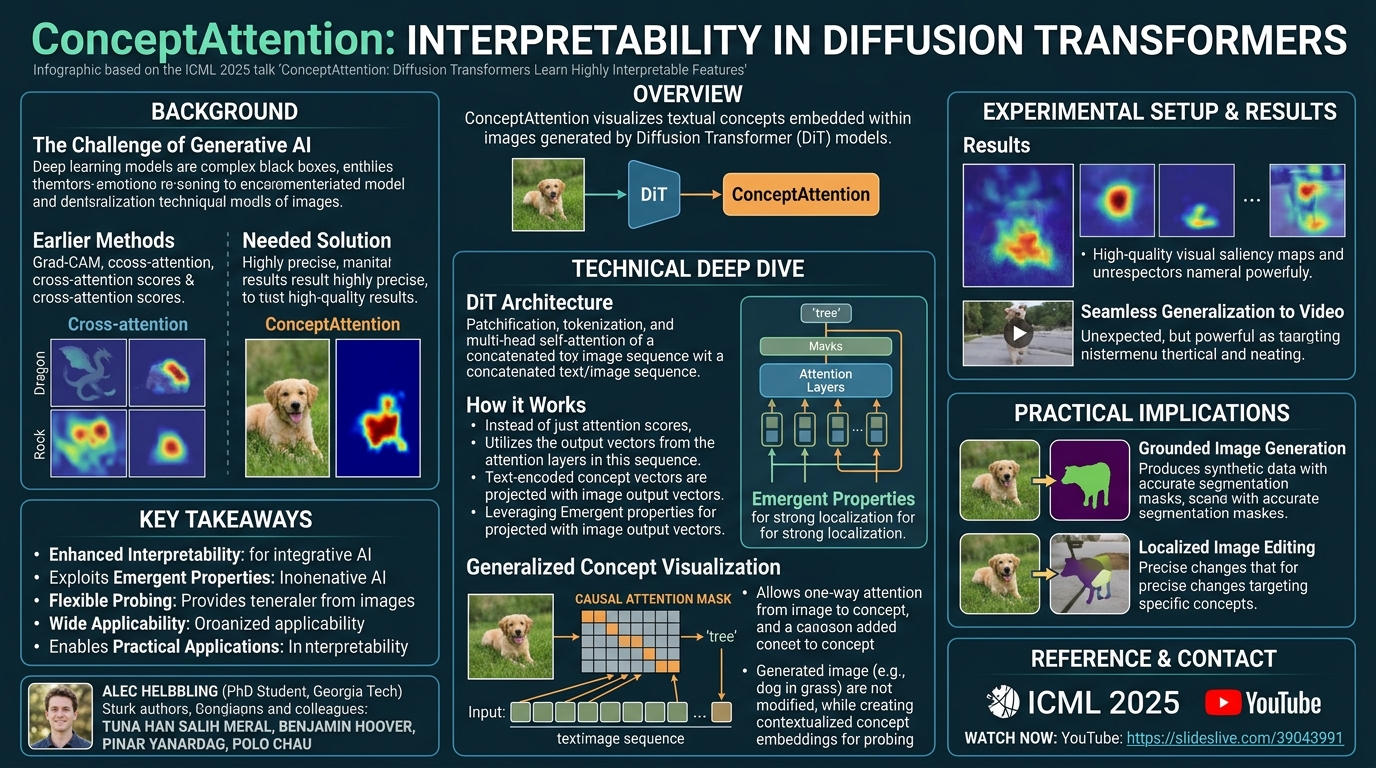
In this insightful talk from ICML 2025, Alec Helbling, a PhD student at Georgia Tech, introduced ConceptAttention, a novel method designed to visualize the textual concepts embedded within the generated images of Diffusion Transformer (DiT) models. As text-to-image and increasingly text-to-video diffusion models continue to push the boundaries of generative AI, their inherent complexity—characterized by billions of parameters, high-dimensional internal representations, and the simultaneous processing of vast numbers of tokens and image patches—renders them notoriously difficult to interpret. ConceptAttention addresses this critical interpretability gap by providing a mechanism to generate high-quality, textual saliency maps that highlight which parts of an image correspond to specific textual concepts.
Key moments
- 0:00 Introduction to ConceptAttention and diffusion model interpretability
- 2:00 Key advantages: better quality, no training, generalization
- 3:00 Demo: high-quality saliency maps for any concept
- 4:00 Practical applications: grounded generation and localized image editing
- 5:00 How ConceptAttention works: leveraging Diffusion Transformer properties
- 6:00 Core technical insight: richer saliency maps from output vectors
- 7:00 Generalizing to any concept using a causal attention mask
ConceptAttention: Diffusion Transformers Learn Highly Interpretable Features
Speakers: Alec Helbling, PhD Student, Georgia Tech; Tuna Han Salih Meral; Benjamin Hoover; Pinar Yanardag; Polo Chau
Conference: ICML 2025
YouTube: https://slideslive.com/39043991
Overview
In this insightful talk from ICML 2025, Alec Helbling, a PhD student at Georgia Tech, introduced ConceptAttention, a novel method designed to visualize the textual concepts embedded within the generated images of Diffusion Transformer (DiT) models. As text-to-image and increasingly text-to-video diffusion models continue to push the boundaries of generative AI, their inherent complexity—characterized by billions of parameters, high-dimensional internal representations, and the simultaneous processing of vast numbers of tokens and image patches—renders them notoriously difficult to interpret. ConceptAttention addresses this critical interpretability gap by providing a mechanism to generate high-quality, textual saliency maps that highlight which parts of an image correspond to specific textual concepts.
The significance of ConceptAttention lies in its ability to demystify the internal workings of these powerful generative models without requiring any additional training or modification to the underlying architecture. By leveraging the emergent properties of DiT activations, ConceptAttention offers a superior alternative to existing interpretability methods, such as cross-attention, which often produce less precise or desirable saliency maps. This approach not only provides a clearer window into how DiTs synthesize visual information from textual prompts but also opens doors for practical applications in areas like grounded image generation and localized editing, making it a vital contribution to the field of trustworthy and controllable AI.
Background
▶ Watch: Introduction to ConceptAttention and diffusion model interpretability (0:00)
The rapid advancements in deep learning, particularly in generative AI, have brought forth models like text-to-image diffusion models that exhibit astounding capabilities in synthesizing photorealistic images from textual descriptions. These models, exemplified by architectures like Diffusion Transformers (DiTs), have expanded their prowess to video generation and other modalities. However, their immense scale and intricate internal mechanisms present a significant challenge: interpretability. With billions of parameters, internal vectors spanning thousands of dimensions, and the simultaneous processing of hundreds or thousands of tokens and image patches, understanding why a diffusion model generates a particular output or how it associates specific textual concepts with visual features remains largely opaque. This "black box" nature hinders debugging, limits fine-grained control, and erodes trust in AI systems.
Historically, interpretability in vision models has often relied on saliency maps, techniques like Grad-CAM, which visualize the regions of an input image most influential to a model's classification decision by analyzing gradients. For generative models, particularly diffusion models, the problem shifts from understanding classification to understanding generation – specifically, how textual prompts manifest visually. A common approach for localizing objects and concepts within diffusion models, widely used in tasks such as image editing, has been to examine the cross-attention scores. These scores are derived from the attention matrices where image and text modalities interact within the transformer blocks. While cross-attention offers some insight, its generated saliency maps often "leave a lot to be desired," providing coarse or incomplete outlines that fail to precisely capture the nuanced presence of concepts. The inherent design of earlier U-Net architectures, which predominantly featured bottleneck convolutional layers and shallow projection layers for text integration, further limited the scope for extracting rich, contextualized textual embeddings necessary for more advanced interpretability methods. This historical context underscores the persistent need for more effective and precise interpretability tools for the latest generation of transformer-based diffusion models.
Key Findings
▶ Watch: Demo: high-quality saliency maps for any concept (3:00)
ConceptAttention introduces several compelling advancements in the interpretability of Diffusion Transformer models, addressing the limitations of prior methods and unlocking new capabilities:
- Superior Saliency Map Quality: The method significantly outperforms existing approaches, particularly the widely used cross-attention mechanism, in generating higher-quality, more precise saliency maps that accurately localize textual concepts within images.
- No Additional Training Required: ConceptAttention leverages the intrinsic properties and activations of pre-trained DiT models, meaning it requires no fine-tuning, retraining, or architectural modifications, making it highly efficient and easy to deploy.
- Generalized Concept Visualization: Unlike methods often tied to the input prompt, ConceptAttention can visualize any single-token textual concept present in the model's vocabulary, offering a more flexible and exhaustive interpretability tool.
- Minimal Computational Overhead: The approach operates with very low additional compute and memory requirements, ensuring it can be integrated into existing workflows without significant performance penalties.
- Seamless Generalization to Video: Despite being developed with image models in mind, ConceptAttention generalizes effortlessly to state-of-the-art text-to-video generation models, owing to their similar Diffusion Transformer architectures with an added temporal dimension. This broadens its applicability to an emerging and complex domain.
- Applicability to Real Images: Beyond generated content, ConceptAttention can be applied to real-world images. By using the DiT as a multimodal encoder, images can be represented within the DiT's activation space, allowing text concepts to probe these representations and generate saliency maps for existing imagery.
- Leverages Emergent Properties: The core innovation lies in exploiting the "emergent properties" of the DiT architecture's output vectors, rather than relying on explicitly trained or encouraged features, suggesting a deeper, inherent interpretability within these models.
Technical Deep Dive
▶ Watch: Practical applications: grounded generation and localized image editing (4:00)
ConceptAttention’s effectiveness stems from a clever re-evaluation of how textual and visual information is processed and mixed within Diffusion Transformer (DiT) architectures, distinguishing itself from prior interpretability techniques like cross-attention.
At its core, the state-of-the-art DiT architecture for text-to-image and text-to-video generation is built upon the transformer paradigm. This involves two key initial steps: patchification of the input image (breaking it into a sequence of visual tokens) and tokenization of the input text (converting the prompt into a sequence of textual tokens). These two sequences are then concatenated to form a single, multimodal input sequence. This combined sequence is fed through a series of multi-head self-attention operations. These attention layers are jointly responsible for the dual tasks of image denoising (the core function of diffusion models) and incorporating textual information into the image patches, ensuring the generated image aligns semantically with the user's text description. Within each multimodal self-attention operation, the familiar Query (Q), Key (K), and Value (V) mechanism is applied across the concatenated sequence, allowing information to be mixed and contextualized across both modalities as it passes through multiple layers and blocks.
The prevailing method for interpretability in this context has been to analyze cross-attention scores. This involves inspecting the attention matrices where image tokens query text tokens (or vice versa) to identify regions of interaction. While this provides some indication of concept localization, as demonstrated in the talk with an example of a "dragon" and "rock," the resulting saliency maps often lack precision and leave much to be desired, failing to accurately outline the target concepts.
ConceptAttention proposes a remarkably simple yet powerful alternative. Instead of focusing solely on the raw attention scores, it looks at the output vectors produced by these multimodal self-attention operations. The key insight is that these output vectors, particularly when combined, contain richer, more contextualized information about the interplay between text and image. Specifically, ConceptAttention proposes to take the text-encoded concept vectors (the embeddings of specific textual concepts) and project them with the image output vectors from the DiT layers. This projection, akin to a dot product or cosine similarity, reveals a much stronger and more localized correspondence between the concept and specific image regions. Crucially, this method leverages "emergent properties" of the DiT architecture – it’s not something explicitly designed or trained for interpretability, but rather a characteristic that naturally arises from how DiTs process and fuse multimodal information.
To generalize this approach beyond concepts explicitly present in the initial prompt, ConceptAttention employs a clever technique involving a causal attention mask. When a user wants to visualize an arbitrary single-token concept (e.g., "tree" in an image generated from "a dog in the grass"), this concept is added to the input sequence as if it were part of the original text prompt. However, a causal attention mask is applied to enforce a one-way flow of attention: the image tokens are allowed to influence the representations of these added concept tokens, but these concept tokens are explicitly prevented from influencing the generation or appearance of the image itself. This ensures that the generated image remains unchanged, regardless of how many concepts are added for visualization. This process yields a set of contextualized embeddings for each concept at each layer of the DiT, which live in the same high-dimensional space as the image tokens. These contextualized concept embeddings can then be used as probes to generate the detailed saliency maps by projecting them with the image output vectors. This innovative masking strategy allows for hundreds of concepts to be analyzed simultaneously without altering the original generation.
The timing of ConceptAttention's development is also significant. This approach was not feasible with earlier U-Net architectures, which dominated text-to-image generation until recently. U-Nets typically incorporated text information via shallow projection layers within their bottleneck convolutional structures, primarily focusing on iteratively updating image representations. They did not produce the kind of rich, contextualized text embeddings that DiTs inherently generate, which are essential for ConceptAttention's mechanism. The architectural shift to Diffusion Transformers, with their unified sequence processing and deep multimodal integration, has thus created the necessary conditions for this powerful interpretability method to emerge.
Experimental Setup & Results
▶ Watch: Core technical insight: richer saliency maps from output vectors (6:00)
While the talk emphasizes the conceptual elegance and practical advantages of ConceptAttention, it primarily showcases its capabilities through qualitative demonstrations and comparisons rather than detailing a formal experimental setup with specific datasets, baselines, or quantitative metrics. The speaker highlights that "our evaluation significantly outperforms this approach" (referring to cross-attention) and that ConceptAttention "generally speaking outperform[s] it" when compared to the popular cross-attention method.
The presentation includes a demo interface where users can input a text prompt (e.g., "a dog in the grass in a park"), select specific textual concepts they wish to visualize, and then observe the resulting high-quality saliency maps. These qualitative results visually demonstrate ConceptAttention's ability to precisely localize concepts like "dog," "grass," and "park" within the generated image, often providing much sharper and more accurate outlines compared to the observed outputs from cross-attention. The talk also illustrates the method's versatility by showing its application to real images uploaded by the user, where the Diffusion Transformer acts as a multimodal encoder to generate saliency maps for concepts within existing photographs.
Furthermore, the seamless generalization of ConceptAttention to video generation models is presented as a surprising yet significant finding, indicating the robustness of the underlying principle across different generative modalities. Although specific hardware, training configurations, or benchmark datasets are not explicitly mentioned in the transcript, the claims of "minimal additional overhead in terms of compute and memory" suggest an efficient implementation suitable for practical deployment. The core evidence for ConceptAttention's superiority is primarily based on these compelling visual comparisons and the inherent logical advantages of its technical approach over prior methods.
Practical Implications
▶ Watch: Generalizing to any concept using a causal attention mask (7:00)
ConceptAttention offers a suite of highly practical implications for various stakeholders involved in the AI/ML ecosystem, from practitioners to infrastructure teams and model deployers. Its ability to provide fine-grained interpretability for complex Diffusion Transformer models addresses several critical needs in the development and application of generative AI.
For model builders and researchers, ConceptAttention serves as an invaluable debugging and understanding tool. By visualizing which image regions correspond to specific textual concepts, developers can gain deeper insights into how their models are processing and synthesizing information. This can help identify biases, pinpoint where a model might be misinterpreting a concept, or validate that it is grounding concepts correctly. The fact that it requires no additional training means it can be readily integrated into existing development pipelines without incurring significant computational costs or delaying iteration cycles.
Infrastructure teams and deployers will appreciate the "minimal additional overhead in terms of compute and memory." This characteristic is crucial for deploying interpretability features in production environments, where resource efficiency is paramount. The ability to run ConceptAttention with minimal impact on inference latency or memory footprint makes it a viable option for real-time analysis or post-hoc interpretability without requiring dedicated hardware or complex scaling solutions.
For practitioners leveraging generative AI, ConceptAttention unlocks powerful new applications:
- Grounded Image Generation: One significant implication is the ability to generate images that are "grounded" with explicit segmentation maps for specified concepts. For example, a user could generate an image of "a car on a road" and simultaneously obtain a precise mask for where the "car" and "road" concepts are located. This is incredibly valuable for generating high-quality synthetic data where precise object localization and semantic segmentation are required, which can then be used for training other vision models.
- Localized Image Editing: The precise saliency maps generated by ConceptAttention enable highly controlled and localized image editing. Instead of applying an edit globally or relying on coarse bounding boxes, users can target specific regions identified by a concept's saliency map. This ensures that edits (e.g., changing the color of a "dog") are applied only to the intended area, preventing unintended modifications to other parts of the image (e.g., the "grass" or "park"). This level of control is essential for professional content creation and fine-tuned image manipulation.
- Analysis of Real Images: The method's ability to operate on real images, using the DiT as a multimodal encoder, extends its utility beyond pure generation. It allows for semantic analysis of existing photographs, identifying and localizing textual concepts within them, which could be useful for content understanding, search, or even forensic analysis.
While the talk does not explicitly detail limitations, a potential consideration for practitioners is that the method is currently described as working for "any single token textual concept." This might pose a challenge for highly complex, multi-word concepts or abstract ideas that do not map neatly to a single token in the model's vocabulary. However, the core principle of leveraging emergent properties and causal masking provides a robust framework for future extensions. The trade-off here is the simplicity and efficiency of the single-token approach versus the potential for greater semantic complexity, a balance that can be optimized based on specific application needs. Overall, ConceptAttention represents a significant leap towards making powerful generative AI models more transparent, controllable, and useful in a wide array of practical scenarios.
Key Takeaways
- Enhanced Interpretability for DiTs: ConceptAttention provides significantly higher-quality and more precise saliency maps for textual concepts in Diffusion Transformer (DiT) models compared to traditional cross-attention methods.
- Leverages Emergent Properties: The method exploits the inherent "emergent properties" of DiT output vectors, projecting text-encoded concept vectors with image outputs to reveal strong semantic correspondences without needing additional model training.
- Flexible Concept Probing: A novel causal attention mask allows users to probe any single-token textual concept within the model's vocabulary, even those not in the original prompt, without altering the generated image.
- Broad Applicability: ConceptAttention is efficient, requires minimal computational overhead, and seamlessly generalizes to both generated and real images, as well as state-of-the-art text-to-video generation models.
- Enables Practical Applications: Key practical implications include generating grounded synthetic data with precise concept segmentation maps and enabling highly localized image editing to specific conceptual regions.
- Architectural Enabler: The method's feasibility is a direct result of the architectural shift to Diffusion Transformers, which provide richer, contextualized text embeddings that were not available in earlier U-Net-based generative models.
About the Speaker(s)
The primary speaker for this presentation was Alec Helbling, who is identified as a PhD student at Georgia Tech. His research focuses on developing methods for visualizing and interpreting the complex internal representations of advanced AI/ML models, particularly in the realm of generative AI. The work presented on ConceptAttention is a collaborative effort, with co-authors including Tuna Han Salih Meral, Benjamin Hoover, Pinar Yanardag, and Polo Chau. This team brings together expertise in deep learning, computer vision, and human-centered AI, aiming to make powerful generative models more transparent and controllable.
Reviews
Maya Iyer (Theoretical ML Researcher) — SOLID
ConceptAttention is a competent, practically motivated interpretability method for Diffusion Transformer models that produces sharper saliency maps than cross-attention by projecting contextualized text-concept vectors against image output vectors, with a causal masking trick to probe arbitrary vocabulary concepts without modifying generation. The core mechanism is sensible and the results appear visually compelling. However, the theoretical justification for why the output vectors carry this semantic structure is absent — 'emergent properties' is invoked without definition or analysis — and the evaluation is almost entirely qualitative, which makes it impossible to assess the actual…
Chen Zhao (Applied ML Researcher & Empiricist) — SOLID
ConceptAttention is a technically interesting interpretability method for Diffusion Transformers that leverages output vector projections and causal masking to localize textual concepts in generated and real images. The core mechanism is elegant and the architectural motivation is sound. However, based on what's described in this article, the evaluation is almost entirely qualitative — the paper's claims of superiority over cross-attention rest primarily on visual comparisons, with no disclosed quantitative benchmarks, no ablation studies, no matched baselines, and no error analysis. The method may well be genuinely better, but the experimental evidence as presented here is insufficient to…
→ Top-rated talks at International Conference on Machine Learning 2025
All talks from International Conference on Machine Learning 2025