Conformal Prediction as Bayesian Quadrature
Jake Snell, Thomas Griffiths
Overview
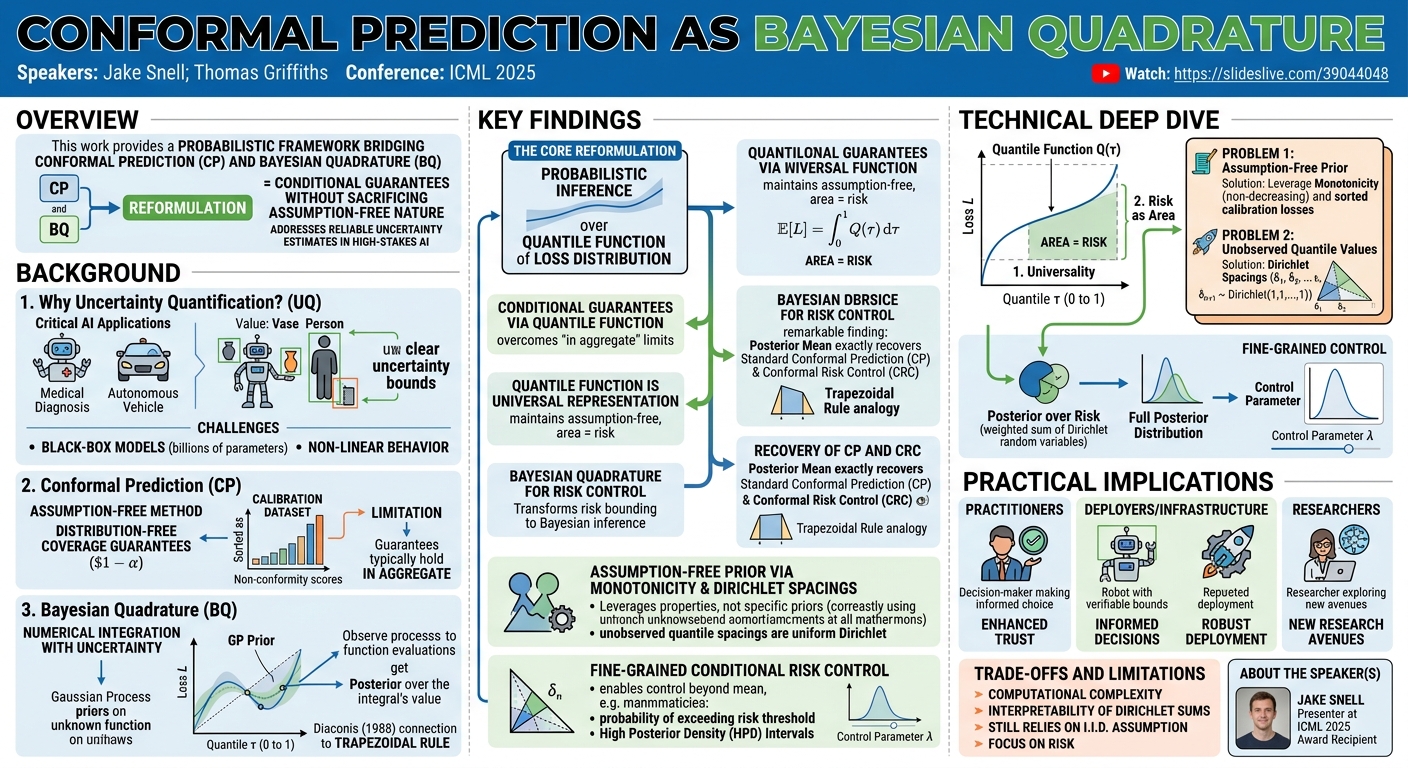
In this insightful talk from ICML 2025, Jake Snell, co-authored with Thomas Griffiths, presents a novel theoretical framework that bridges two seemingly disparate areas of machine learning: conformal prediction (CP) and Bayesian quadrature (BQ). The core of their work reformulates conformal prediction through a probabilistic lens, offering a new justification for its efficacy and unlocking avenues for more robust uncertainty quantification. Snell highlights the critical need for reliable uncertainty estimates in AI systems, especially as models become more complex and deployed in high-stakes decision-making environments, from autonomous robots to large language models.
Key moments
- 0:00 Bridging Conformal Prediction and Bayesian Quadrature
- 2:15 Conformal Prediction: Illustration and coverage guarantee
- 4:00 Motivation: Achieving conditional guarantees for CP
- 4:50 Quantile function representation for loss distributions
- 6:10 Bayesian Quadrature explained for integral computation
- 7:50 Challenges applying BQ for conditional risk control
- 8:10 Leveraging non-decreasing property for assumption-free bounds
- 8:45 Addressing unobserved quantile values with Dirichlet
Conformal Prediction as Bayesian Quadrature
Speakers: Jake Snell; Thomas Griffiths
Conference: ICML 2025
YouTube: https://slideslive.com/39044048
Overview
In this insightful talk from ICML 2025, Jake Snell, co-authored with Thomas Griffiths, presents a novel theoretical framework that bridges two seemingly disparate areas of machine learning: conformal prediction (CP) and Bayesian quadrature (BQ). The core of their work reformulates conformal prediction through a probabilistic lens, offering a new justification for its efficacy and unlocking avenues for more robust uncertainty quantification. Snell highlights the critical need for reliable uncertainty estimates in AI systems, especially as models become more complex and deployed in high-stakes decision-making environments, from autonomous robots to large language models.
The talk addresses a fundamental limitation of traditional conformal prediction, which provides coverage guarantees that hold in aggregate over many runs or calibration sets, but not necessarily conditioned on a specific, observed calibration set. By re-framing the problem of risk control within a Bayesian inference paradigm, specifically by applying Bayesian quadrature to the quantile function of the loss distribution, Snell demonstrates how to achieve conditional guarantees without sacrificing the assumption-free nature that makes conformal prediction so appealing. This innovative connection not only deepens our understanding of conformal prediction but also opens up a promising new domain for probabilistic modeling, potentially fostering greater interaction and cross-pollination between these previously distinct research communities.
The significance of this work lies in its ability to enhance the reliability and trustworthiness of AI systems. By enabling more precise and conditionally valid uncertainty estimates, it empowers practitioners to deploy models with greater confidence, particularly in applications where the cost of misprediction is high. The presented framework moves beyond simply bounding the expected loss to controlling the probability of experiencing an excessively large risk, offering a more fine-grained and actionable approach to uncertainty management.
Background
▶ Watch: Bridging Conformal Prediction and Bayesian Quadrature (0:00)
The pervasive integration of AI models into critical applications – ranging from medical diagnostics and autonomous driving to financial forecasting and content generation by large language models (LLMs) – underscores the paramount importance of uncertainty quantification (UQ). While AI's promise to improve lives is immense, no model is perfect. Understanding the limitations and potential errors associated with a model's predictions is crucial for making informed, safe, and ethical decisions. For instance, a robot might need to differentiate between a valuable vase and a person to avoid damage or greet appropriately, requiring clear uncertainty bounds on its object recognition.
However, obtaining reliable uncertainty estimates for modern AI models presents significant challenges. Contemporary models are often black-box in nature, characterized by billions of parameters and intricate architectures that defy simple analytical scrutiny. Furthermore, their behavior can be highly non-linear and sensitive to input perturbations, making it difficult to ascertain the confidence associated with any single prediction. Traditional probabilistic methods often rely on strong distributional assumptions about the data or model errors, which may not hold true in real-world scenarios or for complex, black-box systems.
This landscape has led to a surge of interest in assumption-free methods for uncertainty quantification, with conformal prediction (CP) emerging as a leading paradigm. Conformal prediction provides distribution-free, finite-sample coverage guarantees. The core idea is to construct prediction intervals (for regression) or sets (for classification) such that the true label falls within the predicted region with a pre-specified probability, typically denoted as $1 - \alpha$.
To illustrate, consider a regression task where we have an input variable X and a target variable Y, along with a predictor function. Conformal prediction operates by leveraging a calibration dataset, distinct from the training data, but drawn from the same underlying distribution. For each point in the calibration set, a non-conformity score (e.g., the absolute residual, or distance between the true Y and the predicted Y) is calculated. These scores are then used to determine a threshold. When a new test point arrives, its non-conformity score is compared against this threshold to construct a prediction interval. The fundamental coverage guarantee of CP states that, if the test data is drawn from the same distribution as the calibration data, the probability that the true target variable for a new test point falls outside its prediction interval is bounded above by $\alpha$. For example, if $\alpha = 0.1$, there's at most a 10% chance the true value will be outside the interval. This concept has been generalized beyond simple 1-0 miscoverage loss to bounding the expected loss or risk for more general loss functions.
A critical nuance of traditional conformal prediction, and a primary motivation for Snell's work, is that these guarantees typically hold in aggregate. This means the probability bound for $\alpha$ is defined over both the random draw of the calibration data and the test point. In practice, if one were to run the CP algorithm many times with different calibration sets, the average coverage would meet the guarantee. However, for any particular calibration set that a practitioner might obtain and use, the guarantee might not strictly hold. This conditional uncertainty is a significant limitation, especially in applications where a single deployment or a specific dataset is paramount, prompting the question: "Can we reformulate conformal prediction to provide guarantees conditional on the specific calibration data we actually have, while still remaining assumption-free?"
To tackle this, the authors turn to Bayesian quadrature (BQ). Bayesian quadrature is a numerical integration technique used to compute the integral of a function when there is uncertainty about the function itself. Instead of providing a single point estimate of an integral, BQ yields a posterior distribution over the integral's value. The process involves:
- Evaluating the function at a few input points.
- Placing a prior distribution over the space of possible functions (e.g., a Gaussian process prior).
- Conditioning this prior on the observed function evaluations to obtain a posterior distribution over functions.
- Integrating each function sample from the posterior and marginalizing these integrals to get a posterior distribution over the integral's value.
A classic result by Persi Diaconis (1988) demonstrated that if a Gaussian process prior with a specific covariance structure is chosen, the posterior mean of the integral recovers the familiar trapezoidal rule from calculus. This connection highlights BQ's ability to provide principled uncertainty estimates for integration problems, making it a powerful tool for scenarios where the integrand is unknown or noisy. The challenge, however, is adapting BQ to the assumption-free context of conformal prediction while addressing the issue of unobserved quantities.
Key Findings
▶ Watch: Motivation: Achieving conditional guarantees for CP (4:00)
The central discovery presented by Snell is a novel reformulation that marries the strengths of conformal prediction's assumption-free guarantees with the probabilistic rigor of Bayesian quadrature, specifically addressing the long-standing challenge of achieving conditional coverage. The key findings are:
- Conditional Guarantees via Quantile Function: The authors demonstrate that by performing probabilistic inference over the quantile function of the loss distribution, it is possible to derive guarantees that hold conditioned on the specific calibration data. This overcomes the "in aggregate" limitation of traditional conformal prediction.
- Quantile Function as a Universal Representation: The quantile function, which maps quantiles (probabilities) to loss values, is shown to be a suitable representation for any loss distribution, regardless of its parametric form. This maintains the assumption-free spirit while providing a clear target for probabilistic modeling. Crucially, the area under the quantile function is precisely equal to the risk (expected loss), which is the quantity conformal methods aim to control.
- Bayesian Quadrature for Risk Control: By applying Bayesian quadrature principles to the unknown quantile function, conditioned on observed loss values, a posterior distribution over the risk can be computed. This effectively transforms the problem of risk bounding into a Bayesian inference problem.
- Recovery of Conformal Prediction and CRC: A remarkable finding is that the posterior mean of this derived risk distribution precisely recovers standard conformal prediction (CP) and conformal risk control (CRC). This provides a deep, probabilistic justification for these existing methods, showing them to be analogous to the "trapezoidal rule" in the BQ context – a point estimate from a richer probabilistic framework.
- Assumption-Free Prior and Dirichlet Spacings: To maintain the assumption-free nature, the framework cleverly avoids committing to a specific prior over the quantile function by leveraging its monotonic non-decreasing property, which provides natural bounds. Furthermore, the unobserved quantile values are handled by recognizing that quantile spacings (the differences between consecutive quantile values) for any continuous function are distributed according to a uniform Dirichlet distribution. This allows marginalizing over these unobserved quantities.
- Fine-Grained Conditional Risk Control: Beyond recovering existing methods, the full posterior distribution over the risk, obtained through this Bayesian framework, enables more sophisticated and fine-grained risk control. Instead of merely controlling the posterior mean, practitioners can now control the probability of the risk exceeding a certain threshold, conditioned on their specific calibration set. This can be achieved by selecting the control parameter (lambda) such that a High Posterior Density (HPD) interval for the risk falls within acceptable bounds, offering a more robust and actionable form of uncertainty management.
In essence, Snell and Griffiths have unveiled a profound connection: conformal prediction, often viewed as a purely frequentist, non-parametric method, can be understood as a specific, point-estimate outcome of a more general Bayesian inference process applied to the quantile function of losses. This re-framing not only solidifies CP's theoretical foundations but also expands its capabilities to provide stronger, conditional guarantees.
Technical Deep Dive
▶ Watch: Bayesian Quadrature explained for integral computation (6:10)
The technical core of this work lies in reformulating the problem of conformal risk control as a Bayesian inference task over the quantile function of the loss distribution. This approach elegantly sidesteps the need for parametric assumptions about the loss distribution while enabling conditional guarantees.
Let $L$ be the loss associated with a prediction, and $Y$ be the true target. The goal of conformal prediction is often to control the risk, defined as the expected loss, $E[L]$. Traditional CP achieves this with aggregate guarantees. To obtain conditional guarantees, the authors propose to work with the quantile function of the loss distribution, denoted as $Q(\tau)$, where $\tau \in [0,1]$ is the quantile. The quantile function $Q(\tau)$ gives the loss value such that $P(L \le Q(\tau)) = \tau$. It is a monotonically non-decreasing function.
There are two primary reasons for choosing the quantile function:
- Universality: Any continuous loss distribution can be represented by its quantile function. This maintains the "assumption-free" spirit, as no specific parametric form for the loss distribution needs to be assumed. The quantile function is always bounded within a known box: the quantile $\tau$ is on the x-axis (from 0 to 1), and the loss $L$ is on the y-axis (from 0 to some upper bound $B$, if applicable).
- Risk as Area: Crucially, the area under the quantile function is equal to the expected loss, or risk. That is, $E[L] = \int_0^1 Q(\tau) d\tau$. This means if we can infer the quantile function, we can compute its integral to obtain the risk.
The challenge then becomes how to compute this integral when the quantile function $Q(\tau)$ is unknown, and we only have discrete observations of losses from our calibration data. This is precisely where Bayesian Quadrature (BQ) becomes relevant. A naive application of BQ would involve:
- Choosing a prior over $Q(\tau)$ (e.g., a Gaussian Process).
- Observing some values of $Q(\tau)$.
- Computing a posterior over $Q(\tau)$.
- Integrating samples from the posterior to get a distribution over the risk.
However, this naive approach faces two significant problems in the context of assumption-free conformal prediction:
Problem 1: Assumption-Free Prior: Committing to a specific prior (like a Gaussian Process) for $Q(\tau)$ would violate the assumption-free nature. The authors address this by leveraging a fundamental property of quantile functions: they are monotonically non-decreasing. This property, combined with the observed calibration data, provides natural constraints on the posterior without needing to specify a parametric prior for the function's shape.
Specifically, if we observe a set of $n$ calibration losses $L_1, \dots, L_n$, we can sort them to get $L_{(1)} \le L_{(2)} \le \dots \le L_{(n)}$. These sorted losses correspond to empirical quantiles $\frac{1}{n+1}, \frac{2}{n+1}, \dots, \frac{n}{n+1}$. The monotonicity implies that the true quantile function $Q(\tau)$ must pass through or be bounded by these empirical observations. This allows for constructing an upper bound on the risk by forming a step function that does not exceed the observed data points.
Problem 2: Unobserved Quantile Values: We do not directly observe $Q(\tau)$ for specific $\tau$ values. Instead, we observe loss values $L_i$. The link between observed losses and the quantile function is through the spacings between quantiles. If we consider the empirical quantiles corresponding to the sorted losses, the "rectangle widths" between these quantiles are not directly known.
This is resolved by a crucial statistical insight: for any continuous distribution, the spacings between ordered statistics (in this case, the quantile values corresponding to observed losses) are distributed according to a uniform Dirichlet distribution. Specifically, if we have $n$ observations from a continuous distribution, and we consider the $n+1$ spacings between the ordered statistics, these spacings are distributed as Dirichlet($1, 1, \dots, 1$). This means that the probability density function for these spacings is constant over the simplex where their sum is 1.
By combining these insights, the authors construct a probabilistic model for the risk. The posterior distribution over the risk (area under $Q(\tau)$) is obtained by:
- Considering the observed calibration losses $L_i$.
- Leveraging the monotonic property of $Q(\tau)$ to define bounds.
- Marginalizing over the unknown quantile spacings, which are distributed as uniform Dirichlet random variables.
The resulting posterior distribution for the risk is a weighted sum of Dirichlet random variables. This is a non-trivial distribution, but its properties can be analyzed.
A key theoretical "miracle" uncovered is that the posterior mean of this derived risk distribution exactly recovers the values prescribed by conformal prediction (CP) and conformal risk control (CRC). This means that CP and CRC, traditionally seen as standalone frequentist methods, can be reinterpreted as point estimates (specifically, the posterior mean) within a more general Bayesian framework for risk control. Just as the trapezoidal rule is the posterior mean for a specific BQ setup, CP and CRC are the posterior means for this specific Bayesian inference problem involving quantile functions and Dirichlet spacings.
The true power of this Bayesian framing, however, lies in its ability to go beyond the posterior mean. By having access to the full posterior distribution over the risk, one can achieve fine-grained conditional risk control. Instead of just setting a control parameter (lambda) such that the mean risk is below a target $\alpha$, practitioners can now choose lambda such that the probability of the risk being excessively large is controlled. For example, they can determine lambda such that the High Posterior Density (HPD) interval of the risk distribution is contained within an acceptable range. This allows for statements like: "Given this calibration data, there is a 95% probability that the true risk is below $X$." This provides a much stronger and more actionable guarantee than the aggregate guarantees of traditional CP, making AI deployments more reliable in critical applications.
Experimental Setup & Results
▶ Watch: Challenges applying BQ for conditional risk control (7:50)
The work presented by Jake Snell and Thomas Griffiths is primarily theoretical and foundational, establishing a novel connection between conformal prediction and Bayesian quadrature. As such, the talk does not detail traditional experimental setups involving specific datasets, model architectures, or empirical performance benchmarks in the way one might expect from a paper focused on applied machine learning.
Instead, the "results" of this work are the theoretical derivations and the conceptual breakthroughs:
- Theoretical Recovery of CP/CRC: The demonstration that the posterior mean of the risk distribution, derived from their Bayesian quadrature framework, precisely recovers the control parameters of standard conformal prediction and conformal risk control. This is a significant theoretical validation of existing methods through a new probabilistic lens.
- Proof of Conditional Guarantees: The establishment of a framework that, by performing Bayesian inference over the quantile function of the loss distribution and accounting for Dirichlet-distributed quantile spacings, can yield risk guarantees that are conditional on the specific calibration data used.
- Enhanced Risk Control Capabilities: The conceptual advancement that the full posterior distribution over the risk, beyond just its mean, enables more sophisticated and fine-grained control over the probability of experiencing a high risk, using tools like High Posterior Density (HPD) intervals.
The talk focuses on the mathematical formulation, the underlying assumptions (or lack thereof), and the logical steps that bridge these two domains. While the utility of this framework for real-world applications is a central theme, the presentation does not delve into specific numerical experiments, dataset names (e.g., ImageNet, CIFAR-10), hardware specifications (e.g., GPU types), or comparisons against empirical baselines with headline numbers (e.g., "achieved 2x speedup" or "reduced miscoverage by 5%"). The primary contribution is a new way of thinking about and deriving uncertainty quantification, rather than an empirical evaluation of a new algorithm.
Therefore, for this particular talk, there isn't a "Experimental Setup & Results" section in the conventional sense. The focus is on the theoretical elegance and the implications of this new understanding for the field of uncertainty quantification.
Practical Implications
▶ Watch: Addressing unobserved quantile values with Dirichlet (8:45)
The work presented by Snell and Griffiths carries profound practical implications for a wide range of stakeholders in the AI/ML ecosystem, particularly as the demand for robust and trustworthy AI continues to grow.
For Practitioners and Model Builders:
- Enhanced Trust in Predictions: The most direct benefit is the ability to obtain conditional coverage guarantees. Instead of relying on guarantees that hold "on average" across many hypothetical calibration sets, practitioners can now make stronger statements about the uncertainty of their models given the specific calibration data they have collected. This is crucial for high-stakes applications (e.g., medical diagnosis, autonomous systems, financial trading) where the consequences of a single misprediction or an under-covered interval can be severe.
- More Informed Decision-Making: With a full posterior distribution over the risk, practitioners can move beyond a single point estimate of uncertainty. They can quantify the probability that their risk exceeds a certain threshold, allowing for more nuanced decision-making. For example, instead of just aiming for an average 5% miscoverage, they can ensure there's only a 1% chance that the actual miscoverage exceeds 10% for their deployed model.
- Deeper Understanding of Conformal Prediction: For those already using CP, this work provides a deeper theoretical justification, showing CP as a specific instance (the posterior mean) of a more general Bayesian inference problem. This understanding can foster confidence and potentially guide future methodological improvements.
For Infrastructure Teams and Deployers:
- Robust Deployment Strategies: Infra teams responsible for deploying AI models can leverage these conditional guarantees to build more robust and resilient systems. They can set more stringent and verifiable risk thresholds, ensuring that models operate within acceptable uncertainty bounds even with limited or specific calibration data.
- Better Monitoring and Alerting: The ability to quantify the probability of high risk, conditioned on observed data, can inform more sophisticated monitoring systems. If the posterior distribution for risk shifts, indicating a higher probability of exceeding acceptable bounds, alerts can be triggered more intelligently, prompting model recalibration or human intervention.
For Researchers in Uncertainty Quantification and Probabilistic Modeling:
- New Research Avenues: This work effectively bridges two distinct communities – conformal prediction and Bayesian quadrature – opening up a rich new domain for interdisciplinary research. It suggests that many problems traditionally viewed through a frequentist, assumption-free lens might benefit from a probabilistic re-framing.
- Foundation for Extensions: The framework provides a strong foundation for future extensions, such as incorporating different forms of prior knowledge (if available and justifiable) or developing more computationally efficient algorithms for sampling from or characterizing the derived risk posterior.
Tradeoffs and Limitations:
- Computational Complexity: While the talk doesn't explicitly detail the computational cost, working with full posterior distributions (especially those involving weighted sums of Dirichlet random variables) is generally more computationally intensive than simply calculating a quantile from a set of non-conformity scores, as in standard CP. This might be a practical consideration for very large-scale, high-throughput applications.
- Interpretability of Dirichlet Sums: While theoretically sound, the direct interpretation and manipulation of a "weighted sum of Dirichlet random variables" for practitioners might require specialized tools or simplified approximations.
- Still Relies on I.I.D. Assumption: Like traditional CP, the validity of the guarantees still implicitly relies on the assumption that the calibration and test data are drawn independently and identically distributed (I.I.D.) from the same underlying distribution. While assumption-free regarding the form of the loss distribution, it doesn't solve distribution shift or covariate shift problems.
- Focus on Risk: The current framework focuses on controlling the expected loss (risk). While generalizable, applying it to other specific uncertainty metrics (e.g., precise confidence intervals for individual predictions) might require further adaptation.
In summary, this work provides a powerful conceptual leap, moving uncertainty quantification for AI models from aggregate statistical statements to more precise, conditionally valid probabilistic guarantees. This shift is critical for building truly reliable and trustworthy AI systems, enabling practitioners to deploy models with a deeper understanding of their inherent uncertainties and to manage risks more effectively.
Key Takeaways
- Conformal Prediction as Bayesian Quadrature: The core insight is that conformal prediction (CP) and conformal risk control (CRC) can be rigorously re-framed as a prior-agnostic form of Bayesian quadrature (BQ).
- Conditional Guarantees: This reformulation allows for deriving risk control guarantees that hold conditioned on the specific calibration data observed, overcoming a key limitation of traditional CP's aggregate guarantees.
- Probabilistic Justification for CP: The work provides a novel probabilistic justification for existing CP and CRC methods, showing them to be the posterior mean of a Bayesian inference problem over the quantile function of the loss distribution.
- Leveraging Quantile Functions: The approach models the unknown loss distribution via its quantile function, whose area equals the risk, and utilizes the uniform Dirichlet distribution for quantile spacings to maintain an assumption-free stance.
- Fine-Grained Risk Control: By accessing the full posterior distribution over the risk, practitioners can achieve more sophisticated risk control, for instance, by bounding the probability of an excessively large risk using High Posterior Density (HPD) intervals.
- Bridging Communities: This research fosters a promising interaction between the conformal prediction and Bayesian probabilistic modeling communities, opening new avenues for theoretical and applied uncertainty quantification.
About the Speaker(s)
Jake Snell is the presenter of this talk at ICML 2025, where he was also an award recipient, underscoring his significant contributions to the field of machine learning. His work, co-authored with Thomas Griffiths, focuses on fundamental aspects of uncertainty quantification, particularly bridging theoretical concepts in probabilistic modeling with practical methods like conformal prediction. While the transcript does not provide extensive biographical details, his presentation highlights a deep understanding of statistical inference and its application to contemporary AI challenges.
Reviews
Maya Iyer (Theoretical ML Researcher) — STRONG ACCEPT
Snell and Griffiths present a genuinely interesting theoretical reframing: conformal prediction and conformal risk control, typically motivated by frequentist exchangeability arguments, can be derived as the posterior mean of a Bayesian quadrature problem over the quantile function of the loss distribution. The key technical move — recognizing that (1) risk equals the area under the quantile function, (2) quantile spacings of any continuous distribution are uniformly Dirichlet, and (3) these two facts together yield a tractable posterior whose mean recovers standard CP/CRC thresholds — is clean and non-obvious. The work earns genuine novelty credit for the conceptual bridge between two…
Chen Zhao (Applied ML Researcher & Empiricist) — SOLID
Snell and Griffiths offer a genuinely interesting theoretical reframing — showing that conformal prediction and conformal risk control emerge as posterior means under a specific Bayesian quadrature treatment of the loss quantile function, with Dirichlet-distributed spacings handling the assumption-free requirement. The connection is elegant and the probabilistic justification for CP/CRC is a real contribution to the theoretical foundations of uncertainty quantification. That said, this is a theory paper presented without empirical validation, and the article summary I'm reviewing doesn't surface evidence of ablations, concrete experiments, or comparison against alternative conditional…
→ Top-rated talks at International Conference on Machine Learning 2025
All talks from International Conference on Machine Learning 2025