Implicit Regularization for Tubal Tensor Factorizations via Gradient Descent
Santhosh Karnik, Anna Veselovska (postdoc), Mark Iwen (Michigan State), Felix Krahmer
Overview
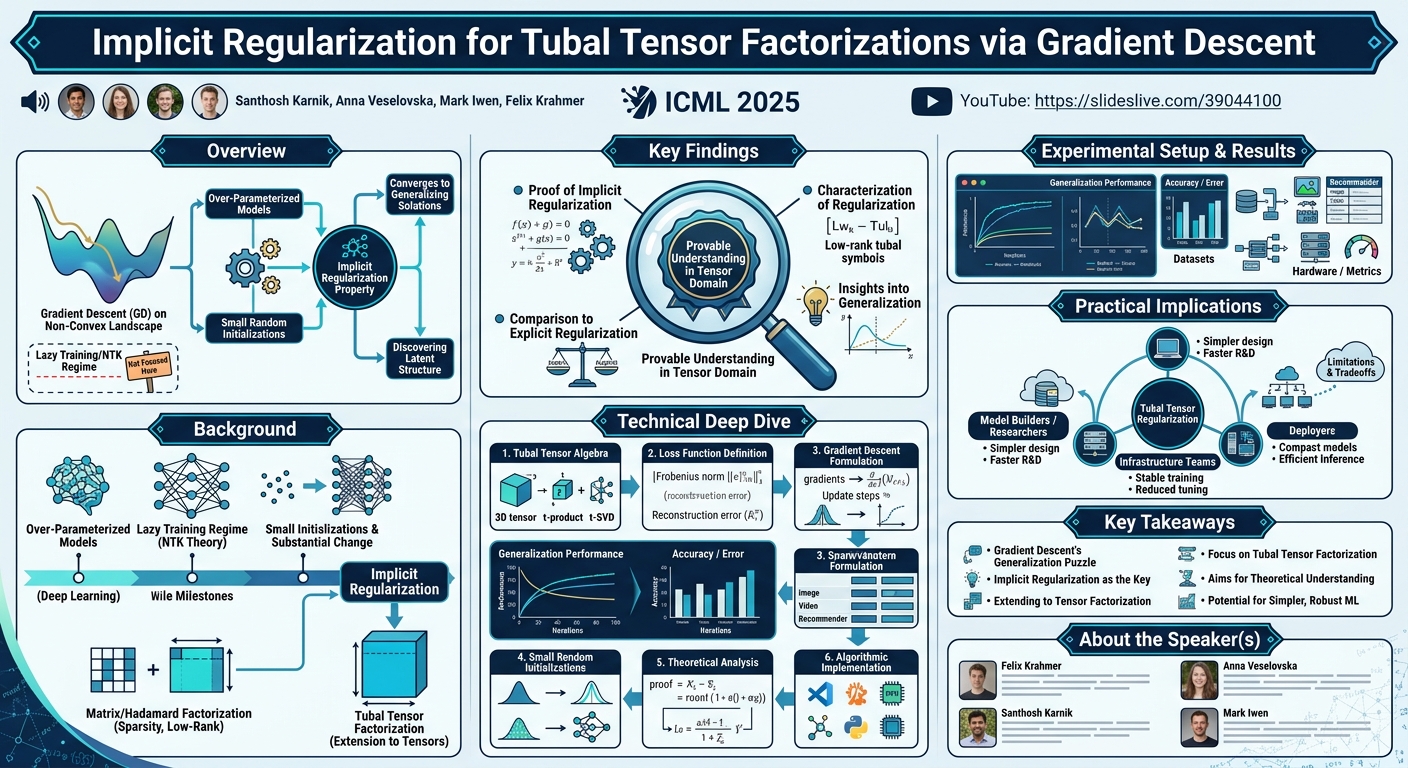
This talk, presented at ICML 2025 by a collaborative team including Santhosh Karnik, Anna Veselovska, Mark Iwen, and Felix Krahmer, delves into one of the most fundamental and persistent theoretical puzzles in modern machine learning: the remarkable efficacy of gradient descent (GD). Specifically, the researchers address why GD, despite operating on highly non-convex loss landscapes and in heavily over-parameterized models, consistently manages to converge to solutions that generalize exceptionally well to unseen data. The focus of this investigation is not on the well-studied "lazy training" or Neural Tangent Kernel (NTK) regime, but rather on the more intricate scenario of small random initializations, where the model parameters undergo significant changes during training.
Key moments
- 0:00 Talk Introduction and Speakers
- 0:10 Addressing Gradient Descent's Success
- 0:20 Small Initialization's Role in Generalization
- 0:30 Implicit Regularization in Matrix Factorization
- 0:45 Applying Implicit Regularization to Tensors
- 0:50 Introduction to Tubal Tensor Factorization
Implicit Regularization for Tubal Tensor Factorizations via Gradient Descent
Speakers: Santhosh Karnik, Anna Veselovska, Mark Iwen, Felix Krahmer
Conference: ICML 2025
YouTube: https://slideslive.com/39044100
Overview
This talk, presented at ICML 2025 by a collaborative team including Santhosh Karnik, Anna Veselovska, Mark Iwen, and Felix Krahmer, delves into one of the most fundamental and persistent theoretical puzzles in modern machine learning: the remarkable efficacy of gradient descent (GD). Specifically, the researchers address why GD, despite operating on highly non-convex loss landscapes and in heavily over-parameterized models, consistently manages to converge to solutions that generalize exceptionally well to unseen data. The focus of this investigation is not on the well-studied "lazy training" or Neural Tangent Kernel (NTK) regime, but rather on the more intricate scenario of small random initializations, where the model parameters undergo significant changes during training.
The core hypothesis explored by the speakers is that gradient descent inherently possesses an implicit regularization property. This means that without any explicit regularization terms added to the loss function (like L1 or L2 penalties), the dynamics of gradient descent itself guide the optimization process towards solutions with desirable structural properties, such as sparsity or low-rankness. While this phenomenon has been mathematically proven for simpler settings like Hadamard factorizations (leading to sparse solutions) and matrix factorization (converging to low-rank solutions), its implications and mechanisms within the more complex tensor setting remain less understood. This talk aims to extend this understanding, particularly focusing on tubal tensor factorization, a specific and increasingly relevant form of tensor decomposition. By unraveling the implicit regularization mechanisms in this context, the research seeks to provide deeper theoretical insights into the generalization capabilities of deep learning models that rely on tensor-based representations.
Background
▶ Watch: Talk Introduction and Speakers (0:00)
The landscape of modern machine learning, particularly deep learning, is characterized by its reliance on massively over-parameterized models trained using simple optimization algorithms like gradient descent (GD) and its variants. Despite the theoretical challenges posed by non-convex loss functions and the presence of numerous global minima in over-parameterized settings, these models consistently achieve state-of-the-art performance across a wide array of tasks. This empirical success has spurred a "general question of learning theory": why does gradient descent work so well? The answer to this question is crucial for building more robust, interpretable, and theoretically grounded AI systems.
Historically, the understanding of GD's behavior in complex landscapes has evolved through several theoretical frameworks. One prominent explanation is the lazy training regime, often associated with the Neural Tangent Kernel (NTK) theory. In this regime, when a neural network is sufficiently wide and initialized with small random weights, its behavior during training can be approximated by a linear model around its initialization. The network's parameters remain close to their initial values, and the optimization process effectively converges to a global optimum of this linearized model, behaving much like a kernel method. While NTK theory provides valuable insights into certain aspects of deep learning, it doesn't fully capture the dynamics observed in many practical scenarios where model parameters deviate significantly from their initial states.
The alternative, and often more challenging, regime is that of small random initializations where the model's parameters undergo substantial changes. It is in this setting that the phenomenon of implicit regularization becomes particularly salient. Implicit regularization refers to the observation that optimization algorithms, even when minimizing an unregularized loss function, implicitly favor solutions with certain structural properties. These properties, such as sparsity (where many parameters are zero) or low-rankness (for matrices or tensors, indicating a reduced number of independent components), are often known to promote better generalization. For instance, in Hadamard factorizations (element-wise products), it has been observed that GD implicitly encourages sparse solutions. More famously, for the matrix factorization problem—a cornerstone of recommender systems and dimensionality reduction—it has been provably shown that gradient descent with small random initialization converges towards low-rank solutions. This low-rank property is vital for preventing overfitting and discovering meaningful latent structures in data.
The transition from matrix factorization to tensor factorization represents a natural and necessary generalization for handling multi-dimensional, multi-modal, or spatio-temporal data. A tensor is a multi-dimensional array, and tensor factorization aims to decompose it into a sum or product of simpler components. Just as matrices are 2D arrays, tensors can be 3D (e.g., video data: height x width x time), 4D (e.g., medical images: height x width x depth x time), or higher-order. Common tensor decomposition methods include CANDECOMP/PARAFAC (CP) and Tucker decomposition. However, these traditional methods often face challenges with computational complexity and interpretability in certain data structures.
This context sets the stage for the talk's focus on tubal tensor factorization. This is a specific class of tensor factorization methods that generalize concepts like Singular Value Decomposition (SVD) from matrices to tensors, often leveraging operations in the Fourier domain. Key to tubal tensor factorization is the concept of a "tube" or "fiber," which refers to a specific mode of the tensor. For example, in a 3D tensor, a tube might be a vector extracted along the third dimension by fixing the first two indices. Methods like tensor SVD (t-SVD), a prominent form of tubal tensor factorization, operate by unfolding the tensor into "frontal slices," applying a 2D Fourier transform to each slice, and then performing SVD on the resulting block-diagonal matrix in the Fourier domain. This approach is particularly adept at capturing global correlations and preserving structural information across the "tubes" of a tensor, making it highly effective for tasks such as tensor completion, denoising, and low-rank approximation in applications like image and video processing, recommender systems, and scientific computing. The problem then becomes: if matrix factorization benefits from implicit low-rank regularization, what form does implicit regularization take, and how does it manifest, in the more complex and structured domain of tubal tensor factorization? This question lies at the heart of the research presented.
Key Findings
▶ Watch: Small Initialization's Role in Generalization (0:20)
The provided excerpt for this talk primarily outlines the research question and the scope of the investigation rather than presenting the detailed findings or results. The speakers aim to address the fundamental question of "why and how implicit regularization of gradient descent works and what it does in a tensor setting," with a specific focus on tubal tensor factorization. While the excerpt does not detail the specific discoveries, contributions, benchmarks, or results, it clearly articulates the objective: to mathematically and empirically demonstrate the existence and nature of implicit regularization in this specific tensor domain.
Based on the stated goal, the anticipated key findings would likely involve:
- Proof of Implicit Regularization: A formal mathematical proof or theoretical framework demonstrating that gradient descent, when applied to tubal tensor factorization problems with small random initializations, implicitly favors solutions with certain desirable properties (e.g., a specific form of low-rankness or sparsity analogous to the matrix case).
- Characterization of Regularization Property: A precise characterization of what kind of regularization is implicitly induced. For matrix factorization, it's low-rankness. For tubal tensor factorization, this might translate to "tubal low-rankness" or other tensor-specific structural properties that promote generalization.
- Comparison to Explicit Regularization: An analysis of how this implicit regularization compares to explicitly adding regularization terms, potentially showing that implicit regularization achieves comparable or superior generalization performance without the need for hyperparameter tuning of regularization strength.
- Insights into Generalization: Deeper insights into why models employing tubal tensor factorizations generalize well, linking the optimization dynamics directly to the structural properties of the learned tensor components.
The talk intends to move beyond mere observation, aiming to provide a provable understanding of these mechanisms, thereby extending the theoretical guarantees of gradient descent to a more complex and high-dimensional data representation.
Technical Deep Dive
▶ Watch: Implicit Regularization in Matrix Factorization (0:30)
While the provided transcript excerpt initiates the discussion by setting the stage for the research problem, it explicitly states, "I will tell you in a minute what this is," referring to tubal tensor factorization. Consequently, the detailed technical content, including specific model architectures, training/inference techniques, systems design, hardware/software stack, algorithms, or protocols, is not present within this brief introduction. However, based on the problem statement, one can infer the types of technical content that would be covered in the full presentation.
A comprehensive technical deep dive into implicit regularization for tubal tensor factorizations would necessarily involve several key mathematical and algorithmic components:
- Tubal Tensor Algebra: The foundation would be a thorough explanation of tubal tensor algebra, which differs significantly from traditional tensor algebra. This would include definitions of the tensor-tensor product (t-product), tensor SVD (t-SVD), and the concept of tubal rank. The t-product, often defined via circulant matrices and the discrete Fourier transform (DFT), is central to this framework. Understanding how these operations generalize matrix multiplication and singular value decomposition to tensors is paramount. The talk would likely elaborate on how a 3D tensor can be transformed into the Fourier domain (e.g., via
fftalong the third dimension), where operations become block-diagonal matrix operations, simplifying analysis. - Loss Function Definition: The talk would define the specific loss function being optimized. For factorization problems, this typically involves minimizing the reconstruction error between the original tensor and its factorized approximation. For example, if a tensor $\mathcal{A}$ is approximated by a product of two lower-rank tensors $\mathcal{U}$ and $\mathcal{V}$ (i.e., $\mathcal{A} \approx \mathcal{U} \mathcal{V}$ using the t-product), the loss function might be a Frobenius norm of the difference: $L(\mathcal{U}, \mathcal{V}) = ||\mathcal{A} - \mathcal{U} \mathcal{V}||_F^2$.
- Gradient Descent Formulation: The precise formulation of gradient descent for updating the tensor factors ($\mathcal{U}$, $\mathcal{V}$, etc.) would be detailed. This involves computing gradients of the loss function with respect to the tensor factors, which requires careful application of tensor calculus and chain rule in the context of tubal tensor operations. Given the reliance on Fourier transforms for the t-product, gradient computations might also involve operations in the frequency domain. The talk would likely specify the learning rate schedule and initializations used.
- Small Random Initializations: A crucial aspect highlighted in the overview is the focus on small random initializations. The talk would specify the distribution and scale of these initializations (e.g., Gaussian with small variance) and explain why this particular regime is chosen over the NTK regime. The theoretical analysis would then focus on the dynamics of GD starting from these initial conditions.
- Theoretical Analysis of Implicit Regularization: This would be the core technical contribution. The speakers would present the mathematical proofs or arguments demonstrating how the gradient updates, over many iterations, inherently steer the tensor factors towards solutions exhibiting properties like tubal low-rankness. This might involve analyzing the evolution of specific tensor norms or the singular values (in the tubal sense) of the factorized components during training. Techniques from optimization theory, matrix perturbation theory, and potentially spectral methods would be employed. The analysis might draw parallels to existing proofs for matrix factorization, adapting them to the more complex tensor algebra.
- Algorithmic Implementation Details: While not explicitly mentioned, any practical investigation would involve implementing these tensor factorization algorithms. This would touch upon the choice of software frameworks (e.g., PyTorch, TensorFlow, or specialized tensor libraries like Tensorly or Julia's TensorToolbox), and how the Fourier transforms and block-diagonal operations are efficiently handled. The computational complexity of tubal tensor operations, especially for large tensors, would also be a relevant consideration.
In essence, the technical deep dive would bridge the gap between abstract optimization theory and concrete tensor algebra, demonstrating how the specific structure of tubal tensor operations, combined with the dynamics of gradient descent, leads to provable implicit regularization effects that are beneficial for generalization.
Experimental Setup & Results
▶ Watch: Applying Implicit Regularization to Tensors (0:45)
The provided transcript is a brief introduction to the talk and therefore does not contain any details regarding the experimental setup or results. The speaker explicitly states the intention to discuss "why and how implicit regularization... works and what it does in a tensor setting," indicating that the subsequent parts of the full talk would present these findings. Consequently, there are no datasets, baselines, hardware specifications, metrics, headline numbers, or ablation studies mentioned in the excerpt.
However, based on the subject matter, one can anticipate the types of experimental components that would typically be included in such a study:
- Datasets: Experiments for tubal tensor factorization and implicit regularization would likely use synthetic datasets to control specific properties (e.g., known tubal rank, noise levels) and real-world datasets that naturally exhibit tensor structure. Examples could include:
- Image/Video Data: Multi-spectral images, video sequences (representing 3D or 4D tensors where time or spectral bands form a "tube").
- Recommender Systems: User-item-context tensors (e.g., user x item x time, user x item x genre).
- Scientific Data: Spatio-temporal sensor data, neuroimaging data (fMRI, EEG).
- Synthetic Tensors: Artificially constructed tensors with a predefined tubal rank, allowing for precise evaluation of recovery and approximation accuracy.
- Baselines: The performance of gradient descent with implicit regularization would typically be compared against several baselines:
- Explicitly Regularized Tensor Factorization: Tubal tensor factorization models with explicit regularization terms (e.g., nuclear norm regularization for tubal rank, L1/L2 penalties on factors). This would demonstrate if implicit regularization achieves comparable or superior results without the need for hyperparameter tuning.
- Traditional Tensor Factorization Methods: Such as CP decomposition or Tucker decomposition, possibly with their own regularization schemes, to show the advantages of the tubal approach.
- Matrix Factorization Baselines: Where appropriate, by flattening or unfolding tensors into matrices, to highlight the benefits of directly modeling tensor structure.
- Hardware: While not specified, tensor operations can be computationally intensive. Experiments would likely be conducted on GPUs (e.g., NVIDIA V100, A100) or potentially TPUs for acceleration, especially when dealing with large tensors or extensive hyperparameter searches.
- Metrics: Evaluation metrics would depend on the specific task:
- Reconstruction Error: Such as Frobenius norm of the difference between the original and reconstructed tensor, or Root Mean Squared Error (RMSE).
- Generalization Error: On held-out test data for tasks like tensor completion or prediction.
- Tubal Rank Recovery: For synthetic data, measuring how accurately the model recovers the true underlying tubal rank.
- Sparsity: Measuring the percentage of zero elements in the factor tensors, if sparsity is an implicitly regularized property.
- Computational Efficiency: Training time, convergence speed, and memory footprint.
- Headline Numbers & Ablations: The full talk would present quantitative results, showcasing improvements in generalization, efficiency, or accuracy. Ablation studies would likely investigate the impact of different initialization schemes, learning rates, or specific components of the tubal tensor algebra on the implicit regularization effect.
Without the actual content, it's impossible to provide specific numbers, but the research sets a clear expectation for a rigorous experimental validation of the theoretical claims about implicit regularization in tubal tensor factorization.
Practical Implications
▶ Watch: Introduction to Tubal Tensor Factorization (0:50)
The theoretical insights into implicit regularization for tubal tensor factorizations via gradient descent hold several significant practical implications for practitioners, infrastructure teams, model builders, and deployers in the machine learning ecosystem. Understanding how fundamental optimization algorithms inherently guide model learning towards desirable structures can lead to more robust, efficient, and less complex ML pipelines.
For model builders and researchers, this work provides a deeper theoretical grounding for the observed empirical success of deep learning models that utilize tensor representations. If gradient descent implicitly ensures low-rank or sparse solutions in the tubal tensor context, it means practitioners might not need to explicitly add complex regularization terms or tune their hyperparameters. This simplifies model design, reduces the search space for optimal configurations, and potentially accelerates the development cycle. It also suggests that models based on tubal tensor factorizations could naturally achieve good generalization without heavy reliance on explicit regularization, which can sometimes be difficult to interpret or tune effectively. This could be particularly impactful in domains like multi-modal data fusion, video analytics, medical imaging, and recommender systems, where data naturally forms high-order tensors and low-rank approximations are crucial for efficiency and generalization.
Infrastructure teams could benefit from the potential for simpler and more stable training processes. If implicit regularization reduces the need for explicit regularization, it might lead to more predictable convergence behavior and less sensitivity to hyperparameter choices. This could translate into reduced computational costs associated with extensive hyperparameter tuning and potentially faster training times, as the optimization landscape is implicitly guided towards "good" solutions. Furthermore, if the implicitly regularized solutions are indeed lower-rank, the resulting models could be more compact, requiring less memory for storage and potentially enabling faster inference, which is critical for deployment on edge devices or in latency-sensitive applications.
For deployers, the implications are twofold. First, models that generalize well due to implicit regularization are inherently more reliable and robust in production environments, as they are less likely to overfit to training data artifacts. Second, if these models are more compact due to low-rank properties, they become easier to deploy and manage. Smaller model sizes mean faster loading times, lower bandwidth requirements for distribution, and reduced memory footprint on inference servers, all of which contribute to a more efficient and scalable deployment strategy. This is especially relevant for large-scale AI services where even marginal improvements in efficiency can lead to substantial cost savings.
However, there are also tradeoffs and limitations to consider. While implicit regularization simplifies the process, it might not always yield the optimal regularization strength for every specific task or dataset. Explicit regularization terms offer fine-grained control that implicit methods inherently lack. Understanding the specific conditions under which implicit regularization is most effective (e.g., specific initialization schemes, learning rates, or network architectures) is crucial. If these conditions are not met, the benefits might not materialize, or the model might still overfit. Furthermore, the mathematical analysis of implicit regularization, especially in complex tensor settings, can be highly abstract and may not immediately translate into intuitive practical guidelines for all practitioners. The complexity of tubal tensor algebra itself can be a barrier to entry for some model builders.
In summary, this research contributes to a deeper understanding of why deep learning works, potentially leading to more principle-driven model design and deployment. By elucidating the hidden mechanisms of gradient descent in the context of tubal tensor factorizations, it paves the way for building more efficient, robust, and generalizable AI systems with reduced reliance on complex manual tuning, provided the specific conditions for such implicit benefits are well understood and met.
Key Takeaways
- Gradient Descent's Generalization Puzzle: The talk addresses a fundamental question in ML theory: why gradient descent (GD) in over-parameterized, non-convex settings consistently finds well-generalizing global optima, specifically focusing on the regime of small random initializations, not lazy training.
- Implicit Regularization as the Key: The central hypothesis is that GD possesses an implicit regularization property, where its dynamics inherently guide optimization towards solutions with desirable structural properties (e.g., sparsity, low-rankness) without explicit regularization terms.
- Extending to Tensor Factorization: The research extends prior work on implicit regularization (seen in Hadamard and matrix factorizations leading to sparse and low-rank solutions, respectively) to the more complex and higher-dimensional tensor setting.
- Focus on Tubal Tensor Factorization: The specific focus is on tubal tensor factorization, a generalization of matrix SVD to tensors that leverages operations in the Fourier domain and is relevant for multi-modal data analysis.
- Aims for Theoretical Understanding: The talk aims to provide a provable, mathematical understanding of how implicit regularization manifests and what properties it induces within the context of tubal tensor factorizations.
- Potential for Simpler, Robust ML: Unraveling these mechanisms could lead to the design of more robust, efficient, and generalizable tensor-based ML models with reduced need for explicit regularization and complex hyperparameter tuning.
About the Speaker(s)
The talk "Implicit Regularization for Tubal Tensor Factorizations via Gradient Descent" is a collaborative effort presented by Felix Krahmer, who gave the talk, and co-authored with Anna Veselovska, Santhosh Karnik, and Mark Iwen. The collaborative nature of the research is highlighted, with Mark Iwen affiliated with Northeastern University and Michigan State University, suggesting a strong academic background in the fields of applied mathematics, signal processing, and machine learning. While specific titles for all speakers are not provided in the excerpt, Felix Krahmer's role as the presenter indicates his leading involvement in communicating this research. Anna Veselovska is mentioned as Felix Krahmer's postdoc, indicating her contribution to the research at an advanced academic level. The collective expertise of the team suggests a strong foundation in theoretical machine learning, optimization, and tensor analysis.
Reviews
Maya Iyer (Theoretical ML Researcher) — SOLID
A theoretically motivated extension of implicit regularization results from matrix factorization to tubal tensor factorizations under gradient descent with small random initialization. The work sits in a well-defined and legitimate lineage — Gunasekar et al. on matrix factorization, Li et al. on Hadamard products — and the research question is the right one to ask. However, based on what the article actually conveys, the contribution reads as a technically competent generalization rather than a conceptually transformative one. The article itself is frustratingly thin on the actual theorems, proof techniques, and experimental findings, making it impossible to assess whether the core claims…
Chen Zhao (Applied ML Researcher & Empiricist) — WEAK
This is a theory paper on implicit regularization for tubal tensor factorizations under gradient descent with small random initializations — a legitimate research question in the lineage of Gunasekar et al. and Arora et al. on matrix factorization. The article, however, is almost entirely an elaboration of the research question and anticipated findings, with essentially no reportable experimental results, no stated theorems, and no described proofs. What's presented reads as an extended abstract or introduction section, not a complete contribution. Without access to the actual theorem statements, proof techniques, experimental validations, or any quantitative results, this cannot be…
→ Top-rated talks at International Conference on Machine Learning 2025
All talks from International Conference on Machine Learning 2025