Improved Regret Analysis in Gaussian Process Bandits: Optimality for Noiseless Reward, RKHS norm, and Non-Stationary Variance
Shogo Iwazaki, Shion Takeno
Overview
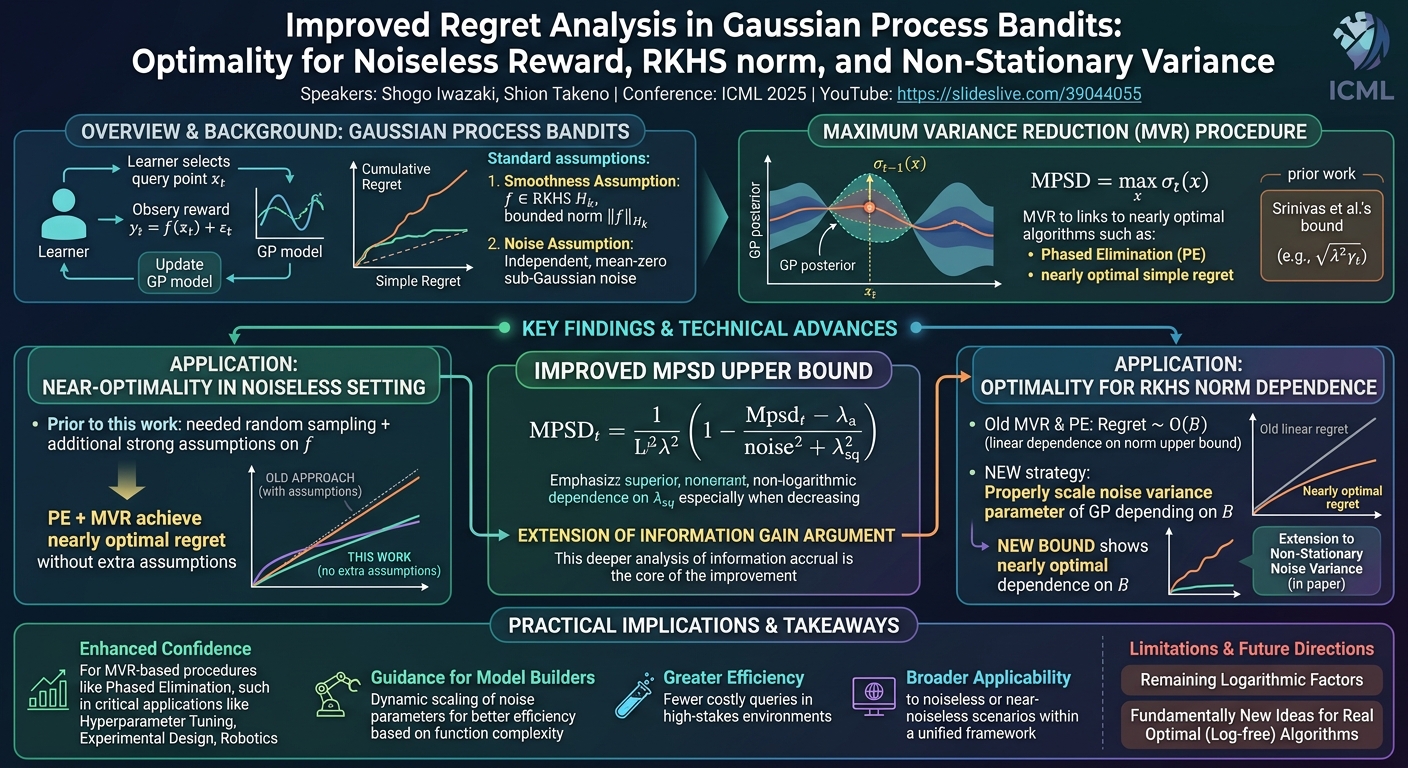
This talk, presented by Shogo Iwazaki and Shion Takeno at ICML 2025, delves into the theoretical underpinnings of Gaussian Process (GP) bandits, a fundamental problem in sequential decision-making under uncertainty. The core focus is on refining the regret analysis of these algorithms, particularly those based on the Maximum Variance Reduction (MVR) procedure. GP bandits are widely employed across various critical machine learning applications, including hyperparameter tuning, experimental design, and robotics, where a smooth but unknown reward function must be optimized with minimal queries.
Key moments
- 0:00 Introduction to Gaussian Process Bandits and MVR.
- 1:18 Summary of results: improved MPSD bound and resolved open questions.
- 2:00 Basic problem setup, assumptions, and MVR procedure.
- 4:00 Main result: Deriving an improved MPSD upper bound.
- 5:00 Application: Near optimality in noiseless GP bandit setting.
- 5:58 Application: Improving RKHS norm upper bound in regret.
- 6:50 Conclusion: Key takeaways and future directions.
- 7:30 Q&A: Discussion on achieving real optimal algorithms.
Improved Regret Analysis in Gaussian Process Bandits: Optimality for Noiseless Reward, RKHS norm, and Non-Stationary Variance
Speakers: Shogo Iwazaki, Shion Takeno
Conference: ICML 2025
YouTube: https://slideslive.com/39044055
Overview
This talk, presented by Shogo Iwazaki and Shion Takeno at ICML 2025, delves into the theoretical underpinnings of Gaussian Process (GP) bandits, a fundamental problem in sequential decision-making under uncertainty. The core focus is on refining the regret analysis of these algorithms, particularly those based on the Maximum Variance Reduction (MVR) procedure. GP bandits are widely employed across various critical machine learning applications, including hyperparameter tuning, experimental design, and robotics, where a smooth but unknown reward function must be optimized with minimal queries.
The research presented addresses a long-standing challenge in the field: improving the theoretical bounds on regret, especially concerning the dependence on noise variance and the Reproducing Kernel Hilbert Space (RKHS) norm of the unknown function. By deriving a novel and improved upper bound for the Maximum Posterior Standard Deviation (MPSD), a key quantity in MVR-based algorithms, the authors demonstrate significant advancements. This theoretical breakthrough not only sharpens our understanding of GP bandit performance but also resolves several open questions regarding the near-optimality of these algorithms in previously challenging settings, such as those with noiseless rewards or specific dependencies on the RKHS norm.
The significance of this work lies in its contribution to the theoretical foundations of efficient exploration-exploitation strategies. By providing stronger guarantees for MVR-based procedures, which are integral to nearly optimal algorithms like Phased Elimination (PE), the research enhances confidence in their application. It paves the way for potentially more robust and efficient GP bandit implementations, offering a deeper insight into the factors that govern their performance and guiding future algorithm design.
Background
▶ Watch: Introduction to Gaussian Process Bandits and MVR. (0:00)
The Gaussian Process bandit problem is a sequential decision-making framework where a learner aims to maximize an unknown reward function, f, over a compact input domain. At each discrete time step t, the learner selects a query point x_t, observes a corresponding noisy reward y_t, and then updates its beliefs about f. The primary objective is to minimize regret, which quantifies the cumulative difference between the optimal reward and the reward obtained by the learner. Two common forms of regret are cumulative regret (sum of instantaneous regrets over time) and simple regret (the difference between the optimal reward and the best reward found by the algorithm after T steps).
Meaningful algorithms for this problem require certain regularity assumptions. The talk adopts two standard assumptions:
- Smoothness Assumption: The unknown reward function
fis assumed to belong to a Reproducing Kernel Hilbert Space (RKHS), denotedH_k, endowed with a known positive definite kernelk. This assumption implies a certain level of smoothness and allows for GP inference. The functionfis also assumed to have a bounded RKHS norm. Commonly used kernels in this context include the Squared Exponential kernel and the Matern family of kernels, which are specifically focused on to derive explicit regret upper bounds. - Noise Assumption: The observed noise
epsilon_tis assumed to be a sequence of mutually independent, mean-zero sub-Gaussian random variables. A special case, the noiseless setting, arises when the variance proxy of this noise is zero.
A central concept in GP bandit algorithms is the Maximum Variance Reduction (MVR) procedure. MVR is a greedy strategy where, at each step t, the learner chooses the query point x_t that maximizes the posterior standard deviation (or posterior variance) of the current Gaussian Process across the entire input space. This strategy inherently prioritizes exploration, aiming to reduce uncertainty in areas where it is highest. MVR plays a pivotal role in constructing nearly optimal GP bandit algorithms. For instance, in cumulative regret minimization, the Phased Elimination (PE) algorithm, which iteratively applies MVR on potential maximizers, is widely recognized as a nearly optimal approach. MVR itself is known to achieve nearly optimal simple regret.
The key quantity for analyzing MVR-based algorithms, and thus the focus of this research, is the Maximum Posterior Standard Deviation (MPSD), denoted as max_x sigma_{t-1}(x). This value is directly proportional to the maximum confidence width of the GP over the input space and is intimately linked to the regret incurred by MVR-based algorithms. For example, in simple regret upper bounds, the regret is often proportional to MPSD.
Prior work by Srinivas et al. (2010) established a well-known upper bound for MPSD, which typically takes the form MPSD <= C sqrt(lambda_sq gamma_t), where lambda_sq represents the noise variance parameter of the Gaussian Process, and gamma_t is the maximum information gain. The information gain is a kernel-dependent complexity parameter that also depends on the noise variance. This existing bound, while foundational, presented certain limitations, particularly in its dependence on the noise variance and RKHS norm, which motivated the current research to seek improvements.
Key Findings
▶ Watch: Basic problem setup, assumptions, and MVR procedure. (2:00)
The primary contribution of this research is the derivation of an improved upper bound for the Maximum Posterior Standard Deviation (MPSD) under the Maximum Variance Reduction (MVR) procedure. This new bound offers a more refined understanding of how the MPSD evolves over time and, crucially, demonstrates a superior dependence on the noise variance parameter of the Gaussian Process compared to previous state-of-the-art results. Specifically, the improvement manifests as a more favorable, non-logarithmic dependence on the noise variance in certain conditions, which becomes particularly significant when the noise variance is decreasing.
Beyond the theoretical improvement in the MPSD bound itself, this work leveraged the new bound to resolve several long-standing open questions in the field of GP bandits:
- Near-Optimality for Noiseless Settings: Prior to this work, achieving nearly optimal regret in noiseless GP bandit settings typically required random sampling-based approaches, which often necessitated additional strong assumptions on the reward function
fand employed analytical techniques distinct from the established information gain arguments. This research demonstrates that, using the newly derived MPSD bound and an extension of the information gain argument, MVR-based procedures (and by extension, Phased Elimination) can achieve nearly optimal regret without imposing any extra assumptions onf. This unifies the analytical framework and provides robust guarantees for a wider range of scenarios.
- Optimality for RKHS Norm Upper Bound in Regret: In standard noisy settings where the variance proxy is a positive constant, existing MVR and Phased Elimination algorithms exhibited a suboptimal dependence on the RKHS norm upper bound (B), with regret increasing linearly with
B. Reducing this linear dependence was an important open problem. The authors found that their improved MPSD bound, combined with a strategy of properly scaling the noise variance parameter of the GP depending onB, leads to a nearly optimal dependence onBin the regret bounds. This signifies a substantial theoretical advancement, showing that the algorithms can adapt more effectively to the complexity of the underlying function.
- Near-Optimality for Non-Stationary Noise Variance Settings: While not elaborated upon in the presentation due to time constraints, the paper also extends these optimality results to settings with non-stationary noise variance. This indicates the broad applicability and robustness of the new MPSD bound across various challenging noise conditions.
In summary, the core finding is a more precise characterization of exploration in GP bandits via the MPSD, which has cascading effects, allowing for the establishment of stronger theoretical guarantees and resolving critical optimality gaps in the literature.
Technical Deep Dive
▶ Watch: Application: Near optimality in noiseless GP bandit setting. (5:00)
The technical core of this work revolves around the Maximum Variance Reduction (MVR) procedure and its central quantity, the Maximum Posterior Standard Deviation (MPSD). In a GP bandit setting, the MVR strategy dictates that at each time step t, the learner selects the next query point x_t by maximizing the posterior standard deviation sigma_{t-1}(x) of the Gaussian Process model conditioned on all previous observations. That is, x_t = argmax_x sigma_{t-1}(x). The MPSD is simply the maximum value of this posterior standard deviation at a given time step: MPSD_t = max_x sigma_t(x).
The existing framework for analyzing MPSD, largely established by Srinivas et al., provides an upper bound that is proportional to sqrt(lambda_sq * gamma_t). Here, lambda_sq represents the noise variance parameter of the Gaussian Process, and gamma_t is the maximum information gain. Information gain is a crucial concept in GP bandits, quantifying how much information about the unknown function f is gained by making a certain number of observations. It is a kernel-dependent complexity parameter that also incorporates the noise variance. Specifically, gamma_t typically grows sub-linearly with t (e.g., logarithmically or as a fractional power of t), reflecting the diminishing returns of exploration.
The first major technical contribution is the derivation of an improved upper bound for MPSD. The authors state that under the condition where the noise variance of the GP is not decreasing too rapidly, such that the corresponding information gain increases sub-linearly, they can obtain a new upper bound. While the exact mathematical form is not explicitly presented in the transcript, the key insight is that the dependence on the noise variance parameter lambda_sq is improved from a logarithmic term to a more favorable form. The previous bound’s dependence on lambda_sq was often intertwined within gamma_t in a way that led to suboptimal regret. The new bound, by contrast, shows a "crucial" difference when lambda_sq is decreasing, implying a more direct and beneficial relationship, perhaps by isolating or reducing the logarithmic impact of lambda_sq. This refinement relies on an extension of the information gain argument originally proposed by Srinivas, suggesting a deeper analysis of how observations reduce uncertainty and contribute to information gain, especially in the presence of varying noise characteristics.
This improved MPSD bound then serves as the foundation for resolving several open questions:
- Noiseless Setting Optimality: In the noiseless GP bandit setting (
lambda_sq = 0), the problem becomes particularly challenging because there's no inherent noise to smooth out the exploration. Previous approaches to prove nearly optimal regret in this setting relied on random sampling and required additional assumptions onf(e.g., specific smoothness properties) and employed different analytical techniques, moving away from the information gain framework. The authors' analysis, however, demonstrates that their new MPSD bound, derived through an extension of the information gain argument, allows Phased Elimination (PE) to achieve nearly optimal cumulative regret even in the noiseless setting, without any extra assumptions onf. PE is an iterative algorithm that applies MVR on a set of potential maximizers, effectively balancing global exploration with local exploitation. The ability to prove this within the established information gain framework is a significant unification of theoretical results.
- RKHS Norm Upper Bound Optimality: The RKHS norm of the function
f, denoted||f||_{H_k}, represents its "complexity" or "smoothness" within the chosen RKHS. An upper boundBon this norm is often used in regret analysis. Prior to this work, existing MVR and PE algorithms showed a suboptimal linear dependence onBin their regret bounds, meaningRegret ~ O(B). This linear dependence suggested that as the complexity of the function increased, the regret would grow proportionally, which is undesirable. The authors demonstrate that by properly scaling the noise variance parameter of the GP depending onB, their improved MPSD bound leads to a nearly optimal dependence onB. This implies that the algorithms can more efficiently learn complex functions without incurring a disproportionately higher regret, achieving a dependence that is optimal up to logarithmic factors. This scaling strategy is a critical technical detail, as it shows how the algorithm's hyperparameters (specifically, the assumed noise level) can be adapted to the known properties of the function space to achieve better theoretical performance.
The overall approach highlights that a deeper, more nuanced understanding of the MPSD, obtained through a refined information gain analysis, can unlock tighter regret bounds and extend optimality guarantees to more general and challenging GP bandit scenarios. The post-talk discussion hints that while these improvements are significant, achieving "real optimal" algorithms (i.e., eliminating all logarithmic factors) might require fundamentally new ideas beyond the current information gain arguments, suggesting future avenues for research.
Experimental Setup & Results
▶ Watch: Application: Improving RKHS norm upper bound in regret. (5:58)
This talk primarily focuses on theoretical contributions, deriving novel bounds and proving optimality guarantees for Gaussian Process bandit algorithms. As such, it does not present specific experimental setups, datasets, baselines, hardware configurations, or empirical performance metrics.
The "results" discussed are entirely in the form of theoretical optimality proofs and improved regret bounds compared to existing literature. For instance, the authors demonstrate that their refined Maximum Posterior Standard Deviation (MPSD) bound leads to:
- Nearly optimal cumulative regret for Phased Elimination (PE) in the noiseless setting. This is a theoretical comparison against known lower bounds for GP bandits, confirming that the algorithm's performance is optimal up to logarithmic factors.
- Nearly optimal dependence on the RKHS norm upper bound (B) in regret. This improvement is also established by comparing the derived upper bounds against theoretical lower bounds, showing that the previous linear dependence on
Bhas been reduced to a nearly optimal form.
These results are analytical and do not involve running algorithms on real or simulated data. The strength of the contribution lies in its mathematical rigor and its ability to resolve theoretical inconsistencies and suboptimalities in the existing understanding of GP bandit performance.
Practical Implications
▶ Watch: Q&A: Discussion on achieving real optimal algorithms. (7:30)
The theoretical advancements presented in this talk have several significant practical implications for practitioners, infrastructure teams, and model builders working with Gaussian Process (GP) bandits:
- Enhanced Confidence in MVR-based Algorithms: The Maximum Variance Reduction (MVR) procedure, and algorithms like Phased Elimination (PE) that build upon it, are foundational to GP bandits. By providing improved theoretical guarantees, especially for challenging scenarios like noiseless environments or when dealing with functions of varying complexity (RKHS norm), this work increases confidence in the robustness and efficiency of these algorithms for real-world applications such as hyperparameter tuning, experimental design, and robotics. Practitioners can be more assured that MVR-based exploration strategies are theoretically sound and perform optimally under a broader set of conditions.
- Guidance for Algorithm Selection and Parameter Tuning: The resolution of the RKHS norm dependence issue is particularly relevant. The finding that optimal dependence on
Bcan be achieved by "properly scaling noise variance parameter of GP depending on B" provides crucial guidance for model builders. It suggests that GP bandit implementations should dynamically adjust their assumed noise levels based on prior knowledge or estimates of the complexity of the function being optimized. This adaptive parameterization can lead to more efficient exploration-exploitation trade-offs, reducing the number of costly queries needed to find an optimal solution.
- Efficiency in High-Stakes Environments: In fields like drug discovery or materials science (experimental design), where each query can be expensive or time-consuming, minimizing regret is paramount. The improved regret bounds directly translate to more efficient search processes. For instance, in a noiseless or near-noiseless setting (e.g., deterministic simulations), the new proofs ensure that MVR-based algorithms are nearly optimal, preventing suboptimal exploration that could waste resources.
- Broader Applicability: The extension of optimality to scenarios previously requiring different analytical techniques (like noiseless settings) simplifies the theoretical landscape and potentially broadens the practical applicability of a single class of algorithms (MVR-based) to a wider range of problem types without needing specialized, ad-hoc solutions.
Tradeoffs and Limitations:
While the improvements are substantial, the talk also implicitly highlights some inherent tradeoffs and limitations:
- Remaining Logarithmic Factors: As discussed in the Q&A, even with the improved bounds, "logarithmic factors" in the regret still remain, preventing the achievement of "real optimal" performance (i.e., bounds that match the absolute theoretical minimum without any log terms). This suggests that while MVR-based approaches are nearly optimal, there might be a fundamental limit to what can be achieved with current information gain arguments. For practitioners, this implies that there's always a theoretical gap for absolute efficiency, though the practical impact of logarithmic factors is often minor compared to polynomial factors.
- Theoretical vs. Empirical Performance: The work is purely theoretical. Translating these theoretical guarantees into observable empirical speedups or performance gains in complex real-world systems might still involve practical challenges not covered by the analysis (e.g., computational cost of MVR, sensitivity to kernel choice, numerical stability).
- Complexity of Non-Stationary Settings: The fact that the non-stationary noise variance setting was omitted from the talk due to time constraints suggests its inherent complexity. While the paper addresses it, practical implementation in such dynamic environments might introduce additional challenges not fully explored in the presentation.
Overall, this research strengthens the theoretical foundation of GP bandits, offering more robust performance guarantees and guiding the development of more sophisticated and adaptable algorithms for critical AI/ML applications.
Key Takeaways
- A novel and improved upper bound for the Maximum Posterior Standard Deviation (MPSD) under the Maximum Variance Reduction (MVR) procedure was derived, demonstrating better dependence on the noise variance parameter of the Gaussian Process.
- The new MPSD bound resolves the open question of near-optimality for noiseless GP bandits, proving that MVR-based algorithms (like Phased Elimination) can achieve nearly optimal regret without requiring additional assumptions on the reward function
f. - This work also achieves nearly optimal dependence on the RKHS norm upper bound (B) in regret, addressing a previous suboptimal linear dependence by properly scaling the GP's noise variance parameter.
- The analytical improvements are rooted in an extension of the information gain argument from prior work, refining our understanding of how information accrues in GP bandits.
- MVR-based procedures are confirmed to be highly effective components for constructing nearly optimal GP bandit algorithms for various settings, including hyperparameter tuning and experimental design.
- While significant progress has been made, the presence of remaining logarithmic factors suggests that achieving "real optimal" (log-free) algorithms may require fundamentally new theoretical ideas beyond current information gain arguments.
About the Speaker(s)
The talk was presented by Shogo Iwazaki and Shion Takeno at ICML 2025. Based on the transcript, their affiliations or specific roles were not detailed, but they are researchers actively contributing to the theoretical foundations of machine learning, specifically in the domain of Gaussian Process bandits and regret analysis.
Reviews
Maya Iyer (Theoretical ML Researcher) — SOLID
Iwazaki and Takeno present an improved MPSD upper bound for MVR-based GP bandit algorithms, resolving three open questions: near-optimality in the noiseless setting, better RKHS-norm dependence in regret, and non-stationary variance. The technical core is a refined information gain argument that sharpens the noise-variance dependence in the MPSD bound, with downstream consequences for Phased Elimination. This is honest, competent theoretical work that closes real gaps in the GP bandit literature. It does not, however, introduce a new conceptual framework or fundamentally reframe the problem — it is a refinement within an established analytical paradigm, and the residual logarithmic factors…
Chen Zhao (Applied ML Researcher & Empiricist) — SOLID
Iwazaki and Takeno present a tighter upper bound on the Maximum Posterior Standard Deviation (MPSD) under the Maximum Variance Reduction (MVR) procedure, which they leverage to resolve several open questions in GP bandit theory: near-optimality in the noiseless setting without extra assumptions on f, and nearly optimal dependence on the RKHS norm B via noise variance rescaling. The theoretical contributions are genuine and fill real gaps in the literature. However, this is a pure theory paper with no empirical component, the improvements are incremental refinements within the information gain framework rather than a new paradigm, and logarithmic gaps to the lower bound remain unresolved…
→ Top-rated talks at International Conference on Machine Learning 2025
All talks from International Conference on Machine Learning 2025