Learning Time-Varying Multi-Region Brain Communications via Scalable Markovian Gaussian Processes
Weihan Li (Georgia Tech), Yule Wang, Chengrui Li, Anqi Wu (Georgia Tech)
Overview
In this insightful talk from ICML 2025, Weihan Li and collaborators from Georgia Tech presented a novel approach to decipher the complex, dynamic communication patterns within the brain. The work, titled "Learning Time-Varying Multi-Region Brain Communications via Scalable Markovian Gaussian Processes," addresses a fundamental challenge in neuroscience: understanding how different brain regions exchange information, not just in a static sense, but as these interactions evolve over time during cognitive processes. The key innovation lies in a scalable framework that can model both the direction and speed of information flow between multiple brain areas, accounting for their inherently dynamic nature.
Key moments
- 0:00 Introduction to dynamic brain communication challenge
- 2:09 Model objective: learning latent brain communication variables
- 3:07 Traditional Gaussian Process approach and its limitations
- 4:37 Approximating GPs with State-Space Models (Markovian GPs)
- 5:50 Universal approximation for non-separable multi-output kernels
- 7:40 Adaptive delay model for continuous time-varying communication
- 8:20 Efficient inference via parallel Kalman filter (log T complexity)
- 9:00 Summary of key contributions of the proposed method
Learning Time-Varying Multi-Region Brain Communications via Scalable Markovian Gaussian Processes
Speakers: Weihan Li, Yule Wang, Chengrui Li, Anqi Wu, Georgia Tech
Conference: ICML 2025
YouTube: https://slideslive.com/39044052
Overview
In this insightful talk from ICML 2025, Weihan Li and collaborators from Georgia Tech presented a novel approach to decipher the complex, dynamic communication patterns within the brain. The work, titled "Learning Time-Varying Multi-Region Brain Communications via Scalable Markovian Gaussian Processes," addresses a fundamental challenge in neuroscience: understanding how different brain regions exchange information, not just in a static sense, but as these interactions evolve over time during cognitive processes. The key innovation lies in a scalable framework that can model both the direction and speed of information flow between multiple brain areas, accounting for their inherently dynamic nature.
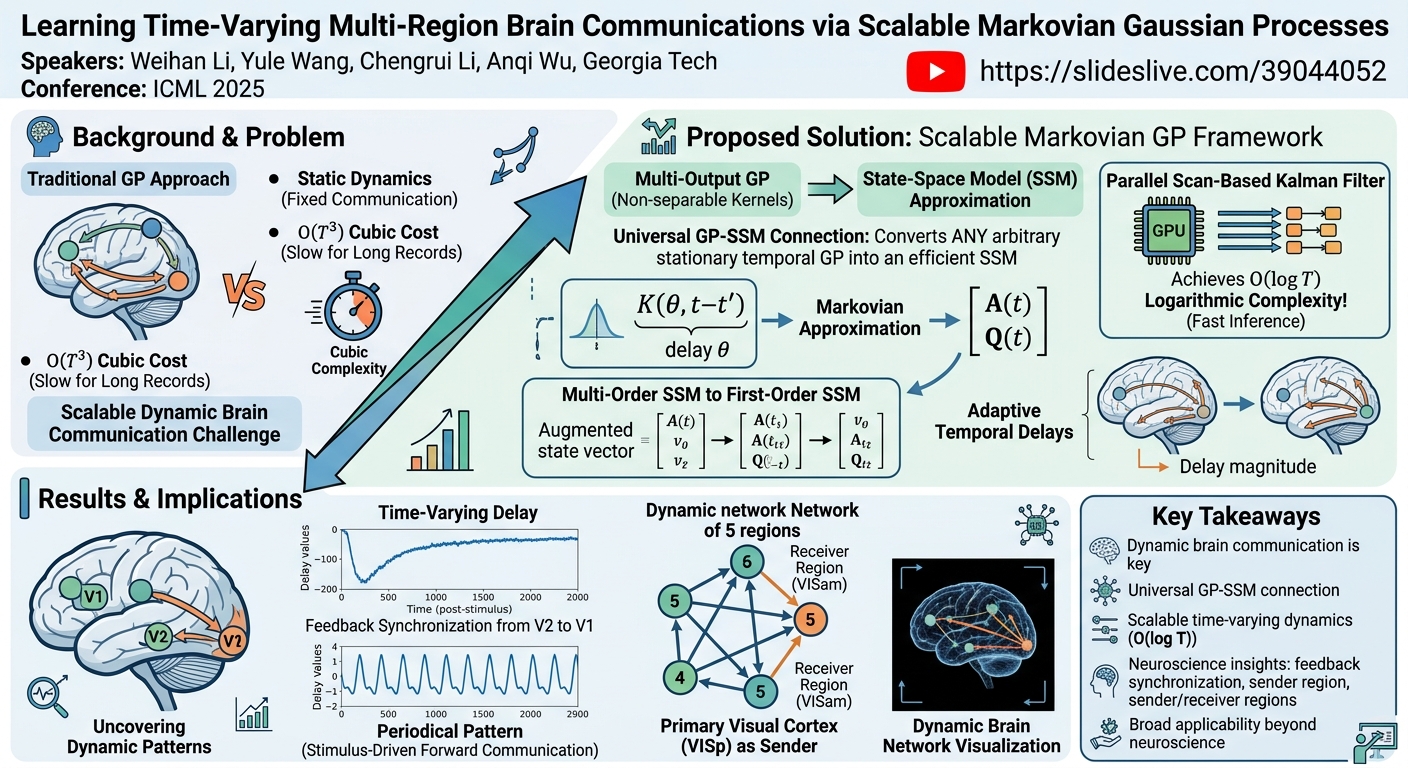
The core problem tackled is the limitations of traditional Gaussian Process (GP) models when applied to high-dimensional, noisy neural data. While GPs are powerful for modeling correlations, they typically assume static relationships and incur prohibitive computational costs (cubic in time points) for long recordings. The proposed solution introduces a universal connection between Gaussian Processes and State-Space Models (SSMs), specifically leveraging a Markovian Gaussian Process (MGP) approximation. This transformation enables efficient inference and, crucially, allows the modeling of time-varying temporal delays, which directly translate to dynamic communication patterns in the brain.
This research holds significant implications for both neuroscience and the broader machine learning community. For neuroscientists, it provides a powerful tool to generate testable hypotheses about brain function, revealing previously hidden dynamics of inter-regional communication and synchronization. For ML practitioners, the universal GP-SSM connection offers a generalizable method to scale GPs to large datasets and capture time-varying dynamics in various time-series applications beyond neuroscience, whenever complex, non-separable temporal correlations are of interest.
Background
▶ Watch: Introduction to dynamic brain communication challenge (0:00)
Understanding brain communication is a cornerstone of modern neuroscience. It refers to the intricate flow of information between distinct brain regions, a process fundamental to cognition, perception, and action. A critical challenge in this field is that these communications are not static; they are highly dynamic, changing in speed, direction, and strength over milliseconds to seconds, influenced by internal states, external stimuli, and ongoing cognitive tasks. Traditional methods for analyzing neural data, particularly high-dimensional and noisy recordings from multiple brain regions, often struggle to capture these time-varying, directional dynamics.
Historically, Gaussian Processes (GPs) have been a favored statistical tool for modeling correlations and latent variables in many scientific domains, including neuroscience. In the context of brain communication, GPs can be used to describe the correlation between neural signals from different regions, often employing specialized kernels designed to capture temporal relationships. A common approach involves modeling latent variables representing communication signals as a multi-output GP, where the kernel incorporates a temporal delay parameter (theta). This parameter is crucial for inferring directional information: a positive delay might indicate information flow from region A to B, while a negative delay suggests feedback from B to A. Furthermore, the magnitude of this delay can be interpreted as the speed or latency of communication.
However, despite their expressive power, traditional GP methods face two major limitations when applied to real-world, dynamic neural data. First, they typically assume static parameters, meaning the temporal delay and communication patterns are fixed over the entire observation period. This contradicts the known dynamic nature of brain activity, where communication changes rapidly. Second, GPs are computationally expensive. Their inference and parameter estimation scale cubically with the number of time points (O(T³)), rendering them impractical for long neural recordings or large datasets with many regions. These limitations necessitate a more scalable and dynamic modeling framework to truly unlock the secrets of time-varying brain communication.
Key Findings
▶ Watch: Traditional Gaussian Process approach and its limitations (3:07)
The talk highlights two primary contributions that address the aforementioned challenges, offering both a methodological breakthrough and significant neuroscience insights:
- Universal Connection Between Gaussian Processes and State-Space Models (GP-SSM): The most significant methodological contribution is the development of a universal approximation method that connects any arbitrary stationary temporal Gaussian Process (GP) to a State-Space Model (SSM). Crucially, this method is not restricted to single-output or spatially/temporally separable multi-output kernels, unlike previous works. This universality allows for the efficient modeling of complex, non-separable multi-output GPs, which are essential for capturing the intricate, directional, and multi-channel nature of brain communication. By transforming the GP into an SSM, the cubic computational cost of GPs is drastically reduced, enabling scalable analysis of large time-series datasets.
- Scalable Discovery of Dynamic Brain Communications: Leveraging the GP-SSM connection, the proposed model can effectively learn time-varying, multi-region brain communications from high-dimensional, noisy neural data. The model specifically estimates adaptive temporal delays between brain regions, which change continuously over time. This capability allows for:
- Identification of directional information flow: Distinguishing between forward and feedback communication channels.
- Quantification of communication speed: Observing how the latency of information exchange evolves.
- Detection of synchronization patterns: Revealing periods where brain regions become highly synchronized or stable.
- Discovery of functional hierarchies: Identifying "sender" and "receiver" regions within a network.
- Dynamic Brain Network Visualization: Creating animated representations of brain networks where edge directions and lengths (representing delay magnitude) dynamically shift, providing intuitive insights into evolving brain states.
Through experimental validation on real-world neural datasets, the model successfully uncovered biologically plausible dynamic patterns, such as the speeding up of feedback communication in visual cortices post-stimulus and the identification of a primary visual cortex (VISp) as a central "sender" in a multi-region network.
Technical Deep Dive
▶ Watch: Universal approximation for non-separable multi-output kernels (5:50)
The core of this work lies in overcoming the limitations of traditional Gaussian Processes (GPs) for modeling dynamic, multi-region brain communication. The problem begins with high-dimensional, noisy neural data, denoted as Y. The goal is to learn a low-dimensional latent representation X that captures brain communications. This latent variable X is conceptualized as having multiple components: several communication channels (shared across regions, potentially with different directions or patterns) and region-specific activity (unique to each region, not involved in communication).
Traditionally, brain communication has been modeled using multi-output Gaussian Processes. This involves defining a kernel K that describes the covariance between latent variables across different regions and time points. A key innovation in earlier GP-based approaches was to design this kernel K with a temporal delay parameter (theta). This theta parameter allows the kernel to shift, capturing directional information: a positive theta signifies information flow from region A to B, while a negative theta indicates feedback from B to A.
However, these traditional GP methods suffer from two critical drawbacks:
- Static Dynamics: The
thetaparameter, and thus the communication pattern, is assumed to be constant over time. This static assumption fails to capture the dynamic, time-varying nature of real brain activity. - Computational Inefficiency: GP inference typically involves matrix inversions that scale cubically with the number of time points
T(O(T³)), making them impractical for long neural recordings.
To address these issues, the authors propose approximating the Gaussian Process as a State-Space Model (SSM). This approach is termed a Markovian Gaussian Process (MGP), defined as an SSM approximation where its transition and dynamics are derived from a GP. While previous works have explored connections between GPs and SSMs, they were limited to single-output kernels or multi-output kernels that are separable in temporal and spatial domains. The brain communication problem, however, involves a multi-output kernel K that is not separable in both temporal and spatial domains, rendering prior methods inapplicable.
A major technical contribution is the development of a universal approximation method that can convert any arbitrary stationary temporal Gaussian Process (single-output or multi-output, separable or non-separable) into an SSM. This universality is crucial for the neuroscience application.
Specifically, the model utilizes a multi-order SSM structure. In this structure, the current state depends on multiple past states. The transition dynamics are governed by a matrix A, which is directly computed from the kernel matrix K and, significantly, depends on the delay parameter theta. This means the dynamics of the SSM are intrinsically linked to the brain's communication patterns. The order P of the SSM dictates how many past time points influence the current state. While initially a P-order system, it can be mathematically transformed into a more manageable first-order state-space model by augmenting the state vector. This transformation results in a block matrix A-hat, often referred to as a controllable canonical form in control theory.
To overcome the static assumption, the authors introduce an adaptive delay model. In this refined model, the transition matrix A (and consequently the delay parameter theta) is made time-varying. This allows theta to change continuously over time, capturing the dynamic nature of brain communication influenced by internal states or external stimuli.
Finally, to ensure computational efficiency for inference and parameter estimation, the problem, once formulated as an SSM, can leverage efficient algorithms. The authors apply a parallel scan-based Kalman filter. This technique allows for GPU parallelization, drastically reducing the time complexity from O(T³) to O(log T), where T is the number of time steps. This logarithmic complexity makes the model scalable to very long recordings, albeit with a trade-off in memory consumption for the parallel scan operation. The A and Q matrices (transition and noise covariance) are directly computed from the GP kernel K, ensuring that the SSM dynamics faithfully reflect the underlying GP.
Experimental Setup & Results
▶ Watch: Adaptive delay model for continuous time-varying communication (7:40)
The effectiveness of the proposed Markovian Gaussian Process (MGP) model was demonstrated through experiments on real-world neural datasets.
Dataset:
The primary dataset used consisted of simultaneously recorded neural activity from the primary visual cortex (V1) and the secondary visual cortex (V2). Both V1 and V2 are crucial brain regions involved in processing visual input. This initial two-region analysis was later scaled up to a larger dataset involving five distinct brain regions with longer recording time points to evaluate the model's scalability and ability to uncover more complex network dynamics.
Key Findings and Observations:
- Time-Varying Feedback Communication (V2 to V1):
- The model successfully estimated time-varying delays between V1 and V2 following a stimulus onset, observed over approximately 2000 milliseconds.
- A prominent feedback communication channel from V2 to V1 was identified, characterized by consistently negative delay values.
- Initially, this feedback was slow (large negative delay magnitude). However, around 200 milliseconds post-stimulus, the delay magnitude decreased significantly, indicating that communication became faster and more synchronized. This synchronization suggests that the brain regions were working together to converge to a stable state after stimulus presentation. The delay values eventually stabilized, further supporting the idea of synchronization.
- Stimulus-Driven Forward Communication:
- Another communication channel revealed forward information flow, distinct from the feedback channel.
- This forward communication exhibited a very clear periodical pattern. The speakers noted that this pattern directly correlated with the frequency of the external visual stimulus presented to the monkey from which the neural data was recorded. This strongly suggests that this particular communication channel is stimulus-driven, reflecting the direct influence of external visual input on brain activity.
- Multi-Region Network Analysis (Five Regions):
- When scaled to five brain regions, the model computed pairwise time delays for all 10 region pairs.
- Identification of a "Sender" Region: The primary visual cortex (VISp) was identified as a central "sender" region. All estimated delay parameters involving VISp showed positive values, indicating that VISp consistently sends forward information to the other regions. This finding aligns well with established neuroscience hypotheses, as VISp is known to be at the bottom of the visual system hierarchy, receiving initial visual input and distributing it.
- Identification of a "Receiver" Region: Conversely, another region, VISam, was identified as a "receiver." It consistently received information from all other regions, also consistent with known neuroscience.
- Dynamic Brain Network Visualization:
- The estimated time-varying delays were used to construct a dynamic brain network. This was visualized as an animation where:
- Nodes represent brain regions.
- Arrow directions between nodes indicate the direction of communication (determined by the sign of the delay).
- Edge lengths represent the magnitude of the delay (shorter length for faster communication).
- This dynamic visualization clearly illustrated the synchronization phenomenon: after an initial period of rapid change immediately following the visual stimulus, the network stabilized, with communication patterns becoming more consistent, visually demonstrating the brain converging to a more stable state.
Hardware and Scalability:
The experiments confirmed the model's scalability. The authors noted that they successfully tested the model on five brain regions using a modern laptop (e.g., MacBook). However, they also highlighted a practical trade-off: the parallel scan-based Kalman filter, while providing significant speedups (O(log T)), requires more memory. For applications involving more than 10 regions, they anticipate the need for server-grade machines with larger GPU memory to handle the increased memory footprint.
In summary, the experimental results not only validated the technical capabilities of the MGP model in uncovering dynamic, directional communication from complex neural data but also yielded biologically meaningful insights that align with existing neuroscience knowledge, while also offering new perspectives on the temporal evolution of brain states.
Practical Implications
▶ Watch: Summary of key contributions of the proposed method (9:00)
The "Learning Time-Varying Multi-Region Brain Communications via Scalable Markovian Gaussian Processes" work presents significant practical implications for several communities:
For Neuroscientists and Cognitive Scientists:
- Deeper Understanding of Brain Dynamics: This model provides an unprecedented tool to move beyond static analyses of functional connectivity. It enables the precise quantification of time-varying directional information flow (forward vs. feedback) and communication speed (delay magnitude) between brain regions. This is critical for understanding how brain circuits adapt and process information dynamically during complex cognitive tasks or in response to stimuli.
- Uncovering Synchronization and Hierarchies: The ability to detect periods of synchronization and identify sender/receiver regions within a network can lead to new hypotheses about functional hierarchies and the mechanisms underlying coherent brain activity.
- Robustness to Noisy, High-Dimensional Data: The model is designed to handle the inherent noisiness and high dimensionality of neural recordings, making it a robust analytical framework for real-world experimental data.
- Biomarker Discovery: Understanding dynamic communication patterns could potentially lead to the discovery of novel biomarkers for neurological disorders where brain communication is disrupted.
- Dynamic Network Visualization: The ability to visualize brain networks as dynamic animations offers an intuitive way to explore and present complex temporal changes in connectivity, fostering deeper insights.
For ML Practitioners and System Builders:
- Universal GP-SSM Connection: The most generalizable contribution is the universal method to approximate any stationary temporal Gaussian Process with an SSM. This is a powerful methodological advance for the broader ML community. It means that practitioners working with large time-series datasets who traditionally face computational bottlenecks with GPs can now leverage the efficiency of SSMs, even for complex, multi-output, non-separable kernels.
- Scalability for Time-Series Analysis: The O(log T) complexity achieved through the parallel scan-based Kalman filter makes this framework highly scalable for long time series. This opens doors for applications in diverse domains beyond neuroscience, such as climate modeling, financial time series analysis, physiological monitoring, or industrial process control, where capturing dynamic, interdependent patterns is crucial.
- Incorporating Domain-Specific Kernels: The framework's flexibility in handling arbitrary stationary temporal kernels allows domain experts to design highly specialized kernels that encode specific prior knowledge or assumptions about their data, and then efficiently convert them to SSMs for inference.
Tradeoffs and Limitations:
- Memory Footprint: While the parallel scan-based Kalman filter offers significant speedups, it comes with an increased memory cost. This means that scaling to a very large number of regions (e.g., beyond 10-20) might require substantial GPU memory, potentially limiting deployment on edge devices or standard consumer hardware for extremely complex scenarios.
- Stationarity Assumption: The universal GP-SSM connection is currently applicable to stationary temporal kernels. While this covers a broad range of applications, extending it to non-stationary GPs would further broaden its applicability.
- Interpretability of Latent Variables: While the model identifies latent variables for communication, interpreting the precise neurophysiological meaning of each latent channel might still require careful validation against domain knowledge.
In essence, this work provides a robust, scalable, and interpretable framework for analyzing dynamic relationships in time-series data, with immediate and profound implications for understanding the working brain, and broader potential for advancing time-series modeling across various scientific and engineering disciplines.
Key Takeaways
- Dynamic Brain Communication is Key: Brain communication is highly dynamic, changing over time in speed and direction, and traditional static GP models fail to capture this complexity.
- Universal GP-SSM Connection: The research introduces a novel, universal method to approximate any arbitrary stationary temporal Gaussian Process (including complex multi-output, non-separable kernels) as an efficient State-Space Model.
- Scalable Time-Varying Dynamics: The transformed State-Space Model, coupled with an adaptive delay mechanism and a parallel scan-based Kalman filter, allows for efficient inference (O(log T)) of time-varying directional communication patterns and delays.
- Neuroscience Insights: The model successfully uncovered biologically plausible phenomena in real neural data, such as dynamic feedback synchronization in visual cortices and identified "sender" (VISp) and "receiver" (VISam) regions in multi-region networks.
- Broad Applicability: Beyond neuroscience, the universal GP-SSM connection offers a generalizable framework for efficient, dynamic time-series analysis in any domain where complex, correlated, and time-varying patterns are present, addressing a major scalability bottleneck of traditional GPs.
- Trade-off in Resources: While offering significant speedups, the parallel scan technique for inference demands more memory, requiring powerful GPUs for analyses involving a large number of interacting components or regions.
About the Speaker(s)
The talk was presented by Weihan Li, with contributions from his labmates Yule Wang and Chengrui Li, and their advisor Anqi Wu. All are affiliated with Georgia Tech, indicating a strong research focus on machine learning applications in neuroscience within their group. Their collective expertise spans the theoretical underpinnings of Gaussian Processes and State-Space Models, as well as their practical application to complex biological data, particularly in understanding brain function and communication.
Reviews
Maya Iyer (Theoretical ML Researcher) — SOLID
A technically competent paper that connects multi-output non-separable Gaussian processes to state-space models for the purpose of inferring time-varying directional brain communication. The GP-SSM link for non-separable multi-output kernels is the cleanest contribution and has some genuine utility. The neuroscience application is well-motivated and the experimental results are biologically plausible. However, the 'universality' claim deserves scrutiny — converting stationary GPs to SSMs via spectral methods or controllable canonical forms is well-trodden territory, and the novelty rests on how carefully the authors handle the non-separable multi-output case specifically. The paper sits…
Chen Zhao (Applied ML Researcher & Empiricist) — SOLID
Li et al. present a methodologically interesting contribution: a universal approximation that converts arbitrary stationary multi-output GPs (including non-separable kernels) to state-space models, applied to time-varying brain communication estimation. The GP-SSM connection is the cleanest contribution here, and the parallel scan-based Kalman filter brings the compute to a tractable regime. The neuroscience results are biologically plausible and the dynamic delay framing is genuinely useful for the domain. What keeps this at a 3 is the experimental evidence as reported: validation appears to rest on a small number of real datasets without synthetic ground-truth experiments to validate…
→ Top-rated talks at International Conference on Machine Learning 2025
All talks from International Conference on Machine Learning 2025